The article
You heard about Manus.
You signed up. You got 1,000 credits. You ran two complex research tasks, watched both consume 400 to 500 credits each, and found yourself out of budget before you had finished evaluating whether the thing actually worked.
Or you ran one task, it looped, the credits drained anyway, and Manus stopped mid-output with no save state and no refund.
Or you are reading this because Manus is now owned by Meta, and you are not entirely sure what that means for your data, your workflows, or whether the product will even exist in its current form twelve months from now.
All of these are legitimate reasons to look for something else. This post gives you seven alternatives, what each one actually does, and which category of work each one is genuinely suited for. One of them was built specifically to solve the problem Manus was supposed to solve, without the credit roulette, without the acquisition uncertainty, and with a documented accuracy track record across over a million real research sessions.
What Manus Does Well (And Where It Falls Short)
Start with the honest picture. Manus is a genuinely capable autonomous agent. It runs in a cloud sandbox with a real browser, file system, and code execution. You give it a goal, it plans sub-tasks, executes them asynchronously, and delivers a finished output. You can close your laptop, and it keeps working. For well-defined tasks on publicly accessible data, it is impressive.
The problems are structural, not cosmetic.
The credit system charges by LLM tokens, virtual machine time, and third-party API calls simultaneously. There is no cost preview before a task starts. A task that looks simple can burn 600 to 900 credits. Credits do not roll over at the end of the billing cycle. When they run out, work stops immediately, no pause, no save. One reviewer described running four queries on 1,000 free credits and being out before finishing the evaluation.
Then there is the Meta acquisition. Manus’s pricing page now reads ‘© 2026 Meta.’ The long-term implications for data handling, product direction, and access are genuinely uncertain. For teams with any concern about data sovereignty, that uncertainty is not trivial.
And Manus still hallucinates. The cloud sandbox is real, the browser access is real, but the AI reasoning underneath is not immune to fabrication. There is no published accuracy benchmark, nor is there an anti-hallucination architecture. For tasks where the output needs to be right, that gap matters.
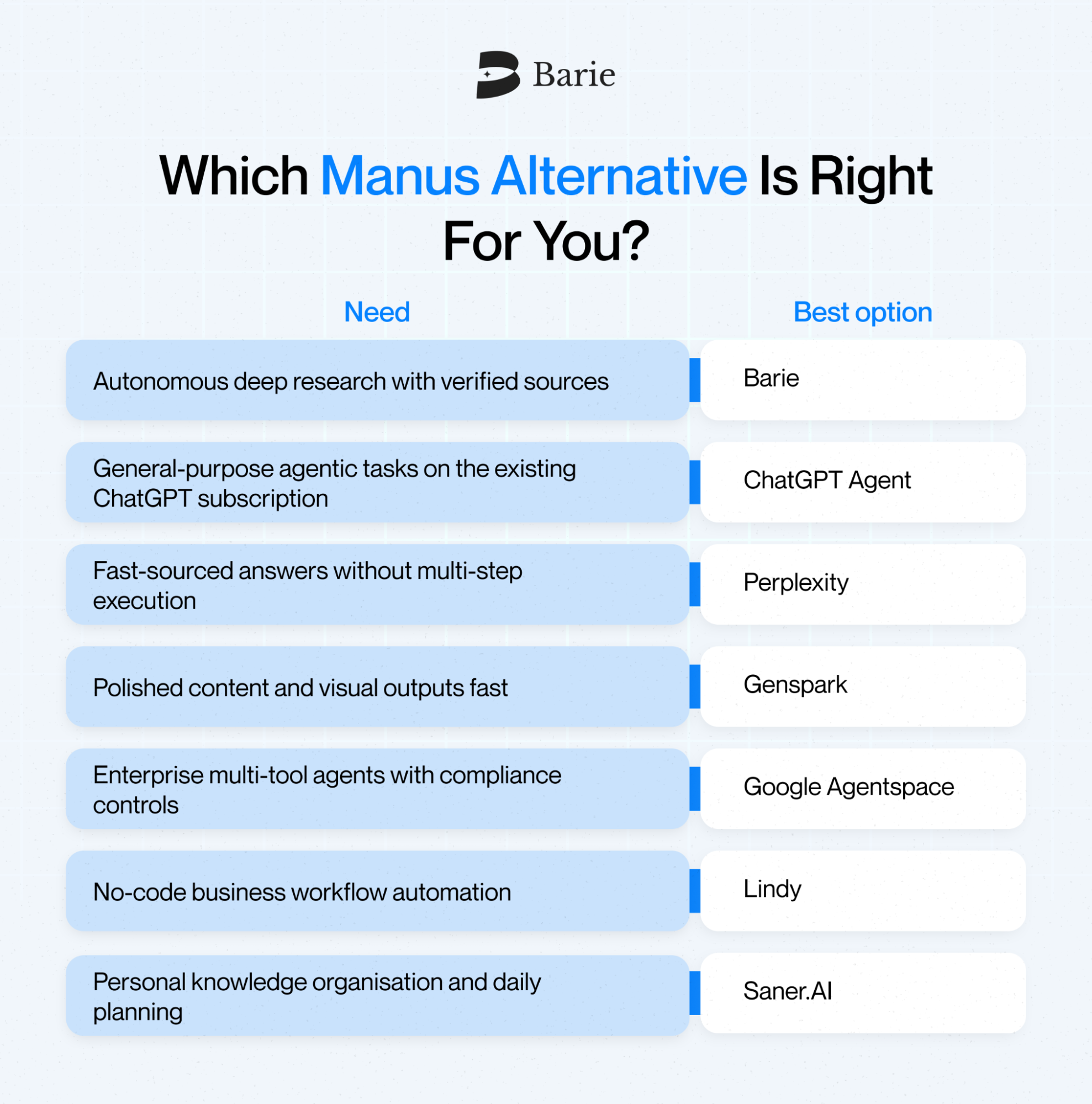
1. Barie: For Research That Executes, Not Just Answers
Barie was built around a specific frustration: AI agents that produce confident, well-formatted, completely wrong outputs. Every tool in the Manus category has this problem to some degree. Barie built its entire architecture around solving it.
The difference in practice: Barie researches the live web across parallel threads simultaneously. Not one source, then the next. Multiple sources at once, cross-referenced, with every factual claim traced to a live, clickable citation. You do not get a confident-sounding summary. You get a verified one.
A founder requests a competitive analysis of 5 SaaS tools, with recent funding activity flagged and pricing gaps identified. Barie does not research them sequentially. It fires all five simultaneously, synthesizes the outputs into a structured report, and exports it directly to Notion via Connectors. What would take a research analyst a full working day takes Barie one session.
That is agentic execution. Not autonomous browsing with unpredictable credit consumption. Not a chat interface with a research button. A tool that connects to your apps, runs multi-step workflows, and delivers output into the systems your work already lives in.
Barie aces the GAIA Level 3 benchmark for complex agentic workflows. 90% accuracy rate. Over 1 million hallucination-free chats processed across 25 industries. The free tier gives you 900 credits with no card required, and the credit system does not charge you for VM time in addition to token usage.
Best for: Any multi-step deep research task where accuracy is non-negotiable, and the output needs to go somewhere.
Pricing: 900 free credits on sign-up. No card needed.
2. ChatGPT Agent: For General-Purpose Autonomous Tasks
OpenAI’s ChatGPT Agent is the most accessible general-purpose autonomous tool in this category. It can browse the web, run code in a sandbox, fill out forms, interact with websites, and chain multi-step tasks together. It runs on the GPT-5 model family and benefits from OpenAI’s investment in reliability.
The honest limitation: ChatGPT Agent is sequential by default. It does not run parallel research threads. It is also not built around accuracy verification. Hallucinations happen, citations are inconsistent without prompting, and there is no anti-hallucination architecture. For creative tasks, content production, and well-scoped automation, it is strong. For research where the output will inform a decision, it needs supervision.
Best for: General task automation, content creation, coding assistance, users already on ChatGPT Plus ($20/month).
3. Lindy: For Business Workflow Automation
Lindy is built for operators, not researchers. It automates repeating business workflows: email triage, lead qualification, meeting scheduling, follow-up sequences, and CRM updates. The no-code drag-and-drop builder lets non-technical teams build workflows in natural language. It connects to over 4,000 apps and has more than 400,000 professionals using it in production.
What Lindy does not do is research. It automates workflows you have already defined. It does not discover new information, synthesise across sources, or handle tasks that require live web research and analytical judgment. If your frustration with Manus is that it is overly autonomous and you actually just want reliable workflow automation, Lindy is the better fit.
Best for: Business process automation, lean teams replacing repetitive admin tasks.
Pricing: Free tier. Paid from $49/month.
4. AutoGPT: For Open-Source Autonomy
AutoGPT is the open-source option. It has matured significantly since its 2023 debut. The 2026 version includes a visual Agent Builder, a persistent server, and a plugin system. You give it a goal, it plans, executes, evaluates, and iterates, using web browsing, code execution, and memory across sessions.
The cost model is appealing: AutoGPT itself is free, and you pay only for the underlying API calls, typically $0.50 to $5 per complex task. The trade-off is setup overhead, no polished UI, and accuracy that depends entirely on the LLM model you wire underneath it. For developers who want full control and can absorb the technical setup, it is a genuine alternative. For everyone else, the friction is real.
Best for: Technical users who want open-source autonomy and full control over their agent stack.
Pricing: Free. You pay only for API usage.
5. Devin: For Autonomous Software Engineering
Devin is purpose-built for one thing: autonomous software engineering. Give it a ticket, a bug report, or a feature description. It spins up a development environment, writes the code, runs tests, fixes failures, and opens a pull request. By 2026, it will support more languages, provide tighter CI/CD integration, and deliver significantly better reliability for scoped engineering tasks than at launch.
It is not a research tool and is not trying to be. At $500 per month, it is priced for engineering teams with a specific backlog problem. If your frustration with Manus is that you needed autonomous coding execution and Manus was not reliable enough, Devin is the more focused answer.
Best for: Engineering teams automating routine software development tasks.
Pricing: $500/month.
6. OpenManus: For Manus Without Meta
OpenManus is the open-source implementation of Manus’s core agent capabilities. It runs locally, connects to any OpenAI-compatible API, and gives you autonomous task execution without a cloud subscription or metadata handling.
The setup requires technical comfort: cloning the repository, configuring API keys, and managing dependencies. The experience is less polished than hosted Manus, and some advanced features are absent. But if the Meta acquisition is your primary concern and you have the technical capability to self-host, OpenManus is the cleanest path to Manus-style autonomy with full data sovereignty. For a fuller breakdown of how Manus-style agents compare to purpose-built research tools, see Barie vs Manus.
Best for: Privacy-conscious technical users who want Manus-style execution on their own infrastructure.
Pricing: Free. You pay only for API calls.
7. Perplexity Computer: For Multi-Model Agentic Orchestration
Perplexity launched Computer in February 2026: a multi-model agentic system that orchestrates sub-agents across 19 AI models, connects to 400 apps, including Gmail, Slack, Notion, and Salesforce, and is designed to execute workflows rather than answer questions. It is architecturally interesting and genuinely ambitious.
The practical caveats are real. It launched after a cancelled press demo due to last-minute product flaws. Security researchers documented prompt injection vulnerabilities in its Comet browser agent within weeks of launch. It is a web desktop only, no mobile. Usage is credit-limited at 10,000 credits per month on the $200/month Max plan. For a February 2026 product, the long-term reliability track record simply does not exist yet.
If you are already a Perplexity Max subscriber and want to test agentic execution within that ecosystem, it is worth exploring. If you need something reliable today, it is not the right bet.
Best for: Perplexity Max subscribers willing to accept early-product trade-offs.
Pricing: Included in Perplexity Max at $200/month.
The Honest Comparison
Most of the frustration with Manus comes down to three things: unpredictable costs, uncertain outputs, and now, uncertain ownership.
The credit system is the most reported complaint. A tool that charges by LLM tokens, VM time, and API calls simultaneously, with no cost preview, no rollover, and work that stops with no save state when credits run out, is not a professional research tool. It is an expensive demo environment.
The Meta acquisition is newer but significant. Manus was built by Butterfly Effect, a Singapore-registered company. It is now owned by the largest social media company in the world. Whether that changes the product, the pricing, the data handling, or the access terms is not yet clear.
The accuracy problem is the one that matters most for anyone using these tools for real work. Manus does not publish benchmark results. There is no third-party evaluation of its output accuracy. For tasks where being wrong is expensive, the absence of evidence is not reassuring.
Barie publishes its numbers. GAIA Level 3. 90% accuracy. 1 million-plus hallucination-free chats. Those are specific, verifiable claims. The product was built by a team that got burned by AI hallucinations in production and decided to fix the problem rather than work around it.
If you need an autonomous research agent that works today, costs predictably, connects to your tools, and has a documented accuracy record: that is the one.
Try Barie free. 900 credits, no card required. Run a real research session and see the difference between confident output and verified output. barie.ai/login