The article
Enterprise AI is no longer just about faster writing, cleaner summaries, or smarter chat windows. In 2026, the real shift is happening behind the scenes, where AI is starting to plan tasks, connect with tools, retrieve business context, and complete work across systems.
That is why agentic AI has become such an important conversation for enterprise teams.
The best agentic AI platforms are not just assistants. They act more like execution layers that understand a goal, break it into steps, use the right tools, and move the workflow forward with the right level of human control.
For enterprise teams, this matters because work rarely happens in one place. A single task may involve CRM data, internal documents, emails, project tools, customer records, support tickets, and approval flows. Traditional AI can help with parts of that work. Agentic AI is designed to connect those parts into a more complete workflow.
What Makes an Agentic AI Platform Useful for Enterprises?
A strong agentic AI platform should help teams move from simple task support to actual workflow execution. It should understand instructions, work with a live business context, connect with existing tools, and maintain enough control so teams can trust what is happening.
For enterprises, trust is the real buying factor. A platform may look impressive in a demo, but if it cannot handle permissions, data security, audit trails, integrations, and human approvals, it will struggle inside real business environments.
This is why enterprise teams should evaluate agentic AI through a practical lens, not just a feature checklist.
The question is not only “what can this AI do?” The better question is, “can this AI safely work inside our business?”
Microsoft Copilot Studio
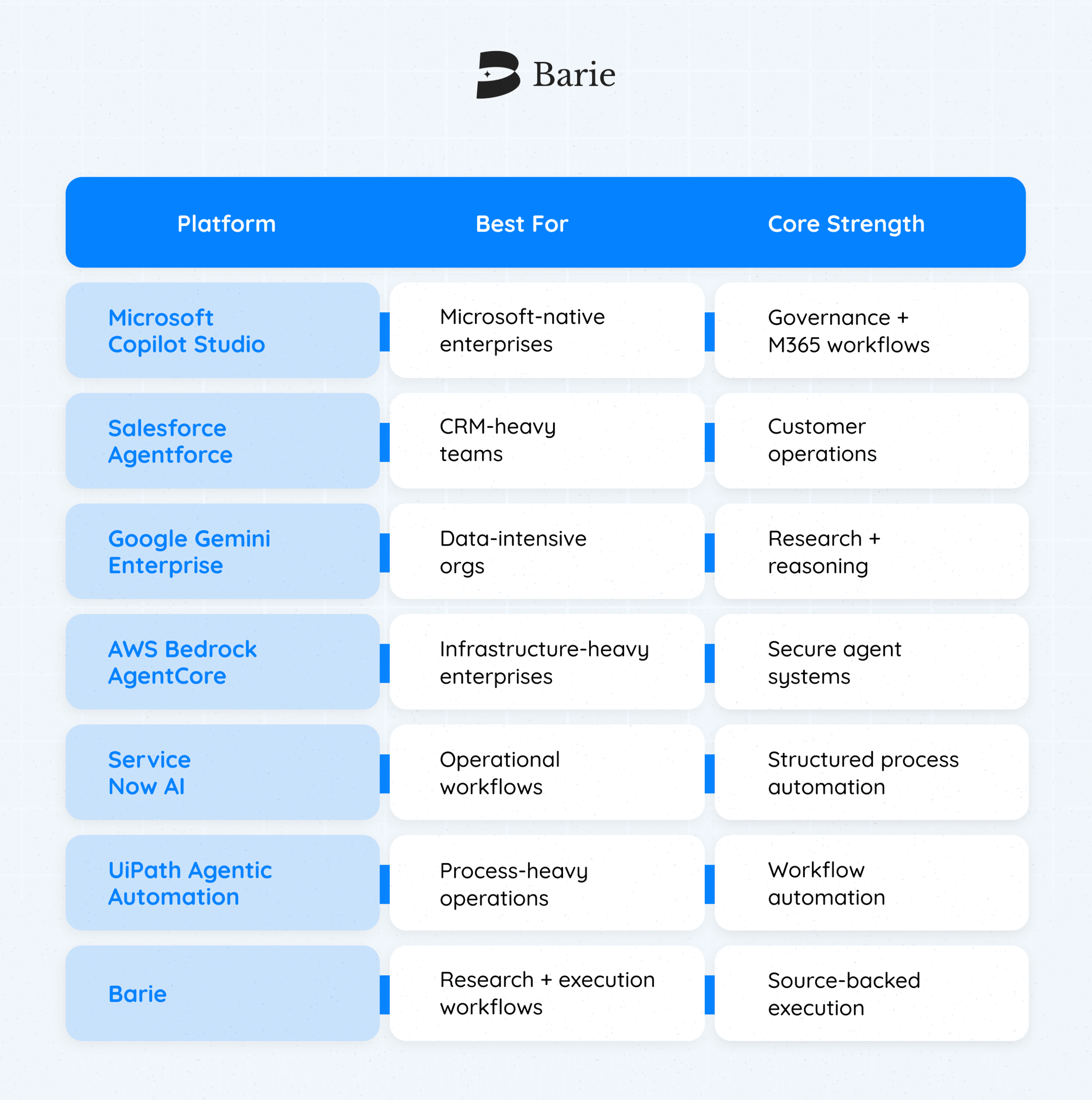
Microsoft Copilot Studio is one of the strongest options for enterprises already using Microsoft 365, Teams, SharePoint, and Dynamics. Its biggest advantage is familiarity. Many companies already have their documents, communication, and collaboration workflows inside Microsoft’s ecosystem, so building agents there feels like a natural next step.
Copilot Studio allows teams to create AI agents that can support internal operations, answer employee questions, automate knowledge workflows, and connect with business data. It is especially useful for organizations that want agentic AI without forcing employees into a completely new environment.
Its strength is not just convenience. Microsoft also brings strong enterprise governance, identity management, compliance controls, and security infrastructure. For large organizations, that can make adoption easier.
Still, Copilot Studio works best when Microsoft is already central to the company’s workflow. For teams using many non-Microsoft systems, some additional planning may be required.
Salesforce Agentforce
Salesforce Agentforce is built around customer operations. That makes it a strong choice for sales, service, support, and revenue teams that already depend on Salesforce.
Instead of using AI as a separate assistant, Agentforce brings AI agents closer to customer records, CRM workflows, service tickets, and pipeline activity. This allows teams to automate customer-facing and internal processes with more context.
For example, an agent can help support teams respond faster, assist sales teams with account information, or guide service workflows based on customer data. Since Salesforce already holds critical customer context for many enterprises, Agentforce has a clear advantage in CRM driven environments.
The limitation is also clear. It is strongest when Salesforce is already the center of the business workflow. If an enterprise does not rely heavily on Salesforce, the value may not be as immediate.
Google Gemini Enterprise Agent Platform
Google Gemini Enterprise Agent Platform is a strong option for companies that need flexibility, data reasoning, and custom AI workflows.
Google’s advantage comes from its strength in search, cloud infrastructure, and large scale data processing. This makes Gemini Enterprise especially useful for organizations that want AI agents to work with complex knowledge bases, research workflows, internal data, and multi-step reasoning tasks.
It can support teams that need more than a simple plug and play assistant. For enterprises building deeper AI systems, Gemini offers room for customization and scale.
However, this also means it may require more technical planning. Companies with mature cloud and data teams will likely get more value from it than teams looking for a very simple starting point.
Amazon Bedrock AgentCore
Amazon Bedrock AgentCore is designed for enterprises that want strong control over how AI agents are built, deployed, and governed.
For AWS native companies, this can be a powerful choice. Bedrock supports multiple models, secure deployment, memory, authentication, monitoring, and agent orchestration. It is especially relevant for industries where infrastructure control and compliance matter, such as finance, healthcare, and large-scale enterprise operations.
The platform is less about giving every employee a ready-made assistant and more about helping organizations build secure agentic systems on top of AWS.
That makes it highly capable, but not necessarily lightweight. Teams need the right cloud expertise to use it well.
ServiceNow AI Platform
ServiceNow is a strong contender for enterprises focused on operational workflows.
Many large companies already use ServiceNow for IT service management, HR workflows, customer service, and internal operations. Its AI platform builds on that foundation by helping teams automate structured workflows across departments.
This is where ServiceNow stands out. It is not trying to be a generic AI tool for everything. It is focused on making enterprise operations more intelligent, controlled, and efficient.
For organizations with complex internal processes, ServiceNow can help AI agents work within defined workflows rather than acting loosely across disconnected tools. That is valuable when governance and process consistency matter.
Its best fit is with companies already using ServiceNow as a major operational system.
UiPath Agentic Automation
UiPath has a strong background in automation, and that gives its agentic AI platform a practical advantage.
Many enterprises already use UiPath to automate repetitive tasks. With agentic automation, UiPath brings AI agents, robots, workflows, and human approvals into the same operating model.
This makes it useful for finance, procurement, compliance, document processing, back office operations, and other process-heavy areas. Instead of only responding to prompts, UiPath can help move structured business processes from start to finish.
Its value is strongest where companies already have repetitive workflows that need intelligence, not just automation.
However, UiPath is less of a conversational AI platform and more of an automation platform strengthened by agents. For operations teams, that may be exactly the point.
Barie
Barie is built around a slightly different idea: agentic AI should not only help teams think faster, but it should also help them execute faster.
For enterprise teams, this distinction matters. Many AI tools still stop at suggestions, summaries, or draft generation. Barie is positioned as an AI platform that can work across tools, conduct deeper research, create structured outputs, and support execution from a single prompt.
Its strength lies in turning scattered work into a more connected workflow. A team could use Barie to research a market, prepare content, organize findings, generate structured documents, and coordinate next steps without constantly switching between tools.
That makes it especially relevant for teams working across strategy, marketing, research, operations, and business intelligence.
Barie’s advantage is its execution focused approach. It is not just about giving an answer. It is about helping teams complete the work behind the answer.
How to Choose the Right Platform
Choosing from the best agentic AI platforms depends less on popularity and more on fit.
If your company already works deeply inside Microsoft, Copilot Studio will feel natural. If your main workflows are built around customers, Salesforce Agentforce is worth considering. If your team needs flexible AI development and large-scale data reasoning, Google or AWS may be stronger choices. If operations and service workflows are central, ServiceNow deserves attention. If automation is already part of your business, UiPath is a practical option.
And if your team needs an AI platform that focuses on execution across research, content, workflows, and business tasks, Barie brings a more flexible agentic layer into the conversation.
The best choice is the one that fits how your business already works.
Because agentic AI should not force teams to rebuild their workflow around the tool. The tool should understand the workflow and help improve it.
Evaluate Agentic AI Beyond the Demo
Agentic AI is becoming one of the most important enterprise technology categories in 2026. But the market is also getting crowded, which makes careful evaluation more important.
The strongest platforms are not simply the ones with the biggest names or most impressive demos. They are the ones that can connect with business systems, follow governance rules, support real workflows, and help teams complete work with confidence.
For enterprise teams, that is the real value of agentic AI. Not just faster answers. Better execution.