The article
Someone asked their AI tool to handle a competitive intelligence brief. Pull data from five sources. Cross-reference pricing pages. Summarise the findings. Drop the output into a shared doc.
The AI wrote four confident paragraphs. Two sources were paraphrased from training data eighteen months old. One pricing table was fabricated. The shared doc link went nowhere. The AI had answered the question. It had not done the work.
That is the difference between a chatbot and an AI agent. In 2026, if you do not understand that distinction, you are either wasting your time with the wrong tool or making decisions on outputs you cannot trust.
What a Chatbot Does. And What It Doesn’t.
Here is what a standard AI chatbot does when you ask it a complex question:
It looks inside itself. Retrieves patterns from training data. Generates text that sounds like a correct answer. Hands it to you with complete confidence.
That is the whole workflow.
No web access. No tool use. No verification. No execution. A very sophisticated autocomplete engine shaped like a colleague.
Most people discovered this the hard way, asking ChatGPT or Gemini for a recent market figure, a live competitor price, or a regulatory update from last quarter. The AI answered immediately, fluently, and incorrectly.
The data had a cutoff date. The world had moved on. The AI had not.
This is not a character flaw. It is the architecture.
So What Actually Is an AI Agent?
An AI agent is a system that perceives a goal, plans a series of actions to reach it, uses tools to execute those actions, observes what happens, and adapts until the task is complete.
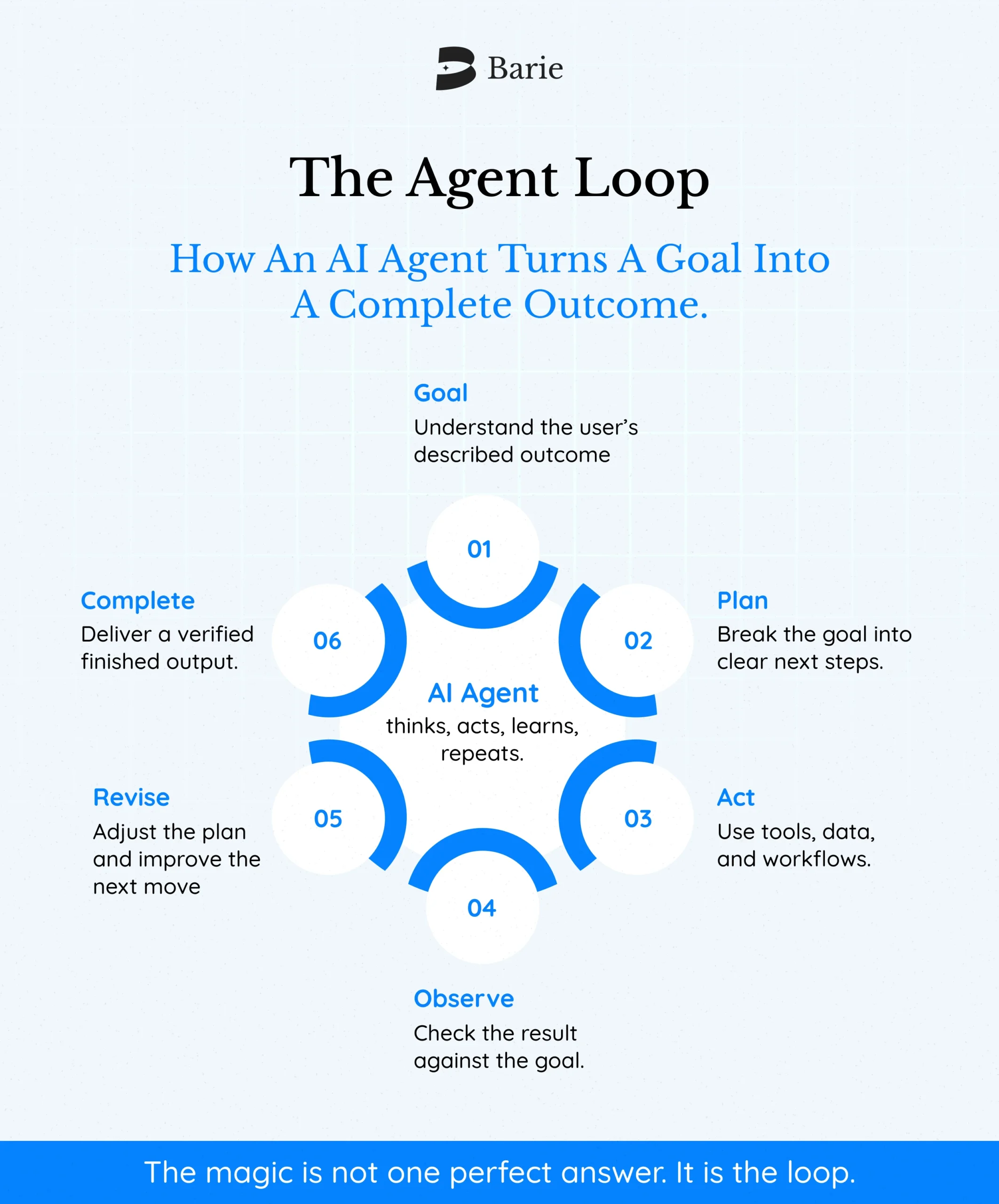
Not a single prompt and a response. A loop, plan, act, observe, revise, running until the task is finished.
The core components that separate an agent from a chatbot:
Perception: takes into context the goal, the environment, and the current state of whatever system it’s operating in.
Reasoning: Evaluates what it knows, what it needs, and what sequence of actions closes the gap.
Memory: Holds what it has done and learned across steps. Not starting from zero at every action.
Tool use: Calls external tools. Web search. Code execution. APIs. File systems. It goes and gets what it needs rather than answering from internal knowledge alone.
Action and feedback: Executes. Observes the result. Adjusts.
That loop is what makes the difference. Not a subtle architectural footnote. A completely different product category.
The Part Nobody Tells You About “Agents”
The word “agent” has been appended to roughly every AI product released in the last eighteen months.
An autocomplete tool with a search button is now an agent. A chatbot that can open a browser tab is an agent. A workflow platform that uses GPT-4 for a summary step is, apparently, an agent.
It is not a precise term. It is a marketing posture.
A real agent executes across multiple tools in sequence, adapts based on intermediate results, and delivers a completed output, not a text block describing what the output should look like.
If the “agent” gives you a list of things to do instead of doing them, it is a chatbot.
If it calls an API, reads the result, decides the next step, and continues until the task is done, that is an agent.
How AI Agents Actually Work
In practice, here is what a well-built agent does when you give it a goal:
Step one: Breaks the goal into subtasks. “Research five competitors and produce a structured brief” becomes five parallel research threads, a synthesis step, a formatting step, and a delivery action.
Step two: Fires those subtasks simultaneously. Not one by one. Five threads running at the same time, each pulling live sources, each returning structured results.
Step three: Processes the outputs. Cross-references findings. Flags conflicts. Identifies gaps needing another search pass.
Step four: Produces the output. A structured, cited, presentation-ready report. A deliverable, not a wall of prose.
Step five: If a delivery action was specified, Notion, Slack, or email, it executes that too.
You describe the outcome. The agent figures out how to get there. That is what distinguishes a goal-driven system from an instruction-driven one.
What Agents Can, and Cannot, Do Right Now
Here is where honest content diverges from vendor marketing.
AI agents operate best within well-defined scopes and structured environments. What you can reliably build today are systems that execute workflows, coordinate tools, and make bounded decisions, not fully autonomous operators that handle every edge case.
An agent with a clear goal in a structured environment, competitive research, financial analysis, and legal document review performs remarkably well. It sources live data. Follows multi-step logic. Delivers auditable outputs.
An agent with a vague goal and no feedback mechanisms is a liability. It drifts. It compounds errors. It produces confident garbage at speed.
The best agents in 2026 are built with guardrails, clear scope definitions, and human-in-the-loop checkpoints for decisions that carry real-world consequences. That is not a weakness. That is how trustworthy systems are designed.
What Makes Barie Different From Every “AI Agent” You’ve Tried
Here is the problem with most tools calling themselves agents in 2026. They execute. Sometimes. They source live data. Inconsistently. They cite their outputs. Rarely.
Barie does not answer from the training data. It actively researches the live web, processes multi-step parallel workflows, connects to third-party apps via Connectors, and delivers source-cited, visually formatted outputs. Every claim is traceable to a live source.
That should not be remarkable in 2026.
It is.
When Barie handles a competitive analysis, five companies, live pricing, and market positioning, it does not research them one by one. It fires all five threads simultaneously, synthesizes the outputs, and delivers a structured, cited report. What would take an analyst a full day takes Barie one session.
When a founder connects Barie to their workflow via Connectors, they are not copy-pasting from a chat window. They are running autonomous multi-step workflows: pull data, process it, format the output, and deliver it to the right place. That is execution, not assistance.
Barie aces the GAIA Level 3 benchmark, the standard test for whether an AI can complete genuinely complex, multi-step tasks reliably. Most tools do not publish GAIA scores. Make of that what you will. 90% accuracy rate. 1M+ hallucination-free chats across 25+ industries. These are not marketing statistics. They are the receipts.
Conclusion
An AI agent is a system that plans, executes, observes, and adapts until a task is complete.
A chatbot answers.
An agent does.
In 2026, that is not a technical footnote. It is the entire question. Are you using a tool that generates text describing what the answer should look like? Or one that goes and gets the answer, verifies it, and delivers something you can actually act on?
Most teams have not asked that question yet.
The ones who have are not going back.
Try Barie free and get 900 credits. See what it looks like when an AI agent actually does the work. barie.ai/login