The article
Artificial intelligence has evolved rapidly over the past few years. However, many organizations are discovering that a single AI model often struggles to handle complex business tasks from start to finish.
While traditional AI can generate content, answer questions, or analyze data, it frequently falls short when workflows require research, planning, execution, monitoring, and decision making across multiple systems. This challenge has led to the rise of multi agent AI.
Instead of relying on one AI assistant to perform every task, businesses are increasingly deploying teams of specialized AI agents that collaborate toward a shared objective.
Each agent handles a specific responsibility, creating a more scalable and efficient approach to automation.
As organizations move beyond simple AI assistants toward autonomous execution, multi-agent AI systems are becoming one of the most important developments in enterprise technology. Industry analysts, technology vendors, and enterprise leaders increasingly view multi-agent architectures as the next stage of agentic AI adoption.
What Is Multi Agent AI?
Multi agent AI refers to an architecture where multiple AI agents work together to complete tasks, solve problems, or achieve business objectives.
Rather than assigning every responsibility to a single model, organizations create specialized agents with distinct roles.
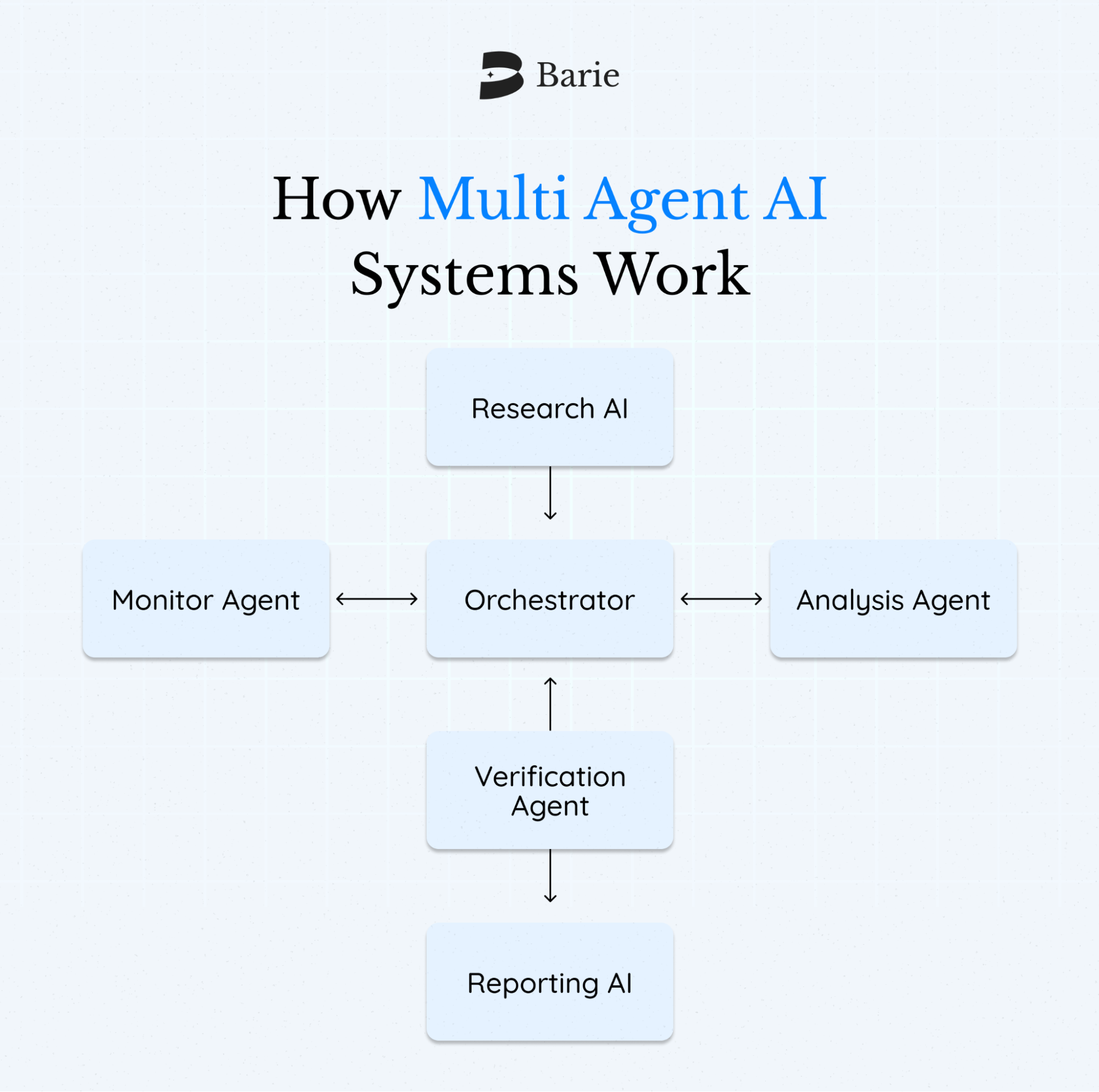
For example, a business intelligence workflow might include:
- A research agent that gathers information
- A verification agent that validates sources
- An analysis agent that identifies patterns
- A reporting agent that summarizes findings
- A monitoring agent that tracks changes over time
Each agent focuses on a specific task while communicating with other agents throughout the workflow.
This structure mirrors how human teams operate. Instead of expecting one employee to manage every responsibility, organizations assign specialized roles and coordinate efforts to achieve better outcomes.
Why Single Agent Systems Have Limitations
Many AI implementations today still rely on a single assistant.
Although this approach works well for straightforward tasks, limitations become apparent as workflows become more complex.
Single agent systems often struggle with:
- Large, multi-step projects
- Long running workflows
- Real-time monitoring
- Context management across systems
- Task prioritization
- Coordinating multiple objectives simultaneously
As organizations demand greater autonomy from AI, these challenges become more significant.
This is why businesses are increasingly exploring AI multi agent architectures that distribute responsibilities across multiple specialized agents rather than concentrating everything within one system.
How Multi-Agent AI Systems Work
A typical multi-agent AI system consists of several agents operating within a coordinated framework.
Each agent may possess:
- Specialized knowledge
- Access to specific tools
- Distinct objectives
- Unique decision-making capabilities
- Memory and contextual awareness
An orchestration layer coordinates communication between agents and ensures that each participant contributes to the overall objective.
For example, consider a market research project.
- One agent identifies relevant sources.
- A second agent collects data.
- A third agent evaluates credibility.
- A fourth agent analyzes trends.
- A fifth agent generates recommendations.
Instead of overwhelming a single AI model with every responsibility, work is distributed among specialized agents that collaborate efficiently. This approach often improves accuracy, resilience, and scalability.
Multi Agent AI and the Shift Toward Autonomous Work
The current AI landscape is shifting from assistance toward execution.
In earlier generations of AI tools, users needed to guide every step of a process manually. Today, organizations want systems capable of completing objectives with minimal supervision. This shift has fueled interest in multi AI agent environments.
Rather than asking an AI to simply answer a question, businesses increasingly expect AI systems to:
- Conduct research
- Evaluate information
- Make recommendations
- Execute actions
- Monitor outcomes
- Adjust strategies when conditions change
Multi-agent architectures provide the coordination necessary to support these more advanced workflows.
As a result, enterprises are investing heavily in agent orchestration, agent communication protocols, and governance frameworks designed specifically for multi-agent environments.
Key Benefits of Multi Agent AI in Business Industry
Improved Specialization
Each agent can focus on a specific responsibility. This allows organizations to design workflows that resemble expert teams rather than relying on general-purpose models for every task.
Greater Scalability
As business needs evolve, additional agents can be introduced without redesigning the entire system. Organizations can expand capabilities by adding specialized agents for new functions.
Better Accuracy
When multiple agents review, verify, and analyze information, the likelihood of errors often decreases. Collaborative workflows create opportunities for validation and quality control.
Increased Efficiency
Tasks can be performed simultaneously rather than sequentially. Parallel execution significantly reduces completion times for complex projects.
Enhanced Resilience
If one agent encounters limitations or errors, other agents can continue supporting the workflow. This creates greater operational stability compared to single-point systems.
Real World Applications of Multi-Agent AI Systems
Organizations across industries are already exploring practical applications for multi-agent AI systems.
Market Intelligence
Research agents gather information from multiple sources. Analysis agents identify trends. Monitoring agents track developments continuously. Reporting agents deliver insights to decision makers.
Business Due Diligence
Agents can investigate corporate entities, analyze ownership structures, verify records, assess risk factors, and generate comprehensive assessments.
Financial Analysis
Multiple agents can examine financial reports, monitor news developments, compare market conditions, and identify emerging opportunities.
Competitive Intelligence
Different agents track competitors, monitor announcements, evaluate strategic moves, and consolidate findings into actionable intelligence.
Content Operations
Research agents collect information. Editorial agents organize structure. Writing agents generate drafts. Quality assurance agents review outputs before publication.
These examples demonstrate why organizations increasingly view multi-agent architectures as the future of operational AI.
Governance Challenges in Multi Agent AI
While the potential benefits are significant, implementing multi-agent AI also introduces new challenges.
Organizations must address:
- Security controls
- Access permissions
- Decision transparency
- Data governance
- Compliance requirements
- Agent accountability
As agents become more autonomous, governance becomes increasingly important. Industry experts emphasize that successful deployments require strong orchestration, oversight mechanisms, and clearly defined responsibilities for each agent within the system.
Without proper governance, organizations may struggle to maintain trust, reliability, and regulatory compliance.
Why Multi Agent AI Matters for Business Leaders
The conversation around AI is no longer focused solely on models. Increasingly, competitive advantage comes from how organizations orchestrate intelligence.
The most successful businesses are not simply adopting larger models. They are designing systems where specialized agents collaborate to solve real business problems. This represents a fundamental shift.
Instead of asking: “What can this AI model do?”
Organizations are now asking: “How can multiple AI agents work together to achieve outcomes?”
That change is driving the rapid growth of multi-agent architectures across enterprise environments.
How Barie Brings Multi Agent AI Into Practical Business Workflows
Many organizations understand the potential of multi-agent systems but struggle to operationalize them.
The challenge is not creating individual agents. The challenge is coordinating research, reasoning, decision making, and execution across an entire workflow.
This is where platforms like Barie AI are helping organizations move from experimentation to practical application.
Barie is built around the idea that AI should do more than generate answers. It should help organizations investigate, analyze, and execute complex tasks.
Through coordinated AI workflows, businesses can move from a simple prompt to structured research, deeper analysis, and actionable outcomes without constantly switching between disconnected tools and systems.
Rather than focusing on isolated automation, the goal is to create an environment where intelligence, context, and execution work together to support better business decisions.
Moving Beyond AI Assistance
The future of AI is not a single assistant handling every task. It is a network of specialized agents working together toward a shared objective.
As organizations demand more autonomous execution, multi agent AI will continue shaping how research, analysis, operations, and decision making are performed across industries.
Businesses that understand how to orchestrate intelligence rather than simply deploy models will be better positioned to unlock the next phase of AI value.
Explore What Agentic Execution Looks Like
Many organizations have already adopted AI tools. The next challenge is turning those tools into coordinated systems that can research, reason, and act.
Barie AI helps organizations move beyond isolated AI interactions toward workflows that connect intelligence with execution, enabling teams to focus less on managing tasks and more on achieving outcomes.