The article
Small businesses in 2026 face a critical challenge: AI tools often look impressive but deliver unreliable outputs. Whether it’s competitor research, market analysis, or workflow automation, many affordable AI agents generate confident, clean-looking results that are outdated, incomplete, or outright fabricated. For lean teams without legal or analyst support, acting on false information is costly—bad data can misinform decisions, waste budgets, and derail growth.
The real industry issue is not access to AI, but access to accurate, verifiable, and actionable intelligence. The best AI agents for small businesses today are those that execute reliably, connect to existing tools, and produce outputs you can trust. This guide ranks 2026’s top AI agents based on what they actually deliver, not just what they promise.
What Makes the Best AI Agents for Small Business Different in 2026
The market has split. On one side: chat tools that answer questions from training data, format the response nicely, and give you no way to verify a single claim. On the other hand, agents that research live, execute across apps, and show their work.
For small businesses and startups, the second category matters most. Not because it sounds more impressive, but because acting on wrong information is expensive. A bad competitor analysis wastes your positioning. A hallucinated vendor quote wastes your budget. A fabricated case study in your pitch deck ends the conversation.
The best autonomous AI agents for small businesses in 2026 are the ones that execute reliably, connect to your existing tools, and do not make things up.
The Best AI Agent Tools for Small Businesses in 2026
1. Barie — Best for Deep Research, Agentic Execution, and Verified Outputs
Barie was built because the team that got burned by AI hallucinations. Not as a business problem. As a personal one. They were using the same tools everyone else was, getting confident outputs from fabricated sources, and making decisions based on fiction dressed up as research.
So they built something different.
Barie does not answer from the training data. It goes to the live web, runs parallel subtasks simultaneously, and cites every source in the output. You can trace any claim back to its source. That is not a checkbox on a feature list. That is the entire product philosophy.
For small businesses, the practical difference looks like this: ask Barie to research five competitors before a product launch, and it analyses all five at once, pulls live pricing and positioning data, and delivers a structured brief with traceable citations. What would take your team half a day takes Barie one session.
Barie also connects to third-party apps through Connectors, which means it not only researches, but also acts. Pull data, update a project board, and send a summary to your team. One prompt, multiple outputs across multiple tools.
It meets the GAIA Level 3 benchmark, which tests whether an AI can reliably complete genuinely complex, multi-step tasks. Most tools do not publish GAIA scores. Draw your own conclusions.
Best for: Founders and operators who need research they can actually trust, and workflows that run without babysitting.
Pricing: 900 free credits on sign-up. No card required.
2. Zapier — Best for Simple Automations Without Engineering Help
If your needs are straightforward, trigger an email when a form is submitted, tag a lead when they open a specific page, log a Slack message to a spreadsheet, Zapier handles it well. The AI Copilot lets you describe what you want in plain language and suggests the workflow.
It is not built for reasoning-heavy tasks. There is no live research, no memory across sessions, and the agent features are still relatively basic. But for repetitive, low-complexity automations across the 8,000+ apps it connects to, it is reliable and fast to set up.
Best for: Non-technical teams that need quick wins on routine tasks.
Pricing: Free plan with 100 tasks/month. Paid from $29.99/month.
3. Make — Best Visual Builder for Multi-App Workflows
Make gives you a drag-and-drop canvas for wiring apps together and mapping the logic of how data moves between them. It supports branching conditions, error handling, and scheduling, without writing a line of code.
It is better suited to workflow automation than autonomous agent behavior. The AI modules handle some reasoning, but Make’s real strength is giving non-technical users granular control over how their data flows between tools like Gmail, HubSpot, Airtable, and Notion.
Best for: Ops-minded founders who want visual control over multi-app workflows.
Pricing: Free plan available. Paid from $10.59/month.
4. Relevance AI — Best for Agents That Work from Your Internal Data
Relevance AI builds agents that can pull from your internal documents, score inputs using your own logic, and route tasks based on conditions you define. It uses vector search and long-term memory, which matters when the context your agents need lives in your own files and past interactions, rather than on the public web.
There is a steeper learning curve than most no-code tools. If no one on your team is comfortable with API connections or branching logic, expect friction during setup. But if you want agents that behave based on how your business actually works, not generic templates, Relevance AI gives you that control.
Best for: Data-driven teams with light technical skills who want agents built around internal context.
Pricing: Free plan with 200 actions/month. Paid from $29/month.
5. Botpress — Best Conversational Agent for Support and Internal Requests
Botpress is built for chat-first workflows. Support triage, HR FAQs, internal request routing, situations where the agent needs to understand what someone is asking, and guide them through a structured response flow.
It does well on intent detection and handles natural conversation reasonably well. The tradeoff is that it stays inside the chat channel. If your use case involves executing across multiple tools or running research tasks, it will not cover that ground. That is the gap autonomous AI agents fill, and where Barie operates.
Best for: Teams building a support or internal assistant that lives in Slack, Teams, or a chat widget.
Pricing: Free plan available. Paid from $89/month plus AI spend.
6. LangChain + LangGraph — Best for Technical Teams Building Custom AI Applications
If you have engineers and want to build AI products rather than use them, LangChain and LangGraph give you the most architectural flexibility available in open source. LangChain handles tool chaining and memory. LangGraph adds state management and looping patterns for complex agent behavior.
This is a framework, not a product. There is no visual interface, no template library, and no day-one setup. The tradeoff is complete control over how your agents think, remember, and act. For startups building AI into their core product, that control is worth the engineering overhead.
Best for: Engineering teams building custom AI applications from scratch.
Pricing: Free if self-hosted. Paid platform from $39/seat/month.
Which AI Agent Tool Is Right for Your Business?
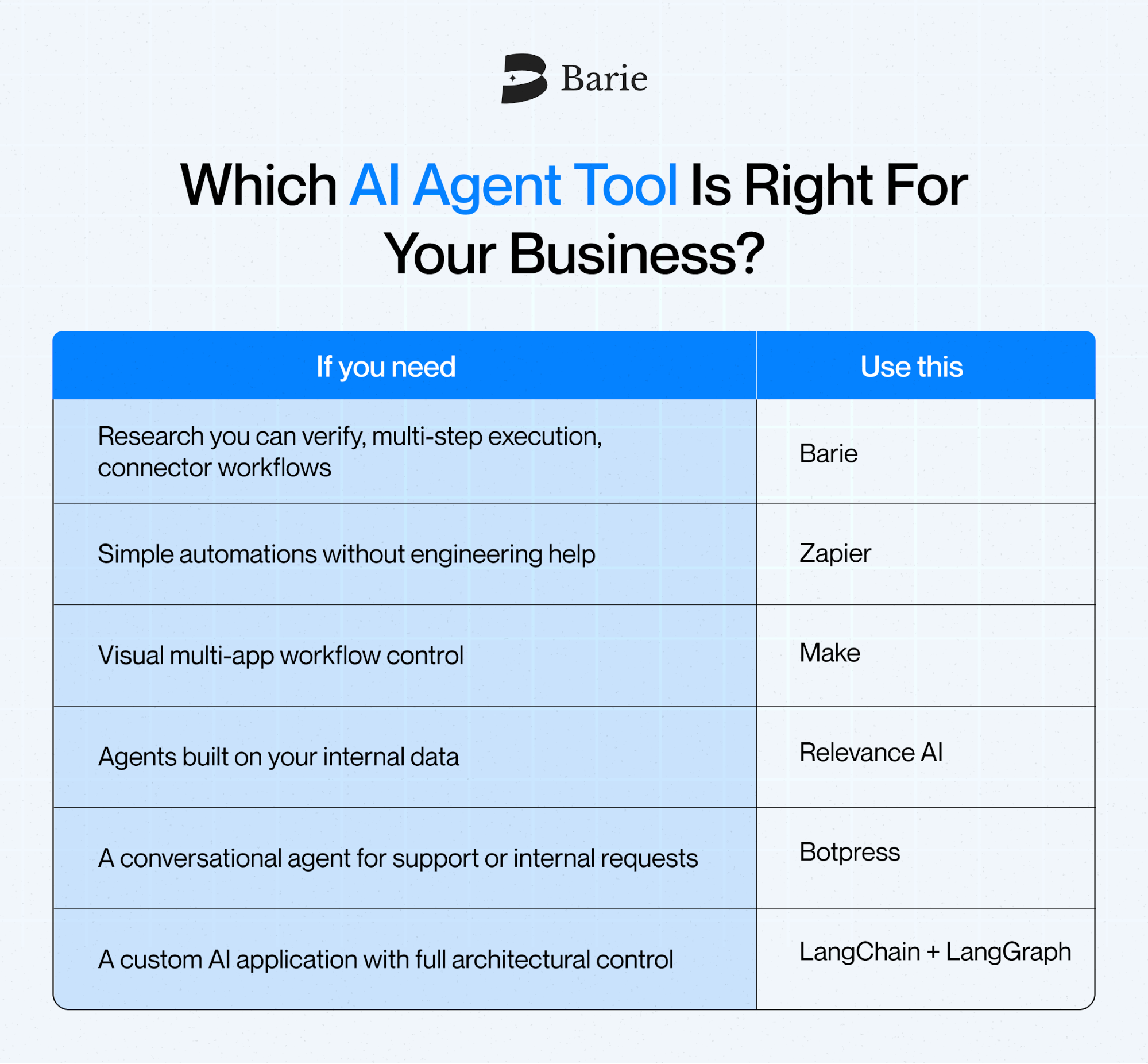
The best AI tools for small businesses in 2026 share one quality: they do something specific well, and they are honest about what they cannot do. The tools that claim to do everything tend to do most things poorly.
The One Thing Every Affordable AI Agent Tool Gets Judged On
Speed is irrelevant if the output is wrong.
Most affordable AI agent tools for startups will automate your workflows. Most will produce clean-looking outputs. The question is whether you can trust what is in those outputs, or whether you are one bad research brief away from a decision you will regret.
That is the problem Barie was built to solve—no faster answers. Accurate ones. Sourced, traceable, and verifiable. 1M+ hallucination-free chats across 25+ industries is not a marketing claim. It is a track record.
Start Without the Enterprise Budget
You do not need an enterprise contract to access the best autonomous AI agents available right now. Barie’s free tier gives you 900 credits to run real research sessions, test Connectors, and see what it produces before you spend anything.
Start your first deep research session free. No card needed.