The article
For years, software sold access. Access to dashboards, tools, templates, reports, and features that looked powerful but still left most of the work sitting on the user’s desk.
Now, AI is changing that logic. People no longer want to pay only for software access. They want to pay for the result. Not a research tool, but a competitor report.
Not a CRM automation feature, but a qualified lead list. Not a content platform, but a campaign plan ready to use.
That shift is creating the AI outcomes marketplace, a new model where prompts turn into structured, repeatable, and purchasable results. In this model, the product is not just the interface. The product is the completed outcome.
And honestly, it makes sense. Nobody wakes up excited to manage one more dashboard. People want the work done.
What is an AI Outcomes Marketplace?
An AI outcomes marketplace is a place where users can buy specific business results created or delivered by AI agents.
Instead of choosing a generic tool and figuring out how to use it, the user selects the outcome they need. That outcome could be a market research report, campaign plan, hiring shortlist, SEO audit, product comparison, investor memo, customer analysis, or operational workflow.
In other words, traditional software sells capability. An outcomes marketplace sells completion.
This is a major shift because the user is no longer paying for the possibility of doing the work. They are paying for the work to be done.
The prompt becomes the starting point, while the AI agent becomes the execution layer between intent and delivery. Simply put, the prompt becomes the order form.
Why Prompts Are Becoming Products
At first, prompts were treated as instructions. You asked a question, gave context, and waited for the model to respond.
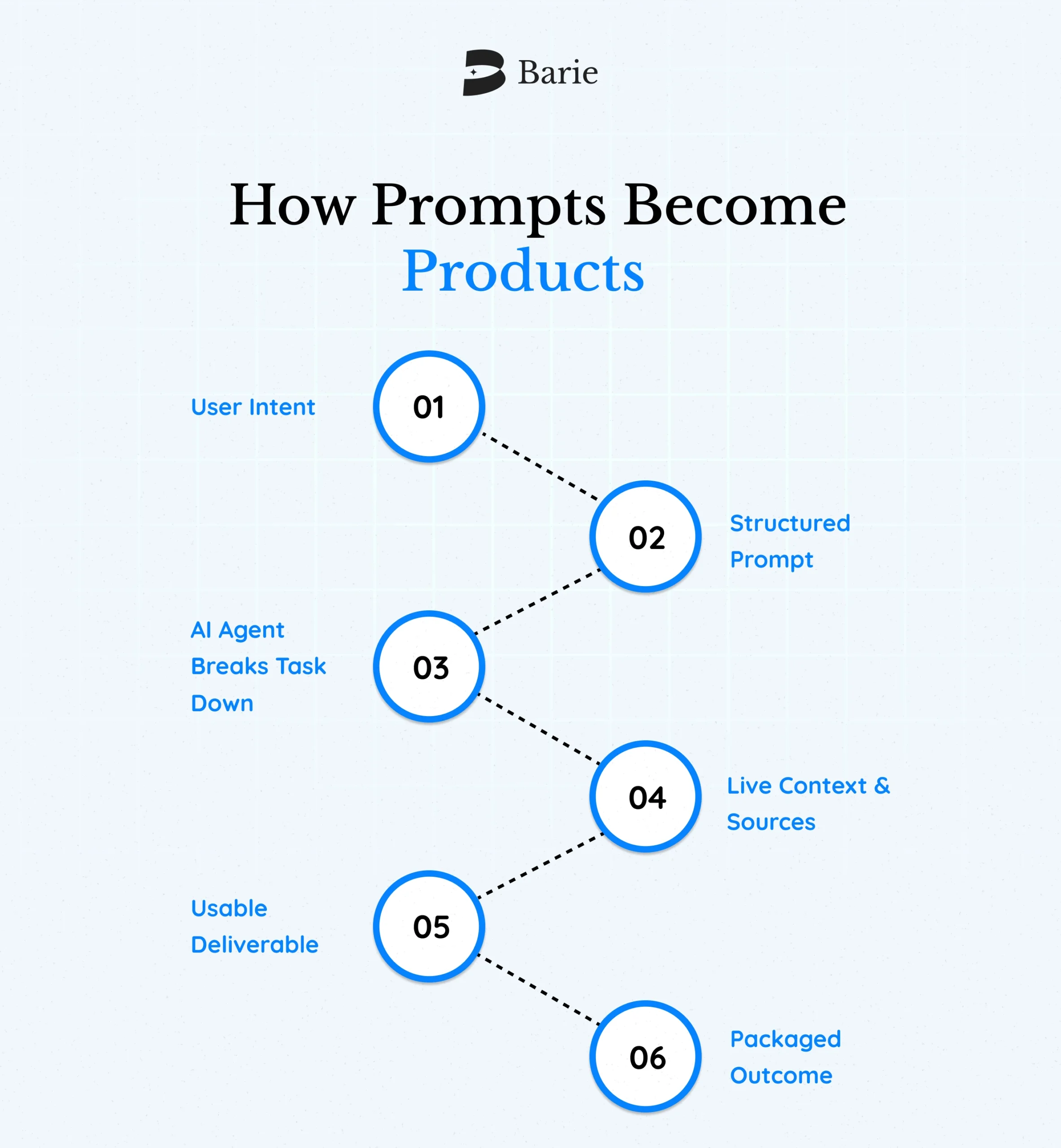
However, in an outcomes marketplace, a prompt becomes closer to a product brief. It defines what the user wants, what inputs are needed, how the output should be structured, and where the final result should go.
For example, “analyze my competitors” is too open-ended. But “create a five competitor positioning report with pricing, messaging, feature gaps, and go-to-market opportunities” is a clear outcome.
Once that structure becomes repeatable, it can be packaged, priced, and sold.
This is where AI starts moving beyond chat. A strong AI agent does not only respond to the prompt. It breaks the task into steps, gathers context, checks sources, organizes findings, and produces something usable. As a result, the prompt stops being just a question. It becomes a transaction.
The Shift From Tools to Results
For a long time, SaaS made users do most of the work. A marketing platform helped teams plan campaigns, but they still had to research the audience, write the copy, organize assets, review the strategy, and launch the workflow themselves.
Similarly, a research tool helped users find information, but the user still had to verify sources, summarize findings, and turn everything into a usable report.
AI changes that expectation. If an agent can understand the task, collect live context, reason through the steps, and generate the final output, users will naturally expect more than access. They will expect completion.
That is why the AI outcomes marketplace feels like the next logical step. It matches how people already think about work. People do not really want features. They want finished outputs.
They want the pitch deck. They want the launch plan. They want the report that their manager can understand in six minutes. They want the thing done.
What Makes an AI Outcome Worth Buying?
Not every AI output is valuable enough to buy. A generic answer is not an outcome. A rough draft is not always an outcome either. We have all seen outputs that look polished at first glance but fall apart once someone actually reads them.
So, a valuable AI outcome must be specific, usable, trustworthy, and effort-saving.
It should be specific enough for the user to know exactly what they will receive. It should be usable enough to fit directly into a workflow. It should be trustworthy enough to support claims with sources where needed. Most importantly, it should save meaningful time.
Otherwise, the user is not buying an outcome. They are buying homework with better formatting. This is why source-backed execution matters. The more important the outcome, the more trust becomes part of the product itself.
Where Barie Fits Into the Outcomes Marketplace
Barie is built around the idea that AI should deliver finished work, not just a starting point. Its core positioning focuses on execution, structured research, and connected workflows.
Rather than stopping at a simple answer, Barie can break complex tasks into parallel subtasks, research from live verified sources, organize the findings, and deliver a structured output. It is designed to support the movement from prompt to completed work.
This makes Barie highly aligned with the AI outcomes marketplace model.
For example, a founder could ask for a competitive analysis. A marketer could request a campaign plan. A researcher could ask for a source-backed report. An operator could ask for information to be pulled together, structured, and placed into the right workflow.
The important part is that the user is not just receiving text. They are receiving a usable deliverable. That is the real difference between “AI helped me think” and “AI helped me finish.”
How an AI Outcomes Marketplace Could Work
Now imagine opening a marketplace and seeing outcomes instead of software categories.
A startup founder could buy a competitor teardown. A sales team could buy a qualified account list. A content team could buy a full topic cluster with briefs. A hiring manager could buy a candidate shortlist. An ecommerce operator could buy a product research report.
Each outcome would have a clear input, expected output, quality standard, and delivery format. The user would not need to design the process from scratch because the marketplace would already know what a good result should look like.
Behind the scenes, AI agents would run the work. Some outcomes would require live research. Others would require connected app data, templates, approvals or human review.
Therefore, the user experience becomes much simpler. Choose the result, provide the context and receive the output. That is how prompts become packaged workflows.
Why This Matters for Businesses
The AI outcomes marketplace matters because it changes how businesses think about productivity. Instead of asking, “Which tool should we use?” teams can ask, “Which result do we need?”
That difference is powerful. It reduces the pressure of learning new tools, building workflows, and managing repetitive tasks manually. It also makes AI adoption easier because teams can start with a clear business outcome instead of a vague digital transformation plan.
For small teams, this could mean getting expert-level outputs without hiring for every function immediately. For larger organizations, it could mean standardizing repeatable workflows across departments.
For creators, consultants, and operators, it could create a new way to package knowledge, sell repeatable workflows, and scale services. In every case, the marketplace organizes AI around value, not novelty.
The Real Challenge Is Trust
Of course, the biggest challenge will not be demand. People already want faster outcomes.
The real challenge is trust. If users are buying AI-generated outcomes, they need confidence that the result is accurate, current, and usable.
That means an outcomes marketplace cannot rely only on speed. It needs quality checks, source transparency, review flows, and clear standards.
This becomes especially important in research, strategy, compliance, finance, hiring, and customer-facing work. In these areas, a confident but incorrect AI output can create more problems than it solves.
Therefore, the winning outcomes marketplaces will not only sell faster work. They will sell verified execution. That is the real unlock.
The next phase of AI will not only be about better prompts. It will be about better products built from prompts.
The AI outcomes marketplace turns intent into delivery. Instead of buying software access and doing the work manually, users will increasingly buy the result they need and let AI agents handle the path from instruction to execution.
This changes the role of AI from assistant to operator. It also changes the role of software from tool to outcome engine. For businesses, the question is no longer just “What can AI generate?”
The better question is: What results are people already trying to buy? Because in the outcomes marketplace, that result becomes the product.