The article
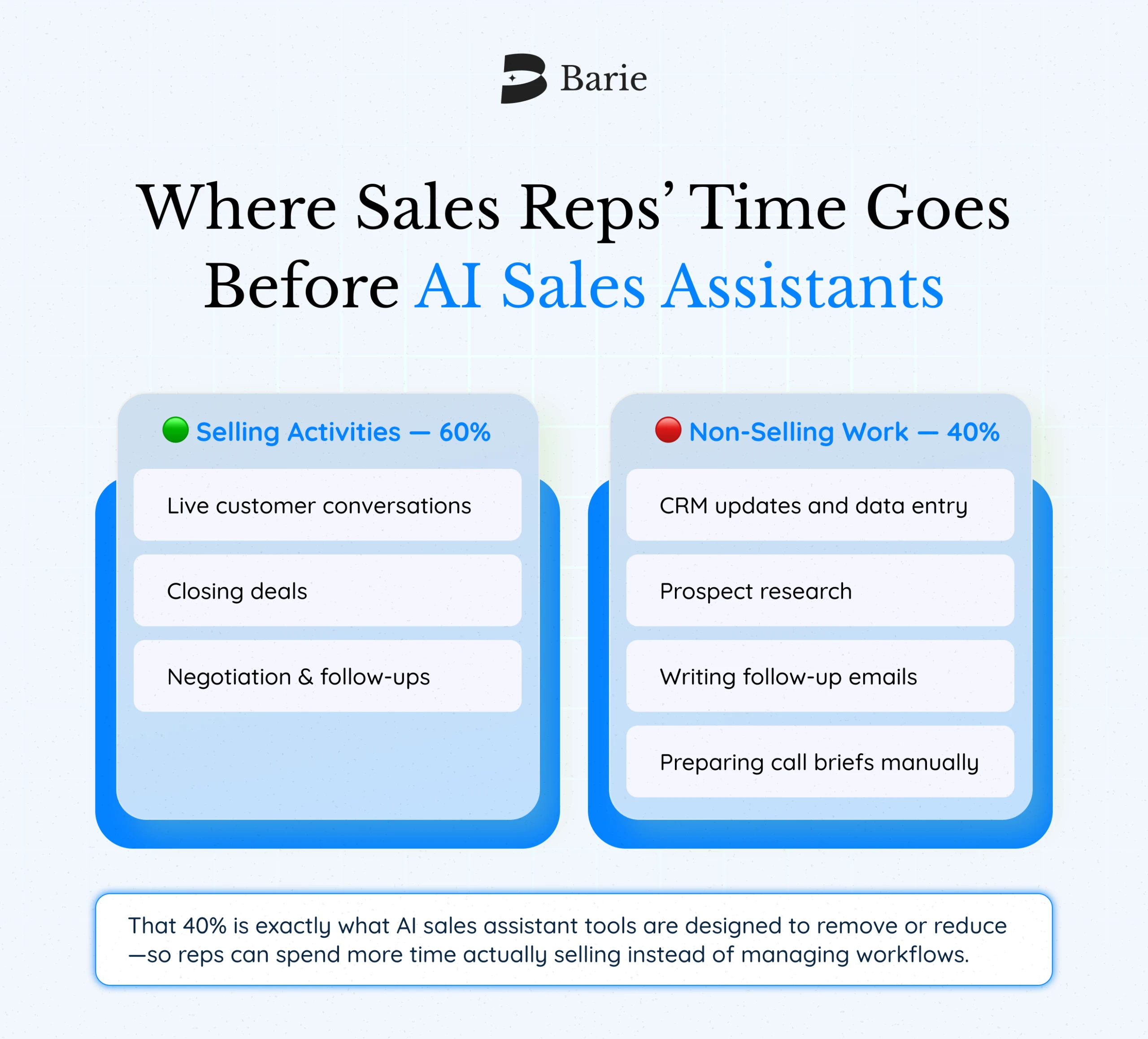
Your reps are spending 40% of their week not selling. They are updating CRM records, researching accounts, writing follow-up emails, and prepping for calls that could have been briefed in minutes. That is the actual problem AI sales assistant software was built to solve. This article breaks down nine tools worth evaluating in 2026: what each does well and where it falls short.
Why the AI Sales Assistant Category Matters Now
Buyer behavior in 2026 has changed, and the best AI sales assistant tools help teams keep up. Decisions now involve more stakeholders and more digital research before anyone picks up the phone. AI can increase leads and appointments by up to 50% by identifying high-intent prospects and automating qualification and follow-ups. That number is worth sitting with for a moment. The gap between teams using sales AI assistants and those still working manually is compounding every quarter.
The 9 Best AI Sales Assistant Tools for B2B in 2026
1. Apollo.io: The All-in-One AI-Powered Sales Assistant for Outbound Teams
Apollo is a go-to-market platform with a 275M+ contact database, AI-powered email sequences, and a built-in CRM. In 2026, it runs end-to-end workflows: finding prospects, writing emails, and booking meetings, without switching tabs. Apollo offers flat, transparent pricing starting at $47 per user per month, with a free plan that includes 1,200 credits per user per year. For lean teams that need a fast pipeline without assembling a five-tool stack, Apollo is the obvious starting point.
Best for: Outbound-heavy B2B teams, startups, and SMBs needing combined data and engagement. Limitation: Weak on Instagram and WhatsApp-based sales channels.
2. ZoomInfo: The Enterprise-Grade AI-Powered Virtual Sales Assistant Tool
ZoomInfo combines a B2B database of 500M+ contacts with AI-powered intelligence to help revenue teams identify, prioritize, and engage their ideal customers. Its GTM Context Graph fuses company data, intent signals, and conversation intelligence into one reasoning layer. ZoomInfo Copilot acts as an AI assistant embedded in your workflow, surfacing insights and recommending next actions. The pricing is not transparent and requires a sales conversation, which narrows its audience to teams with budget and patience.
Best for: Enterprise GTM teams that need intent data and deep CRM enrichment. Limitation: Pricing complexity and annual contracts create friction for smaller teams.
3. Gong: The Sales AI Assistant for Revenue Intelligence
Gong records and analyzes sales calls to surface what top performers actually do differently. Gong tracks which topics reps discuss, how much time buyers spend talking versus listening, and which questions lead to next steps. It feeds those patterns into coaching dashboards and deal risk alerts. The platform does not automate selling: it makes the humans doing the selling measurably better. Pricing runs around $100 per user per month plus a platform fee that scales with team size.
Best for: Sales leaders who want coaching intelligence and forecast accuracy. Limitation: It analyzes deals. It does not close them.
4. Outreach: The AI Sales Assistant Software for Enterprise Sequencing
Outreach AI Agents cover autonomous prospecting, AI-drafted outreach informed by past conversations, deal-stage AI assistance, and workflow automation across CRM and sequencing. Manager dashboards display team activity, reply rates, and pipeline generation in a single view. It is the deepest sequencing platform in the category for large SDR teams. Pricing is quote-based with annual contracts, which is typical for enterprise-grade sequencing tools.
Best for: Large SDR and AE teams with a separate verified data source. Limitation: No native B2B data layer; contact accuracy depends on the vendor behind it.
5. Salesloft: The AI-Powered Sales Assistant for Structured Execution
Salesloft focuses on structured engagement and sales execution and is especially valuable for scaling sales organizations, where consistency across growing teams becomes difficult. Its Rhythm feature surfaces rep tasks based on buyer signals, reducing the cognitive load of deciding what to do next. It integrates with major CRMs and covers email, calls, and LinkedIn in a single workflow. Pricing is enterprise-level and requires a custom quote.
Best for: Mid-to-large sales teams standardizing rep behavior at scale. Limitation: Onboarding and configuration take meaningful ops investment.
6. HubSpot Breeze: The AI Sales Assistant for HubSpot-Native Teams
Breeze is HubSpot’s AI assistant suite, including a Prospecting Agent, Customer Agent, and general Breeze Assistant. For teams already living in HubSpot, Breeze is the lowest-friction way to add AI to the sales workflow. HubSpot Sales Hub pricing runs from $15 to $150 per user per month. It does not match the depth of dedicated sales engagement platforms, but for mid-market B2B teams that prioritize usability, it punches above its price tier.
Best for: Mid-market B2B teams already running on HubSpot. Limitation: Less powerful than standalone sequencing tools at enterprise scale.
7. Salesforce Einstein (Agentforce): The AI Sales Assistant Built Into Your CRM
Einstein adds predictive lead scoring, opportunity scoring, forecasting, and next-best-action suggestions natively inside Salesforce. The 2026 release added Agentforce features that let reps trigger AI workflows directly from the record page. For organizations already on Salesforce, this is the most logical starting point before layering on separate tools. The quality of the output directly correlates with the data hygiene in the CRM underneath.
Best for: Teams on Salesforce that want AI inside the CRM, not alongside it. Limitation: Poor underlying data quality produces poor AI output: garbage in, garbage out.
8. Cognism: The AI Sales Assistant Tool for GDPR-Compliant Prospecting
Cognism specializes in GDPR-compliant B2B data, with a focus on European market coverage, and provides mobile-verified contact numbers, email addresses, and firmographic data for sales prospecting. Its AI flags intent signals to identify which accounts are most likely to buy. Cognism pricing runs from $12,750 to $17,000 per year. For teams selling into regulated European industries where data compliance is a hard requirement, Cognism is the category leader.
Best for: Sales teams prioritizing data quality and compliance in European markets. Limitation: Price point makes it difficult to justify for smaller outbound teams.
9. Barie AI: The AI-Powered Virtual Sales Assistant Tool for Deep Account Research
Most AI sales assistant software stops at sequencing and scoring. Barie AI operates at a different layer entirely. A rep needs to walk into an enterprise meeting knowing the prospect’s latest earnings call, recent leadership changes, regulatory exposure, and competitive positioning. Standard tools do not assemble that picture: they surface contact data and suggest email templates.
Barie AI researches the live web, runs parallel subtasks simultaneously, and delivers source-cited account intelligence in one session. Ask it to analyze a target account before a discovery call. It does not pull from training data that is months old. It goes to the web, finds current information, and shows you exactly where every piece came from. That distinction matters when a deal is $200K, and the buyer has done their homework.
The platform has processed 1M+ hallucination-free chats across 25+ industries and achieves the GAIA Level 3 benchmark, which tests whether an AI can complete genuinely complex, multi-step tasks reliably. Most tools in this list do not publish GAIA scores. Make of that what you will. For B2B sales teams using Barie AI for lead generation, competitive product analysis, and marketing strategy, the outputs are traceable, current, and structured for immediate use.
Best for: Sales teams that need deep, verified account research before high-value meetings. Limitation: Not a sequencing or CRM platform: it is a research and execution layer that works alongside them.
How to Pick the Right AI Sales Assistant Software for Your Team
The category has been split into distinct sub-problems. The right pick depends entirely on whether your biggest gap is finding contacts, understanding accounts, timing outreach, or coaching reps. A team struggling with cold email volume needs Apollo or ZoomInfo. A team losing deals because reps are underprepared needs Gong or Barie AI. A team with reps working inconsistently needs Salesloft. Pick by gap, not by feature count.
Always evaluate the depth of the CRM integration: intelligence that doesn’t surface in Salesforce or HubSpot gets ignored by reps, regardless of how good it is. And do not just compare license fees. Implementation time, training overhead, and the tools you retire all determine real ROI.
The best B2B sales teams in 2026 are not using AI because it sounds innovative. They are using it because the manual alternative is costing them pipeline every week.
Stop Going Into High-Value Meetings Underprepared
Your AI sales assistant stack can cover sequencing, scoring, and call coaching. Most of them still leave one gap: real-time, verified account research before the meetings that matter. That is where Barie AI works.
Try Barie AI free and see what it means to walk into a discovery call with a research brief that is actually current.