The article
You asked your vibe coding tool to build a booking system. It delivered one. Authentication, calendar UI, Stripe integration, the whole thing. You shipped it to staging. Looked solid. Then someone on your team tried to actually use it.
Half the dependencies the AI recommended did not exist. Three of them had been deprecated since 2023. One had been pre-registered on npm by a security researcher tracking exactly this pattern: AI tools hallucinating package names, attackers registering those names before developers install them.
That is not a fringe case. That is the documented architecture of how 2026’s vibe coding tools fail at scale.
What Vibe Coding Actually Became in 2026
Andrej Karpathy coined “vibe coding” in early 2025. The idea was simple: describe what you want, let AI write the code, and iterate through conversation instead of a text editor. Collins Dictionary named it Word of the Year.
Search interest spiked 6,700%. By 2026, the tooling landscape had grown from a handful of experiments into a crowded market of platforms all claiming to ship production apps from a single prompt.
The best vibe coding tools in 2026 fall into two distinct categories. The first group is full-stack AI app builders: Lovable, Bolt, and Replit. They generate complete applications from a written description, handle hosting, and require no coding experience to operate.
The second group is AI coding assistants, Cursor, Claude Code, and Windsurf. These live inside your existing IDE or terminal and help developers write, debug, and ship faster. Cursor has established itself as the strongest pair-programming IDE.
Claude Code is the most capable terminal-native option for codebase-wide reasoning. Bolt wins on raw speed when you need a deployed demo in under ten minutes.
The right tool depends entirely on who you are. A non-developer founder building an internal portal has different requirements than a senior engineer working on a production SaaS. Tools optimized for one audience actively fail the other.
The Gap Between Demo and Deployment
Here is the problem that every best-of vibe coding tools list in 2026 underplays.
Sonar’s State of Code Developer Survey, published January 2026, found that 96% of developers do not fully trust the functional accuracy of AI-generated code.
That is not a niche complaint. AI-generated output now accounts for 42% of all committed code as of 2026, and 88% of developers report negative downstream impacts from it.
Meanwhile, 63% say they have spent more time debugging AI-generated code than it would have taken to write it manually.
The failure pattern is specific and repeatable. Vibe-coded output consistently misses four production pillars: error handling, idempotency, retries with backoff, and structured observability.
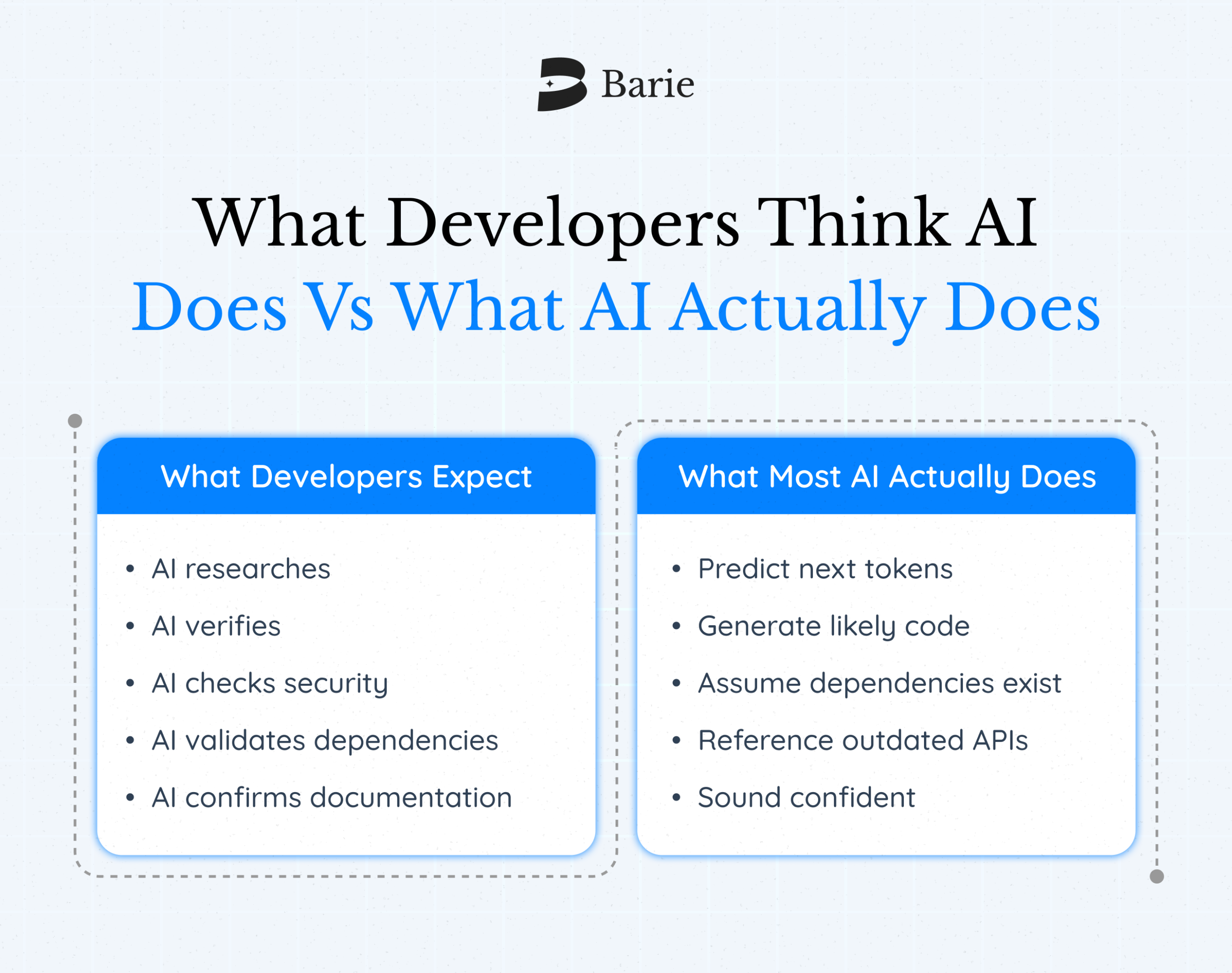
The code looks correct. It uses sensible naming conventions. It is well-structured and readable. It just calls functions that do not exist, references APIs deprecated two years ago, and suggests packages that attackers have already registered for exactly this purpose.
Georgia Tech research tracked CVE counts attributed to AI coding tools. The numbers went from 6 in January 2026 to 15 in February to 35 in March.
Separately, 43% of hallucinated package names were consistently recommended across ten separate queries, not random errors, but systematic ones. This is what the best vibe coding tools 2026 guides are not telling you when they rank Lovable against Bolt on UI polish.
Why Most Vibe Coding AI Tools Optimize for the Demo
Consumer vibe coding tools have a clear customer: indie founders who optimize for speed over compliance. Their UX is built around “ship in five minutes,” not “pass a SOC 2 audit.” Adding security scanning or verification layers would slow them down and reduce conversion. They will not do it.
That is not a criticism; it is a product decision that accurately reflects their market. The limitation is assuming those tools belong in a different use case.
The production gap is structural, not something a future update will close. Vibe coding software development tools shine at rapid prototyping and front-end UI work. Research consistently shows they stall on anything involving complex back-end systems, security-sensitive operations, or large-scale deployments.
The best tools for vibe coding work well for demos and internal prototypes. They require real engineering judgment before anything touches real users, real data, or real infrastructure.
What Accurate AI Research Looks Like in a Coding Context
Here is where it gets interesting for developers who use AI not just to write code, but to research technical decisions.
You are evaluating three infrastructure options for your next project. You ask your vibe coding tool which one has a better security track record, what the dependency vulnerabilities look like, and whether the documentation supports your specific framework version.
What you get back is a confident, well-formatted answer built from training data that could be 18 months old. No sources. No verification. No way to know which claims are current and which are fabricated.
This is the research problem that sits underneath every vibe coding workflow. The code generation part has gotten fast. The research and verification part has not caught up.
Barie AI was built for exactly this gap. Not as a code generator, but as the research layer that answers the questions your vibe coding tools cannot.
When a developer asks Barie to analyze a technical decision, compare framework security records, or audit library dependencies for known vulnerabilities, Barie does not answer from training data.
It goes to the live web, pulls current sources, and shows you exactly where every piece of information came from. Every claim is traceable. Every source is visible. That is not a toggle in the settings. That is the entire philosophy of how the product was built.
Barie meets the GAIA Level 3 benchmark, which tests whether an AI can reliably complete genuinely complex multi-step tasks. Most tools do not publish GAIA scores. Over 1M hallucination-free chats across 25+ industries.
A 90% accuracy rate. These are not marketing claims; they are specific, verifiable numbers that most AI tools avoid publishing because their benchmarks would not survive the comparison.
Using Barie Alongside the Best Vibe Coding Tools
The workflow is concrete. A developer uses Cursor or Claude Code to write and debug code. Before committing to a dependency, an architectural decision, or a third-party integration, they run the research question through Barie.
Barie AI analyses current documentation, checks for recent CVEs, compares approaches with live source citations, and returns a structured brief with traceable claims. The developer makes an informed call instead of trusting a confident hallucination.
One session. Barie AI can research 30 technical sources in parallel, identify the relevant gaps, and structure the output for immediate use. What would take a developer an afternoon of tab-switching and manual verification takes one prompt.
The vibe coding tools handle the build. Barie handles the accuracy layer underneath it.
The Verdict on Vibe Coding Tools in 2026
The best vibe coding tools in 2026 are genuinely good at what they were designed for. Lovable for non-developer founders. Cursor for experienced developers who want a faster IDE. Claude Code for terminal-native codebase reasoning.
Bolt for rapid prototyping. None of them were designed to verify their own outputs, research current security data, or trace their claims to live sources. That is not a failure on their part. It is a scope decision.
The failure happens when developers treat code generation as the only AI problem in their workflow. The research problem, the verification problem, and the “is this dependency safe to install” problem, those require a different tool entirely.
Speed without accuracy is not a development workflow. It is a bug factory with a friendly UI. Try Barie AI free with 900 free credits. See what research-verified AI actually looks like in a development context.
For developers specifically, start with Barie AI coding agent or explore the prompt library for technical research workflows.