The article
You open ChatGPT. You ask it to research something. It answers, so you copy the output. Then you open a new tab, and you paste it somewhere. You go back, ask the next question, and copy that too. Then you open yet another tab.
This is not a workflow. This is a relay race where you are the only runner. Twenty minutes later, you are juggling six browser tabs, two spreadsheets, and a Notion doc. Your clipboard history looks like a crime scene.
You have lost track of which version is the latest one. And somewhere in the middle of all that switching, the actual thinking, the part that required your brain, got buried under the logistics of just moving information from one place to another.
The “AI agent” handled about fifteen seconds of that entire process. You, meanwhile, handled the rest. The copying. The pasting. The reformatting. The tab-hunting. The “wait, where did I put that?” The re-reading is just to remember where you were.
That is not assistance. That is delegation theatre. That is the tab-switching tax, and it does not show up on any invoice. Nobody calculates it in their productivity reports.
But it compounds, every single session, across every single person on your team, adding up to hours of invisible overhead that nobody is fixing because everybody assumes this is just how AI tools work.
It is not how they have to work. Almost every AI agent on the market makes you pay this tax, every single time. They hand you an answer and then hand the wheel straight back to you.
The question is not whether AI can research faster than a human. It already can. The question is, who is doing all the work in between?
What “AI Agent Execution” Actually Means in Practice
The phrase gets used a lot. “AI agent execution.” “Autonomous task completion.” “End-to-end workflow automation.”
Most of the time, what it actually means is that the AI generates text output, and a human carries that output somewhere useful.
That is not execution. That is drafting. There is a difference. Genuine AI agent execution means the agent handles the full loop. It researches. It reasons. It acts inside the tools where the work actually lives. It does not hand you a formatted block of text and wait for you to figure out what to do next.
The gap between those two things is where most workflows fall apart. And it is why so many teams using “AI agents” still spend hours on tasks that should take minutes.
Where Most Agents Break Down
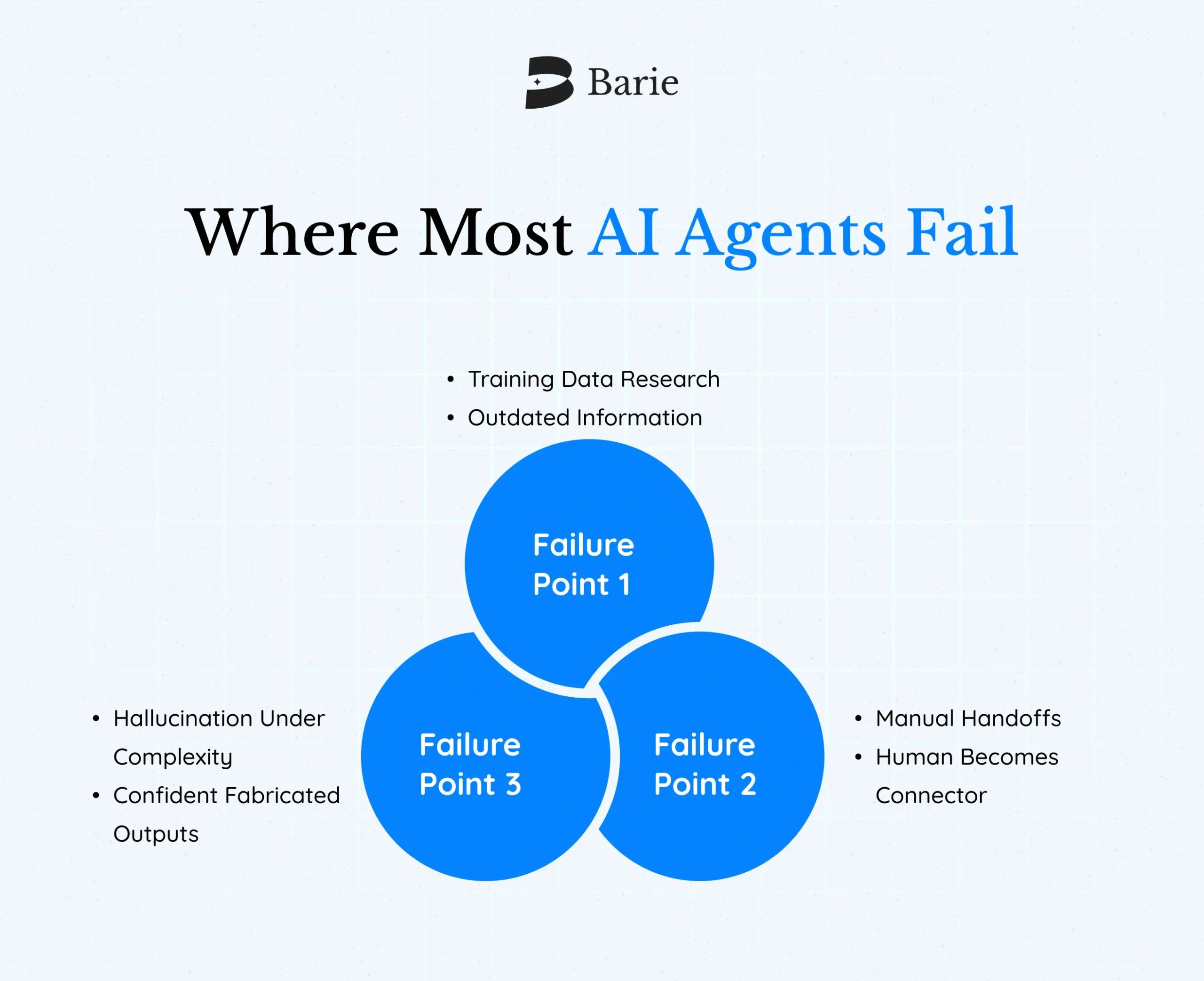
The failure usually happens at one of three points. The first is research quality. An agent that answers from training data is not researching anything.
It is retrieving. If your workflow depends on current information, competitor pricing, recent filings, or anything that changes month to month, a training-data answer is a liability dressed as productivity.
The second is handoff. Even agents with live web access typically stop at the information layer. They find it, surface it, and stop. The next step, whether that is updating a project board, sending a summary, or pulling it into a report, falls back to you.
Every handoff you handle manually is a tax on your time that compounds across every workflow, every week.
The third is hallucination under pressure. Complex, multi-step tasks push models toward confident invention. The longer the chain of reasoning, the more surface area for errors that look right.
An agent that handles simple queries cleanly can quietly generate fabricated results when the task gets genuinely hard. Three failure points. Most agents hit at least one. Many hit all three.
The Real Cost Is Not Just Time
Here is what the tab-switching tax actually costs, beyond the obvious inconvenience. It fragments attention. Every context switch, every manual handoff, every moment spent copying output from one tool and pasting it into another is a small but real interruption.
Research on cognitive load is consistent on this: fragmented workflows do not just waste time, they degrade decision quality. You are working harder to accomplish less.
It creates unverified chains. When a human is the connector between AI output and downstream action, errors travel without friction. A fabricated statistic in step two becomes the basis for a decision in step five. Nobody catches it because the workflow moved too fast, and the source was never surfaced.
It builds dependency on the wrong layer. Teams that use AI heavily for research but manually for execution are not getting the productivity gains they think. They are getting faster first drafts and slower everything else.
The tab-switching tax is not a minor inconvenience. It is a structural problem in how most AI tools are built.
What Execution Without That Tax Looks Like
The alternative is an agent that closes the loop. Not just research. Research, then action, inside the tools where the work lives. One prompt that reaches the live web, synthesizes verified information across multiple sources in parallel, and then delivers the output directly where it needs to go, without you ferrying it there manually.
That is what Barie does. A founder running competitive intelligence does not paste five competitor URLs into a chat window and wait.
Barie breaks the task into parallel subtasks, researches all five simultaneously, cross-references the findings, and produces a structured, source-cited report.
Every claim is traceable back to a live source. Nothing invented, nothing assumed. Then, through Barie Connectors, that output goes where it belongs. Straight into the workflow, not into your clipboard.
One session. No tab-switching. No manual handoffs. No fabricated figures quietly embedded in the output because the model got lazy under complexity.
Barie meets the GAIA Level 3 benchmark, which is the standard test for whether an AI can reliably complete genuinely complex, multi-step tasks. Most tools do not attempt it. The ones that do generally fail it. Barie does not. 90% accuracy rate. 1M+ hallucination-free chats across 25+ industries. These are not estimates. They are the receipts.
Closing the Gap Between AI Output and Execution
The AI agent execution problem is not a model problem. It is an architecture problem. Tools built to answer questions will always hand the execution back to you. That is not a flaw in their design. It is the design. They were never meant to close the loop. They were meant to give you better text, faster.
If what you need is better text, that is fine. Use those tools. If what you need is for the work to actually get done, the architecture changes entirely.
Research, verification, parallel execution, and direct delivery into your workflow. Not a handoff. Not a formatted draft. The actual outcome.
That is what closing the tab-switching tax looks like. And it is the only thing that makes “AI agent execution” mean something beyond a marketing phrase. Try Barie free and get 900 credits. See what execution without the tax actually feels like.