
The article
You picked an AI agent builder last year. Your team spent six weeks integrating it, training it on your data, and demoing it to leadership. It worked beautifully in staging.
Then it hit production.
It hallucinated ticket resolutions. It invented product specs. It gave customers confident, detailed, entirely wrong answers, and nobody flagged it until a support manager noticed the pattern. By then, the damage was done.
This is not an edge case. Teams that move beyond controlled demos quickly discover that systems that perform well in isolation fail under production constraints such as latency, concurrency, and real-world complexity. The AI agent market is saturated with platforms that look identical at the demo stage. The differences only become visible when workflows break at scale, when hallucinated outputs reach real users, or when compliance requirements eliminate half the shortlist overnight.
This guide cuts through that. It covers what to actually evaluate in a best AI agent builder platform, which categories genuinely differ, and where Barie AI fits for teams that need research depth and execution accuracy without the guesswork.
Why Most AI Agent Builder Platforms Fail at the Evaluation Stage
The standard pitch is always the same. Visual workflow builder. No-code setup. Pre-built templates. Easy integrations. Every vendor says it. The market is crowded with platforms claiming agentic AI capabilities, but very few offer the orchestration, governance, and scalability needed for complex, multi-agent production environments.
The actual buying criteria in 2026 have shifted. Ease of use, multi-agent orchestration, human-in-the-loop controls, multi-model flexibility, and governance certifications are the factors that drive real production decisions. A platform that clears all five is rare. Most trade off two or three to optimize for the pitch.
Hallucination control is where most platforms fail quietly. They do not tell you. The agent just starts giving users wrong information with complete confidence, which is worse than no answer, because it looks like the right answer. Any serious evaluation of a best AI agent builder should test it explicitly on tasks where accuracy is verifiable, not just on tasks where plausible-sounding output is sufficient.
What to Look for in the Best AI Agent Builder for Enterprise
Enterprise requirements collapse most of the vendor field immediately. Regulated industries carry hard constraints: data must stay within the customer’s environment, financial teams need audit trails, healthcare organizations require HIPAA-grade infrastructure, and government deployments require sovereign hosting.
Beyond compliance, the billing model matters more than most buyers realize. Per-conversation, per-seat, per-session, and per-editor pricing create very different cost curves at scale, and the model that looks affordable at 500 interactions per day looks very different at 50,000. Get total cost of ownership projections before signing anything.
The best AI agent builder for enterprise also needs genuine multi-agent orchestration, not a single agent handling linear tasks, but multiple specialized agents handing off to each other mid-workflow. The best platforms offer low-code tools, visual workflow builders, and pre-built integrations that let support and operations teams design automations without depending heavily on engineering resources. In practice, that means the platform has to handle both the technical depth engineers need and the operational simplicity that business teams will actually use.
The Best AI Agent Builder for Customer Service: What the Data Says
Customer service is the highest-volume deployment category in 2026. Gartner predicts agentic AI will autonomously resolve 80% of common customer service issues by 2029, and production deployments this year are already landing between 55% and 70% automation for structured workflows.
The best AI agent builder for customer service is not the one with the most channels. It is the one with the highest containment rate on verifiable answers, the ones where the agent either knows the correct answer or clearly escalates rather than inventing one. The 2026 differentiators have shifted to setup time, pricing transparency, and helpdesk compatibility, where the gap between self-serve SaaS and custom enterprise platforms is widest.
Setup time deserves specific attention. Enterprise platforms with managed implementation teams cluster at 8–16 weeks to production. Self-serve SaaS platforms measure setup time in days, not weeks. That gap represents real cost: delayed go-live, extended trial periods, and support load carried by your human team while the agent is still being configured. Ask for the median time-to-first-production-agent before any vendor selection.
Where Research-Heavy Workflows Break, and What Fills the Gap
Most AI agent builder platforms are built for task execution: route this ticket, update this record, send this message. That architecture works for narrow, structured workflows. It falls apart the moment your workflow requires synthesizing information from multiple live sources, generating a structured output with traceable citations, or executing a multi-step research task autonomously.
This is where Barie AI operates in a different product category entirely.
Barie AI is not a task router. It is a deep research agent that executes multi-step parallel workflows, sources from the live web, and delivers outputs with traceable citations on every claim. A founder asking Barie AI for a competitive analysis of five SaaS platforms does not receive a summary hallucination from the training data. Barie AI fires parallel subtasks simultaneously, pulls live sources, synthesizes verified outputs, and structures the final deliverable, with every claim traceable to its origin.
Most AI tools give you text. Barie AI gives you an investigation. That is not marketing language. Barie AI meets the GAIA Level 3 benchmark, which specifically tests whether an AI can reliably complete genuinely complex, multi-step tasks. Most platforms do not publish GAIA scores. Make of that what you will.
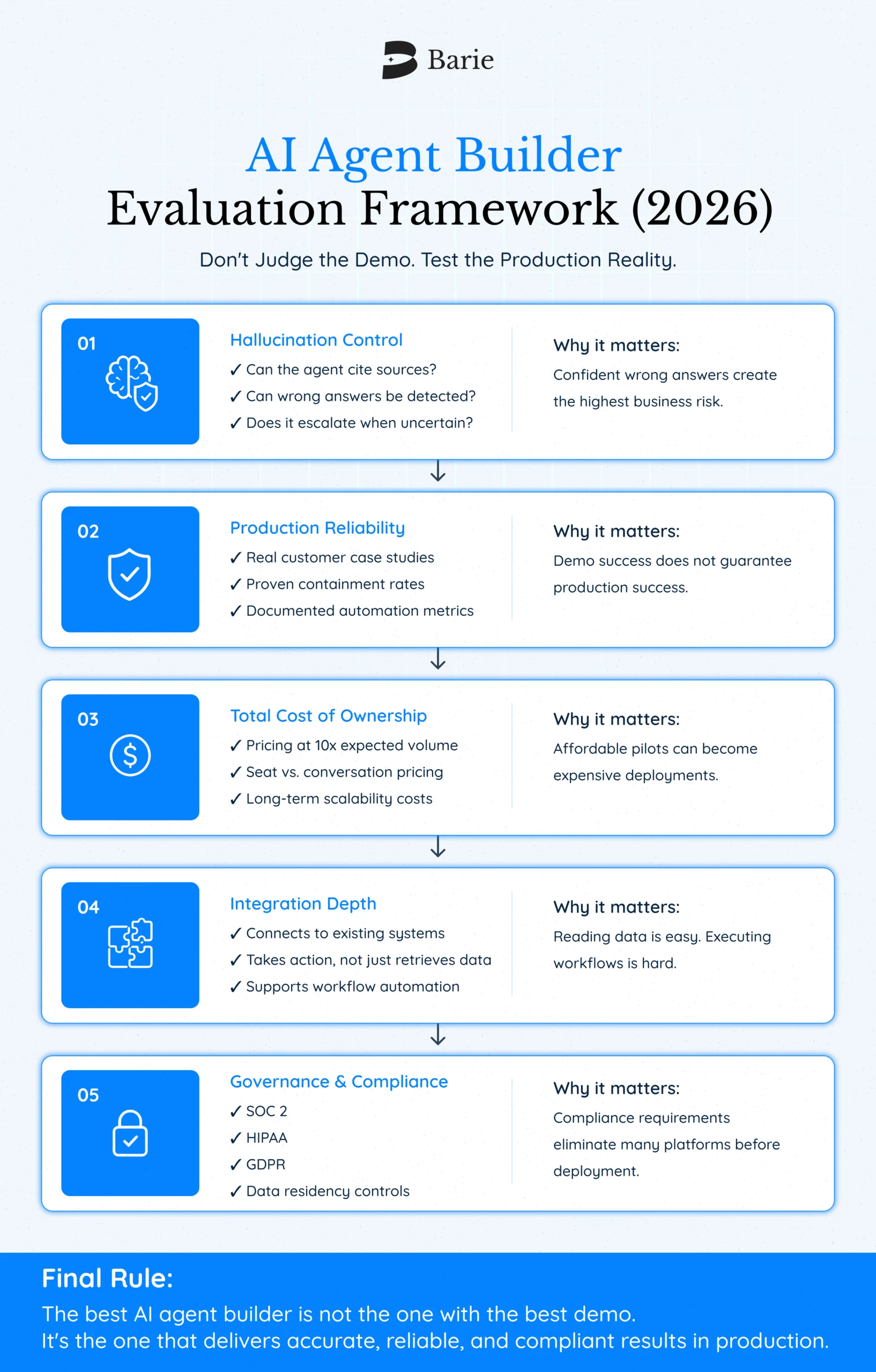
Evaluating the Best AI Agent Builder Platform: A Decision Framework
Buyers’ shortlisting platforms in 2026 should run this evaluation against every vendor before narrowing to a final two or three.
Hallucination control: Can you test the agent on tasks where wrong answers are detectable? Does it cite sources or generate plausible-sounding output without attribution? This is the single most important criterion and the one most vendors hope you test last.
Production reliability: Does the platform have documented case studies with real containment and resolution metrics, not demo metrics? Rasa, for example, deployed its framework for Deutsche Telekom’s internal IT support, resolving 50% of service desk inquiries autonomously and reducing human agent workloads by 30%. That is the standard for a credible production claim.
Total cost of ownership: Model the pricing at 10x your expected day-one volume. Per-conversation pricing that looks reasonable at scale looks very different at 100,000 interactions monthly. Platforms with seat-based or flat pricing become significantly more cost-effective as adoption grows.
Integration depth: Connectors are not differentiators; they are table stakes. What matters is whether the platform can act autonomously across connected systems or just read from them. Execution, not just retrieval.
Governance and compliance: SOC 2, HIPAA, GDPR, and data residency requirements eliminate most platforms for regulated industries. Verify before shortlisting, not after.
The Verdict
The best AI agent builder platform in 2026 is not the one with the best demo. It is the one that handles the tasks your team actually runs, at the volume you actually operate, without generating incorrect answers along the way.
For structured customer service workflows with CRM integration and defined escalation paths, purpose-built platforms with pre-trained domain models reduce time-to-production. For enterprise deployments in regulated industries, self-hosted architecture with deterministic business logic is the hard constraint, not a nice-to-have. For research-intensive workflows, competitive intelligence, legal research, market analysis, and complex data synthesis, Barie AI is where those tasks should live.
Most AI tools answer your question. Barie AI researches it, verifies every claim, and executes on it autonomously. That is a different product. 1M+ hallucination-free chats across 25+ industries is not a product claim. It is a production record.
Start your first deep research session free with Barie.