The article
You asked your AI tool to prep you for a board meeting. It pulled some notes, wrote a clean summary, and sounded completely on top of things. Then you walked into the room and realized two of the competitor stats it cited were fabricated. The companies existed. The numbers did not.
This is the quiet tax that most founders pay every week. AI that sounds helpful while being unreliable. The gap between what “AI assistant” promises and what it actually delivers has never been wider. This guide explains what an AI executive assistant genuinely is in 2026, what separates the real ones from the dressed-up chatbots, and how to pick the right tool for how you actually work.
What Is an AI Executive Assistant, Really?
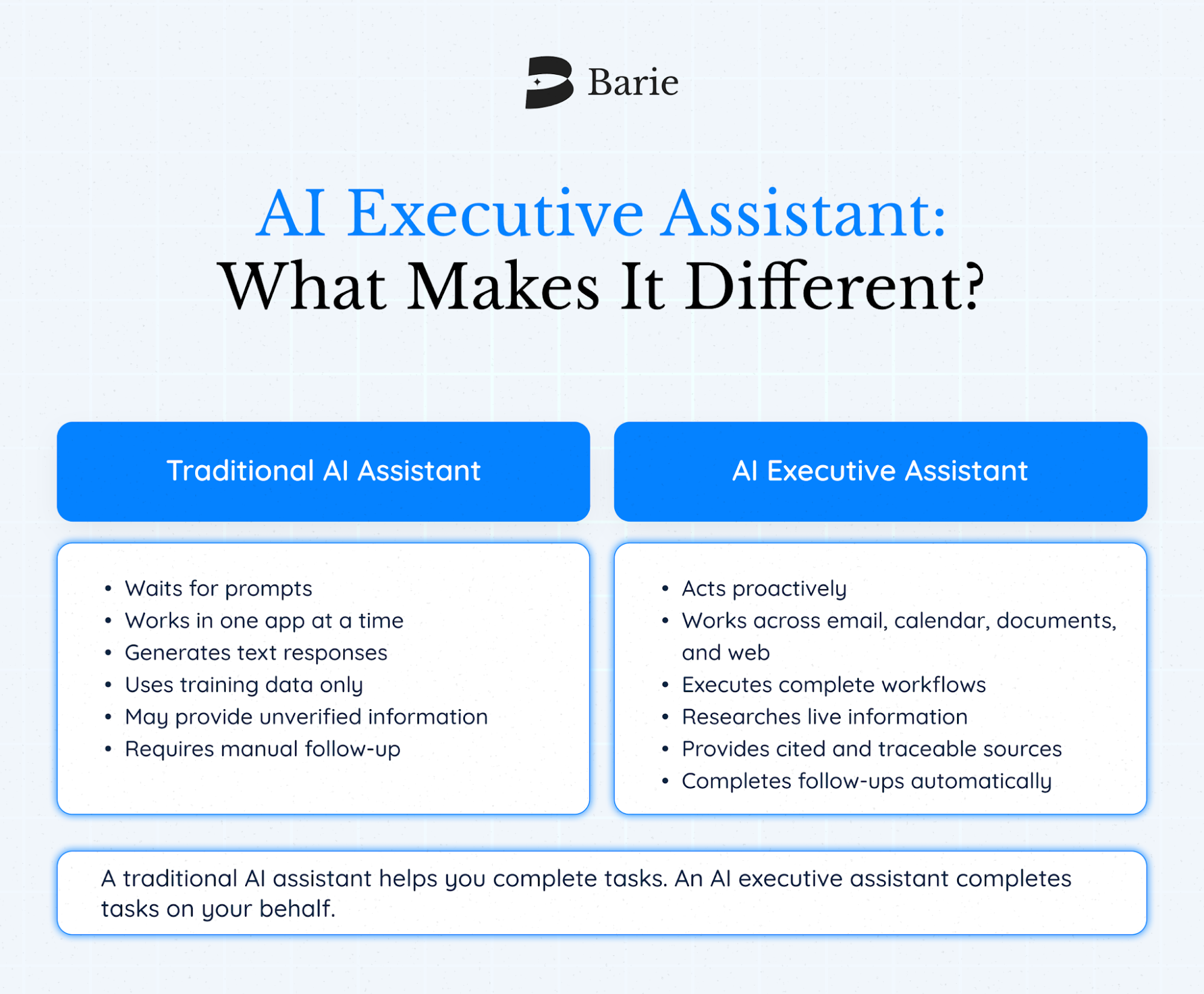
An AI executive assistant is software that autonomously handles the operational layer of executive work. That means calendar management, email triage, meeting preparation, research, document review, and follow-up execution. The keyword is autonomously. It does not wait for you to ask. It acts on your behalf across your tools and surfaces the output.
That definition sounds clean. The reality in 2026 is messier. Most tools marketed as AI executive assistants are single-surface schedulers or inbox managers with a broader label. They handle one workflow well, but struggle when a task crosses into a second app.
A genuine executive assistant AI operates across email, calendar, documents, and the web in a single instruction cycle. You tell it to prep for the 3 pm call, and it opens the email thread, pulls the latest deck, researches the attendees, and drafts an agenda. Several apps, one result. That is what the category should mean.
Why Most AI Executive Assistant Apps Fall Short
The AI executive assistant market in 2026 divides sharply into two camps: single-purpose tools that automate a single executive task well, and multi-purpose agents that handle workflows across multiple applications. Most of what you encounter in listicles belongs to the first camp.
The deeper problem is hallucination. Several widely used AI tools still produce overconfident outputs, with users flagging fabricated information in complex analyses and calculations. When your executive assistant is drafting a brief that informs a hiring decision or a pitch, confidently wrong is worse than no answer at all.
The pattern is predictable: a tool uses training data to generate fluent text and formats it beautifully. Nothing in the output signals indicates which parts are verified and which parts are invented. You only find out when the damage is done.
What the Best AI Executive Assistant for Founders Actually Does
A true AI executive assistant acts before you do. It preps briefings before meetings, flags scheduling conflicts, sends follow-ups, and completes full workflows — drafting the email, scheduling the meeting, and logging the outcome to your CRM, all in one go.
For founders specifically, the stakes are higher. You are running research, strategy, competitive analysis, and decisions simultaneously. A scheduling tool does not solve that. What you need is an agent that can do deep work accurately, connect to your tools, and show its sources.
This is where Barie AI separates from the rest of the category. Barie AI does not answer from the training data. It researches the live web, runs parallel subtasks, and delivers structured outputs with every source traceable. Ask it to run a competitive analysis on five SaaS tools, and it does not queue them one by one. It fires all five simultaneously, synthesizes the results, and builds a sourced report. What an analyst would take a day to complete, Barie AI handles in one session.
The difference is not a feature toggle. It is a different philosophy of what AI is for.
The Best AI Executive Assistant for Founders: What to Actually Look For
Gartner projects that 15% of day-to-day work decisions will be made autonomously through agentic AI by 2026, with McKinsey estimating the productivity impact at $4.4 trillion. The category is moving fast. The tools that earn the label “best AI executive assistant” in that environment share four characteristics.
Cross-app execution. The assistant must operate across multiple tools in a single workflow, not just within one platform. A real cross-tool workflow means “prep for my 2 pm board meeting” triggers the AI to open your email, pull the latest deck, draft an agenda, research the attendees, and send a pre-read — several apps, several actions, one instruction.
Live research with cited sources. Any assistant doing research on your behalf must show where the information came from. Untraced outputs are a liability. Full stop.
Autonomous action, not prompted text. The tool should execute tasks, not generate drafts for you to act on manually. The tools that save the most hours are the ones that read your inbox, remember what you promised, and follow up without being asked. Anything less is a text generator with a scheduling widget attached.
Accuracy you can verify. Barie AI aces the GAIA Level 3 benchmark, the most rigorous public test for whether an AI can complete genuinely complex, multi-step tasks reliably. Most tools do not publish GAIA scores. Barie AI has processed over 1 million hallucination-free chats across 25+ industries. That is not a claim without a number behind it.
How Founders Are Using an AI Executive Assistant App in Practice
Here is what a real session looks like. A founder needs to prep for a Series A pitch. One prompt to Barie: analyze the last three funding rounds in their category, identify gaps in current market positioning, and cross-reference with the most recent investor thesis documents available online.
Barie AIgoes to the live web, runs the research threads in parallel, cross-references sources, and returns a structured brief with citations the founder can open and verify. It then connects via Barie Connectors to push the output directly to Notion. The whole cycle runs under 20 minutes. No hallucinations in the brief. No invented funding figures. No fabricated competitor exists.
That is not a demo setup. That is Tuesday for a founder using the right executive assistant AI.
The Honest Verdict on Executive Assistant AI in 2026
The category label has outrun the actual products. Most tools called AI executive assistants are scheduling tools, inbox managers, or general-purpose chatbots with a broader description in their marketing copy. They are useful. They are not executive assistants.
An executive assistant AI earns that name when it executes multi-step, cross-app workflows accurately and autonomously. When it does research, you can actually trust. When it shows its sources instead of asking you to take its word for it.
The shift in 2026 is from an AI assistant to a persistent agent: software that stays active, remembers context, accesses tools, and manages longer tasks. Founders who build that into their workflows now will make decisions faster than competitors who are still prompting one-off chatbots and reviewing the output for errors.
Try Barie AIAi Before You Commit to Anything Else
Run a real research session on a decision you are sitting on right now and see what executive-grade AI actually looks like when the sources are verified.