The article
You asked an AI to research your top three competitors. It returned a polished brief, clean headers, confident language, and specific numbers. Two companies were fabricated. One statistic pointed to a report that does not exist.
That is not an edge case. That is Tuesday for most AI tools in 2026.
Every “best AI tools 2026” list published this year runs the same playbook. Test the UI, count the features, rank by demo quality, repeat. Not one of them asks the only question that matters in professional use: is the output verifiably correct? This guide is built on that question alone.
Why Most Best AI Tools 2026 Lists Rank the Wrong Things
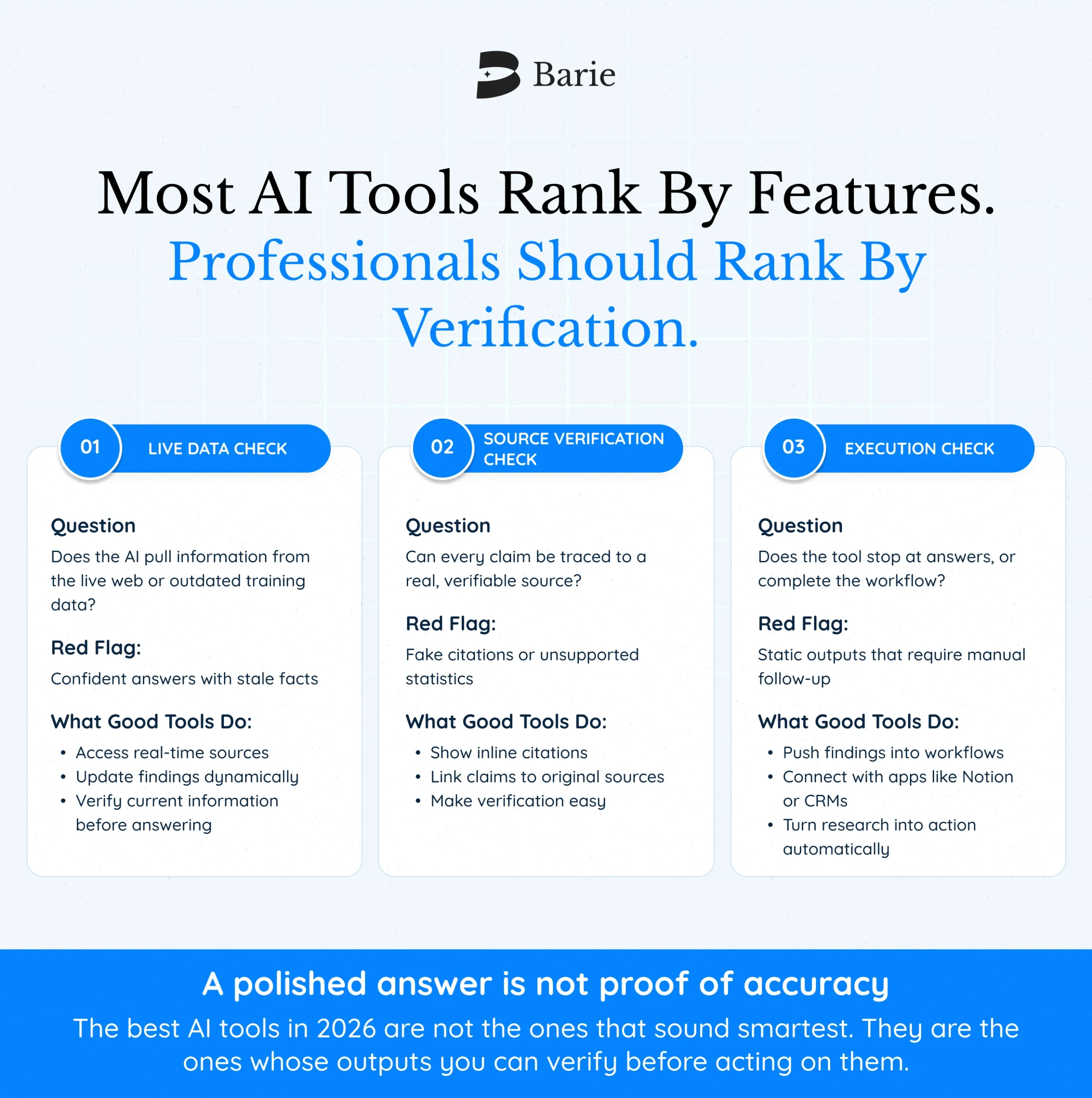
Most roundups evaluate software by feature count and interface design. That approach produces impressive comparison tables and genuinely useless recommendations for anyone doing real work. Before trusting any ranked list, apply a three-part test to every tool it promotes.
Does the tool pull live data, or answer from training data that may be months stale? Does it show you where each piece of information came from, or simply assert it with confidence? Can it act on what it finds, or does it stop at generating a text output and wait?
Run those checks across the AI landscape, and the list shortens fast. Most tools fail at least one part of that test.
The Real State of AI Research Tools in 2026
The research category is where the gap between marketing and reality is widest. Every major platform now labels something “deep research.” Most search the web once and summarize the top results. That is not deep research; that is a search tab wearing a lab coat.
A genuine deep research tool runs an autonomous multi-step process. It crawls dozens of sources simultaneously. It synthesizes findings, resolves conflicts, and delivers a structured report with traceable inline citations. That is the actual standard. Very few tools in 2026 meet it.
One uncomfortable finding from Vectara’s 2026 dataset: reasoning models exceeded a 10% hallucination rate across the board. These are the same models marketed as the most intelligent. Confidence and accuracy are not the same variable. Most AI tools treat them as if they are.
Perplexity is fast. ChatGPT reasons well. Gemini integrates cleanly with Google Workspace. Each of those statements is true. None of them answers whether you can stake a real business decision on the output.
AI Agents 2026 & The Shift From Answers to Execution
The more consequential development in 2026 is not benchmark scores. It is the rise of AI agents, tools that go past generating text into actual workflow execution. These tools act across connected applications, not just inside a single chat window.
Answering a question and completing a task are structurally different products. A tool that researches a competitor and routes the brief to your project board is an agent. A tool that writes a summary for you and waits for your next message is a chat window. The label “AI agent” is not interchangeable with both.
This shift is spreading from coding into research, operations, and business intelligence. Most “best AI tools” roundups have not caught up to it yet.
The AI Tools Worth Your Attention in 2026
An honest breakdown by category, no affiliate arrangements shaping the conclusions.
Deep Research and Agentic Workflows, Barie
Barie was built as an anti-hallucination research agent, not a chatbot retrofitted with a search button. It runs parallel research subtasks simultaneously. Multiple investigation threads fire at once, rather than processing sources one by one. Every output is a source-cited report, with each claim traceable to a verifiable source.
Barie’s Web Search capability sources information from the live web rather than a static training dataset. Source visualization shows you exactly where each finding came from, before you decide whether to act on it. Nothing in the output is decorative.
Barie’s Connectors extend research into execution. One session can pull data from an integrated app and complete the research workflow. The findings are pushed directly into your tools, not into a static file. An active handoff to the next step in your actual process.
Barie aces the GAIA Level 3 benchmark. That test measures whether an AI can reliably complete genuinely complex, multi-step tasks. Most tools do not publish a GAIA score. Barie has completed 1M+ hallucination-free chats across 25+ industries with a 90% accuracy rate.
General-Purpose Chat, Claude, ChatGPT, Gemini
Claude Opus 4.6 leads for natural prose and long-document output. GPT-5.4 is the strongest all-rounder with the largest ecosystem and integrations. Gemini 3.1 Pro offers the most cost-efficient API pricing. All three are genuinely useful. None was built with anti-hallucination as a founding principle. Being helpful and being accurate are different goals.
Coding, Cursor, Claude Code, GitHub Copilot
AI coding tools moved from autocomplete to autonomous agents in 2026. Cursor leads for IDE-native development, and Claude Code leads for complex multi-file terminal work. Both now handle entire features end-to-end, saving developers eight to twelve hours per week in documented use.
SEO, Semrush, Ahrefs
Optimizing for Google alone is no longer sufficient in 2026. AI Overviews appear in roughly 50% of searches. Tools that cannot track visibility inside ChatGPT or Google AI Mode are measuring half the picture. They are calling that half complete.
Automation and Workflows, Zapier, Make
Zapier and Make remain the standard connectors for teams that need no-code multi-app automation without technical overhead. Zapier Free supports 100 tasks per month. Make Free offers 1,000 operations per month. Both are reliable for conditional logic and straightforward multi-step triggers.
For teams needing AI reasoning inside those workflows, not just triggers, the category is evolving fast. The line between automation tools and AI agents is narrowing.
How Barie Actually Works in One Documented Session
One prompt. Barie analyzed 30 financial research papers in a single session. It identified three underexplored market gaps and built a structured brief with live citations. The output was routed to Notion in under 20 minutes. That is a documented use case, not a curated demo.
The architectural difference is not subtle here. Most AI tools answer from training data first, then search the web to make the answer look current. Barie starts with the live web and works forward. Every claim is sourced before it reaches you.
Connectors complete the loop. The research does not stop at text. It becomes a handoff, pushing findings directly into the next step of your actual workflow.
How to Actually Pick the Best AI Tools for Your Work
Before subscribing to anything on this list, run a practical test. Give the tool a research task where you already know the correct answer. Then check whether it cites real sources. Check whether those citations point where they claim to. Check whether the output admits any uncertainty at all.
That test takes ten minutes. It tells you more than any feature table ever will.
The best AI tools in 2026 are not the ones with the most capabilities on the pricing page. They are the ones whose outputs you can verify. The ones whose errors you can catch before they cost you something real.
Barie gives you 900 free credits to run exactly that test. See what research looks like when accuracy is the founding principle, not a checkbox. barie.ai/login