The article
You asked your AI tool to build a competitive analysis.
It returned five competitors, three positioning summaries, a market-size estimate, and a list of differentiators.
Formatted cleanly. Cited confidently.
Two of those competitors merged 18 months ago. One statistic came from a 2019 white paper. And one company had pivoted so far from its original positioning that the summary was describing a different business entirely.
You didn’t know any of that. The tool didn’t either. It answered from training data, which is fine, until markets shift, companies rebrand, and what was true 18 months ago is now quietly misleading your strategy deck.
This is the real problem with using generic AI tools for market research. Not the interface. Not the price. The fact that confidence and accuracy are not the same thing, and most tools won’t tell you when they’ve diverged.
Why Traditional Competitive Research Takes So Long (And Costs So Much)
The keyword “AI tools for market research” runs a $600 average CPC on Google. That number tells you something. The buyers are serious. The purchase decisions are high-stakes. And the gap between a good competitive brief and a bad one has real financial consequences.
Traditional competitive research is slow because it is fragmented. Someone pulls analyst reports. Someone else monitors press releases. A third person audits competitor websites and runs a few Google searches. These inputs land in different files, get synthesized over several days, and by the time a brief reaches a decision-maker, at least some of it is already outdated.
The promise of AI for market research was supposed to fix that. The reality is that most AI tools didn’t fix the accuracy problem; they just made the speed problem worse by letting you generate wrong answers faster.
What AI for Consumer Research Actually Needs to Do
A competitive landscape is not a static document. It’s a snapshot of a moving target. That means the AI tools doing this work need to do three things that most chat-based tools cannot:
Search the live web, not stored training data. A competitor’s pricing page from eight months ago is not a competitor’s pricing page today. Market positioning changes. Funding rounds shift category dynamics. An AI answering from training data will not know about the Series B that just changed who your main rival is actually targeting. Live web research is the only architecture that solves this.
Run multiple research streams simultaneously. A real competitive landscape covers product positioning, pricing, messaging, customer reviews, press coverage, and job postings (which reveal strategic priorities faster than any press release). That’s not a linear task. Running those in sequence takes hours.
Deliver cited, traceable outputs. Every claim needs a source you can open and verify. Not because you don’t trust the tool, but because the person reading your brief will ask where it came from, and “the AI said so” is not a strategy.
How to Run a Competitive Landscape in Under an Hour
Barie is built for exactly this. It researches the live web, runs parallel subtasks, and delivers structured reports with source citations attached to every claim. Here is how a one-hour competitive landscape actually works.
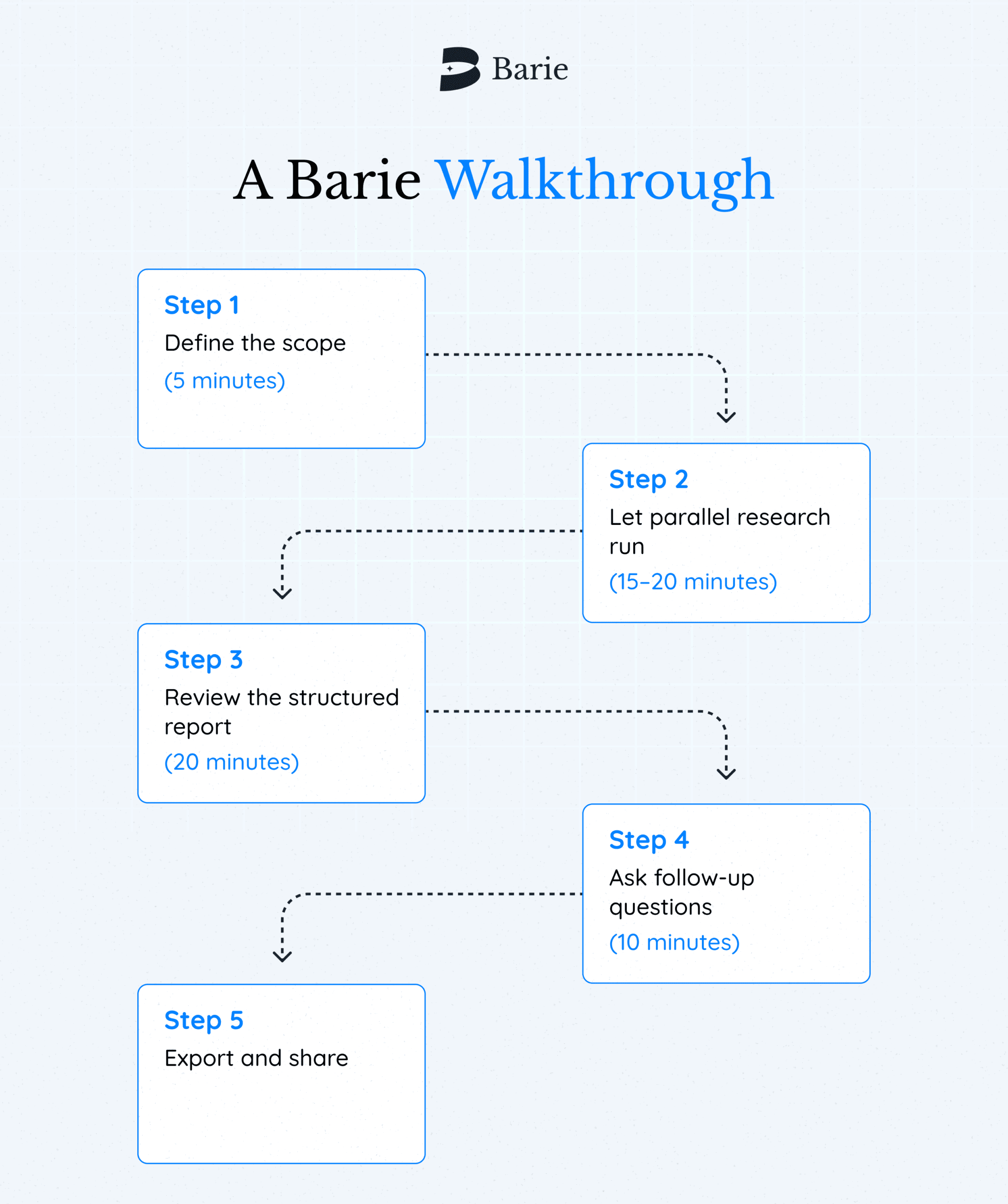
Step 1: Define the scope (5 minutes)
Give Barie a specific brief. Not “research my competitors”, that is too wide for useful output. Instead: name your product category, list the three to five competitors you know about, and specify what you want covered. Pricing. Positioning. Customer sentiment. Recent news. Barie will expand from there.
Step 2: Let parallel research run (15–20 minutes)
This is where Barie does what chat-based tools cannot. It fires parallel subtasks across each competitor simultaneously, scraping live web sources, pulling recent press mentions, analysing positioning language from landing pages, and surfacing customer review patterns from G2 or Trustpilot. What would take a human analyst a full day, Barie completes in a single deep research session.
Step 3: Review the structured report (20 minutes)
The output is not a wall of text. Barie returns a structured brief, competitor by competitor, category by category, with live citations you can click. Every claim traces back to its source. If a pricing page changed last week, that is reflected. If a competitor published a new case study repositioning their product, it is in the brief.
Step 4: Ask follow-up questions (10 minutes)
The brief surfaces a gap you want to pressure-test. A rival just entered your pricing tier and you need to understand their messaging angle more precisely. Ask Barie to go deeper on that thread. It will pull additional sources and return a focused answer without starting the entire research process over.
Step 5: Export and share
The output is presentation-ready. Structured. Cited. Formatted for a deck or a strategy document, not a chat log that someone has to manually clean up.
The Best AI for Market Analysis Does Not Hallucinate the Market
Most AI tools for market research are optimized for fluency. They produce answers that sound researched.
That is not a positioning statement. That is the entire engineering philosophy. 90% accuracy rate. 1M+ verified, hallucination-free research sessions across 25+ industries. The GAIA Level 3 benchmark tests whether an AI can complete genuinely complex, multi-step tasks reliably; most tools don’t attempt it. Barie aces it.
For competitive research specifically, that matters. You are not looking for a plausible answer. You are looking for an accurate one that you can stake a budget decision on.
What AI Market Research Tools Still Cannot Do
Useful tools are honest about their limits. AI market research tools, including Barie, cannot replace the judgment call at the end of a brief. The brief states that Competitor A is investing heavily in the enterprise segment, as indicated by recent job postings and pricing page changes. The brief does not tell you whether that move is working or whether it creates an opening you should take. That is still your job.
What the best AI for market analysis does is give you the inputs you need to make that call, faster, more completely, and with traceable evidence, so you spend your time on the decision rather than the data gathering.
Your Competitive Landscape Should Not Take Three Days
One hour. Five competitors. Structured output. Live citations.
That is not an aspirational use case. That is what Barie does on a Tuesday.
If your current research workflow involves exporting from multiple tabs, reconciling sources in a spreadsheet, and hoping no one asks where a specific statistic came from, there is a shorter path.
Try Barie free. 900 credits, no card required.