The article
You needed a competitive analysis. You opened ChatGPT. You typed a clear, specific prompt. You got back four polished paragraphs with names, numbers, and market share figures.
It looked exactly like what you asked for. Then you tried to verify one of the stats. The source did not exist. The company it cited had shut down two years ago.
The market share figure was fabricated with complete confidence, formatted beautifully, and delivered without a single caveat.
This is not an edge case. It is how ChatGPT works. And if you have used it for anything research-heavy, you have probably been here.
The Problem With Chatting Your Way Through Research
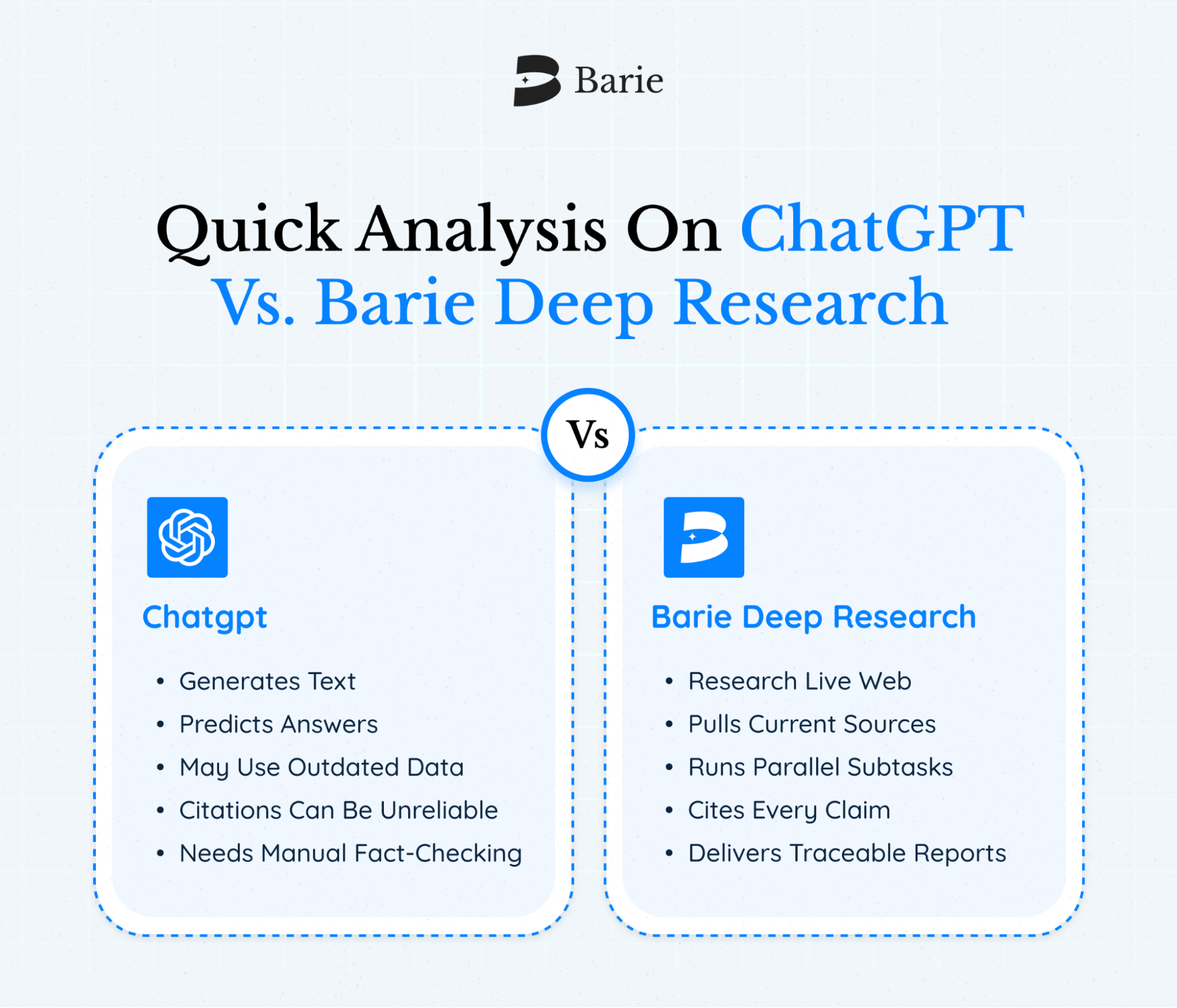
ChatGPT is a language model. It predicts what a helpful answer looks like based on its training data. It does not go to the web for every query.
It does not verify claims before it makes them. It does not know what has changed since it was last trained. It knows how to sound right, which is a different thing entirely from being right.
That distinction matters enormously when the output feeds into a real decision. A legal brief. An investor deck. A market sizing exercise. A product strategy document. In these situations, a confident wrong answer is worse than no answer at all.
The failure mode is not obvious because ChatGPT writes fluently. The made-up citation looks identical to a real one. The invented statistic sits in the same sentence as a true one. You would need to check every single claim independently to catch the errors, at which point you have done the research yourself anyway.
What Deep Research AI Actually Does
A deep research AI does not answer from a static database of training data. It researches.
When you send a query to Barie, it goes to the live web. It pulls current sources. It runs parallel subtasks simultaneously, so instead of investigating one angle at a time, it processes multiple dimensions of a problem at once.
It then synthesizes those sources into a structured output and shows you exactly where every piece of information came from.
Every claim is traceable. Every citation is real. You can follow the source links. You can see which page the information came from and when it was published.
That is a structurally different product. Not a better chatbot. A different category.
What This Looks Like in Practice
A founder needed a competitor analysis across five SaaS tools before a board meeting.
With ChatGPT, this takes two rounds of prompting, a lot of pasted context, and then an afternoon of fact-checking to confirm which parts of the output can actually be trusted.
With Barie, one prompt triggered five parallel research threads. Each competitor was analyzed simultaneously: pricing pages, recent product updates, customer reviews, and positioning copy. The output arrived as a structured report with live citations.
The whole session took under 20 minutes. Every source was traceable. None of it was invented.
The founder did not spend the afternoon checking citations. The report was ready to share. That is what the difference looks like in actual use.
The Citation Problem Nobody Talks About
In 2023, two lawyers submitted a legal brief to a federal court. ChatGPT had written the citations. The cases it cited were detailed and specific, complete with judge names, ruling dates, and case numbers.
Not one of those cases existed.
The lawyers were sanctioned. The story made headlines. And then most people moved on and kept using ChatGPT for research, just hoping their situation would be different.
It will not be different. Hallucination is not a bug that gets patched. It is a structural feature of how language models generate text. They optimize for plausibility, and research requires accuracy. These are not the same objective.
The Benchmark That Actually Measures This
Most AI tools do not publish benchmark results. There is no obligation to do so, and the results are often uncomfortable.
Barie aces the GAIA Level 3 benchmark. GAIA tests whether an AI can reliably complete genuinely complex, multi-step tasks. Level 3 is the hardest tier. It requires multi-source reasoning, tool use, and accurate synthesis across real-world inputs.
Barie holds a 90% accuracy rate and has processed over 1 million hallucination-free chats across 25 industries.
Compare that to what you get from a chat interface that has no obligation to tell you when it is making things up.
The benchmark is not marketing. It is a third-party measurement of a specific capability. Use it like one.
Where ChatGPT Is Still Useful
This is not an argument that ChatGPT is worthless. It is fast, capable, and genuinely good at tasks that do not require factual accuracy to matter.
Drafting emails. Brainstorming. Rewriting copy. Explaining concepts you already understand and want to articulate differently. Generate options for a decision you will make yourself. For these tasks, ChatGPT is a legitimate tool.
The problem is when people use it beyond those limits. When they ask it to tell them something true, something current, something that will feed into a decision with real consequences. That is where it fails, reliably, and where most users do not realize it is failing until it is too late.
The Practical Split
Use ChatGPT to generate first drafts, explain concepts, write, and edit tasks where you supply the facts.
Use deep research AI for competitive analysis, market research, legal research, financial research, and any task where you need the AI to find information that’s real.
The mistake is treating them as interchangeable. They are not. One generates text. The other finds information, verifies it, and gives you a traceable output.
Why This Distinction Matters More Now
AI adoption is accelerating. More teams are using AI outputs to make real decisions. The margin for error is shrinking. A wrong market analysis sends a product in the wrong direction.
A fabricated legal citation has professional consequences. A financial brief built on invented data leads to a bad investment.
The tools people are using have not caught up with the stakes of how they are being used. ChatGPT is designed for conversation. It is being asked to do research. That gap is where the damage happens.
Deep research AI closes that gap. Not by being a smarter chatbot. By being a different kind of tool entirely.