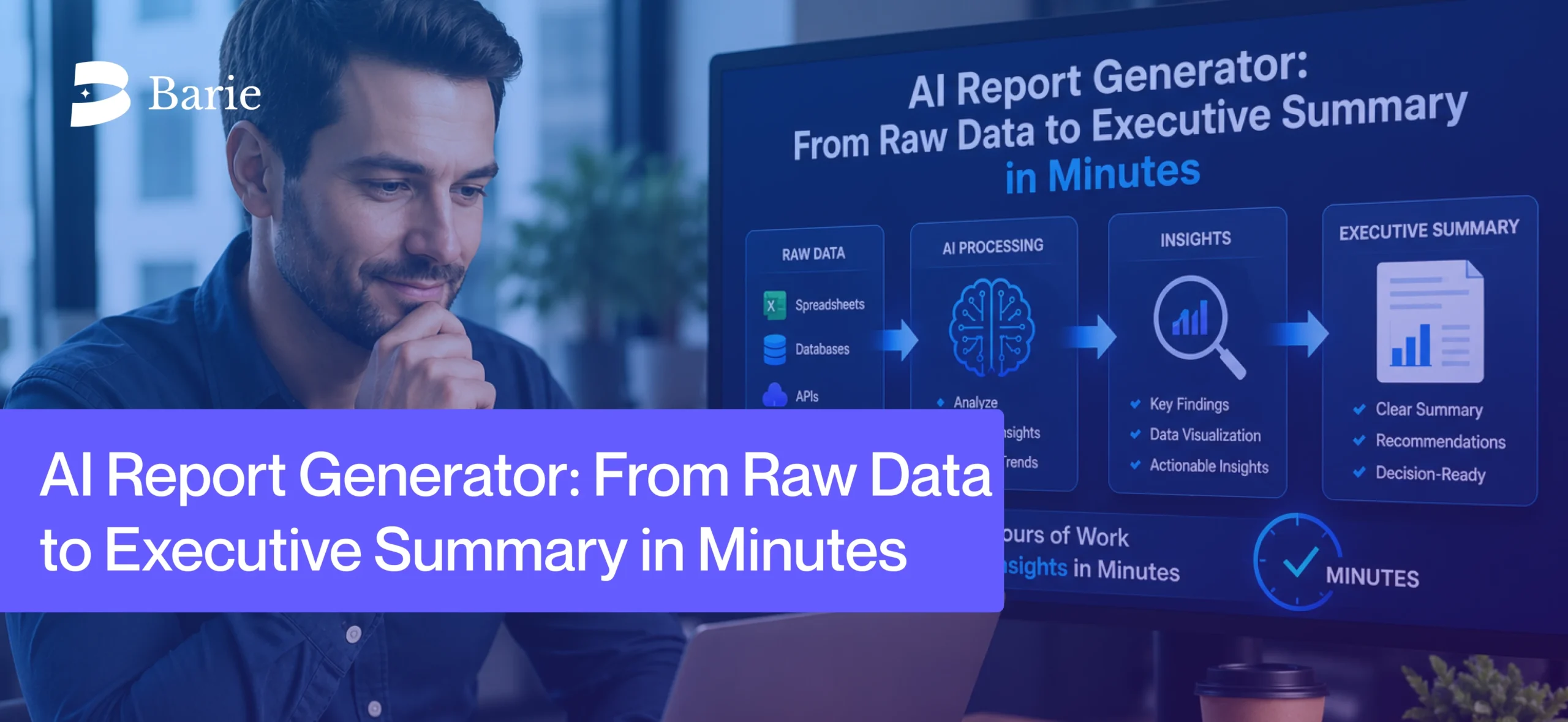
The article
A VP of Strategy asked her AI tool to build a market report before Monday’s board meeting.
She had raw data. Spreadsheets from three sources. Industry articles. Competitor pricing pages. She needed a clean executive summary, not a wall of copy-pasted snippets.
The AI produced something. It looked polished. The headers were clean, the structure was sharp, and two of the cited sources did not exist. One statistic was invented entirely. She caught it on Sunday night, one hour before the deck went to print.
That is not a workflow problem. That is a trust problem. And it is the exact reason people are now asking a more specific question: not “can AI write reports?” but “can an AI report generator actually be trusted?”
The answer depends entirely on which one you use.
The Report Looked Perfect. Half of It Was Invented.
Most tools marketed as AI report generators are doing something much simpler than they claim.
They are wrapping a chat model around a text box and calling it a report pipeline. You paste data in, and they generate text out. What looks like a structured executive summary is the model pattern-matching against its training data, not researching your actual inputs.
The core problem is sourcing. When a report generator cannot trace its outputs to live, verifiable sources, every number it produces is a guess dressed as a finding. A confident guess, formatted in Helvetica, with a title slide.
This matters most when the stakes are real. Board presentations. Investor briefs. Competitive analysis decks. Procurement decisions. These are not contexts where “mostly accurate” is good enough.
The Bar Is Higher Than a PDF Export Button
A genuine AI report generator is not a text tool with a PDF export button.
It needs to research the live web, not recall from stale training data. It needs to process multiple data inputs simultaneously, not sequentially, which is the difference between a 20-minute session and a three-hour one. It needs to show you where every claim came from. And it needs to structure the output in a format that goes directly into a presentation or brief without a round of cleanup editing.
That is a much higher bar than most tools clear.
Barie clears it. Not because of marketing positioning, but because the architecture is built differently from the ground up. Barie researches live sources, runs parallel subtasks across your inputs, and delivers structured reports with every claim traced back to its origin. You do not have to trust the output. You can verify it, line by line, in minutes.
One Prompt. Five Companies. Twenty Minutes. Here Is What Happened.
Here is what a real session looks like.
A market analyst needs a competitive report on five SaaS tools entering the HR tech space. She has raw data: pricing pages, three analyst articles, a LinkedIn post from a competitor’s CEO, and a product comparison CSV she built herself.
She opens Barie. One prompt. She describes the scope, uploads her files, names the five companies, and specifies the output format: executive summary, competitive matrix, and a recommendations section for leadership.
Barie does not process this sequentially. It runs parallel research subtasks on all five companies simultaneously. It pulls live web data to supplement her inputs. It cross-references the analyst articles against current product pages to flag anything outdated. Within 20 minutes, she has a structured report. The executive summary leads with the three most significant competitive gaps. The matrix is formatted for direct insertion into a slide deck. Every data point is linked to its source.
She does not fact-check it nervously the night before the board meeting. She sends it.
Why Running Five Research Threads at Once Changes the Output, Not Just the Clock
The parallel processing is what most people underestimate until they use it.
Standard AI tools handle research linearly. They answer one question, then the next, then the next. If you need a report across five companies, five data sources, and three output formats, you are either running five separate prompts and stitching the results manually or you are waiting significantly longer than you should be.
Barie fires all subtasks simultaneously. That is not a marginal speed improvement. For a report that would otherwise take a full analyst day, it is the difference between having a usable brief by noon and staying late to finish one.
This also produces better reports, not just faster ones. When research runs in parallel and synthesizes at the output stage, the connections between data points surface that sequential processing misses entirely. A pricing signal from one company lands differently when it is placed alongside a funding announcement from a competitor. Barie puts those next to each other because it processed both at the same time.
A Fabricated Statistic Looks Exactly Like a Real One
Here is what makes a fabricated report dangerous. It does not look wrong.
A hallucinated statistic in an executive summary looks identical to a verified one. The formatting is the same. The sentence structure is the same. The font size is the same. The only difference is that one of them is real and one of them will embarrass you in front of investors when someone Googles the source.
Barie was built specifically because Programmers Force watched this happen repeatedly, saw other AI tools treat it as an acceptable edge case, and decided it was not. The entire product architecture exists to make every output traceable. Not as a feature you toggle on for important documents. As the default behavior for every report, every session, and every output.
Over 1 million hallucination-free chats across 25-plus industries. That is not a claim pulled from a press release. That is the result of building anti-hallucination into the foundation, not bolting it on after.
Barie also aces the GAIA Level 3 benchmark, which tests complex, multi-step agentic tasks. Most AI tools do not publish GAIA scores. The ones that do, do not score at this level.
The Output Goes Into the Deck. Not Into a Second Round of Editing.
The finished report is not a wall of AI-generated text that a human has to reformat for three hours.
Barie structures outputs for how reports are actually used. Executive summaries are written for decision-makers, not for the person who commissioned the research. Sections are clearly delineated. Source citations are embedded, not buried in a footnote appendix. If you have connected Barie to Notion, the report lands there directly. If you need a slide-ready format, Barie builds with that structure in mind from the first prompt.
The workflow does not end at text generation. It ends at a usable deliverable.
If Someone in the Room Asks Where the Number Came From, You Need a Better Tool
An AI report generator that cannot verify its sources is not a report generator. It is a confident fabrication machine with good design sense.
The question is not whether AI can help you produce executive summaries faster. It clearly can. The question is whether the executive summary it produces will hold up when someone in the room asks where the number came from.
Barie answers that question before you have to ask it.
Try Barie free and get 900 credits. barie.ai/login