The article
A lawyer filed a brief in federal court last year.
The citations were immaculate. Case names, ruling dates, judge names, and exact docket numbers. Everything you would want to see from thorough legal research.
ChatGPT had generated every single one of them.
Not one case existed.
The court did not find it charming. Neither did the state bar. And that lawyer joined an estimated 712 practitioners worldwide who have had AI-generated hallucinations surface in court proceedings, a number documented by researchers tracking exactly this problem.
That is the state of AI legal research right now. Confident. Well-formatted. And in far too many cases, completely fabricated.
Why AI Hallucinations Are a Specific Crisis in Legal Research
Legal work operates on a different standard than most fields. A hallucinated product description costs a brand some credibility. A hallucinated case citation can cost a client their case, cost a lawyer their license, and cost a firm its reputation, sometimes all three in the same filing.
General-purpose AI tools face a fundamental structural problem: their knowledge is frozen at a training cutoff. Unless the tool actively retrieves from live legal databases, it answers from memory, and that memory has a timestamp. Courts do not accept “the AI was working from old data” as a defense. And they should not.
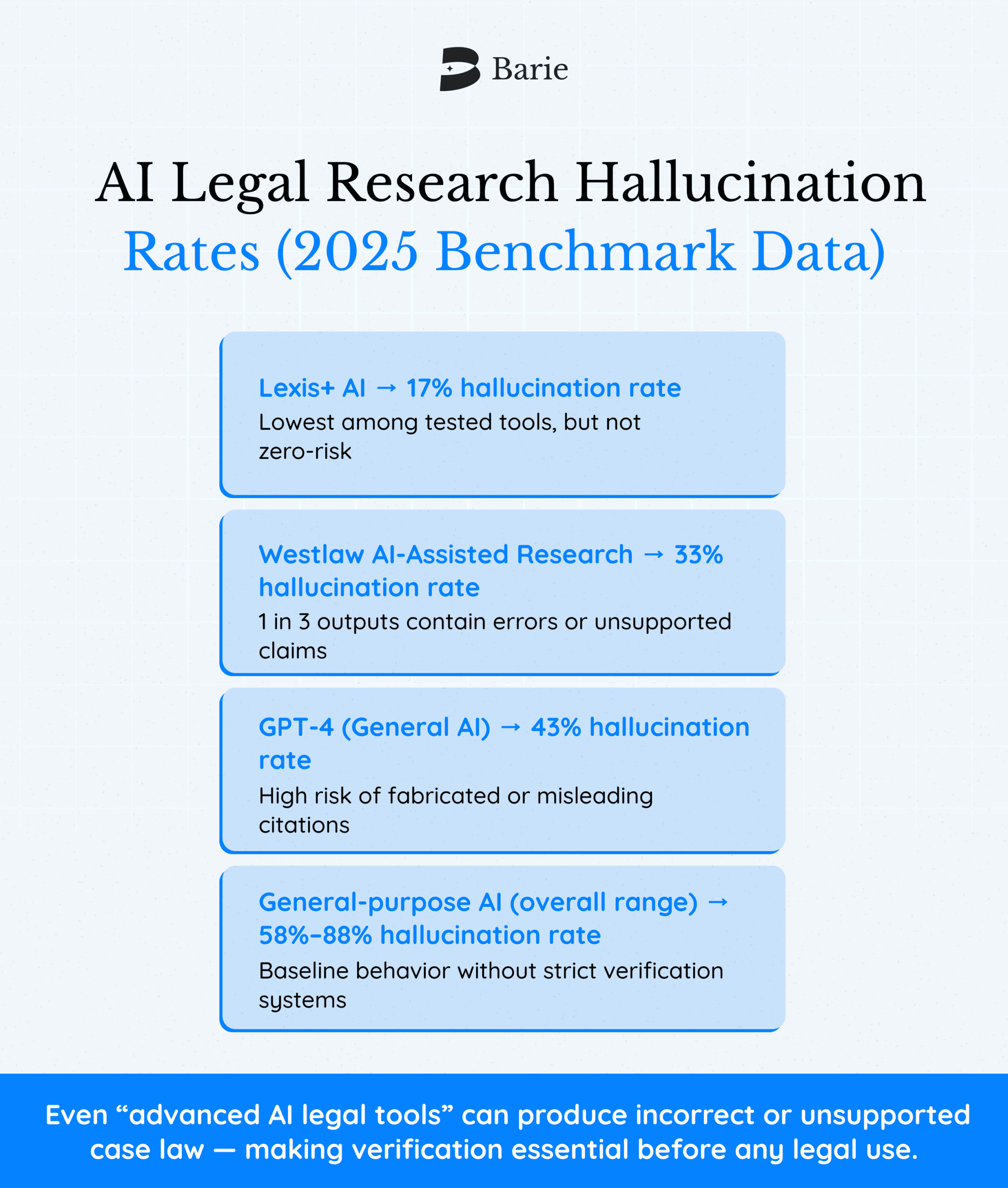
Researchers at Stanford tested state-of-the-art general-purpose models on legal queries and found hallucination rates between 58% and 88%. That is not an edge case. That is the baseline. What the technology is actually doing when you ask it to cite a case is pattern-matching; it generates text that looks like a legal citation, is formatted like a real one, is structured like a real one, and points to nothing.
A 2025 Stanford study found hallucination rates of 17% for Lexis+ AI, 33% for Westlaw’s AI-Assisted Research, and 43% for GPT-4, including both outright fabrications and more subtle errors, such as citing real cases that do not actually support the argument being made. Purpose-built legal AI tools perform better than general models. But “better than 43%” is a low bar to clear when your client’s outcome is on the line.
Courts are running out of patience. The District of Connecticut issued a formal notice stating a no-tolerance policy for briefings that assert legal propositions. Some courts are moving straight to sanctions. Others have disqualified attorneys entirely. The profession is not waiting for AI companies to solve this on their own.
What Accurate AI Legal Research Actually Requires
The problem is architectural, not cosmetic. A general-purpose language model cannot reliably produce verified case law because it is not retrieving from a live source; rather, it predicts what a citation would look like based on patterns in its training data. That is fundamentally different from finding and verifying an actual ruling.
Accurate AI legal research requires three things that most tools do not provide:
Live source retrieval, not answers from training data, but active retrieval from current legal sources, court databases, and verified records.
Traceable citations, every claim linked back to its origin, so a researcher can verify the source exists and says what the AI claims it says.
Multi-step verification, not a single-pass generation, but a process that checks claims against real documents before delivering an output.
Most AI tools offer none of these. They offer the appearance of research. That is a different product entirely.
How Barie Approaches AI Legal Research Differently
Barie does not answer your legal research questions from training data.
When a legal researcher runs a query through Barie’s Deep Research, Barie goes to the live web, pulls from current sources, and processes the findings through parallel subtasks, with multiple retrieval threads running simultaneously and cross-referencing rather than generating. The output arrives with source visualization built in, meaning every claim in the result has a traceable origin you can open in a browser and verify yourself.
This distinction matters more in law than in almost any other field. A financial model built on a hallucinated statistic is bad. A legal brief built on a hallucinated precedent is potentially disbarment-level bad. The standard for “good enough” is categorically different, and the tool has to meet that standard before a researcher puts their name on anything it produces.
A legal researcher using Barie to investigate case law around data privacy violations, for example, does not receive a paragraph of confident synthesis drawn from 2023 training data. Barie runs parallel retrieval across live sources, surfaces recent rulings, identifies the cases that are actually cited in current legal discourse, and delivers a structured output with every citation linked. The researcher can click through. They can verify. They can go to court with confidence.
That is what AI legal research is supposed to do. Most tools describe a version of this. Barie executes it.
The Verification Problem Most Legal AI Tools Quietly Ignore
There is a pattern in how legal AI tools are marketed. The word “hallucination-free” appears frequently. The evidence for that claim is rarely available.
Despite bold claims from major legal AI providers about mitigating or eliminating hallucination risk through techniques like retrieval-augmented generation, none of those claims were accompanied by empirical evidence at the time researchers examined them. Marketing copy and benchmark scores are different things. One of them can be independently verified.
Barie aces the GAIA Level 3 benchmark, the industry test for whether an AI can complete genuinely complex, multi-step agentic tasks reliably. Most tools do not publish GAIA scores. Some have not attempted it. Barie’s 90% accuracy rate and over one million hallucination-free chats across 25+ industries are the kind of numbers that come from building anti-hallucination into the architecture, not tacking a disclaimer onto the output.
When AI Legal Research Goes Right
The downstream difference is measurable. A legal team that can trust its AI research output can move faster, cover more ground, and spend its billable hours on strategy rather than fact-checking what the AI produced. A team that cannot trust the output spends time verifying every citation, which eliminates the time savings that made AI appealing in the first place.
Barie’s parallel subtask processing means that a complex legal research query is not processed serially, one source at a time. Multiple research threads run simultaneously, the outputs are synthesized, and the researcher receives a structured report with live citations, not a wall of confident text they have to audit line by line.
The most effective AI tools in legal research do more than search faster; they reduce cognitive strain by helping lawyers interpret facts, precedent, and context more efficiently. That is what the technology is actually for. Not replacing legal judgment. Making the research that informs legal judgment reliable enough to act on.
The Standard Has to Change
The legal profession cannot continue treating hallucinations as an acceptable cost of using AI. The courts have made their position clear. The fundamentals of legal research have not changed; only the tools have. And the tools have to meet the same standard of accuracy that the profession has always required.
AI legal research that produces fabricated citations is not a research tool. It is a liability.
Barie was built to be the other thing.
Start your first legal research session on Barie.