The article
A portfolio manager uploads a company’s latest 10-K into an AI financial analysis tool, expecting faster answers and sharper insights.
Within minutes, the platform generates a polished summary. Revenue growth looks strong. Margins improved. Management commentary appears positive. The filing seems clean.
Weeks later, the company faces heavy market pressure after investors discover a major supply chain dependency buried deep inside the risk disclosures.
The AI never flagged it. This is becoming one of the biggest problems in AI for financial statement analysis. Most AI tools can summarize a filing quickly, but speed does not always mean accuracy.
And in financial reporting, missing one footnote can change an investment decision entirely. A 10-K is not written like a blog post or news article. Critical information is often hidden inside footnotes, accounting disclosures, contingent liabilities, segment reporting changes, and off-balance-sheet arrangements.
These details are designed for regulatory compliance, not easy reading. Yet many AI financial analysis tools still process documents like standard text.
They prioritize headline numbers, management commentary, and obvious patterns while overlooking the disclosures analysts actually rely on for portfolio monitoring, risk assessment, and valuation models.
That creates a dangerous gap between what AI says and what the filing actually contains.
For investment firms, auditors, hedge funds, and research teams, the challenge is no longer whether to use AI for financial statement analysis. The challenge is finding an AI financial analysis platform that can process filings thoroughly, cross-reference disclosures accurately, and provide source-cited insights analysts can trust.
An analyst at a mid-size investment firm experienced this firsthand while reviewing a 300-page 10-K filing. She spent three days manually tracing revenue breakdowns across segments, reviewing management discussion sections, comparing year-over-year cost structure changes, and digging through footnotes that most AI tools ignored completely.
Then she tested a standard AI tool on the same file. The AI returned a confident summary in four minutes. But it completely missed a $40 million contingent liability disclosure buried in the footnotes.
That moment exposed the real issue with generic AI financial analysis: the tools sound intelligent, but they often fail to perform the deep document analysis that financial professionals actually need.
Why AI for Financial Statement Analysis Is Growing So Fast
The demand for AI financial analysis tools is increasing because modern finance teams are overwhelmed by document volume.
Public companies release annual reports, quarterly filings, earnings transcripts, investor presentations and regulatory disclosures constantly. Analysts are expected to review more information than ever while making faster decisions.
Traditional financial statement analysis workflows are slow. Reviewing a single 10-K filing can take days, especially when analysts must compare segment disclosures, track accounting changes across years, or validate risk disclosures against previous filings.
This is exactly why firms are exploring AI for financial statement analysis. The promise is simple: review filings faster, detect risks earlier, extract financial data more accurately, and reduce the manual burden behind every research workflow.
But the reality is more complicated. Most AI tools were not designed specifically for financial document analysis. They were designed to generate language, and that difference matters.
What Standard AI Gets Wrong About Financial Statement Analysis
Most general-purpose AI models process financial documents like long-form text.
They summarize what appears statistically important rather than identifying what is materially important to an analyst, investor, or auditor.
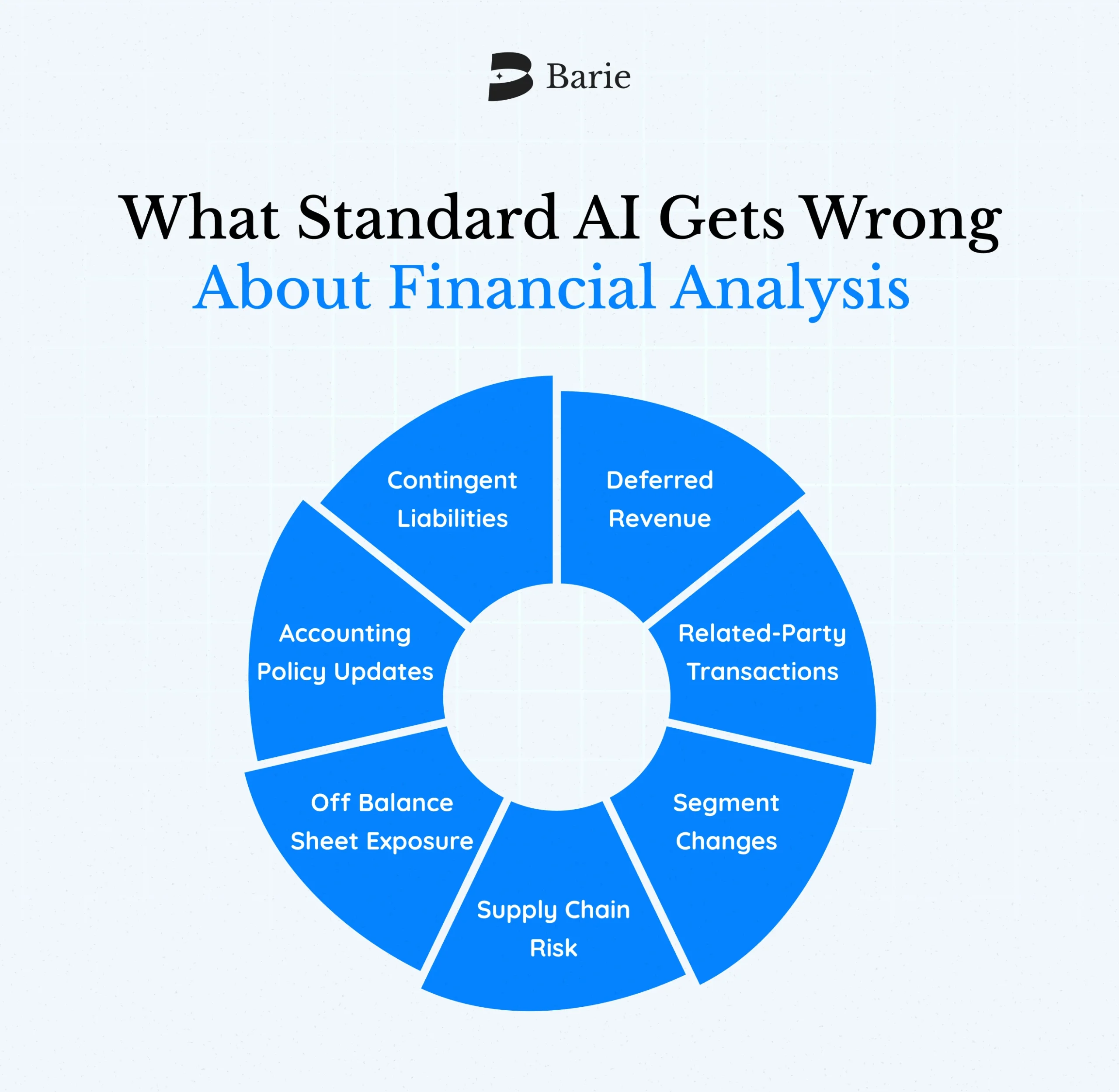
A 10-K filing is not linear. Some of the most critical information exists in areas that generic AI tools routinely overlook, including footnotes, deferred revenue disclosures, related-party transactions, off-balance-sheet arrangements, accounting policy updates, segment reporting inconsistencies, supply chain risks, and contingent liabilities.
Ask a generic chatbot to analyze a financial statement, and it will usually return the obvious items: revenue growth, margin movement, management commentary, and simplified risk summaries.
What it often fails to do reliably is cross-reference disclosures across sections, compare reporting methodology changes year over year, detect contradictions between disclosures and executive commentary, or surface buried accounting risks.
The output sounds credible because the AI has learned financial language patterns. But financial analysis is not about sounding intelligent. It is about finding the details that materially affect valuation, exposure, and decision-making.
That is where many AI financial analysis tools fail.
What AI Financial Statement Analysis Looks Like When It Actually Works
Effective AI financial statement analysis does not rely on assumptions or training patterns alone.
It works directly from live filings. That is the difference Barie focuses on. Instead of generating summaries from historical training expectations, Barie retrieves the live 10-K filing, processes sections simultaneously, and builds outputs directly from the source document.
This matters because financial filings constantly evolve. Companies change accounting methods. Revenue reporting structures shift. Risk disclosures expand. Segment definitions change.
An AI system trained on historical patterns cannot reliably identify those changes unless it analyzes the actual filing in real time.
Example of AI Financial Analysis in Practice
A portfolio manager uploads Apple’s latest 10-K filing and asks Barie to extract the revenue breakdown by segment, identify year-over-year cost structure changes, flag supply chain risk disclosures, and surface any off-balance-sheet arrangements.
Instead of summarizing the document sequentially, Barie runs multiple analysis processes at the same time. Each workflow targets a specific analytical task while cross-referencing findings across sections of the filing.
The output includes structured analysis, source citations, page references, risk highlights and supporting disclosures.
The result is not just a summary. It becomes a working research document analysts can use directly for portfolio monitoring, investment research, audit preparation, risk analysis, internal reporting, and financial modeling.
What previously required days of manual review can now happen in a single session.
Why Accuracy Matters in AI Financial Analysis
Financial statement analysis is not an environment where “mostly correct” is acceptable. A missed disclosure can affect valuation models, debt analysis, portfolio exposure, audit outcomes, investment theses, and regulatory reporting.
This is why accuracy and verifiability matter more than speed alone. Many AI tools generate confident outputs without showing where the information came from.
That creates a serious trust problem. If analysts cannot trace an insight back to the original filing, they cannot verify whether the conclusion is actually correct.
Barie approaches this differently through source-cited outputs and anti-hallucination architecture.
Every claim is tied directly to the original filing. Every insight is traceable. Every output can be verified against the source document. That distinction becomes critical in high-stakes financial analysis workflows.
How AI Can Reduce Manual Work in Financial Analysis
AI is not replacing financial analysts. It is replacing the repetitive document-heavy tasks that consume analyst time.
Traditional financial statement analysis often involves reading hundreds of pages manually, searching for disclosures across sections, comparing historical filings, tracing accounting changes, cross-checking segment reporting, and extracting financial metrics.
These tasks are necessary, but they are time-intensive. AI financial analysis tools can automate much of this retrieval and extraction work, allowing analysts to focus more on investment decisions, strategic interpretation, portfolio strategy, risk evaluation, and scenario analysis.
This is where AI creates the greatest value. Not by replacing judgment. But by accelerating the research process around it.
AI Financial Analysis for Investment Firms and Audit Teams
The use cases for AI financial statement analysis are expanding across finance. Investment firms use AI financial analysis tools to review earnings reports, SEC filings, risk disclosures, revenue segmentation, cost structure changes, and industry exposure.
Audit teams use AI to review disclosures faster, identify inconsistencies, trace accounting policy changes, compare multi-year filings, and detect unusual reporting patterns.
Corporate finance teams use AI financial analysis to benchmark competitors, review peer filings, analyze industry risks, monitor disclosure trends, and prepare board-level reporting.
As filing complexity increases, the need for faster and more accurate financial document analysis will continue growing.
Why Source-Cited AI Matters in Financial Statement Analysis
One of the biggest problems with generic AI tools is that they often provide conclusions without evidence.
That approach does not work in finance. Analysts need traceability, citations, verification, context, and supporting disclosures. A financial insight without a source is not actionable. It is simply an opinion generated by a model.
This is why source-cited AI financial analysis is becoming increasingly important.
Barie’s workflow focuses on making every insight traceable back to the exact filing section, page, or disclosure. That transparency helps finance teams verify findings instead of blindly trusting generated outputs.
The Future of AI for Financial Statement Analysis
AI financial statement analysis will likely become a standard part of investment and audit workflows over the next few years.
But the market will separate into two categories. The first category will consist of tools that generate fast financial summaries. The second will include systems built specifically for deep financial analysis, source verification, and high-stakes decision support.
That distinction matters. Because financial analysis is not about generating the fastest answer. It is about generating the most reliable one.
The firms that benefit most from AI will not be the ones using tools that sound intelligent. They will be the firms using AI systems capable of processing financial filings thoroughly, accurately and transparently.
How Barie Improves AI-Driven Financial Analysis
The finance industry is already adopting AI for financial statement analysis. The real question is not whether AI belongs in financial workflows anymore. The question is which AI systems can actually be trusted with complex financial analysis.
Generic AI tools can summarize documents. But true AI financial analysis requires live filing retrieval, multi-section analysis, cross-referencing capabilities, footnote extraction, risk detection, source-cited outputs, and verifiable insights.
That is the gap Barie was designed to close. Instead of producing financial-sounding summaries, Barie focuses on helping analysts work directly from the source with structured, traceable, and context-aware outputs.
For finance teams reviewing multiple filings every week, that difference can significantly reduce research time while improving confidence in the analysis.
Try Barie free with 900 credits and explore a faster way to analyze 10-K filings, financial statements, and complex financial disclosures.