The article
You ask an AI tool to research a topic, draft a blog post, and generate the supporting visuals. You get three browser tabs, four copy-paste cycles, two hallucinated statistics, and a draft that sounds like it was written by a committee that has never read your brand guidelines.
That is not a content workflow. That is friction dressed up as productivity.
Content teams are not struggling because they lack ideas. They are struggling because the gap between research and published draft still requires five tools, six handoffs, and a human editor correcting things that should never have been wrong. The promise of AI for content creation was always “write more, faster.” What nobody told you is that most AI tools cover only one step and leave you to stitch the rest together yourself.
Why AI Content Creation Tools Keep Failing at the Research Stage
The bottleneck is not the writing. It is always research.
Most AI writing tools pull from training data. That data has a cutoff. It cannot tell you what your competitors published last week, what Google’s algorithm updates look like in practice right now, or what your target audience is actually searching for today. You ask for a research-backed blog post, and you get confident, well-formatted text built on information that may be months or years out of date.
According to a 2025 Content Marketing Institute study, 74% of enterprise marketers had integrated generative AI into their core content workflows, yet content teams still report research accuracy as their biggest pain point. The volume problem got solved. The accuracy problem did not.
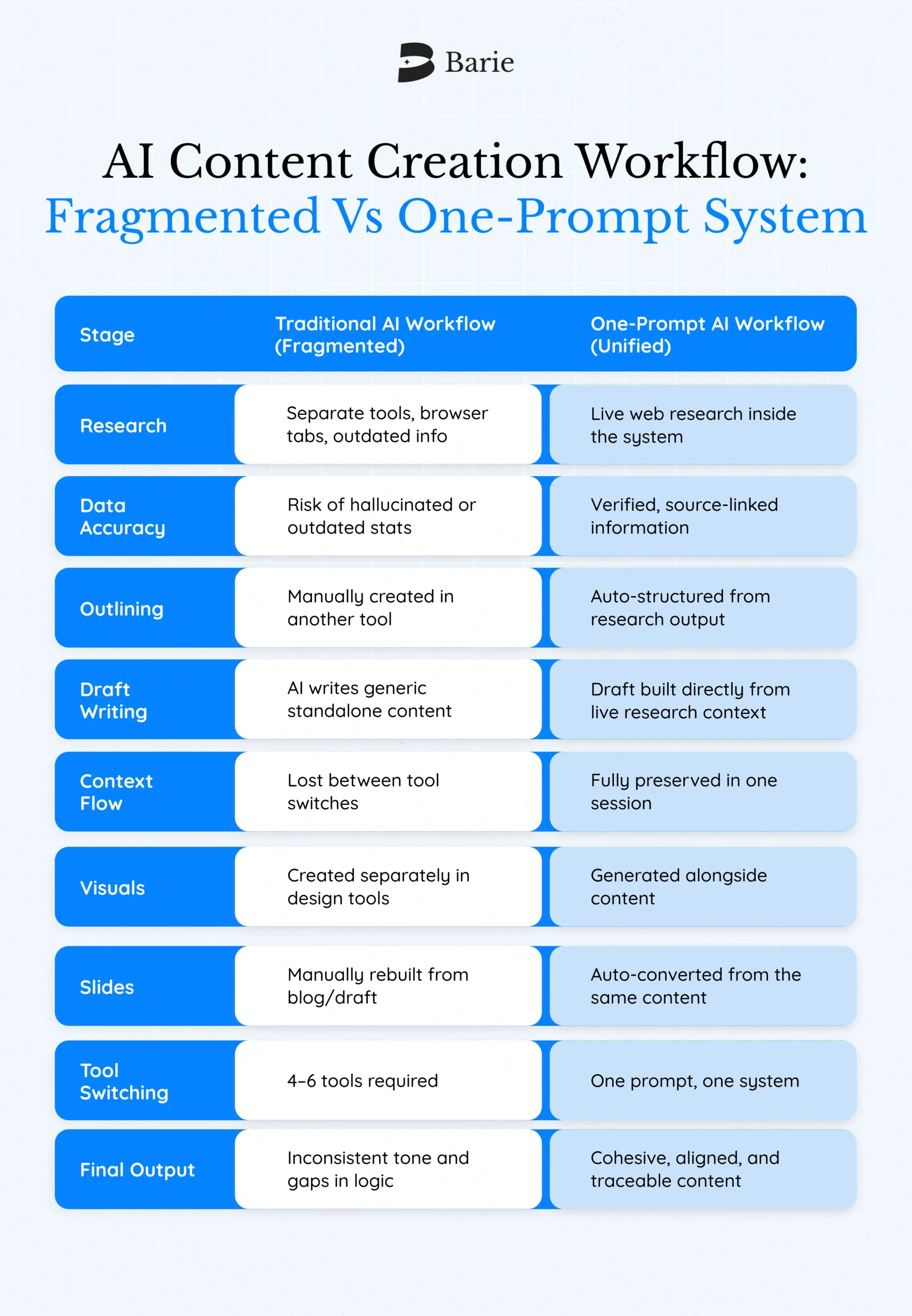
The other failure is fragmentation. Research happens in one tool. Outlining in another. Drafting in a third. Image creation somewhere else. Slides were built manually after the fact. Every handoff is a chance to lose context, introduce inconsistency, and waste time that AI was supposed to save.
What a Real AI Content Workflow Looks Like in One Prompt
A founder needs a competitive analysis post about three SaaS tools in their category. Published by the end of the day.
In a fragmented workflow, that is a half-day project minimum. Keyword research, source gathering, outline, draft, image sourcing, formatting, each step requires a separate tool and a context switch.
With Barie’s Deep Research, the prompt is one instruction. Barie goes to the live web, not training data. It runs parallel subtasks across each competitor simultaneously, pulls sourced data from current pages, synthesizes the findings into a structured draft, and shows you exactly where every claim came from. No invented statistics. No fabricated citations. Every output is traceable to a real, live source.
That is what anti-hallucination actually looks like in a content workflow. Not a disclaimer buried in the terms of service. A verifiable source next to every claim, produced in one session.
AI for Content Creation: Research, Visuals, and Slides in One Place
The writing is only one piece. Content teams producing blog posts, social assets, pitch decks, and internal reports cannot afford a separate tool for each format.
Barie handles the full stack in a single workflow.
Deep Research pulls live, cited information on any topic before a word of the draft is written. The output is not a summary of what the AI already knows. It is a structured brief built from what is actually on the web right now, with source links you can verify.
Image Creation generates visuals directly inside the workflow, no export, no import, no separate subscription to a design platform. The image context matches the content context because they were produced in the same session from the same brief.
Magic Slides converts a research output or a written draft into a formatted presentation automatically. A blog post becomes a deck. A research brief becomes a stakeholder-ready slide. The content does not have to be rebuilt; it gets repurposed within the same session.
The competitive advantage here is not just speed. It is that context that does not get lost between tools. The research that informed the draft also informs the images and the slides. What would normally require four platforms and three rounds of copy-paste happens in one place.
The Hidden Cost of Fragmented AI Content Creation Tools
Every tool switch inside a content workflow costs more than it looks. It costs context.
When a writer researches in one tool, drafts in another, and generates images in a third, the final output reflects that fragmentation. The image does not quite match the tone of the article. The draft misses nuance from the research phase. The slides built from the post lost supporting data because it never made it through the handoff.
Research confirms that the biggest drag on content team productivity is not writing speed; it is the number of context switches between tools. Teams using fragmented stacks spend as much time managing handoffs as they do producing content. Agentic workflows that keep research, drafting, and asset creation inside a single session cut that drag entirely. The output is better because the context was never lost.
The Accuracy Problem That Volume-First AI Tools Ignore
Content volume is not the constraint anymore. Any team can generate a hundred blog posts a month with off-the-shelf AI writing tools.
The constraint is accuracy at scale. Producing a hundred posts with hallucinated statistics, outdated claims, and invented sources does not build authority. It destroys it. Search engines are getting better at detecting thin, unverified content. Readers are getting better at spotting it, too.
Barie was built specifically because organizations had seen AI hallucinations wreck real work. Not occasionally. Consistently. Tools that sounded confident while being factually wrong. That founding frustration is what shaped the entire product philosophy: every output should be verifiable, every claim traceable, every source real.
That philosophy is not a feature toggle. It is the architecture. Barie has processed 1M+ hallucination-free chats across 25+ industries. It meets the GAIA Level 3 benchmark, which tests whether an AI can reliably complete genuinely complex, multi-step tasks. Most tools do not publish GAIA scores. The ones that do not are probably hoping you will not ask.
What This Means for Your Content Team Right Now
The content teams gaining ground in 2026 are not the ones producing the most volume. They are the ones who have solved the research-to-published-draft pipeline without adding headcount or stitching together seven tools.
In practical terms, that looks like this: one prompt that produces a live-sourced research brief, a structured draft with verifiable citations, supporting images, and a presentation-ready slide format, all in one session, without a human running between platforms to keep the context alive.
That is not a future workflow. That is what Barie does on a Tuesday.
The teams still running five-tool content stacks will keep producing content at the same pace, with the same accuracy problems, and the same handoff friction. The teams that shifted to a single agentic workflow will outproduce them without outworking them.
Start Your First Research-to-Draft Session Free
If your current AI for content creation workflow involves more than one tool to go from research to a published draft, there is a faster way to work.
Explore Barie for free and power your first workflows with 900 credits.