The article
Your competitor just submitted a 40-page market analysis. You have the same data, the same team, and a two-day deadline.
They used an AI agent. You used a chatbot.
That is not a small gap. That is the entire race. By 2026, the divide between teams that deploy real AI agents and teams that rely on standard chat AI has become measurable, documented, and expensive to ignore. These are not demos. These are production deployments, running right now, solving tasks that used to eat weeks of human time. Here are 15 of the most useful AI agent examples working in the real world today.
1. Deep Research Agents That Actually Cite Sources
Most chat AI answers are from training data frozen months ago. A deep research agent searches the live web, pulls primary sources, and builds a structured report with traceable citations. Analysts use these for competitive intelligence, market sizing, and investment due diligence. Every claim has a source. Every source is verifiable.
2. Agentic AI Use Cases in Customer Support
A mid-sized e-commerce brand deployed a support agent that autonomously resolved 82% of incoming tickets, order tracking, returns, and billing disputes, without human escalation. The agent reads the CRM history, classifies intent, and either resolves it or hands it off with full context. Support teams now handle edge cases, not queues.
3. Sales Prospecting and Outreach Agents
These agents monitor buyer signals, page visits, content downloads, pricing page activity, and trigger personalized outreach sequences across email and LinkedIn without a rep having to lift a finger. Some examples of agentic AI in sales show response rates improving by over 70% compared to static, rep-managed sequences run on manual timing.
4. Fraud Detection Agents in Financial Services
Banks now run AI agents that monitor transaction patterns in real time across entire customer networks. Static rule sets flagged too many false positives and missed new attack patterns. Agentic systems update their own detection logic based on emerging fraud signals and flag anomalies before human reviewers would even open their dashboards.
5. AI Coding Agents for Software Development
Coding agents are running inside developer workflows right now, reviewing pull requests, catching bugs, suggesting refactors, and generating boilerplate. The measurable result: senior engineers spend less time on code review and more time on architecture. These agents do not replace developers. They remove the work that was slowing them down.
6. Legal Research Agents
Law firms use AI agents to surface relevant case law, statutes, and precedents across jurisdictions in minutes rather than hours. The critical requirement is accuracy. A hallucinated citation in a legal brief has real consequences. Agents built for legal research surface sources, show their work, and let attorneys verify every reference before it gets filed.
7. Inventory and Supply Chain Agents
Retail and logistics operations now use agentic AI that tracks stock levels, predicts demand shifts, generates purchase orders, and flags supplier risks, all without a human initiating each step. One Shopify brand automated its entire restocking workflow. The agent monitors sell-through rates, calculates reorder points, and automatically places orders within pre-approved thresholds.
8. Route Optimization Agents for Logistics
Static morning dispatch plans collapse the moment reality arrives. AI route-optimization agents recalculate delivery schedules in real time as new orders arrive, customers cancel, and traffic shifts. Fleet operations become adaptive rather than reactive, and missed delivery windows drop significantly across deployments.
9. Financial Analysis and Reporting Agents
Finance teams use agentic AI to pull data from multiple sources, accounting software, market feeds, and internal spreadsheets, cross-reference it, and generate structured financial reports with commentary. Quarterly close processes that required five analysts working three days now run in a fraction of that time.
10. Content Research and SEO Agents
Marketers use AI agents that audit competitor pages, identify keyword gaps, pull SERP data, and generate structured content briefs, all from a single prompt. The agent researches, structures, and delivers a publication-ready brief faster than a human researcher could finish reading the first competing article.
11. Recruitment and Hiring Agents
HR teams deploy agents that screen resumes against defined criteria, score candidates, schedule interviews, and send updates to applicants, without a recruiter touching each application. Hiring cycles that took four weeks now close in ten days for standard roles. The recruiter stays in the loop for interviews and final decisions, not inbox management.
12. Healthcare Workflow Automation Agents
Hospitals use agentic AI to manage appointment scheduling, insurance pre-authorization, and patient intake paperwork. These workflows used to require multiple staff members touching the same case across different systems. Agents now coordinate across those systems autonomously, reducing administrative overhead and improving patient throughput without changing clinical staffing.
13. AI Agents for Market and Competitive Intelligence
Startup founders and product teams run competitive intelligence agents that monitor competitor websites, pricing pages, job listings, and press releases continuously. When a competitor launches a new feature or changes pricing, the agent surfaces it, summarizes the change, and updates a shared brief before the team has its Monday standup.
14. Multi-Agent Workflows for Complex Projects
Single agents handle single tasks. Multi-agent systems handle entire projects. A market research report that requires a research agent, a data analysis agent, a writing agent, and a formatting agent can be completed in one coordinated session. These are the agentic AI use cases where the time savings become genuinely hard to believe until you run one yourself.
15. Personal Research Agents for High-Stakes Decisions
Individuals, investors, job seekers, researchers, and founders, use personal AI agents to run multi-hour research sessions on topics that matter: patent landscapes, regulatory environments, product comparisons, and investment theses. The agent works through the complexity, surfaces the relevant sources, and delivers a structured output the human can actually act on.
What Makes an AI Agent Different From a Chatbot
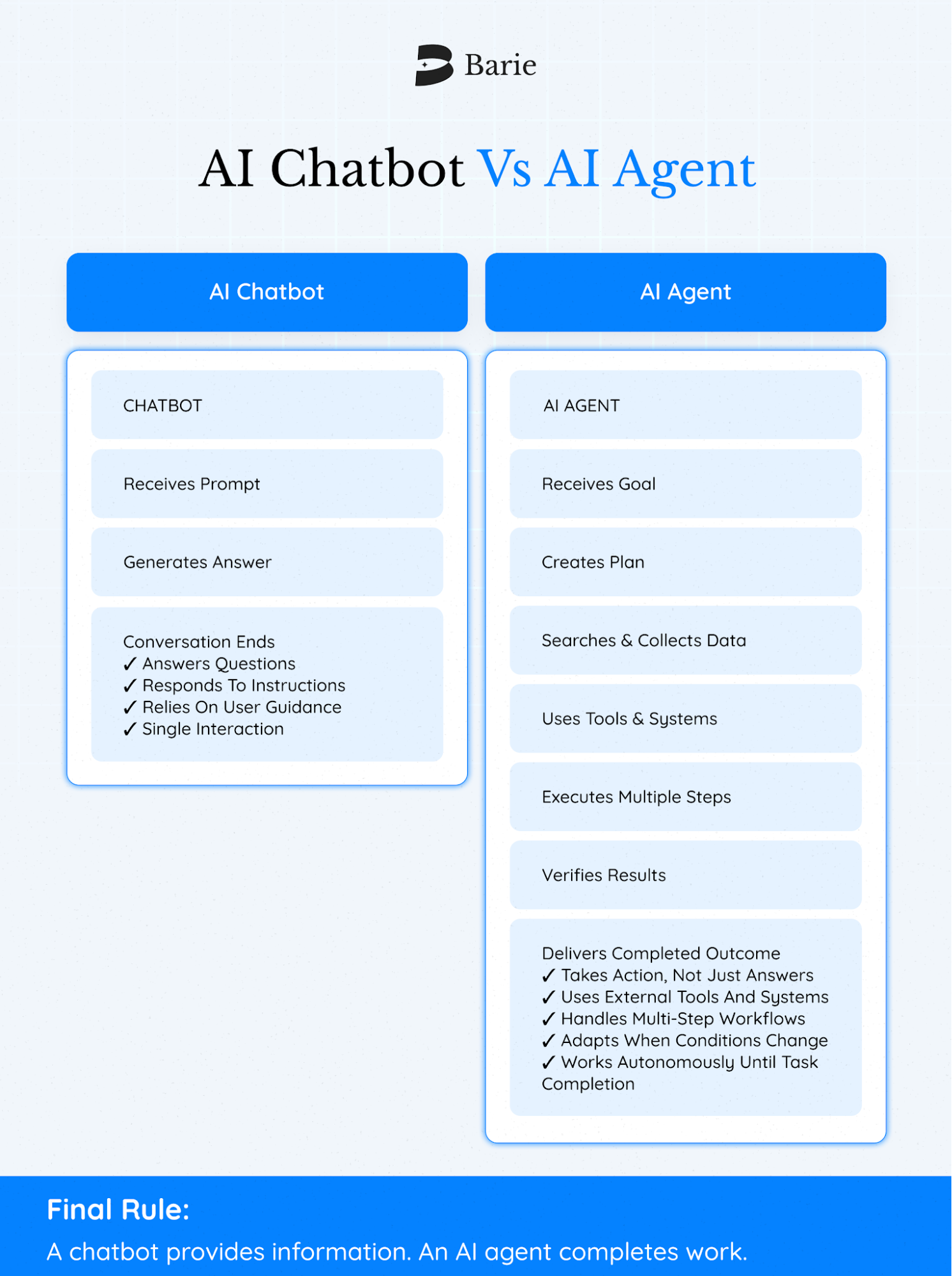
A chatbot answers. An AI agent acts. It plans a sequence of steps, uses tools, calls external systems, adapts when something breaks, and keeps working until the task is done. The fifteen examples above are not chatbots with better prompts. They are systems built to execute workflows the same way a capable employee would, except they do not lose momentum after the third step, and they do not hallucinate their way through sources.
The gap between agentic AI examples that work in production and demos that break after two steps comes down to one thing: accuracy. An agent that confidently executes on wrong information causes more damage than no agent at all.
What Barie Does That Most Agents Don’t
Barie AI was built because hallucinations in AI outputs have real costs, in legal work, financial decisions, competitive strategy, and research quality. It does not answer from the training data. It researches the live web, runs parallel subtasks simultaneously, and shows you exactly where every piece of information came from. Every output is source-cited. Every source is traceable.
It meets the GAIA Level 3 benchmark, the industry-standard test for complex, multi-step agentic task completion. Most tools do not publish a GAIA score. Barie AI does.
Over 1M hallucination-free chats across 25+ industries. That is not marketing copy. That is a documented operational track record.
If the AI agent examples in this article describe problems your team is dealing with, competitive research, financial analysis, legal sourcing, and multi-step workflows across apps, Barie AI runs those sessions today.