The article
You asked an AI assistant to pull a competitor analysis.
It gave you five confident paragraphs, three citations, and a clean summary.
One company it cited had shut down two years ago. Another never existed. The third statistic was invented with no source.
That is not an edge case in 2026. It is a Tuesday.
The problem is not that there are too few AI assistants to choose from. The problem is that most of them sound right while being wrong, and nothing in the interface warns you. This guide cuts through the noise. Below are eleven of the best AI assistants available in 2026, reviewed honestly, organised by what they actually do well.
What Makes the Best AI Assistant in 2026
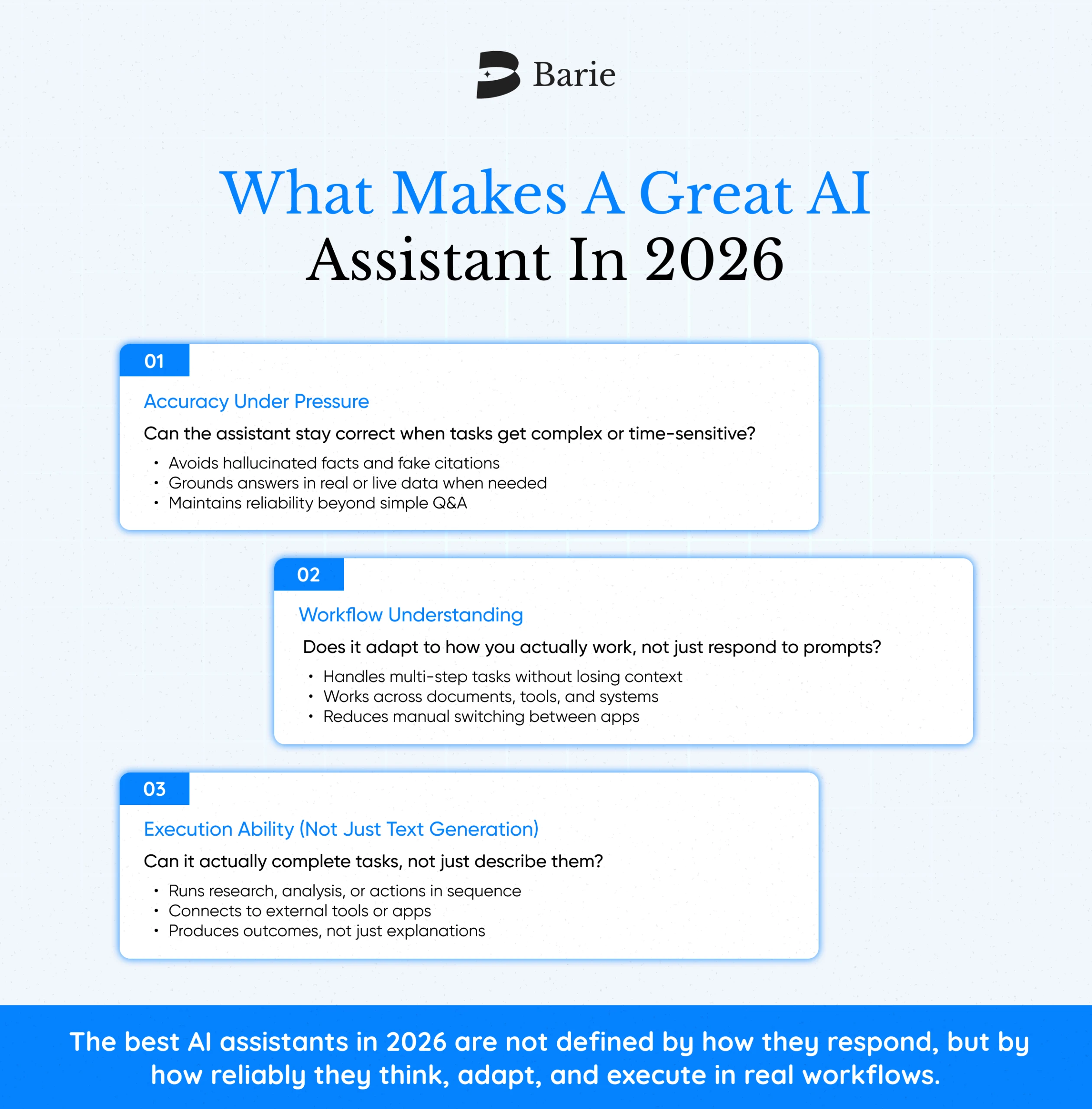
The market has matured enough that raw capability is no longer the differentiator. What separates good AI assistants from great ones comes down to three things: accuracy under pressure, how well they handle your specific workflow, and whether they execute or just generate text.
Most tools do the last one. Fewer do all three.
1. Barie AI, Best for Deep Research and Verified Execution
Barie AI is not a chatbot that answers from training data. It actively researches the live web, runs parallel subtasks, cites every source, and connects to third-party apps to complete multi-step workflows end to end. A founder asking for a competitor analysis across five SaaS products does not wait for sequential responses, Barie AI fires all five research threads simultaneously and delivers a structured, source-cited report. That is what sets it apart from every other tool on this list.
Barie AI has completed 1M+ hallucination-free chats across 25+ industries and aces the GAIA Level 3 benchmark for complex agentic tasks. Accuracy sits at 90%, and every output is traceable to its live source. That is not a feature. That is a different product philosophy.
Free plan: 900 credits on sign-up, no card needed. Paid: Premium tier available.
2. ChatGPT, Best General-Purpose Assistant
ChatGPT remains the most widely used AI assistant in 2026. It handles drafting, summarisation, brainstorming, and code generation with minimal friction. The free tier now includes access to GPT-5.3, and the interface is polished enough that adoption requires almost no onboarding. It is the right starting point for everyday productivity tasks, though fact-checking any output that involves recent data remains necessary.
Free plan: Yes. Paid: $20/month (Plus).
3. Claude, Best AI Writing Assistant
Claude consistently outperforms other models on long-form writing, careful reasoning, and working with large documents. Its 200K context window means it holds more of your document in memory than most tools, making it the best AI writing assistant for anyone editing lengthy reports, legal drafts, or research briefs. The writing it produces is measured, structured, and rarely needs heavy editing for tone.
Free plan: Yes (limited). Paid: $20/month (Pro).
4. Perplexity AI, Best for Research with Live Citations
Perplexity was designed for one thing: answering questions using live web data with visible citations. It does that better than any general-purpose chatbot. Every response links directly to the source, which makes it genuinely useful for anyone who needs to verify claims quickly. It is not the tool for executing workflows or writing long-form content, but for research lookups it remains one of the most reliable options available.
Free plan: Yes. Paid: $20/month (Pro).
5. GitHub Copilot, Best AI Coding Assistant for Teams
GitHub Copilot holds around 42% of the developer tool market and remains the best AI coding assistant for teams already inside the GitHub ecosystem. It works across VS Code, JetBrains, and Neovim, generating context-aware code completions and catching errors inline. The free tier offers 2,000 completions per month, and the enterprise plan includes compliance and security controls that most alternatives have not yet matched. For standardised, team-wide adoption, it is the reliable choice.
Free plan: Yes (2,000 completions/month). Paid: $10/month (Individual), Enterprise pricing available.
6. Cursor, Best AI Coding Assistant 2026 for Individual Developers
Cursor has become the benchmark tool for individual developers working in complex, multi-file codebases. Its Composer feature allows natural-language refactoring across your entire repository, and it indexes your codebase so suggestions reflect real context, not generic patterns. Teams using Cursor report a 70% reduction in PR review comments. It is the best AI coding assistant 2026 has introduced for developers who want deep codebase control rather than autocomplete suggestions.
Free plan: Hobby tier (free). Paid: $20/month (Pro).
7. Google Gemini, Best for Google Workspace Users
Gemini’s strongest use case is inside the Google ecosystem. It integrates directly with Gmail, Docs, Drive, and Chrome, allowing users to summarise emails, draft documents from prompts, and search their files from a single interface. Search grounding with live Google data reduces hallucinations on recent topics. If your team runs on Google Workspace, Gemini removes a layer of copy-pasting that other tools cannot.
Free plan: Yes. Paid: $20/month (Advanced via Google One).
8. Microsoft Copilot, Best for Microsoft 365 Teams
Copilot is built into Word, Excel, PowerPoint, Teams, and Outlook. For organisations already on Microsoft 365, it reduces the time spent on document formatting, meeting summaries, and data interpretation. The integration is native rather than bolted on, which means it works inside the tools teams already use rather than asking them to switch contexts. Enterprise IT teams also get centralised control over data access and permissions.
Free plan: Limited (Windows and Edge). Paid: $30/user/month (Microsoft 365 Copilot).
9. Jasper, Best AI Writing Assistant for Marketing Teams
Jasper is built specifically for marketing content at scale. It supports brand voice training, 50+ content templates, and team collaboration workflows. For agencies and marketing departments producing high volumes of ad copy, email sequences, and blog drafts, the structured approach helps maintain consistency across writers. The $49/month starting price is steep for individual users, but for teams producing content every day, the output speed justifies it.
Free plan: 7-day trial. Paid: From $49/user/month.
10. Writesonic, Best Budget AI Writing Assistant
Writesonic targets content teams who need SEO-optimised output without paying Jasper-level prices. Its Surfer SEO integration generates and scores content against live SERP data, and the free tier allows 10,000 words per month. For small teams producing blog content regularly, it delivers most of what more expensive tools offer at a fraction of the cost. The quality drops noticeably on technical or nuanced topics, but for volume-driven content strategies it holds up well.
Free plan: Yes (10,000 words/month on GPT-3.5). Paid: From $20/month.
11. DeepSeek, Best Free AI Assistant for Technical Users
DeepSeek became a serious option in 2026 for developers and researchers looking for a capable free-tier model with strong reasoning on technical prompts. It performs well on coding, maths, and structured analysis tasks. The context window is large and the free access is genuinely generous compared to most alternatives. Data privacy concerns have kept it off enterprise shortlists, but for individual technical users running local or low-sensitivity work, the price-to-performance ratio is hard to argue with.
Free plan: Yes (generous). Paid: API pricing only.
How to Choose the Right Tool
The right AI assistant depends entirely on what breaks down in your current workflow. For writing and editing, Claude handles long-form better than anything else. For coding, Cursor leads for individual developers while GitHub Copilot remains the enterprise standard. For research that needs citations, Perplexity and Barie AI both deliver. The difference is that Perplexity answers queries while Barie AI researches them, executes on them, and connects to your other tools to complete the job.
If your work involves any task where accuracy matters and you cannot afford to spend time fact-checking AI outputs, the list narrows quickly.
The One Problem Most AI Assistants Still Have
Eighty-eight percent of marketers now use AI tools daily. The adoption is there. What is not always there is reliable output. Most chat-based AI tools pull from training data, generate confident text, and provide no way to verify where any claim came from. That works fine for brainstorming. It falls apart the moment you need a sourced analysis, a verifiable competitor brief, or research that your name is attached to.
That is the gap Barie AI was built to close. Not as a feature, as the entire reason the product exists.
Start your first verified research session at Barie AI