The article
You spend forty minutes every morning doing the same thing. First, you pull data from three different tabs. Then you summarise it into a report nobody fully reads. After that, you copy that report into a different tool, and finally, you send a message just to confirm it was done.
That is not work; that is the scaffolding around work. And right now, most teams are staffing full-time roles simply to hold that scaffolding in place. AI skills automation, however, is the shift that makes that scaffolding disappear entirely. Here is how to actually build it.
What “AI Skills” Actually Means
There is a lot of noise around this term. So let us be precise. An AI skill is a defined capability that an AI agent can execute without human handholding. It is not a prompt you run manually. It is not a chatbot you query when you remember to check it.
It is a trained, configured workflow that fires on a condition, executes a task, and delivers a result.
Think of it as the difference between asking an assistant a question and teaching that assistant a job. One interaction gets you an answer. The other gets you reclaimed hours, every single week.
Companies building AI skills for automation are encoding repeatable decisions into systems that execute them reliably. The skill is not the AI itself. It is the logic, the context, and the execution path you build around it.
Step One: Map the Workflows Worth Automating
Not everything should be automated. But the things that should be automated are usually obvious once you look for them.
Start by listing every task your team does more than twice a week. Then ask which of those tasks follow a consistent input-to-output structure. Research that always follows the same format qualifies. A decision that requires genuine judgment every single time does not.
The clearest candidates for AI skills automation share three traits. First, they have a predictable input. Second, they produce an output that looks roughly the same each time. Third, the person doing them is not adding much value beyond the execution itself.
Weekly performance summaries. Competitive monitoring. Data aggregation across tools. Customer query triage. Contract review pre-checks. These are not edge cases. These are the daily realities of most knowledge work teams.
Step Two: Choose the Right Layer of Automation
This is where most teams get stuck. They default to basic automation tools and wonder why the results feel thin.
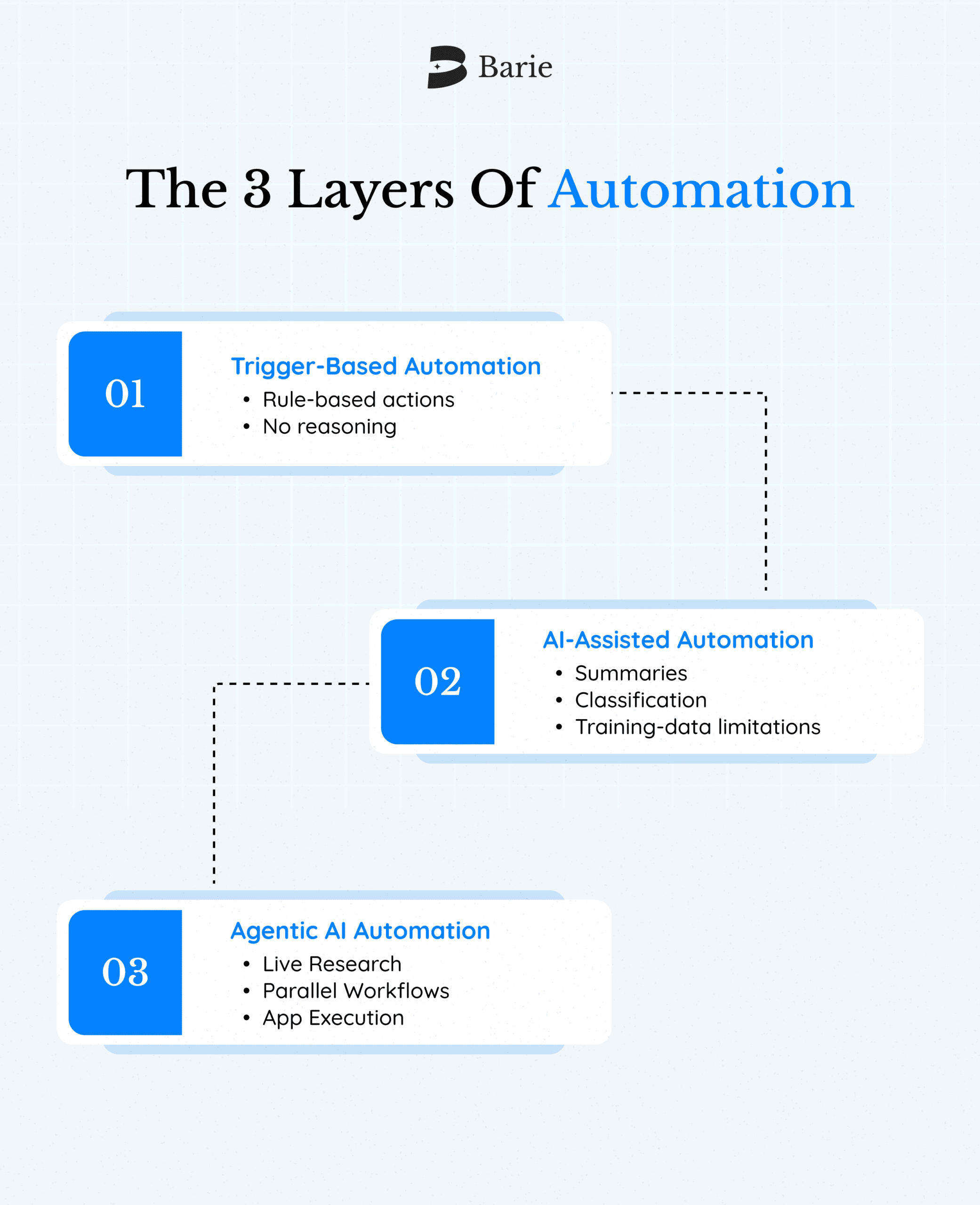
There are three layers to understand. The first is trigger-based automation. Tools like Zapier or Make connect apps and fire actions when conditions are met. They are useful for simple, rule-based handoffs. They do not reason. They do not adapt. They execute pre-defined steps.
The second layer is AI-assisted automation. A language model gets added to the workflow. It can draft text, summarise inputs, and classify data. The output quality improves significantly over pure rule-based systems.
However, most tools at this layer still operate from training data. That means the AI fills gaps with what it learned in the past. Not what is actually happening right now.
The third layer is agentic AI automation. Here, the AI researches live information, runs parallel tasks, and connects to your apps. It delivers structured outputs without being managed step by step.
This is the layer where repetitive workflows genuinely disappear, not just get slightly faster. Knowing which layer you need is the difference between building something useful and creating new maintenance problems.
Step Three: Define the Skill Clearly Before You Build It
Vague instructions produce vague results. This is true whether you are managing a human team or configuring an AI agent.
Before building any automated workflow, write down exactly what a successful output looks like. Not what you want the AI to do. What you want the AI to deliver. Those are different questions.
A well-defined AI skill has four components. A clear trigger: what condition starts the workflow? A defined input: what data or context the AI receives. An explicit output format: what the result looks like and where it goes.
The fourth component is an accuracy standard. How will you know if the result is good enough to trust without reviewing it manually every time?
Teams that skip this step end up with automation that runs but does not actually solve the problem. The AI executes. The output is technically correct. But nobody trusts it enough to stop reviewing it manually. At that point, the automation has added a step instead of removing one.
Step Four: Test on Real Work Before You Scale
Every AI skills automation workflow should be tested on real inputs before it touches any process that matters.
Run the workflow on last week’s actual data. Compare the output to what a human produced. Find the gaps. Tighten the instructions. Run it again.
This is not a one-time setup. The first version of any AI workflow will have rough edges. That is fine. The point of testing is to find those edges before they become errors embedded in a live process.
Teams that skip testing tend to discover the gaps at the worst possible moment. Usually, after the output has already been distributed. Or after a decision was made on data, the workflow got wrong.
Where Barie Fits Into This
Most AI tools answer questions from their training data. Automated research workflows built on training data produce outputs that are confident, well-formatted, and sometimes wrong. Not dramatically wrong. Subtly wrong in ways that are hard to spot before they surface at the worst time.
Barie was built specifically to solve that problem. When you build an AI skills automation workflow inside Barie, the research component pulls from the live web. Not a knowledge base that hasn’t been updated in 12 months.
Every output is source-cited. Every claim is traceable. If the workflow is pulling competitive intelligence, it is pulling today’s competitive intelligence.
More importantly, Barie connects to your apps through Connectors. A single workflow can research a topic, synthesize the findings, and push the output to your CRM. Without any step-by-step management.
The automation is not just text generation. It is the actual execution across the tools your team already uses.
Barie has handled over one million hallucination-free chats across more than twenty-five industries. It passes GAIA Level 3, the benchmark for genuinely complex agentic workflows. That accuracy standard matters most precisely when you are not watching the output every time it runs. Because the whole point of automation is that you stop watching it.
The Verdict
Building AI skills that automate repetitive workflows is not about finding the best AI model. It is about mapping the right tasks and choosing the right automation layer. Then, defining what a good output looks like, and testing before you trust.
The tools that handle this well research live information and execute across multiple apps. They deliver outputs that do not require a human to fact-check them first. That is not a description of most AI tools on the market. Try Barie free and get 900 credits on your trial!