The article
An SEO manager ran a full site audit last quarter. She used one of the popular AI writing tools. It generated a 40-point recommendations report in under five minutes. Clean formatting. Confident language. Specific action items.
She acted on twelve of them.
Three months later, rankings had not moved. When she dug into the recommendations, she found that two were based on Google guidelines that had been updated eighteen months prior. One cited a competitor tactic that the competitor had already reversed.
The AI had answered based on training data, not on the current state of her site or market.
This is the problem with using chat AI for SEO work. It sounds authoritative. It is often outdated. And it never tells you which parts to distrust. Barie was built to fix exactly that.
What AI for SEO Actually Means in 2026
Most tools marketed as AI for SEO are content generators with a keyword input field.
They help you write faster. They suggest related terms. They score your content against a readability rubric. These are useful features. They are not SEO intelligence.
Real AI for SEO means an agent that can do what an experienced SEO consultant would do on day one of an engagement: crawl the site, analyze the technical structure, compare it against live competitors, identify gaps in the content strategy, and produce a prioritized action plan grounded in what is actually happening in search right now.
Not what was happening eighteen months ago when the training data was collected.
Not a generic checklist.
A site-specific, competitor-specific, keyword-specific brief that reflects the live search environment. That is what an AI agent delivers. That is what a content spinner with SEO labels does not.
AI SEO Audit: What a Real Agent Checks and Why It Matters
An AI SEO audit done by a capable agent is not a list of color-coded warnings from a crawler dashboard. It is an investigation.
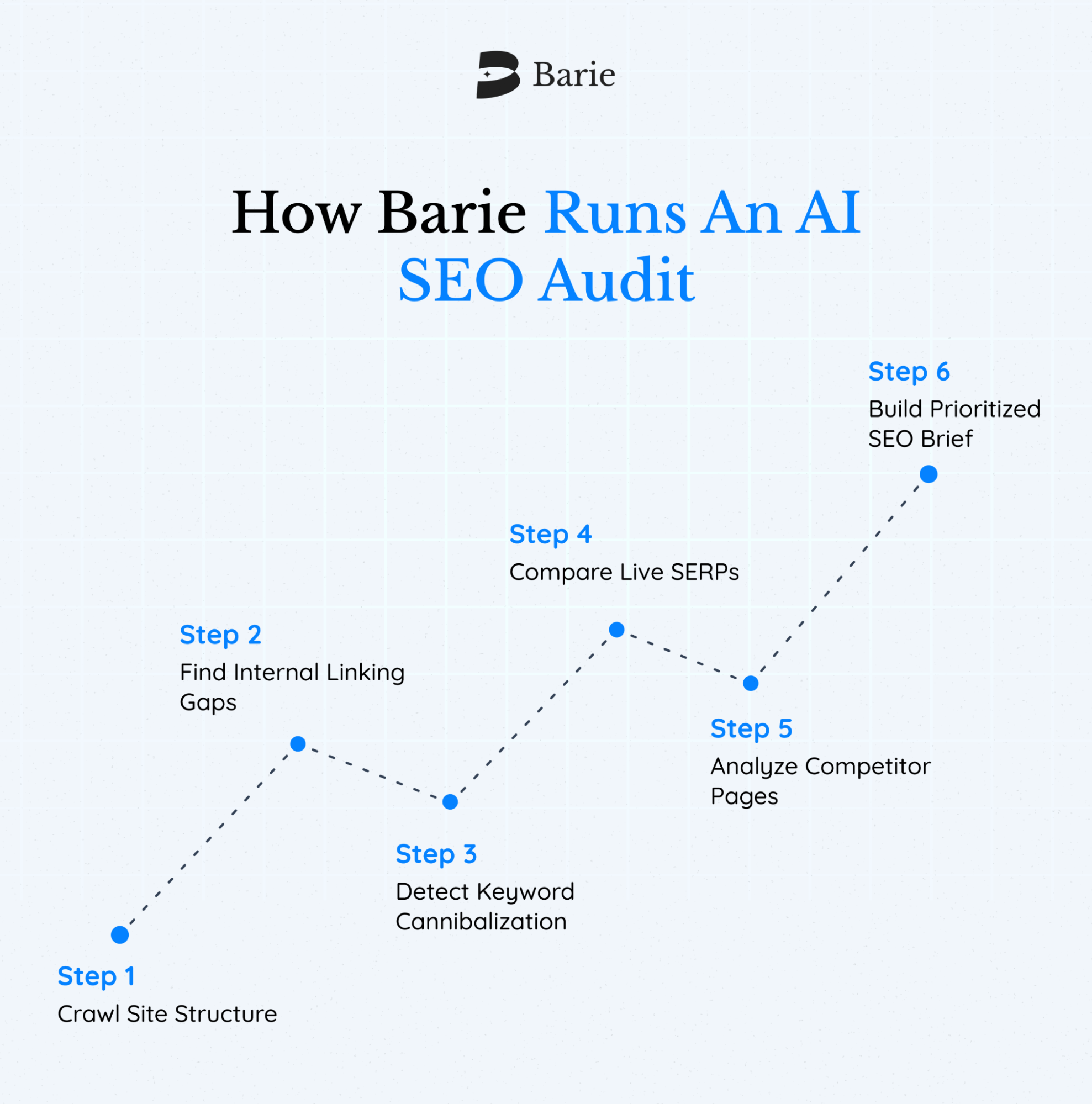
The agent pulls the site structure, identifies crawl inefficiencies, maps internal linking gaps, flags pages that are cannibalizing each other on the same keyword, and cross-references all of it against live search results to show which problems are actually costing rankings right now.
Here is what that looks like with Barie in practice.
A content strategist managing a 200-page SaaS site needed to understand why three core product pages had dropped from page one to page three over the previous quarter. She opened Barie with a single prompt describing the pages and the drop.
Barie ran the research in parallel: it analyzed the pages against current SERP results for the target keywords, pulled competitor pages that had moved up into the vacated positions, identified structural and on-page differences between the ranking and non-ranking content, and surfaced two specific issues: thin internal linking to the affected pages and a title tag structure that no longer matched user intent based on current search patterns.
The full brief arrived in under 25 minutes. Every finding cited a live source. Every competitor reference is linked to the actual page.
No guesswork. No training data drift. No generic best-practice filler.
AI Keyword Research: Beyond Volume Scores
Standard keyword research tools give you volume, difficulty, and CPC. That is a starting point, not a strategy.
An AI agent approaches keyword research the way a strategist would: it maps the keyword landscape around a topic, identifies where competitors are ranking and where gaps exist, analyses the actual search intent behind high-volume terms, and surfaces long-tail clusters that content calendars typically miss.
Intent Mapping at Scale.
A single seed keyword can branch into dozens of intent variations. Informational, commercial, navigational, transactional. An AI agent researches the live SERP for each variation and tells you which format, word count, and structure is currently winning for each intent cluster.
Competitor Gap Analysis.
Most keyword tools show you what your competitors rank for. A real AI SEO agent shows you what they rank for that you do not, why those pages are winning based on current content and structural signals, and which gaps are realistic to close in the next 90 days.
Trend Detection Without a Crystal Ball.
Barie researches the live web when it works, which means it captures keyword trends as they emerge rather than 6 months after they appear in a tool’s database. For fast-moving industries, that lead time is a significant competitive advantage.
AI for Content Optimization: From Gap to Published
Finding a content gap and closing it are two separate problems. Most AI SEO tools solve the first. The second requires execution.
Using Barie’s Connectors, an SEO manager can take the output of a keyword research session and push it directly into a content brief template in Notion, assign it to a writer in Asana, and trigger a Slack notification to the editorial lead, all from within the same session. No tab switching. No copy-pasting a spreadsheet into a project board.
On the content side, Barie analyses top-ranking pages for a target keyword and identifies exactly what the current winners contain that competing pages do not. Word count ranges that correlate with ranking positions.
Heading structures that match search intent. Entity coverage gaps based on what Google appears to be rewarding in the live SERP right now.
The output is a structured content brief with live citations, not a generic word count recommendation and a list of LSI terms to sprinkle in.
The Benchmark That Separates Real AI SEO Tools from Content Spinners
Here is the test most AI SEO tools fail.
Ask them to analyze a specific competitor page that was published last month and explain why it is outranking your page right now. A content generator cannot do this. It has no live data. It cannot read that page.
It cannot compare current SERP positions. It will produce a plausible-sounding analysis based on general SEO principles, and most of it will be fabricated.
Ask Barie the same question, and it goes to the web. It reads both pages. It pulls the current SERP. It cites every observation.
That is the functional difference between a language model trained on SEO content and an AI agent built for search engine optimization work.
Barie meets the GAIA Level 3 benchmark, which tests whether an AI system can handle genuinely complex, multi-step tasks that require real-world reasoning and live information retrieval. Most AI tools do not publish benchmark results.
Barie does. It maintains a 90% accuracy rate across 1M+ sessions spanning 25+ industries, including marketing and competitive research.
For SEO work specifically, accuracy is not a nice-to-have. A recommendation built on fabricated data does not just fail to help. It actively costs rankings when you act on it.
AI Rank Tracking and Reporting: Closing the Loop
The last mile of any SEO workflow is measurement. Did the changes move rankings? Which pages improved? Which competitors closed the gap while you were focused elsewhere?
Standard rank trackers give you position data. An AI SEO agent gives you position data with context.
A Barie session on rank movement goes like this: the agent pulls current rankings for a set of target keywords, compares them to the previous period, identifies which SERP changes are due to your site’s improvements versus competitor moves, surfaces any new entrants into the top ten that represent emerging competitive threats, and produces a structured summary brief with live citations for every data point.
That brief can be pushed directly to a client report in Google Docs or to a project board for the next sprint, using Barie’s Connectors.
Manual reporting that would take two hours for a strategist takes one deep research session. Every number is traceable. No interpolated data. No estimates dressed up as rankings.
Run your first AI SEO research session free. 900 credits, no card needed. barie.ai/login
Frequently Asked Questions
What is AI for SEO?
AI for SEO refers to using artificial intelligence to automate and improve search engine optimization tasks: site audits, keyword research, content optimization, competitor analysis, and rank tracking. The most capable AI SEO tools are agents that research live data and execute workflows, not just generate content from training data.
Can AI do SEO Audits?
Yes, but quality varies significantly. Chat-based AI tools generate audits from training data and general best practices. An AI agent like Barie researches your specific site against live SERP data and current competitor pages, producing findings that reflect what is actually happening in search right now rather than what was true when the model was trained.
What is the Best AI Tool for SEO in 2026?
The most effective AI SEO tools in 2026 are agents that combine live web research with workflow execution.
Does AI Replace SEO Professionals?
No. AI agents accelerate the research and analysis work that consumes most of an SEO professional’s time. The strategic judgment, client communication, and creative problem-solving still require a human. What changes is the time cost: a full competitive analysis that took a day now takes a single Barie session.