The article
You deployed an AI agent to research a market opportunity.
It came back confident. Structured. Beautifully formatted.
Three of the statistics were invented. One cited report does not exist. You discovered all of this after presenting the brief to your board, not before, and not in time to matter.
This is not a fringe scenario. It is the standard failure mode of most AI agent platforms in production today. The agent sounds capable, the outputs look credible, and the accuracy is a gamble every single time.
Picking the right AI agent platform is not about finding the one with the longest feature list. It is about knowing which platforms are built around execution and accuracy, and which ones are built around the appearance of both.
What an AI Agent Platform Actually Does (and Why Most Definitions Miss the Point)
An AI agent platform enables you to deploy autonomous systems that complete multi-step tasks without constant human supervision. Most buyer guides stop the definition there, and that is exactly where the problem starts.
What those guides quietly skip is what happens when the agent hits a knowledge gap. Does it flag uncertainty? Or does it generate a confident, well-formatted answer that happens to be wrong? That question reveals more about any platform than any comparison table will.
Most platforms today run on training data from months or years ago. They cannot verify claims against current information, and they produce outputs that feel complete. Completeness and accuracy are not the same thing, and most vendors would prefer you not dwell on that distinction for too long.
What to Look For in an AI Agent Platform
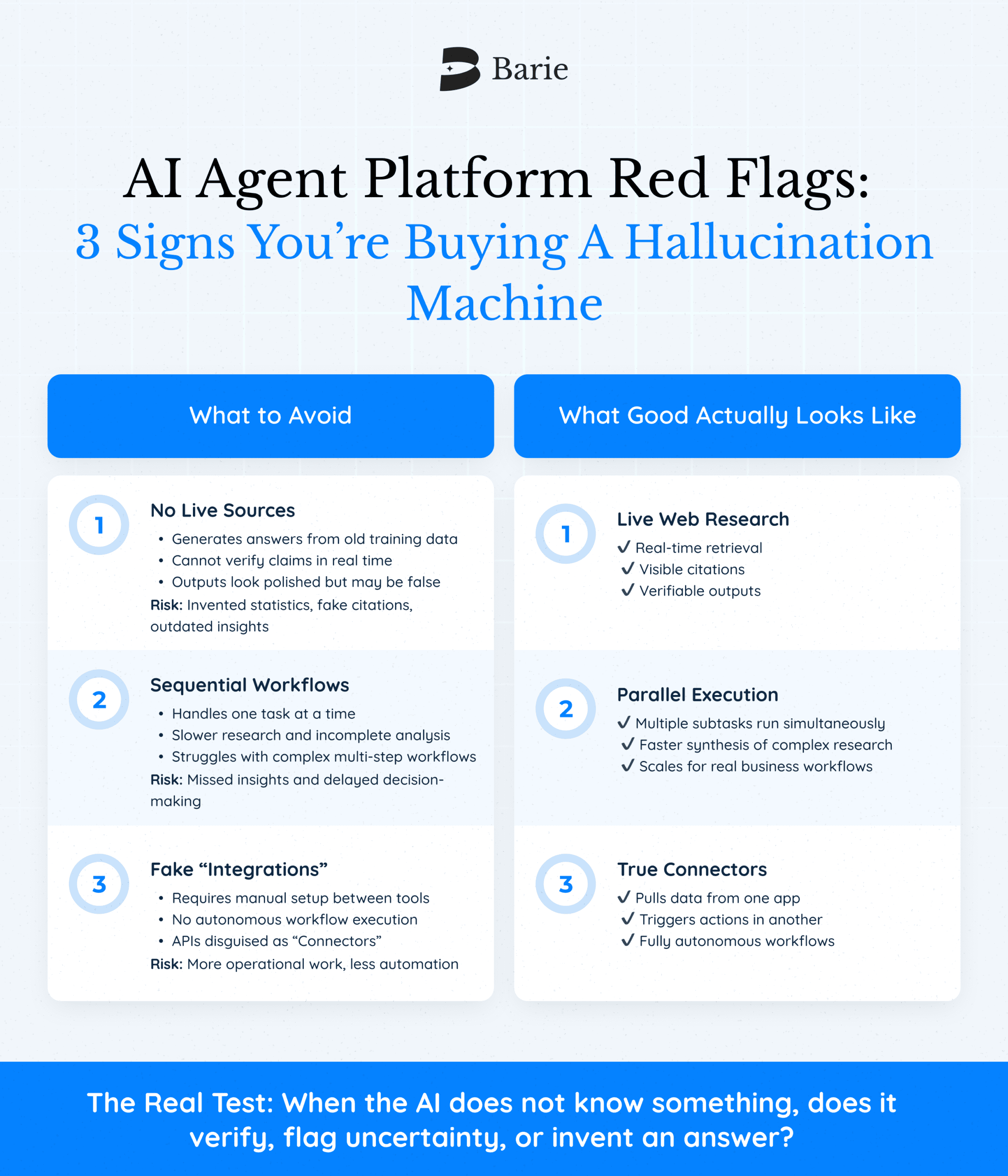
1. Live Web Research, Not Static Training Data
The most important capability any AI agent platform can offer is direct access to sources. Not training data recall. Live retrieval from the current web, with visible citations showing where every claim originated.
This matters most in research-heavy workflows, competitive analysis, market intelligence, legal review, and financial briefings. Any platform without real-time web access gives you yesterday’s answers formatted to look current. If you cannot trace every output back to a source, you do not have a research agent. You have a confident text generator with better branding.
2. Parallel Workflow Execution
Single-threaded agents are slow by design and incomplete by consequence. When a platform processes tasks sequentially, it cannot handle the volume that real business decisions require from an autonomous system you are trusting with complex work.
Look for platforms that fire parallel subtasks simultaneously. A competitive analysis across five companies should not take five sequential steps. A well-built AI agent platform handles all five threads at once and delivers a synthesized result in far less time.
This is a structural difference in what workflows the platform can realistically support. It is not a performance toggle buried in advanced settings, and it is not a minor optimization. It determines whether the platform can handle the work you actually have.
3. Connector Depth and Real App Integration
Integrations listed on a pricing page are not the same as real Connectors. True integration means the agent pulls data from one tool and pushes results to another inside a single autonomous workflow, without any manual routing from you.
Ask vendors one direct question before you proceed: Can your agent retrieve data from App A and trigger an output action in App B inside the same autonomous workflow, without any manual steps?
If the answer involves webhooks you configure yourself, that is not a Connector. That is an API wrapper with a better marketing budget, and you will notice the gap six weeks after signing a contract.
4. Skills That Keep Agent Behavior Consistent
The strongest platforms let you define structured, reusable instructions governing how the agent behaves for specific task types. The agent follows a defined playbook rather than improvising from scratch on every prompt.
This matters directly for reproducibility and operational trust. If the same research prompt produces wildly different outputs across three consecutive runs, you cannot build reliable workflows on top of it. Look for platforms where behavior is auditable, consistent, and adjustable without a developer on standby for every change.
5. A Verifiable, Independent Accuracy Standard
This is the one most vendors will not show you. Ask for benchmark data. Ask how accuracy is measured. Ask for third-party validation, not internal metrics dressed up as independent evidence.
A 2026 ICLR paper found that as LLMs are trained to reason harder, tool-call hallucinations actually increase in frequency. That is a structural risk embedded in any platform that has not specifically addressed it. Without a verified accuracy standard, you are handing business decisions to a vendor’s marketing team and calling it automation.
What to Avoid
Platforms That Cannot Show Their Sources
If an output does not tell you where the information came from, avoid it for any research task. A sourced output is auditable. An unsourced output is a liability you carry silently until it surfaces at the worst possible moment.
Single-Agent Tools Disguised as Platforms
Some products brand themselves as agent platforms but run a single AI process behind a shinier interface. They cannot orchestrate multiple agents, cannot run parallel workflows, and cannot scale to complex multi-step tasks. They are chat interfaces with automation labels attached to their pricing page.
Tools Built for Demos, Not Production
Platforms that perform well on simple, clean prompts and degrade under anything ambiguous or multi-step are not production-ready. Real workflows are messy and time-sensitive. Your platform needs to handle that without constant manual correction from the person it was supposed to replace.
Any Vendor That Cannot Define Its Accuracy Rate
Vague language about hallucination reduction is not a humility signal. If a platform cannot state how it measures output quality and what the verified rate is, treat every output from that tool as provisionally unreliable until you have independent evidence otherwise.
What This Looks Like When It Actually Works
One prompt. Barie analyzed 30 financial research papers, identified three underexplored investment gaps, built a structured brief with live citations, and delivered it to the user’s connected workspace. Under twenty minutes. Every source traceable. Every claim verifiable.
Barie researches the live web instead of recalling from training data. It runs parallel subtasks, so complex research can be completed in a single session. Its Connectors link your existing tools into autonomous multi-step workflows, and its Skills keep agent behavior consistent and reproducible across every run.
It meets the GAIA Level 3 benchmark, which tests whether an AI can reliably complete genuinely complex, multi-step tasks. Most platforms do not publish GAIA results. Barie does. It has processed over one million hallucination-free chats across 25+ industries, and holds a 90% accuracy rate that is documented publicly.
The Question That Separates Real Platforms From the Rest
Before you commit to any AI agent platform, ask one honest question: when the agent does not know something, what does it actually do next, and can you see evidence of that behavior in a real workflow?
If it searches the live web and shows the source, that is a trustworthy system. If it refuses and flags the gap explicitly, that is honest behavior you can design around. If it generates a plausible-sounding answer and moves on, you have a compounding problem that grows harder to catch over time.
The best AI agent platforms are built by people who have asked that question before shipping a single feature. The rest were built by teams who found the question inconvenient and the outputs impressive enough to ship anyway.
Explore Barie for free and power your first workflows with 900 credits.