The article
Your SDR sent 3,000 cold emails last month.
Forty-two people opened them. Six replied. Four told you to remove them from the list.
That is not a volume problem. That is a targeting problem dressed up as a hustle problem. And every tool trying to solve it with better subject lines is fixing the wrong end of the pipeline.
The companies pulling qualified leads in 2025 are not sending more emails. They are researching smarter before sending a single one. That is what AI lead generation actually looks like when it works, and it looks nothing like what most teams are doing.
Why AI Lead Generation Fails When It Starts With Outreach
Most AI lead generation tools are built backward. They give you a list, hand you a sequence, and automate the spray. The AI sits at the send stage, not the research stage. So you get faster spam, not better leads.
Intent data has become essential in modern B2B pipelines. AI can track behavioral signals, website visits, content interactions, and job changes to identify purchase readiness before a prospect ever reaches out to sales. The teams winning right now are reading those signals first and reaching out second.
The problem is that most AI tools cannot do real research. They pull from training data, stale databases, or third-party enrichment APIs that were accurate six months ago. You end up personalizing a cold email based on information that no longer applies to the person receiving it. That is not personalization. That is performance.
What Real AI Lead Research Actually Looks Like
Here is the workflow that separates signal-based prospecting from spam.
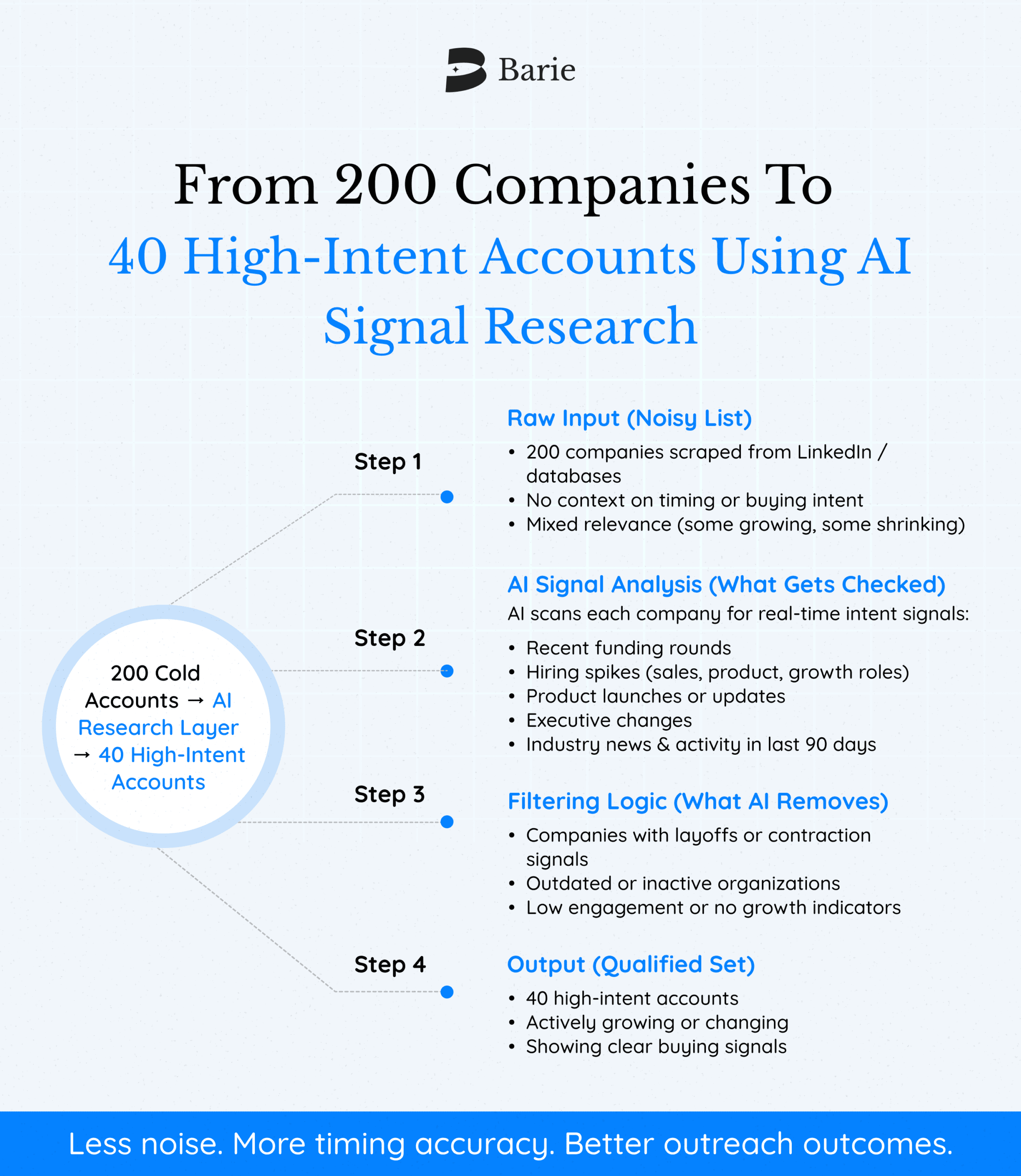
A sales lead at a mid-sized B2B SaaS company is trying to build a pipeline of 50 accounts worth targeting this quarter. She opens a spreadsheet of 200 companies her team scraped from LinkedIn Sales Navigator. The problem is she has no idea which ones are actually in-market right now.
She runs each company through a deep research session. What she gets back is not a contact card. It is a research brief: recent funding rounds, product launches, hiring signals, published content themes, tech stack changes, industry news, and executive quotes from the last 90 days. She can see which companies are actively growing a sales team, a buying signal for her product, and which ones just went through a round of layoffs. The list of 200 becomes a prioritized 40. Those 40 get outreach that references something real.
Static campaign lists are being replaced by dynamically prioritized account lists built from current intent signals. When outreach aligns with actual buying behavior in near real-time, engagement and conversion rates climb significantly. The research is the leverage. The email is just the vehicle.
The Three AI Lead Generation Workflows That Replace Cold Spam
1. Prospect Research at Account Level
The oldest problem in AI lead generation is that most tools stop at the contact. They give you a name, a title, and an email. They do not tell you why this person might buy from you today versus six months ago.
AI agents now analyze datasets that include engagement signals, firmographic data, and intent intelligence simultaneously. Instead of manual research, AI segments audiences based on industry, job title, engagement history, and real-time buying signals.
Barie runs that research in parallel across multiple accounts. One prompt. Every account was researched simultaneously. The output is a structured brief with live citations traceable to their sources, ready to inform outreach before a word of copy is written. What used to take an analyst three days takes one session.
2. Personalization That Is Actually Personal
The reason cold email fails is not frequency. It is relevant. A prospect who receives an email referencing a problem they published about two weeks ago will respond differently than someone who got your standard “I noticed you work in [industry]” opener.
Barie’s Prompt Library contains pre-built research prompts built specifically for lead research workflows, account summaries, ICP matching, competitive gap analysis, and buying signal detection. Sales teams run these prompts across their target accounts and get outputs they can use directly in outreach: the precise context that makes a message feel like it was written by someone who did the work.
That is the distinction. Not AI-written emails. AI-researched context, fed into human-written outreach. Specificity is the key driver of cold outreach conversion. Instead of generalized points, effective outreach gets specific about what genuinely helps the person being targeted.
3. Connecting Research to Execution Without Manual Steps
The other failure mode in most AI lead generation setups is the handoff. Research happens in one tool. Enrichment in another. CRM updates in a third. Sequence creation in a fourth. Each transition introduces delay, data loss, and human error.
Barie’s Connectors handle the handoff autonomously. A research session that identifies 15 high-intent accounts can trigger a workflow that pushes those accounts directly into your CRM, flags them for the relevant rep, and pulls together a one-page brief per account. No copy-pasting. No manual enrichment runs. The research and the execution happen in the same session.
This matters because speed is a competitive signal in lead generation. AI-driven systems identify buying signals and personalize every touchpoint. They generate qualified leads, stronger relationships, and higher engagement for every campaign. The team that reaches a high-intent account first, with relevant context, wins the conversation.
Why Most AI Tools Cannot Do This
Chat-based AI tools will answer your research questions. They will not verify them.
Ask ChatGPT to summarize a company’s recent activity, and it will give you a confident, well-structured paragraph about what that company was doing 18 months ago. It will not tell you about the product launch from last month. It will not flag the executive departure from last quarter. It will not cite a source you can check.
That is not a research tool. That is a paraphrasing tool with good formatting.
Barie does not answer from the training data. It researches the live web, pulls current sources, and shows you exactly where each piece of information came from. Every claim in the output is traceable. When a rep uses a Barie brief to inform their outreach, they know the information is up to date. That changes the quality of the conversation they are walking into.
Barie aces the GAIA Level 3 benchmark, the industry’s most rigorous test for complex, multi-step AI task completion. Most tools do not publish GAIA scores. Barie’s 90% accuracy rate across 1M+ research sessions is not a marketing claim. It is what anti-hallucination looks like in production, across 25+ industries.
The Verdict on AI Lead Generation
The companies that will own their category pipeline in the next two years are not the ones sending more sequences. They are the ones who know more about their prospects before they send the first message than their competitors know after three follow-ups.
AI lead generation is not about automating outreach. It is about conducting research quickly so that every piece of outreach earns a reply because it is actually relevant.
That is the shift. And most teams are still on the wrong side of it.
If your lead research is still taking days, or your AI tool is still confabulating prospect details, your pipeline problem starts earlier than your outreach.
Start your first deep research session free at Barie and get 900 credits.