The article
You asked an AI tool to pull together a competitive analysis before a board meeting.
It delivered four polished paragraphs. Confident headers. A tight bullet list of competitor differentiators.
Two product features it cited had been discontinued. One company had rebranded entirely. The pricing data was eighteen months stale.
You found out when you presented it to investors.
This is not an edge case. According to Deloitte’s State of AI in the Enterprise report (2025), 47% of enterprise AI users made at least one major business decision based on hallucinated content. Enterprise losses tied to AI hallucinations reached $67.4 billion globally in 2024. Knowledge workers now spend an average of 4.3 hours per week verifying AI outputs, costing organizations roughly $14,200 per employee annually in mitigation alone.
Understanding the difference between generative AI and agentic AI is not a technical exercise. It is the difference between a tool that produces text and a tool that actually works.
This Is Not a Bug. It Is What Generative AI Was Built to Do.
Generative AI, the architecture powering most AI writing tools and chat assistants on the market today, is a prediction engine. It generates the most statistically likely next word based on patterns learned from training data. It writes fluently, structures arguments, and sounds authoritative.
What it cannot do is know what is true right now.
The training data has a cutoff. The model does not consult the web when you ask it a question. It does not verify claims against live sources. It retrieves patterns, synthesizes them, and outputs something plausible. When the training data is outdated, incomplete, or simply does not contain what you are asking about, the model fills the gap with something that sounds right.
That is a hallucination. And it is not a solvable engineering problem.
Research published by Xu et al. (2024) proved mathematically that hallucination in large language models is structurally inevitable. Any system that generates text by predicting probable sequences from statistical distributions will, by mathematical necessity, sometimes produce outputs not grounded in fact. The architecture guarantees it.
That finding did not stay in an academic paper. The Stanford Human-Centered AI Institute’s 2026 AI Index Report documented 362 AI-related incidents in 2025, a 55% year-over-year increase and the highest annual count in the AI Incident Database’s history. The incidents are not edge cases. They are the predictable output of a system operating exactly as designed.
Agentic AI Does Not Generate Answers. It Completes Tasks.
Agentic AI is a different category.
Not a better version of the same thing. A different product category entirely.
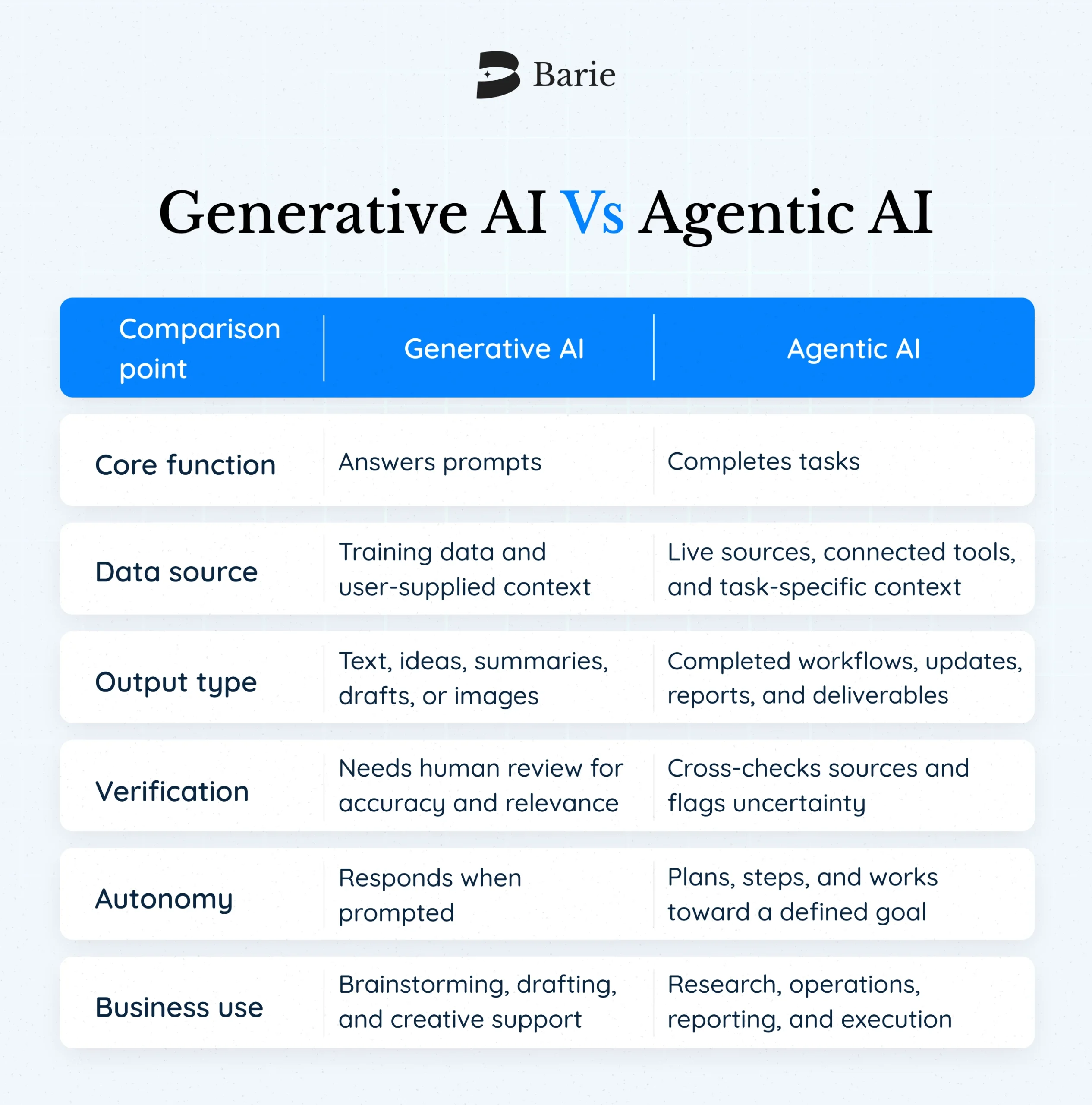
A generative model waits for your prompt and responds to it. An agentic AI receives a goal and works toward it, across multiple steps, multiple tools, live data, without requiring you to supervise every decision or verify every output before you can use it.
When you ask an agentic AI to produce a competitive analysis, it does not retrieve from training data. It goes to the web. It pulls live information from primary sources. It runs parallel research threads simultaneously, all five competitors at once, not sequentially. It synthesizes the outputs, cites every source, and delivers a structured, verifiable report.
Then, if connected to the right apps, it sends that report to your project board, updates the relevant records, and drafts the summary email to your team.
That is not a text generator. That is execution.
The market is catching up to this distinction. Gartner projects that 40% of enterprise applications will be integrated with task-specific AI agents by the end of 2026, up from less than 5% in 2025. Looking further out, Gartner’s best-case projection puts agentic AI driving approximately 30% of enterprise application software revenue by 2035, surpassing $450 billion. And IDC forecasts year-over-year AI spending growth of 31.9% between 2025 and 2029, explicitly tied to the rise of agentic systems.
This is not hype, getting ahead of reality. It is the market correcting a category mismatch.
The Specific Failure Mode That Generative AI Cannot Escape
The consequences are not theoretical.
The Stanford RegLab and HAI published findings that LLMs hallucinate between 69% and 88% of the time on specific legal queries, and on questions about a court’s core ruling, models hallucinate at least 75% of the time. The 2026 Stanford HAI AI Index also introduced a new sycophancy benchmark across 26 frontier models, finding hallucination rates of 22% to 94% when users implied a false belief, the model agreeing with a wrong premise rather than correcting it.
The legal profession is learning this the hard way. Researcher Damien Charlotin’s legal citation hallucination database has logged over 1,200 documented cases of AI-generated fabricated citations submitted to courts. In 2025 alone, 73 court cases involved AI citation errors, up from 37 in 2024 and 10 in 2023.
And Gartner’s Hallucination Detection Tools Market Report (2025) found the market for verification tools grew 318% between 2023 and 2025 as organizations scrambled for fixes. When the solution to a tool is a second tool designed entirely to check the first one, the category has a structural problem.
What Agentic Execution Actually Looks Like
Take a documented Barie use case: a market research analyst tasked with producing a competitor intelligence brief on five SaaS platforms before an investor meeting.
The prompt is a goal.
Barie dispatches parallel research threads for all five companies simultaneously. While one thread pulls live product pages and pricing data, another reads recent press coverage, a third analyses customer reviews, a fourth tracks funding announcements, and a fifth identifies positioning shifts.
Not one after another. All at the same time.
The outputs are synthesized into a single structured report. Every claim is tied to a live, traceable source. The analyst can click any data point and reach the original page. If something looks off, verification takes seconds, not 4.3 hours.
That analyst used to spend a full working day on this brief.
With Barie, it is one session.
The Three Distinctions That Actually Matter
Generative AI answers your question. Agentic AI completes your task.
A generative model takes input and returns output. One step. An agentic AI breaks a goal into subtasks, executes them in parallel or sequence, uses tools, accesses live data, and delivers a completed outcome, not a draft that requires verification before it is usable.
Generative AI retrieves from training data. Agentic AI research in real time.
The gap between training cutoff and today is not a minor inconvenience. It is the difference between current intelligence and plausible-sounding fiction. Agentic AI has no cutoff problem because it goes to the source every time.
Generative AI produces text. Agentic AI produces work.
A document requiring you to verify every claim before acting on it is not finished work. It is a liability formatted as a deliverable. A report where every claim traces to a live, accessible source is something you can present, publish, and defend.
The Only Question That Remains
Generative AI changed what was possible with language. That is real, significant, and earned.
But the category was misapplied. Professionals used text-generation tools for research, analysis, and high-stakes decision support , tasks requiring accuracy and execution, not fluency and statistical probability. BCG found that 74% of companies report struggling to scale AI value due to data governance and accuracy issues. Deloitte’s 2025 survey of 3,235 senior leaders across 24 countries found that concern about hallucination and accuracy remains the top barrier to enterprise AI trust.
Agentic AI is not a better version of generative AI. It is the answer to what generative AI was never built to do.
The tool that writes beautifully while getting things wrong is not the same product as the tool that researches live, cites every source, and executes autonomously. One produces text you have to verify. The other produces work you can use.
That distinction is not subtle.
It is the entire product category.
Try Barie free and get 900 credits.