The article
Over the years, digital research has been understood to mean nothing more than searching, scanning, and summarizing. It was all about speed, either with search engines or even simple AI chatbots that intended to give an answer and move on. However, this has begun to be demonstrated as problematic as information has become more complex and interconnected. Rapid responses tend to be contextless, shallow, and untrustworthy.
It is this gap that has resulted in the emergence of two closely connected ideas: deep research and the AI agent. Unlike conventional tools that only retrieve surface-level information, a deep research approach allows an agent to examine a topic systematically, evaluate multiple sources, and organize findings into structured insights. The system does more than generate a single response; it reasons through information, adapts its strategy as new evidence appears, and continuously refines its understanding throughout the research process.
From Information Retrieval to Knowledge Exploration
The current reality is that most individuals today engage with AI as a sophisticated search engine. You query something, and the system gives you a brief answer. Although it is useful, the model is effective when dealing with straightforward questions and factual searches. It falters when issues must be compared, synthesized, or reasoned about in long form.
An in-depth research AI agent alters this situation. It does not give up on the first plausible answer but looks at a task in the manner that a researcher would approach it. It determines what should be investigated, which aspects should be verified, and how various pieces of information are interrelated. The distinction between in-depth research and standard AI assistance lies in the shift from simple information retrieval to comprehensive investigation.
This practically implies that the user can transition between “Tell me about this topic” and “Analyze this issue” by looking at it through various lenses and discussing what is most important.
What Is Deep Research in an AI Context?
To learn about the role of an AI deep research agent, it is useful to define what is meant by deep research.
Deep research involves:
- Subdivision of multifaceted questions into smaller, structured questions.
- Analyzing numerous trustworthy sources as opposed to just one.
- Locating trends, voids, and inconsistencies.
- Generalizing the conclusions to an explanation.
It is these same principles that are automatically applied by an AI deep research assistant. It is not based on one transmission of information. Rather, it constantly improves its search and reasoning mechanisms as new knowledge is discovered. This renders it especially useful in areas in which speed is not so important as accuracy and context are.
How a Deep Research AI Agent Works in Practice
Although the implementation varies, the majority of deep research agents have a comparable reasoning loop.
Developing a research strategy
The agent does not generate an answer immediately when he is given something to do. The first step it takes is to develop a plan: what should be investigated, what type of sources should be referred to, and how the topic can be divided into logical parts. This provides a roadmap of exploration.
Dynamic exploration of sources
The agent does not scan single results but reads linked material, uses references, and assesses credibility. It modifies its route as it gets to know what information is valuable and what is not.
Changing with the emergence of new knowledge
Once the agent realizes some of its findings are not expected, or the questions are deeper, the agent can restart all over again. This adaptive behavior is reflected as human researchers change focus in solving a problem.
Generalizing organized findings
Lastly, the system packs its discoveries into a comprehensible and practical format. Users are given insights, which point to relationships, trends, and implications instead of raw data. This is done to ensure that the deep research agent is less like a chatbot and more like an online analyst.
Why Businesses and Professionals Need Deep Research Agents
The new work environment requires the ability to perceive the systems that are complex: markets, laws, technologies, and consumerism. Manual research is time-consuming and not always consistent, whereas superficial AI summaries may overlook important nuance.
Deep research agents will fill this gap by providing:
- Deep analysis more quickly
- Less cognitive loading on the knowledge workers
- Increased uniformity in the quality of research
- Better decision support
To organizations, this involves converting huge amounts of data into intelligence instead of disjointed data.
Applicability of Deep Research AI Agents in the Real World
The effects of deep research on agents are already observed in various fields.
Stock Market Analysis
The deep research agents analyze the financial information and follow the past trends as well as correlate the economic variables with the performance of the company. They do not merely provide numbers but point out relationships that are used in making investment decisions.
Legal Research
The agents are able to scan the case law and legal documents to extract pertinent arguments and compare regulatory amendments. This enables the professionals to concentrate on interpretation and not on hunting for documents.
Media and Travel Planning
Flights, accommodation, and activities are only some of the possible activities that deep research agents analyze and create personalized travel guides for, depending on the user’s requirements and limitations.
Complex Data Analysis
Agents have the ability to break down tasks into parallel subtasks when the datasets are large or multi-dimensional to discover insights at rates not previously possible in traditional analytical processes.
Research and Literature Review.
Deep research agents can search through a large number of papers, draw up themes, pinpoint knowledge gaps, and summarize new trends in a scientific and technical field.
Such examples demonstrate that a deep research agent does not belong to a single industry, and it is a generalized instrument of organized thinking.
Deep Research AI Agent vs. Traditional AI Assistants
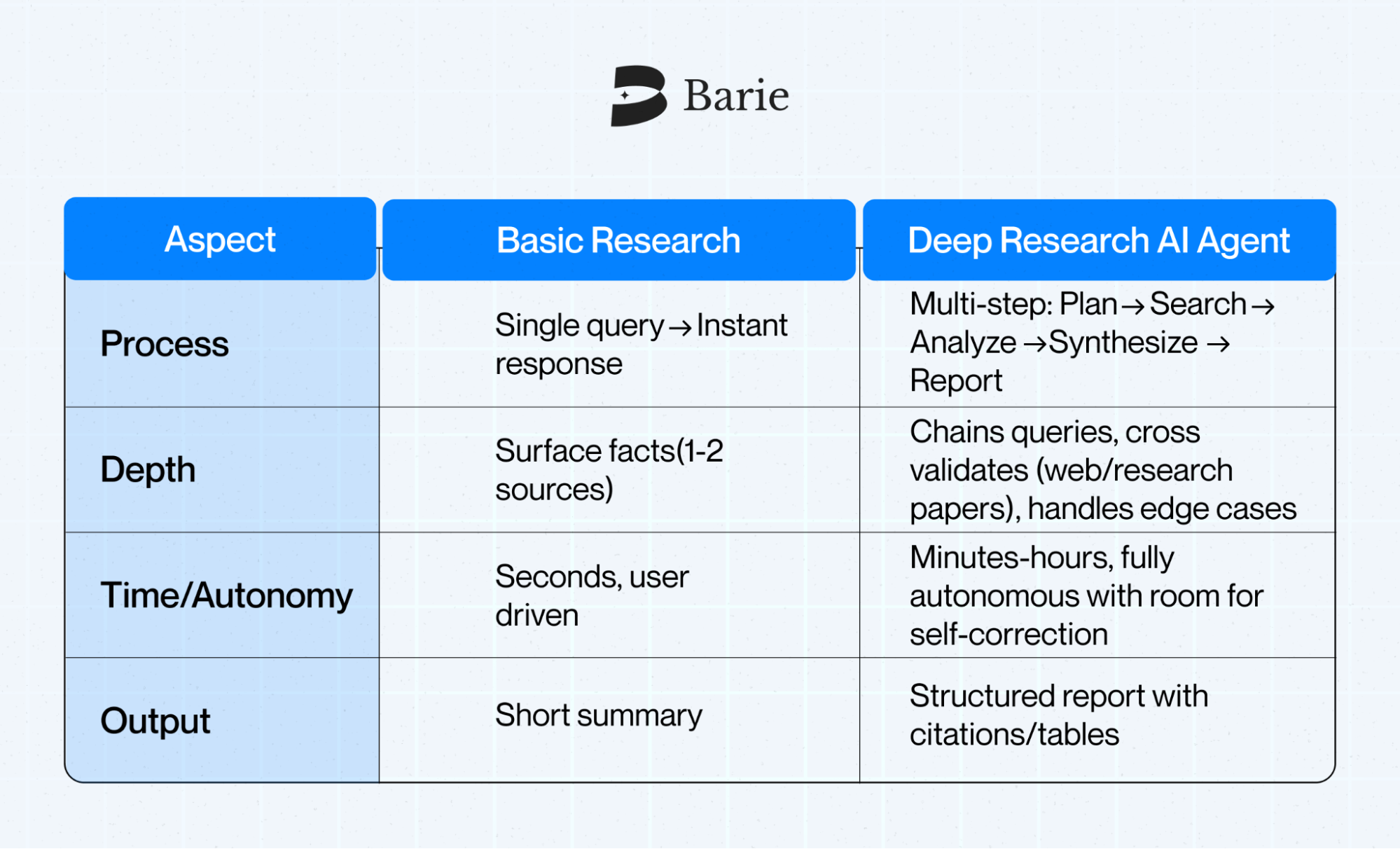
The distinction between an average AI assistant and a deep research AI agent is by purpose and action. Conventional assistants aim at generating one response in the shortest time possible. A deep research agent dwells upon the comprehension of a problem in detail and then responds to it. One is convenience-oriented, and the other is comprehension-oriented.
In a situation where a chatbot would reply, “Here is a summary,” a deep research agent would reply, “What does this topic really mean when explored in many directions?” This difference is critical in cases where accuracy, reliability, and context are critical.
How Barie AI Assistant Helps in Research Across Industries
The emergence of the deep research AI agent is the beginning of a new era in the way we explore and perceive complex information. Beyond the fast response mode of inquiry, these systems facilitate more in-depth research in the fields of finance, law, science, and travel planning. Barie offers a research AI that can think, adapt, and deliver actionable insights. It transforms vast amounts of data into clear information, helping professionals make informed decisions more quickly and efficiently.
Sign up today and see how it works!