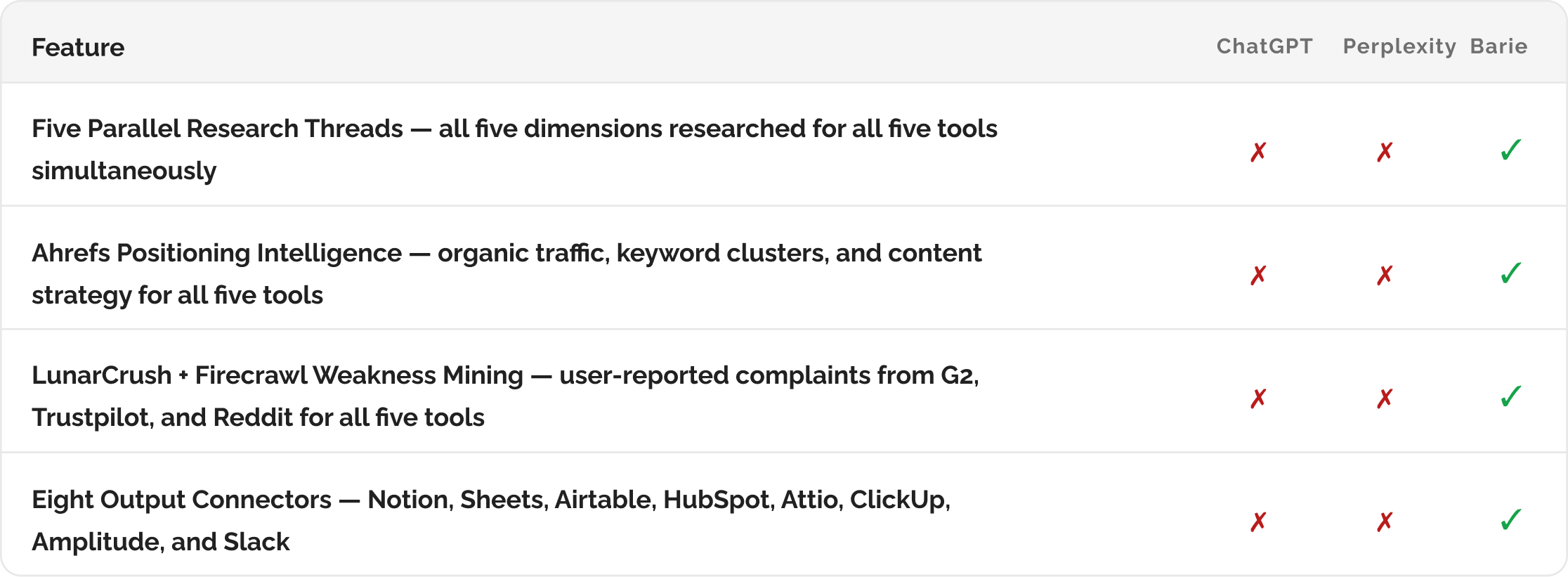
How Barie runs a full competitive teardown of the top 5 project management tools — features, pricing, positioning, funding, and weaknesses
Five parallel research threads. Features extracted from live product pages. Pricing retrieved from published plans at query time. Positioning decoded from marketing copy and SEO strategy via Ahrefs. Funding and investor data from Crunchbase. User-reported weaknesses pulled from G2, Trustpilot, and Reddit via Firecrawl and LunarCrush. Every data point sourced. Every claim traceable to the page it came from.
Why competitive teardowns built manually are outdated before they are finished
A product director at a B2B SaaS company spent four days building a competitive analysis of the top five project management tools before a positioning workshop. She divided the work across three team members and a freelance researcher. By the time all the sections were consolidated into a single document, ClickUp had updated their pricing page twice, Linear had announced a new enterprise tier, and Monday.com had run a new campaign with a completely different messaging angle than the one documented. The analysis was four days old and partially wrong before anyone used it.
The structural problem with manual competitive research is that the research and the market move at different speeds. Features, pricing, and messaging change continuously. A teardown built from screenshots and notes has a timestamp on every data point, even if nobody knows what it is. And when a product or strategy decision is made from that analysis, nobody knows which parts of the picture were current and which were outdated.
Five connectors, five dimensions, five competitors, all at the same time: Barie does not research one tool and then move to the next. All five product pages are crawled by Firecrawl simultaneously. All five pricing pages are retrieved in the same session. Ahrefs pulls the SEO and keyword positioning data for all five at once. Crunchbase funding data for all five is retrieved in parallel. G2 and Reddit user reviews for all five are pulled via LunarCrush and Firecrawl together. The complete dataset across all five dimensions and all five tools is assembled before any analysis is written.
Your prompt
Task prompt
“Do a full competitive teardown of the top 5 project management tools, features, pricing, positioning, funding, weaknesses.”
One sentence. Before the first data point is retrieved, Barie identifies the five tools that constitute the current top of this market and activates the five connectors that handle each research dimension. Here is the full workflow.
1: Competitors Identified · Connectors Activated
Step 1: Five tools confirmed from live market data, five connectors activated
Before Barie retrieves a single pricing page or feature list, it confirms which five tools actually constitute the current top of the project management market. This is not assumed from training data. Ahrefs confirms the five tools with the highest organic search visibility in the “project management software” keyword cluster. G2 category rankings and Gartner Peer Insights category leaders are retrieved via Firecrawl to cross-reference. Crunchbase confirms which five have the highest funding levels and therefore the most market presence. The five confirmed tools feed directly into the parallel research threads.

With the five tools confirmed, Barie activates the five connectors that handle each research dimension. All five research threads fire simultaneously from the moment the prompt is processed.
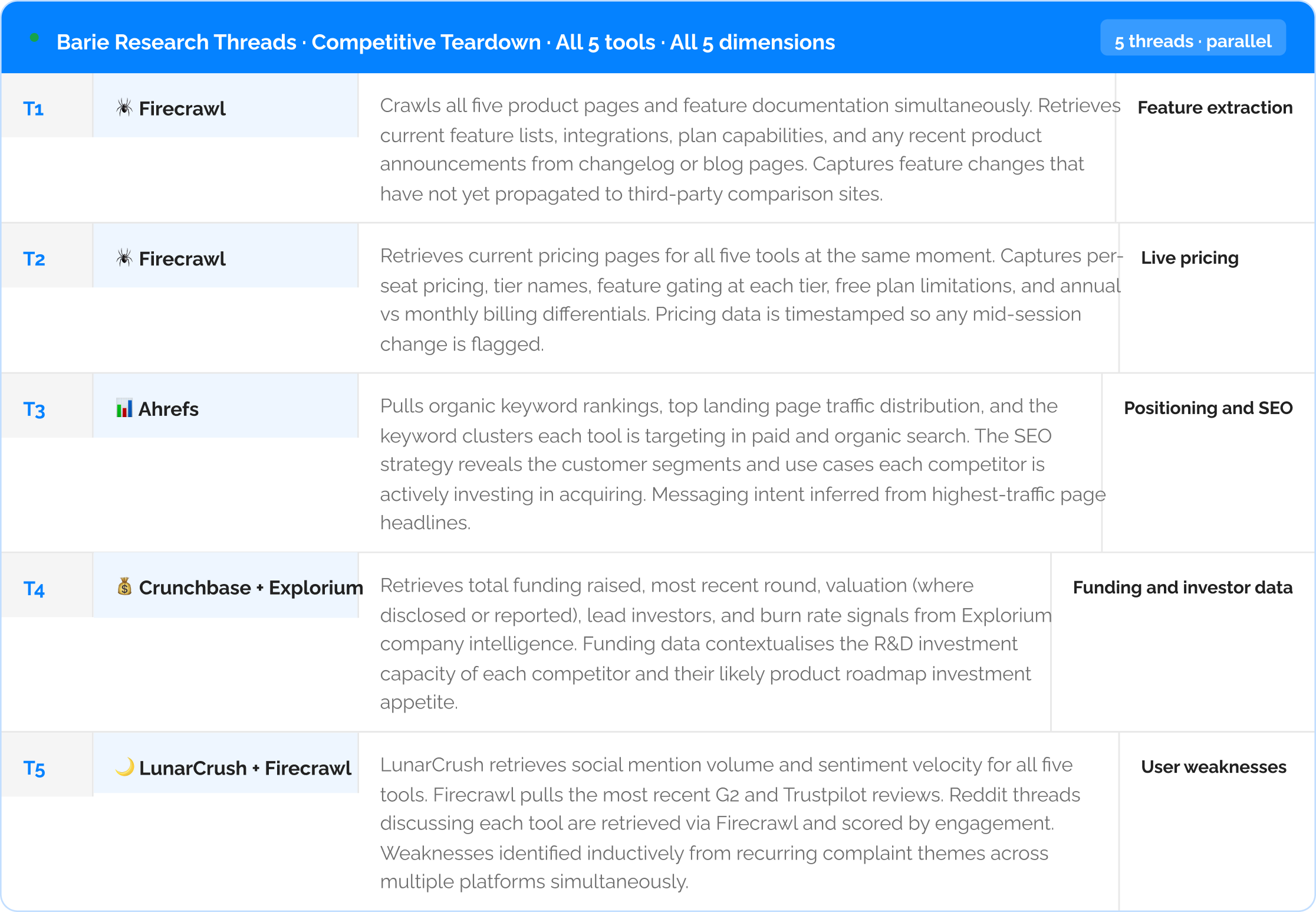
All five threads and all five tools run simultaneously: Thread 1 is not retrieving Asana’s features while Thread 3 waits. All five threads retrieve data for all five tools at the same moment. The full dataset across all 25 combinations of tools and dimensions is assembled before the analysis is written. This is architecturally how Barie can complete a task that would take a team of five researchers a week, in a single session.
2. Parallel Live Research
Step 2: What each connector finds across all five tools

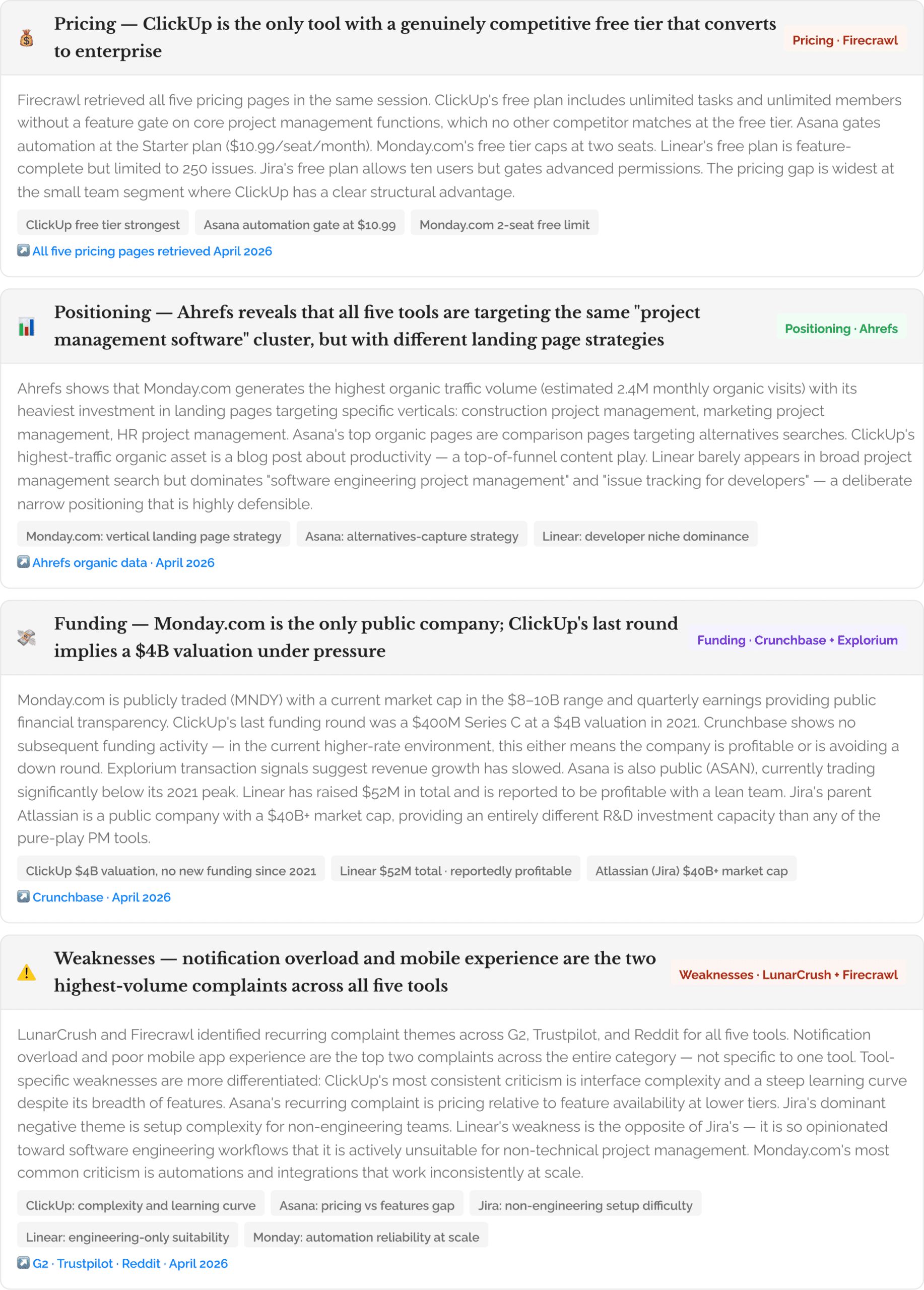
3: Structured Comparison Output
Step 3: The structured comparison — all five tools across all five dimensions
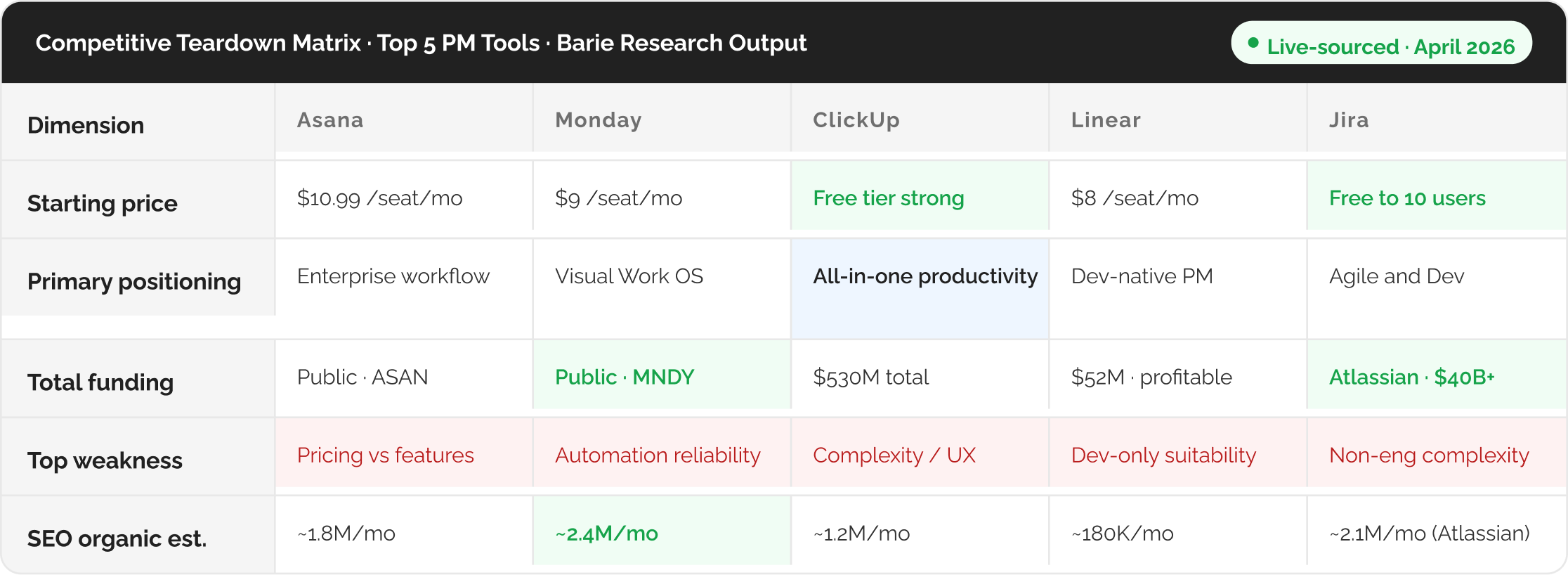
Every cell in the comparison links to the live source it came from: The pricing figures link to the current pricing pages. The SEO estimates link to the Ahrefs data retrieved at query time. The weakness classifications link to the G2 and Reddit thread data. If a pricing figure changes between this session and the next strategy meeting, the source link shows you what the page says now so you can update the single affected cell rather than re-running the entire analysis.
Distributed via Connectors
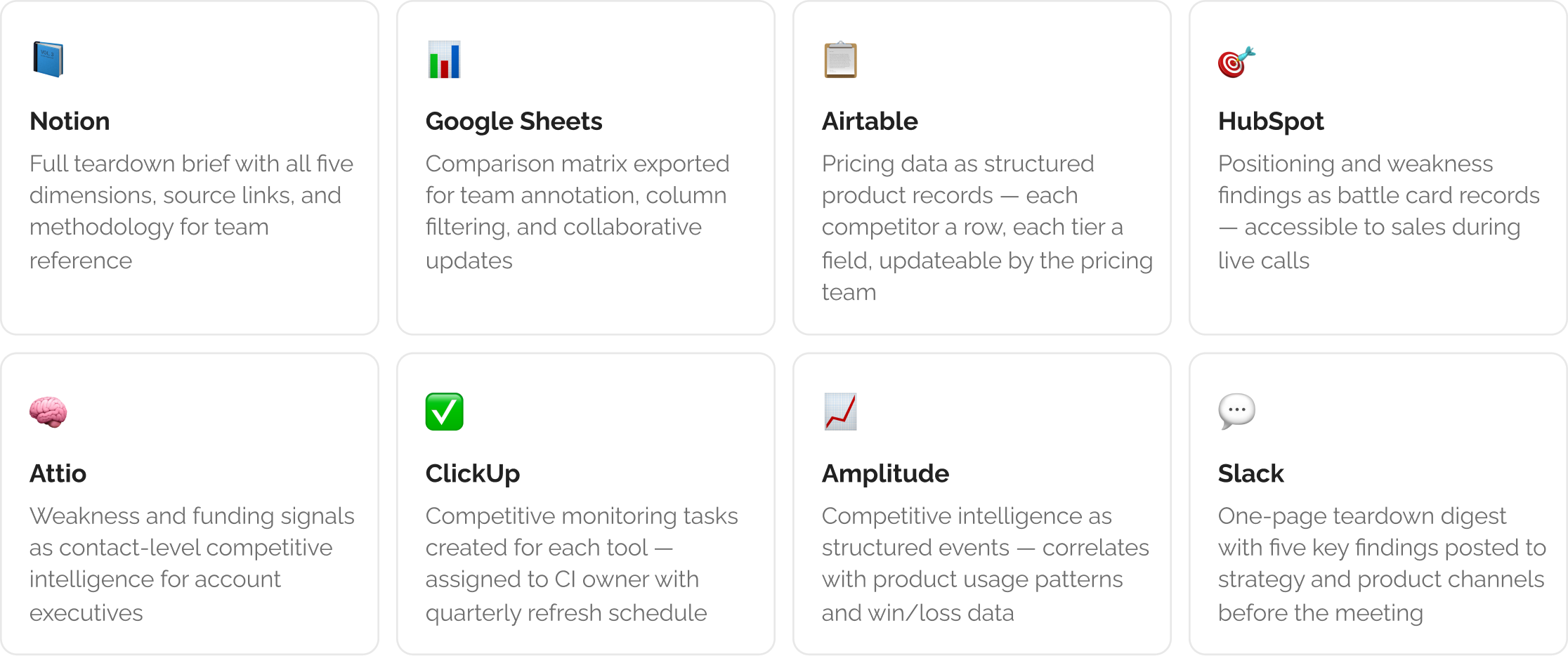
Step 4: The teardown distributed across eight output connectors to where your team actually works
The research is complete and the comparison matrix is built. Barie now routes each component of the teardown to the tool in your stack that is most useful for that component. The full intelligence brief goes to Notion with all source links active. The comparison matrix goes to Google Sheets for team annotation. The pricing data goes to Airtable as a structured product record database your pricing team can update in real time. The competitive positioning findings go to HubSpot as battle card records your sales team can access during live calls. The weakness intelligence goes to Attio as contact-level competitive signals your account executives can reference when prospects mention a competitor. The funding intelligence goes into a ClickUp task for your competitive intelligence owner to monitor for new rounds. Amplitude receives structured competitive intelligence events. A summary digest posts to Slack before the strategy meeting.
Configure a monthly refresh on the pricing and positioning threads: Pricing pages and SEO strategies change faster than features and funding. Configure Barie to re-run Thread 1 (pricing) and Thread 3 (Ahrefs positioning) monthly, pushing changes to the Airtable pricing record and the Notion brief automatically. Thread 4 (funding) re-runs quarterly since funding events are less frequent. The full teardown remains current without a full-session repeat.
What you get
A complete competitive teardown of Asana, Monday.com, ClickUp, Linear, and Jira across five dimensions: current feature set from live product pages, live pricing at query time, SEO and content positioning strategy from Ahrefs, funding and financial health from Crunchbase and Explorium, and user-reported weaknesses from G2, Trustpilot, and Reddit. A structured comparison matrix with every cell source-linked. Distributed across eight output connectors: Notion, Google Sheets, Airtable, HubSpot, Attio, ClickUp, Amplitude, and Slack. Configured for monthly pricing and positioning refreshes and quarterly funding monitoring.
What would take a team of five researchers a full working week, Barie completes in one session. Every data point sourced. Every comparison cell current. Every output routed to where your team works.
The Verdict
A competitive analysis built manually is outdated before the session ends. Pricing changes, features ship, funding rounds close, and messaging pivots happen between when the first screenshot is taken and when the final document is shared. Barie runs five parallel threads — Firecrawl for product and pricing pages, Ahrefs for positioning intelligence, Crunchbase and Explorium for funding and financial signals, LunarCrush and Firecrawl for user review sentiment — all retrieving data for all five competitors simultaneously. The teardown reflects the competitive landscape as it stands today. And because every cell in the comparison links to its source, any element can be verified or updated in one click without re-running the full analysis. That is the difference between a competitive snapshot and a competitive intelligence capability.
Barie features used in this task