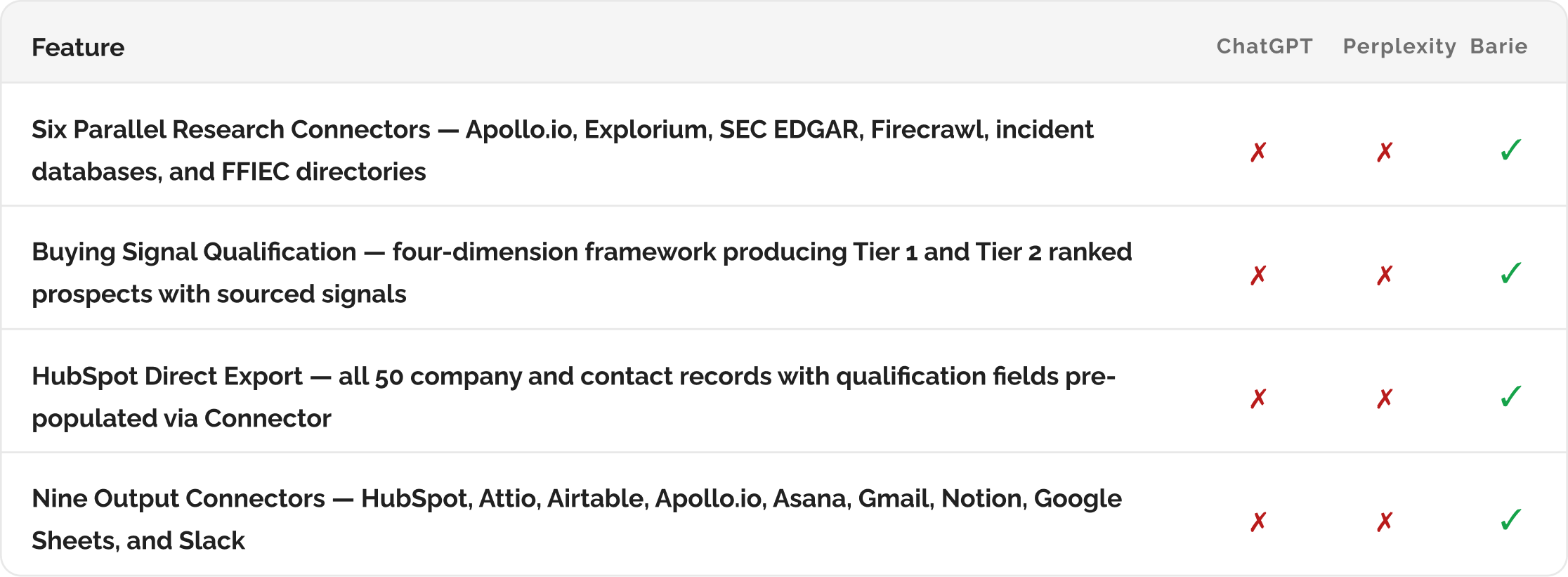
How Barie identifies 50 enterprise customers for an API security product in US financial services and exports the list directly to HubSpot
Barie researches financial institutions by size, API adoption signals, recent security incidents, technology stack, and regulatory exposure from live data sources including FFIEC directories, SEC EDGAR filings, Apollo.io company intelligence, and Explorium transaction signals. It delivers 50 qualified enterprise prospects with company context, buying signal notes, and a decision-maker contact for each. Exported directly to HubSpot. Research to pipeline in one prompt.
Why manually built financial services prospect lists produce the wrong fifty companies
A sales development representative at an API security startup spent three days building a target list of US financial services companies for their first enterprise outreach sequence. She searched LinkedIn for banks and credit unions above a certain size, cross-referenced with a G2 buyer list for API management tools, and added companies from an industry conference attendee list. By the end of the three days she had 50 company names, 50 LinkedIn profiles for the most relevant title she could find, and a spreadsheet with inconsistent data quality across every row.
What the list did not contain: which of the 50 companies had experienced an API security incident in the last 18 months and would therefore have a board-level mandate for exactly this type of product. Which had recently disclosed a material increase in API infrastructure investment in their quarterly filings, indicating an active technology modernisation cycle. Which were currently hiring for API security engineer roles, the clearest possible signal that a company is actively building the internal capability this product augments. And which already used a competing product whose contract was coming up for renewal.
A list of fifty company names is not a prospect list. A prospect list is fifty companies where there is an identifiable reason why they would buy this product, in this quarter, at this price point, from this vendor.
Buying signals, not just company names: Every prospect in the Barie output carries at least one live buying signal — a recent security incident disclosure, an active API security job posting, a recent technology stack change, or a SEC filing that references increased digital infrastructure investment. The signal is what transforms a directory listing into a sales conversation starter. Without it, the outreach starts with “are you interested?” With it, it starts with “we noticed.”
Your prompt
Task prompt
“Identify 50 potential enterprise customers for our API security product in US financial services, then export the list to HubSpot.”
One sentence. Before the first company is evaluated, Barie activates six connectors that provide the distinct data types required to qualify an enterprise financial services prospect beyond name and size. Here is the complete workflow.
1: Six Connectors Activated First
Step 1: Six connectors activated — each covering a data type the qualification framework requires
Qualifying an enterprise financial services prospect for an API security product requires six categories of data that live in six completely different architectures. The FFIEC and OCC public directories provide the universe of qualifying institutions. SEC EDGAR provides the financial disclosures that reveal technology investment signals. Apollo.io provides company intelligence, technology stack data, and decision-maker contact details. Explorium provides transaction signals that indicate active procurement cycles. Firecrawl retrieves open job postings that confirm internal security investment intent. The Have I Been Pwned and CISA databases provide recent security incident signals that create board-level urgency for exactly this type of product. Barie activates all six before the first prospect is evaluated.
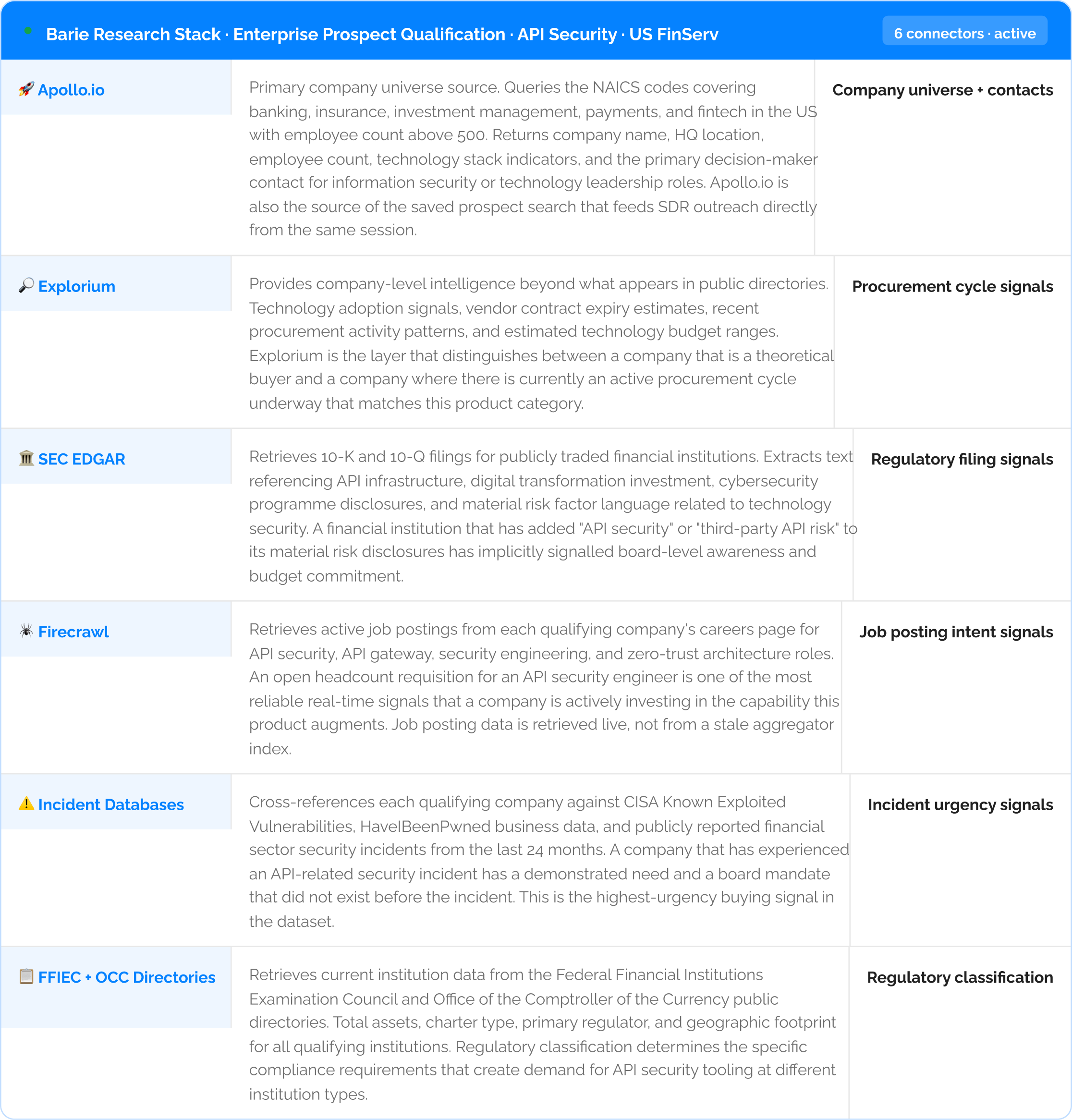
Six connectors run simultaneously, not one after another: The Apollo.io company universe query, the Explorium procurement signal scan, the SEC EDGAR filing extraction, the Firecrawl job posting retrieval, the incident database cross-reference, and the FFIEC directory pull all run at the same time. The complete qualification dataset is assembled before any company is scored. This is how Barie can return 50 qualified, signal-rich prospects rather than 50 company names that still need qualifying.
2: Four-Dimension Qualification Framework
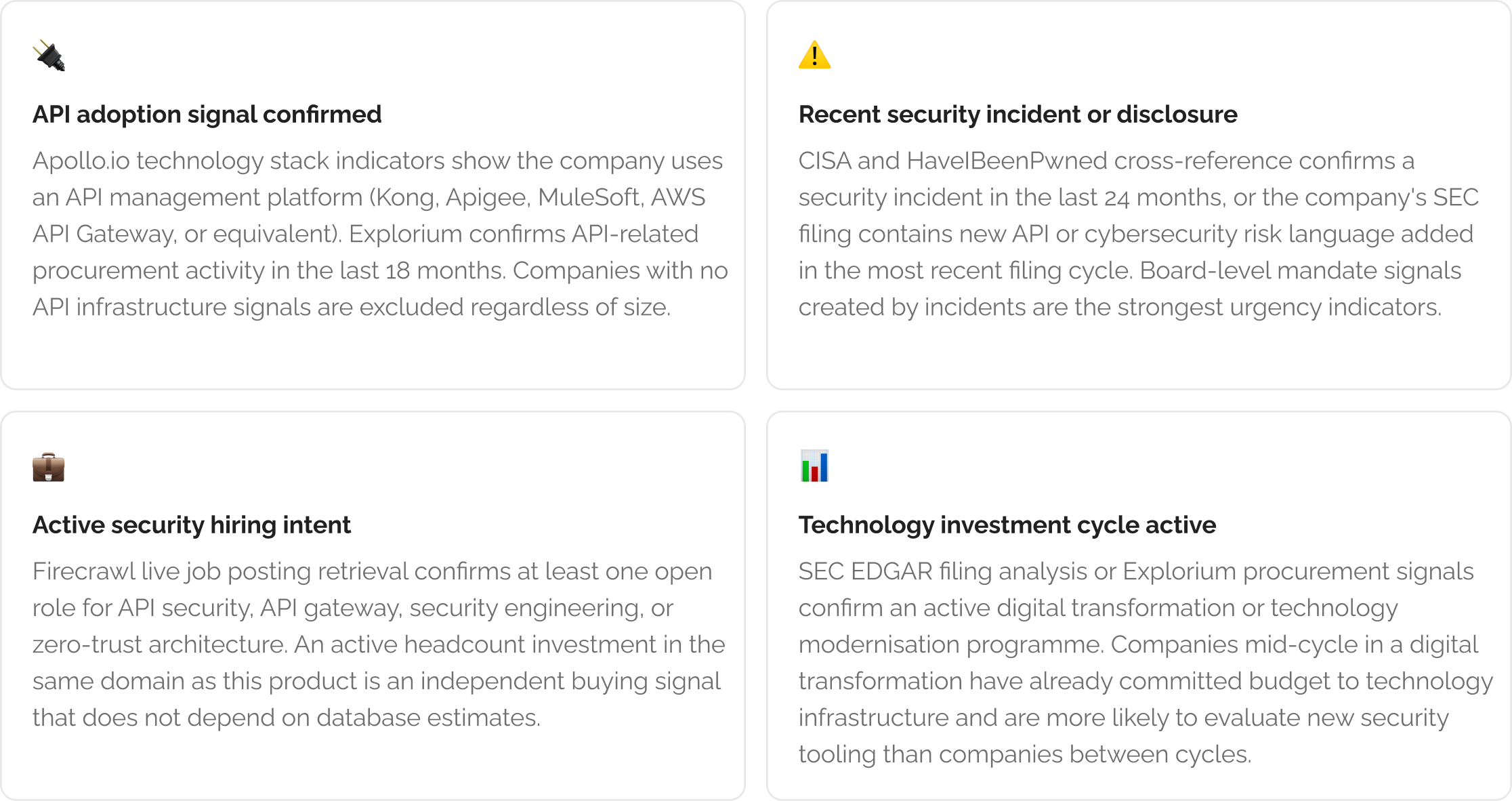
Step 2: Every candidate company passed through four qualification dimensions before entering the output list
Apollo.io returns several hundred qualifying financial institutions in the US above the 500-employee threshold in the relevant NAICS codes. The qualification framework reduces this to 50 by applying four scoring dimensions. A company must pass a minimum threshold on at least two of the four dimensions to enter the final output list. Companies that pass all four are flagged as Tier 1 priority. Companies that pass two or three are Tier 2. This creates a ranked list rather than a flat list of fifty equivalent prospects.
3: The 50 Qualified Prospects
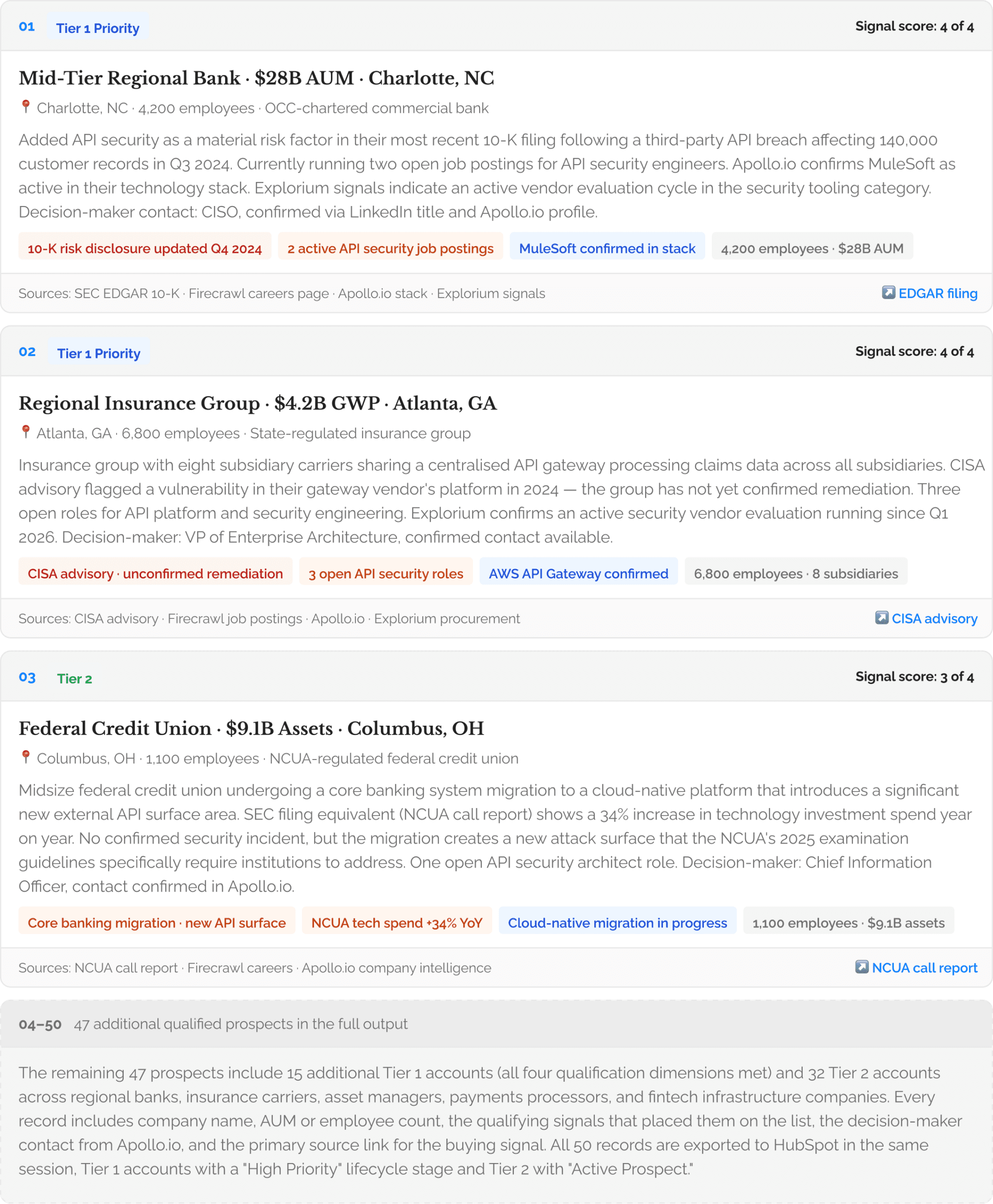
Step 3: The 50 qualified prospects — every company carrying at least one live buying signal

4: HubSpot Export via Connector
Step 4: All 50 qualified prospects exported to HubSpot — with every qualification field pre-populated
The list does not end as a spreadsheet the sales team then has to manually import. Every qualified prospect is pushed to HubSpot via the Barie HubSpot Connector as a new company and contact record the moment the qualification framework completes. Every field that was researched is populated in the corresponding HubSpot property. The SDR who opens HubSpot that morning finds fifty research-backed prospects with context already in the record, not a blank company name waiting for manual enrichment.
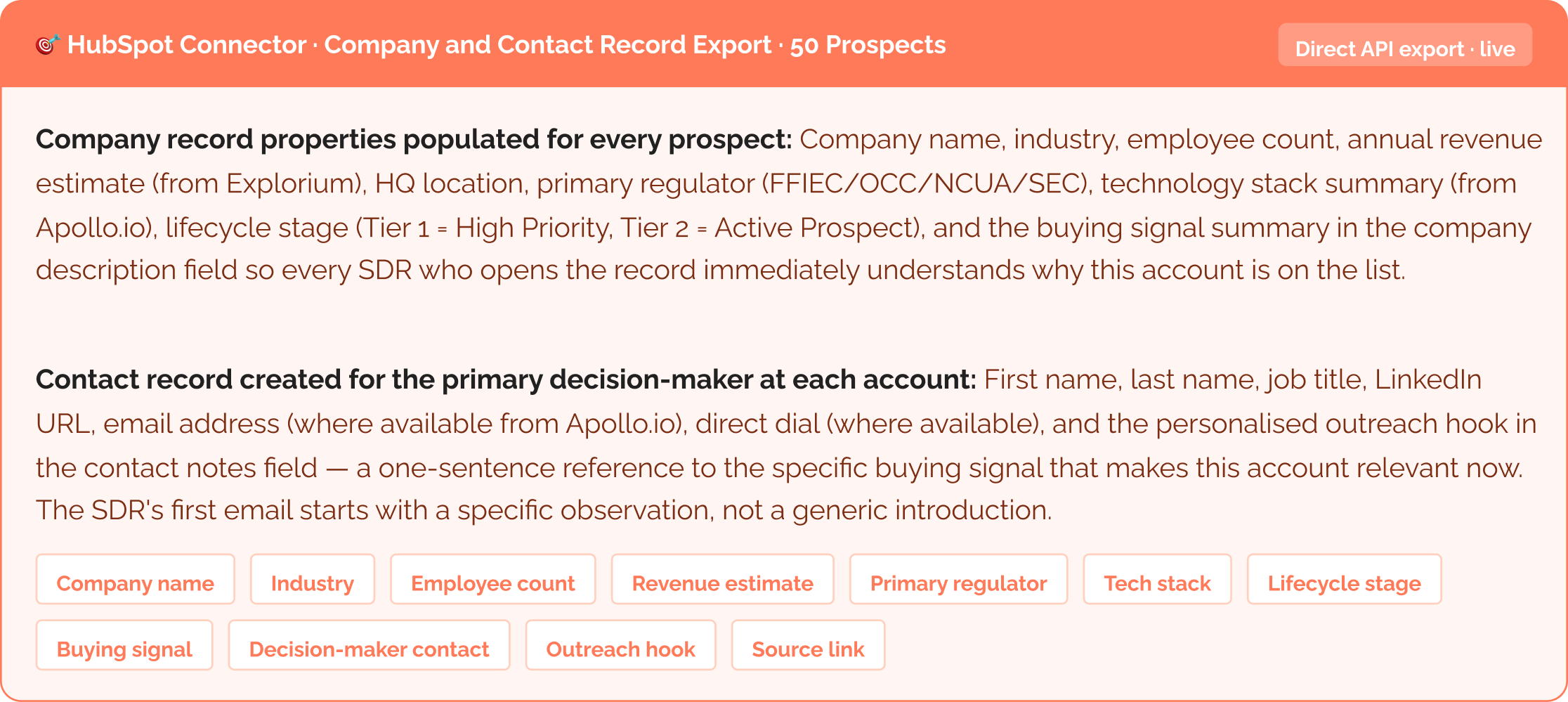
The outreach hook is the field that changes the first email open rate: Every contact record includes a one-sentence personalised hook derived from the specific buying signal: “We noticed [Company] added API security to its material risk disclosures in the most recent 10-K” or “We saw [Company] has two open API security engineer roles on your careers page this week.” The SDR does not need to write this from scratch. It is in the HubSpot notes field, ready to paste into the first line of the outreach sequence.
Distributed via Nine Connectors
Step 5: Every component of the prospect list distributed to where each team member executes
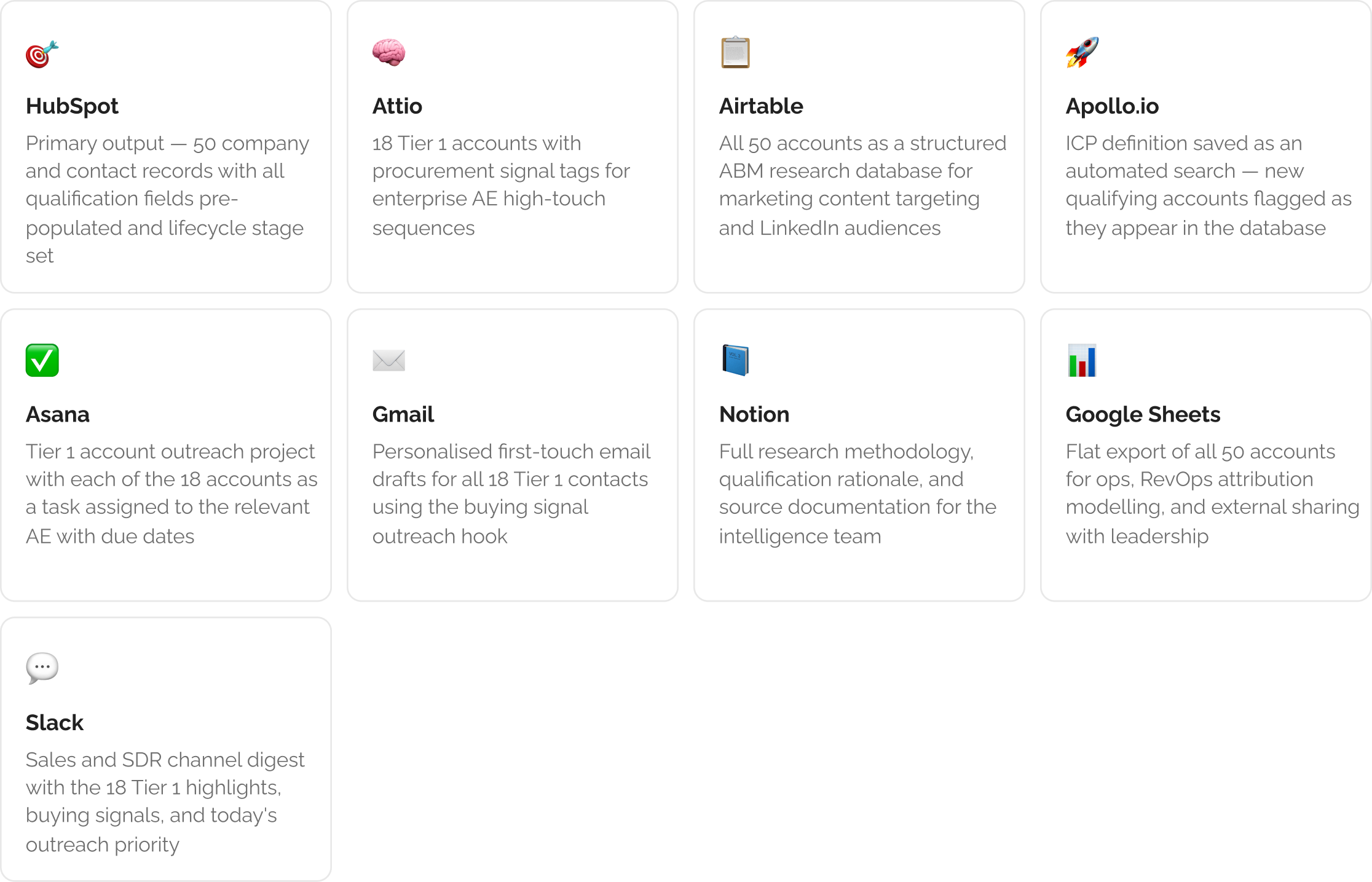
HubSpot holds the primary prospect and contact records for SDR outreach. But the list has multiple downstream uses beyond immediate cold outreach. The Tier 1 accounts are pushed to Attio with procurement signal tags for the enterprise account executives who manage high-touch outreach sequences differently from SDR volume plays. Airtable receives all 50 accounts as a structured research database the marketing team uses to build targeted content campaigns and LinkedIn ABM audiences. Apollo.io receives the ICP definition as a saved search so new accounts matching the qualification criteria are flagged automatically as they appear. Asana creates a project for the Tier 1 account outreach campaign with each of the 18 Tier 1 accounts as a task assigned to the relevant AE. A Gmail draft is prepared for each of the 18 Tier 1 contact records using the outreach hook already in the HubSpot notes field. A Slack digest of the full list summary with the 18 Tier 1 highlights posts to the sales and SDR channels. Notion holds the full research methodology and qualification rationale for the intelligence team to reference when building future lists.
Configure weekly monitoring for new buying signals on all 50 accounts: Set Barie to re-run the Firecrawl job posting check and the incident database cross-reference for all 50 accounts every Monday. When a Tier 2 account opens a new API security role or receives a new CISA advisory, it automatically upgrades to Tier 1 and the HubSpot lifecycle stage updates. The SDR who opens HubSpot on Monday morning sees who moved up and why, without running any additional research manually.
What you get
Fifty qualified enterprise prospects in US financial services for an API security product, each carrying at least one live buying signal identified from SEC EDGAR filings, FFIEC and OCC directories, Apollo.io company intelligence, Explorium procurement signals, Firecrawl job posting data, and CISA incident records. Eighteen Tier 1 accounts passing all four qualification dimensions with decision-maker contacts and personalised outreach hooks. Thirty-two Tier 2 accounts with at least two qualifying signals. All 50 exported to HubSpot with every qualification field pre-populated. Distributed across nine connectors: HubSpot, Attio, Airtable, Apollo.io, Asana, Gmail, Notion, Google Sheets, and Slack. Gmail drafts prepared for all 18 Tier 1 first-touch emails. Weekly buying signal monitoring configured. Research to pipeline in one session.
The Verdict
A manually built prospect list tells you which financial institutions exist at the right size. Barie’s six-connector research framework tells you which ones have an active reason to buy this product this quarter. The SEC filing that added API security to the risk disclosures. The CISA advisory that has not yet been confirmed as remediated. The two open job postings for API security engineers. The Explorium signal that shows an active vendor evaluation is running. Each of these is a specific, verifiable buying signal that transforms a cold outreach into a relevant conversation. The SDR who uses Barie’s output does not send fifty generic emails. They send fifty emails that start with something the prospect cannot ignore, because it is about them.
Barie features used in this task