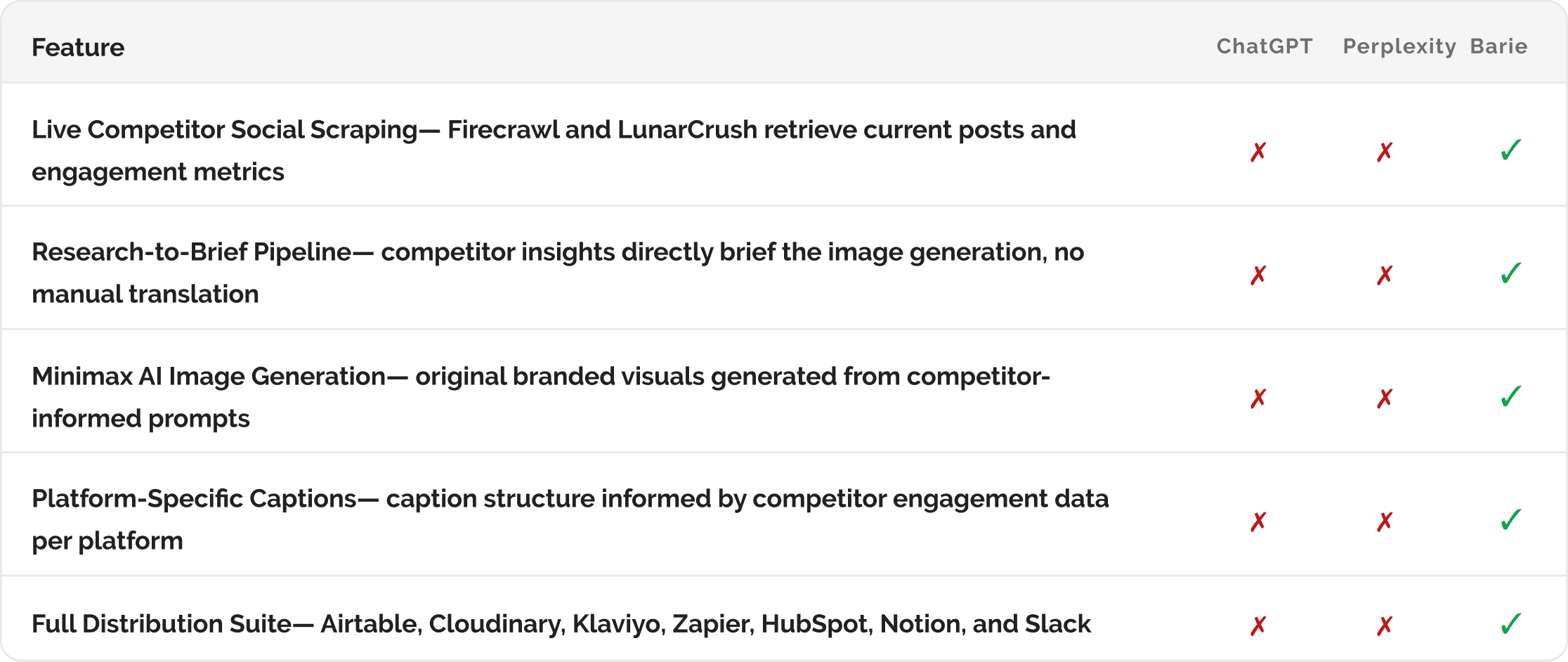
How Barie researches your competitor’s social strategy, then generates 5 branded post images with captions — ready to post
Barie analyses competitor social profiles from the live web, identifies what content formats and topics drive their highest engagement, then generates five original branded images using AI image creation and writes platform-specific captions for each. Visual assets and copy, ready to download and post. One prompt. Five posts. Zero design tools opened.
The gap between knowing what to post and actually having something to post
A marketing manager at a B2B SaaS company spent a Tuesday morning researching what her top three competitors were doing on LinkedIn and Instagram. She found that the highest-performing posts across all three accounts were product-in-use visuals with a short data point headline and a question in the caption to drive comments. She noted this pattern, opened a brief document, wrote three or four sentences describing the format, and sent it to the designer.
The designer was booked out for two weeks. By the time the posts were designed and the captions were written, the moment had passed. The competitor content she had analysed was already three weeks old. The insight never became a post.
Most social media execution fails not because teams lack ideas or intelligence. It fails because the distance between research and a ready-to-post asset is too large. The moment between identifying what works and having something that executes on that insight gets filled by backlogs, briefs, approvals, and scheduling delays.
What Barie does differently: Barie collapses the research-to-asset gap to zero. It analyses the competitor social strategy, identifies the content patterns driving engagement, uses that intelligence to brief the AI image generation, creates five original branded images, and writes the captions in one session. The research does not sit in a brief waiting for a designer. It becomes five posts before the session ends.
Your prompt
Task prompt
“Research our competitor’s social media strategy, then generate 5 branded social media post images and write the captions, ready to post.”
One sentence. Barie scrapes the competitor’s live social profiles, analyses posting cadence and engagement patterns, extracts the content formats and topics generating the most traction, uses those insights to generate five original branded images, writes platform-specific captions, and delivers everything as downloadable assets. Here is the complete workflow.
1: Live Competitor Research
Step 1: Barie scrapes the competitor’s live social profiles and extracts engagement patterns
Before generating a single image, Barie retrieves current data from the competitor’s social profiles. Firecrawl retrieves live posts, captions, and engagement metrics directly from the competitor’s public social presence. LunarCrush provides real-time engagement scoring across post types. The combination gives Barie a current picture of what is actually working for this specific competitor right now, not what worked for similar brands at some point in the past.

Barie examines the last 90 days of competitor posts across LinkedIn, Instagram, and X. It analyses posting frequency, average engagement rate per format, caption length and structure, hashtag strategy, visual style consistency, and the topic clusters that generate comment volume versus simple likes. The output of this step is not a summary. It is a ranked list of the specific content patterns that are performing and the gaps where the competitor has low volume relative to high potential engagement.
The research directly briefs the image generation: The insights from the competitor analysis are not handed to the user as a report and then manually translated into a creative brief. Barie uses the findings directly to construct the image generation prompts for each of the five posts. The content pattern that is working for the competitor becomes the structural input for the branded version Barie creates for you.
2: Competitive Intelligence Findings
Step 2: What Barie finds before it creates anything
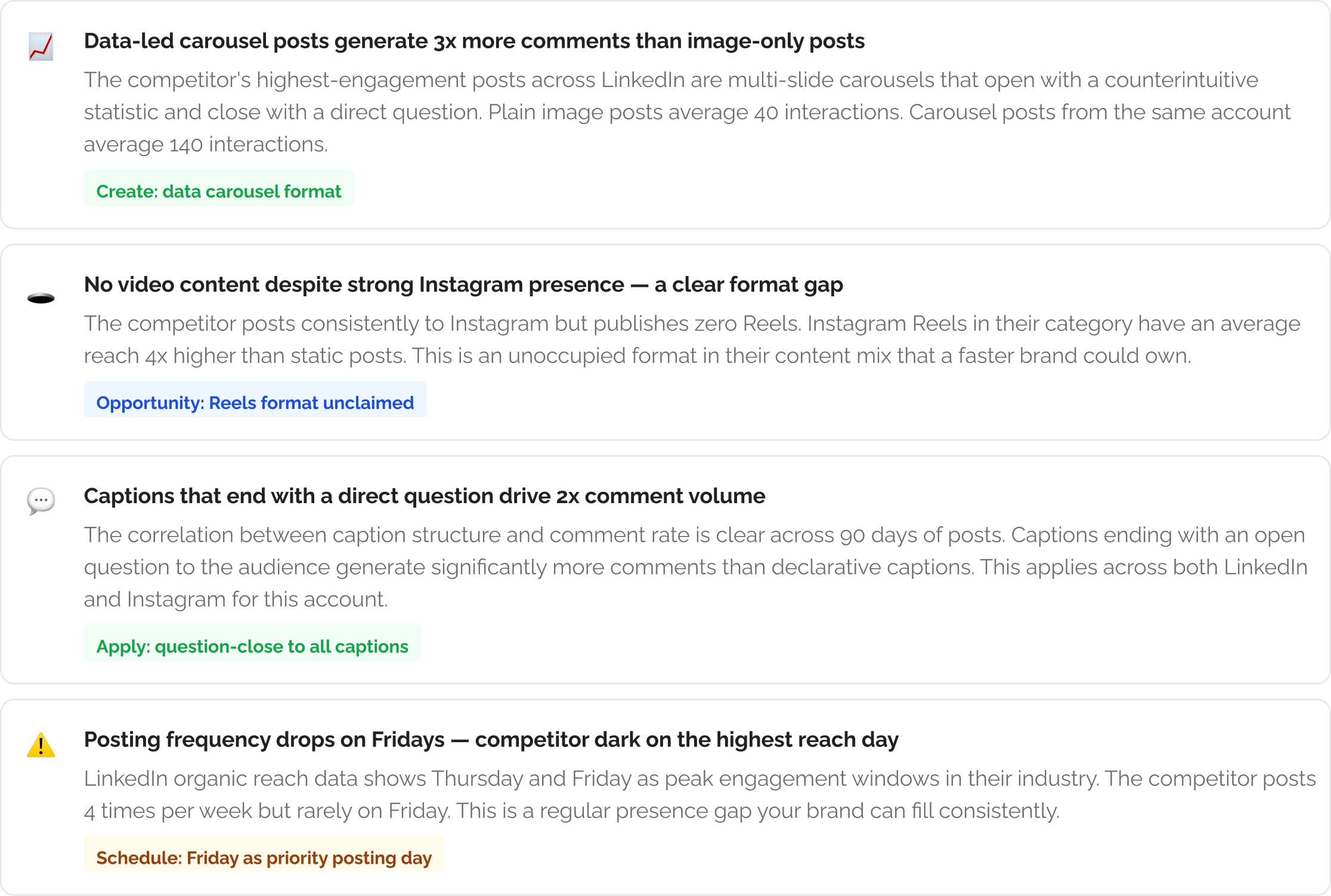
The competitor analysis produces a set of specific, actionable intelligence findings. These findings shape every creative decision in the next step. Barie identifies the formats, topics, and copy patterns that are generating engagement, the gaps where the competitor is leaving traffic on the table, and the opportunity windows that a faster competitor could capture.
3: AI Image Creation + Captions
Step 3: Five branded posts generated — images created, captions written, assets ready to download

Each of the five posts is built from the competitor intelligence gathered in Step 2. Barie uses Minimax AI image generation to create the visual assets and writes a platform-specific caption for each. The images are generated as original branded visuals, not stock photos or template fills. The captions apply the caption structure patterns that the competitor analysis identified as driving the highest comment volume.
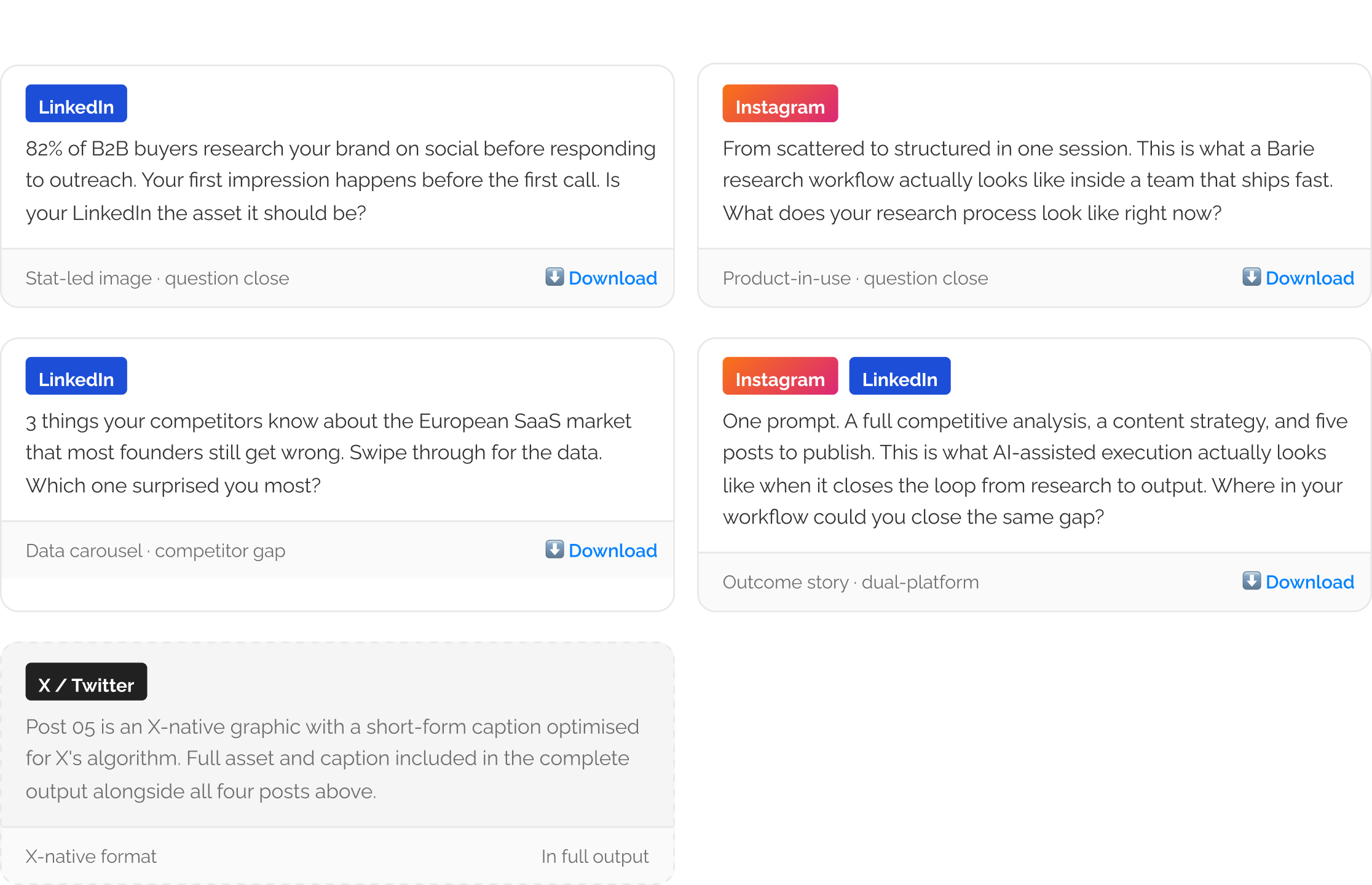
Every image is original, not templated: Barie uses Minimax AI image generation to create each visual from a prompt that is informed by the competitor analysis and your brand guidelines. The images are not stock photos selected from a library. They are not filled design templates. They are original AI-generated visuals created specifically for these five posts, for your brand, based on the content patterns that are performing for your competitors right now.
4: Publish and Distribute
Step 4: Posts scheduled and distributed through your content and CRM tools
With five posts ready, Barie routes each one to the right destination in your content workflow. The posts do not sit in a folder waiting to be manually uploaded to each platform. Barie connects to your scheduling tools and content management systems and does the distribution in the same session that generated the assets.
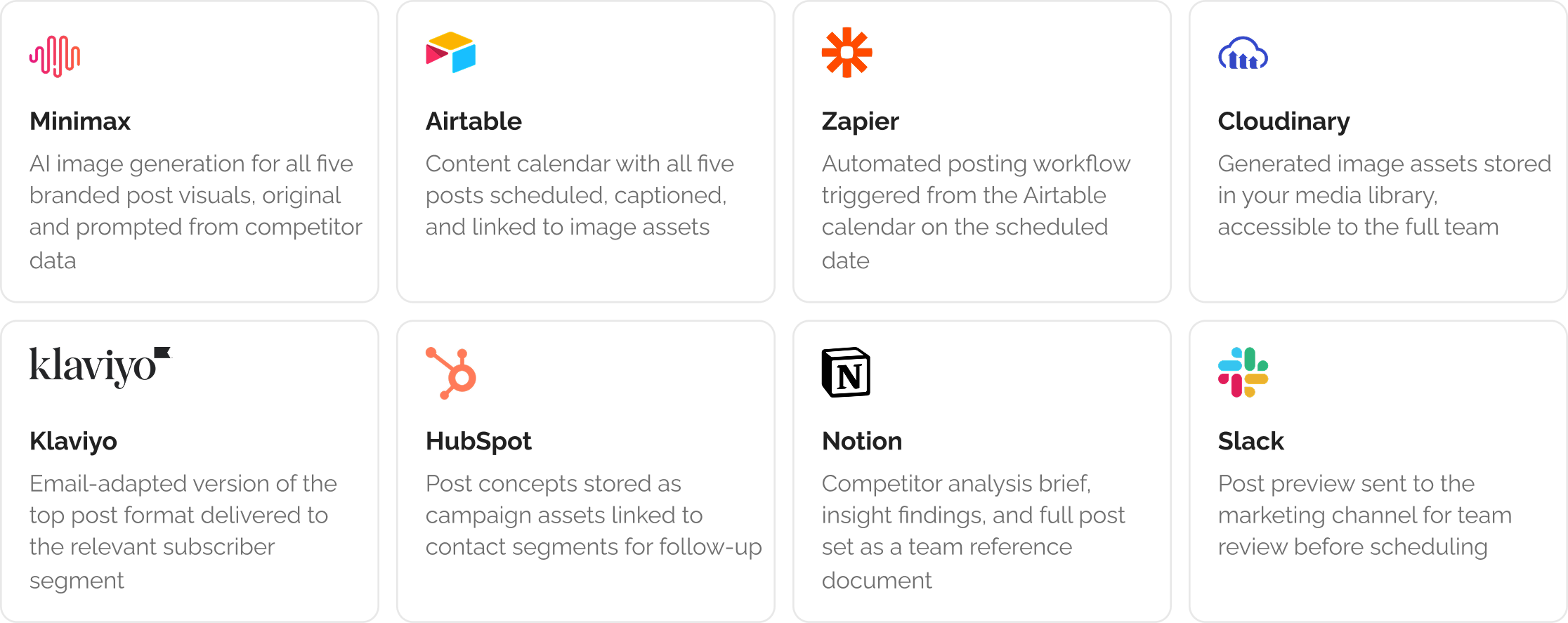
Klaviyo receives a version of the highest-performing post format adapted for an email newsletter segment, so your social content output also feeds your email marketing workflow. HubSpot stores the post concepts as marketing campaign assets linked to the relevant contact segments. Airtable hosts the full content calendar with all five posts scheduled, captioned, and linked to their downloadable image files. Notion holds the competitor analysis brief, the insight findings, and the full post set as a reference document for your content team.
For teams using Zapier, a workflow can trigger automatic posting to social platforms from the Airtable content calendar on the scheduled date, removing the manual upload step entirely. Cloudinary stores the generated image assets in your media library so they are accessible to your full team without needing to re-run the generation.
Run it weekly for a rolling content calendar: Configure Barie to run the competitor analysis and content generation weekly, pushing each batch of five posts directly to Airtable. Your content calendar stays stocked with competitor-informed, branded posts without a weekly manual research and briefing session. The competitor intelligence refreshes each run so the content reflects what is working right now, not what worked last month.
What you get
A live competitor social media analysis covering 90 days of post data across LinkedIn, Instagram, and X. Four specific intelligence findings identifying the content formats and patterns driving engagement, the gaps in the competitor’s strategy, and the opportunity windows your brand can move into. Five original AI-generated branded post images at platform-ready dimensions with platform-specific captions applying the caption structures that perform. All five posts distributed to Airtable, Cloudinary, Klaviyo, HubSpot, Notion, and Zapier in the same session.
What it would take a marketing manager a morning to research, a designer two weeks to produce, and a content coordinator an hour to schedule, Barie delivers before lunch. Zero design tools opened. Zero briefs written. Zero approval cycles for assets that could have been ready yesterday.
The Verdict
The gap between social media intelligence and social media output is where most teams lose. The research happens. The insight is real. Then it sits in a brief, waits for a designer, goes through an approval, and posts three weeks later when the competitive window has closed. Barie closes that gap entirely. The competitor analysis and the five finished posts come from the same session. The images are original and branded, not templated. The captions are informed by what is actually driving engagement on the competitor’s account right now. Research and execution in one prompt. That is what content teams should be doing instead of managing the gap between them.
Barie features used in this task