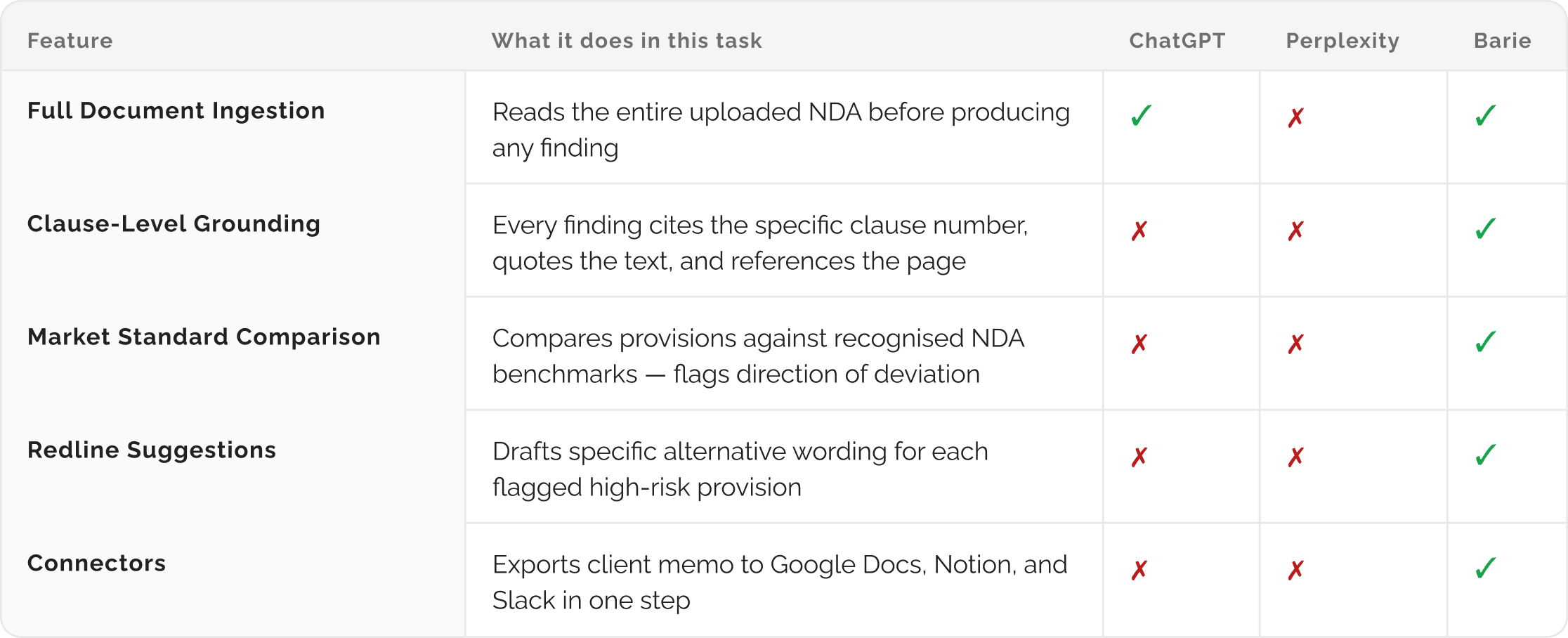
How Barie reviews an NDA, flags non-standard clauses, and identifies risk for your client
Upload the NDA. Barie reads the entire document, identifies provisions that deviate from standard market practice, compares key terms against recognised NDA frameworks, and flags every risk clause with an explanation grounded in the actual text. Not a generic checklist. Not a hallucinated interpretation of a contract it has not read.
The problem with AI-assisted contract review
A solicitor asked an AI tool to review an NDA before sending it to a client. The tool produced a four-page risk summary — confidentiality scope concerns, non-standard term lengths, a broad non-compete clause, and an unusual jurisdiction provision.
The problem: none of those findings mapped to specific clauses in the actual document. The tool had answered with generic NDA risk points it had learned during training — not findings from the agreement it was handed. When the solicitor checked the document, two of the flagged risks did not exist in this NDA at all. One genuine risk — a perpetual confidentiality obligation with no survival carve-out — was not mentioned anywhere in the output.
This is the specific failure mode of applying a language model to document review without actually grounding the output in the document. The tool answers from pattern memory. It produces confident-sounding findings that may or may not correspond to what is on the page in front of it.
How Barie is different: Barie reads the uploaded document in full before producing a single finding. Every flagged clause cites the specific clause number and quotes the relevant language from the actual NDA. If a provision is not in this document, it does not appear in the output. That distinction is the difference between document review and a generic risk checklist dressed up as document review.
Your prompt

One sentence and one document upload. Barie ingests the full NDA, structures a clause-by-clause analysis against market-standard NDA terms, flags every deviation with a risk classification and a direct quote from the relevant provision, and delivers a client-ready review memo. Here is exactly what happens.
1. Document Ingestion
Step 1: Full document ingestion — every clause read before any finding is made
Before Barie produces a single observation, it reads the entire NDA. Not the first three clauses. Not the most conspicuous provisions. All of it — definitions, obligations, exceptions, schedules, and boilerplate — in sequence.
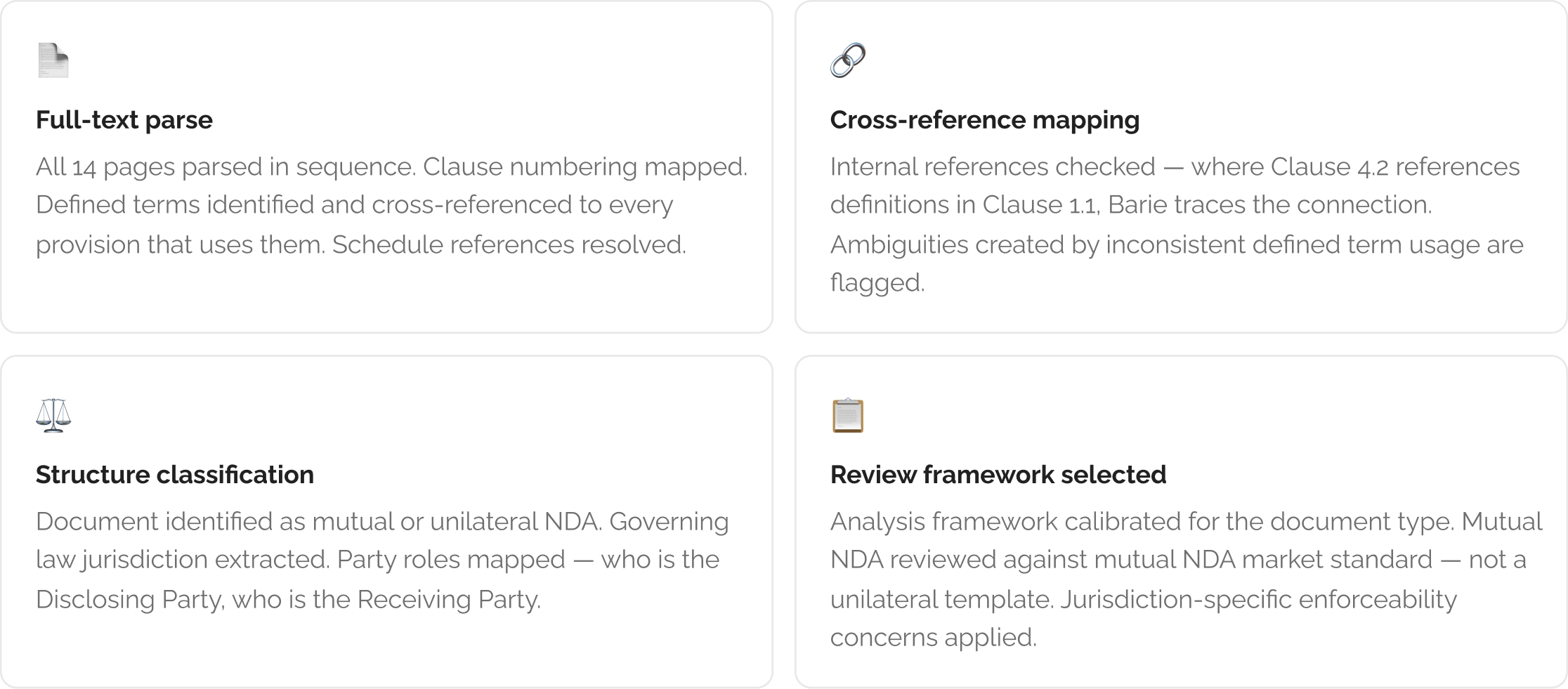
Why full-document ingestion changes the output quality: A tool that skims a contract for keywords will miss the interaction between clauses. An unusually broad definition of “Confidential Information” in Clause 1 may make an otherwise standard non-disclosure obligation in Clause 3 materially more burdensome. Barie reads the document as a whole — because risk in contracts is often structural, not clause-level.
2. Market Standard Comparison
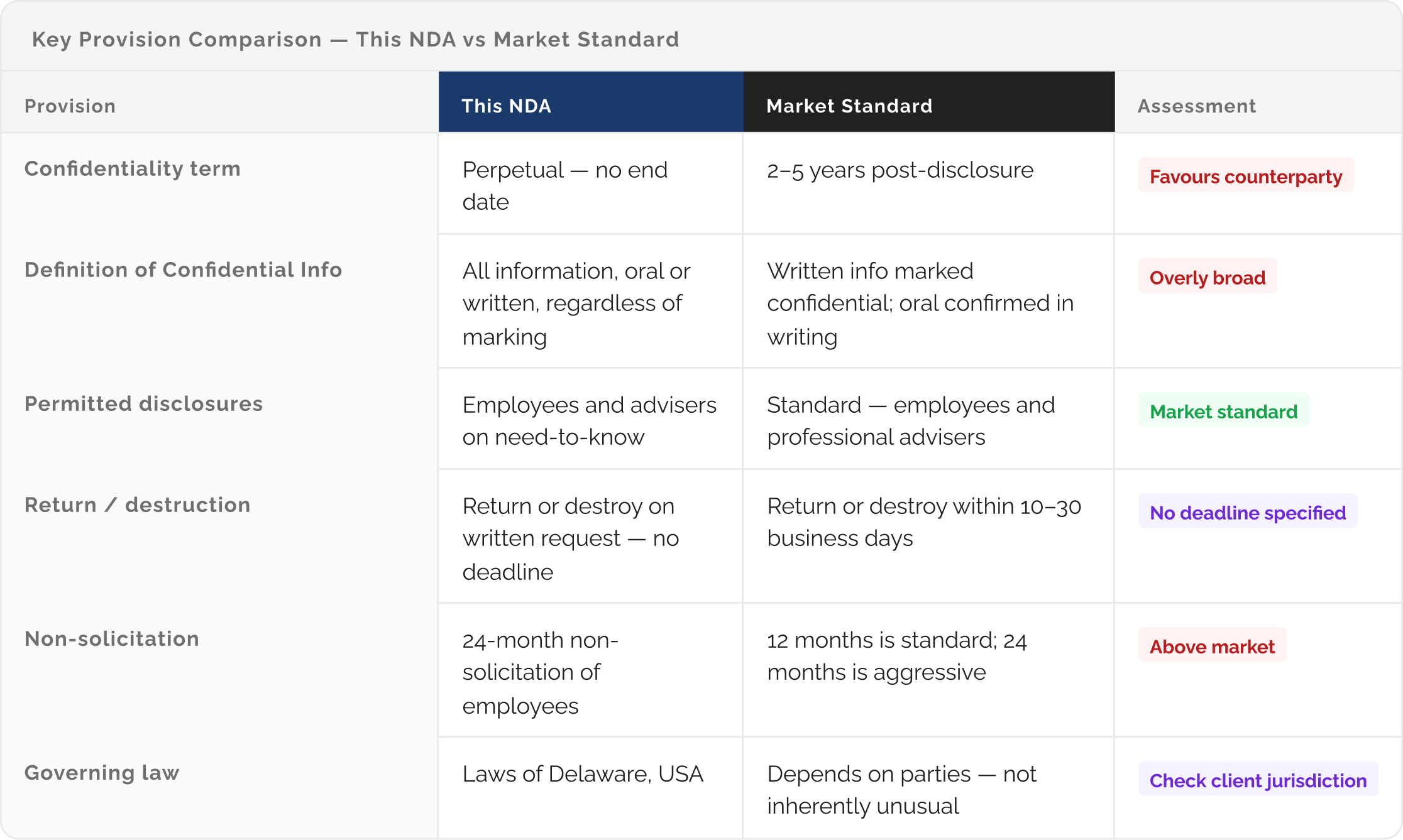
Step 2: Comparison against market-standard NDA terms
Each key provision is compared against recognised market benchmarks — the BVCA model NDA, the LMA standard confidentiality agreement, and common commercial NDA practice in the governing law jurisdiction identified in the document. Deviations are classified by direction: does the non-standard term favour the counterparty, or is it simply unusual without being materially one-sided?
3. Risk Clause Findings
Step 3: Flagged findings — every risk grounded in the actual clause text
Each flagged finding quotes the relevant language directly from the uploaded document, explains why it deviates from market standard or creates risk, and where appropriate suggests the alternative wording your client should request. Every finding is traceable to a specific clause number in the document you uploaded.
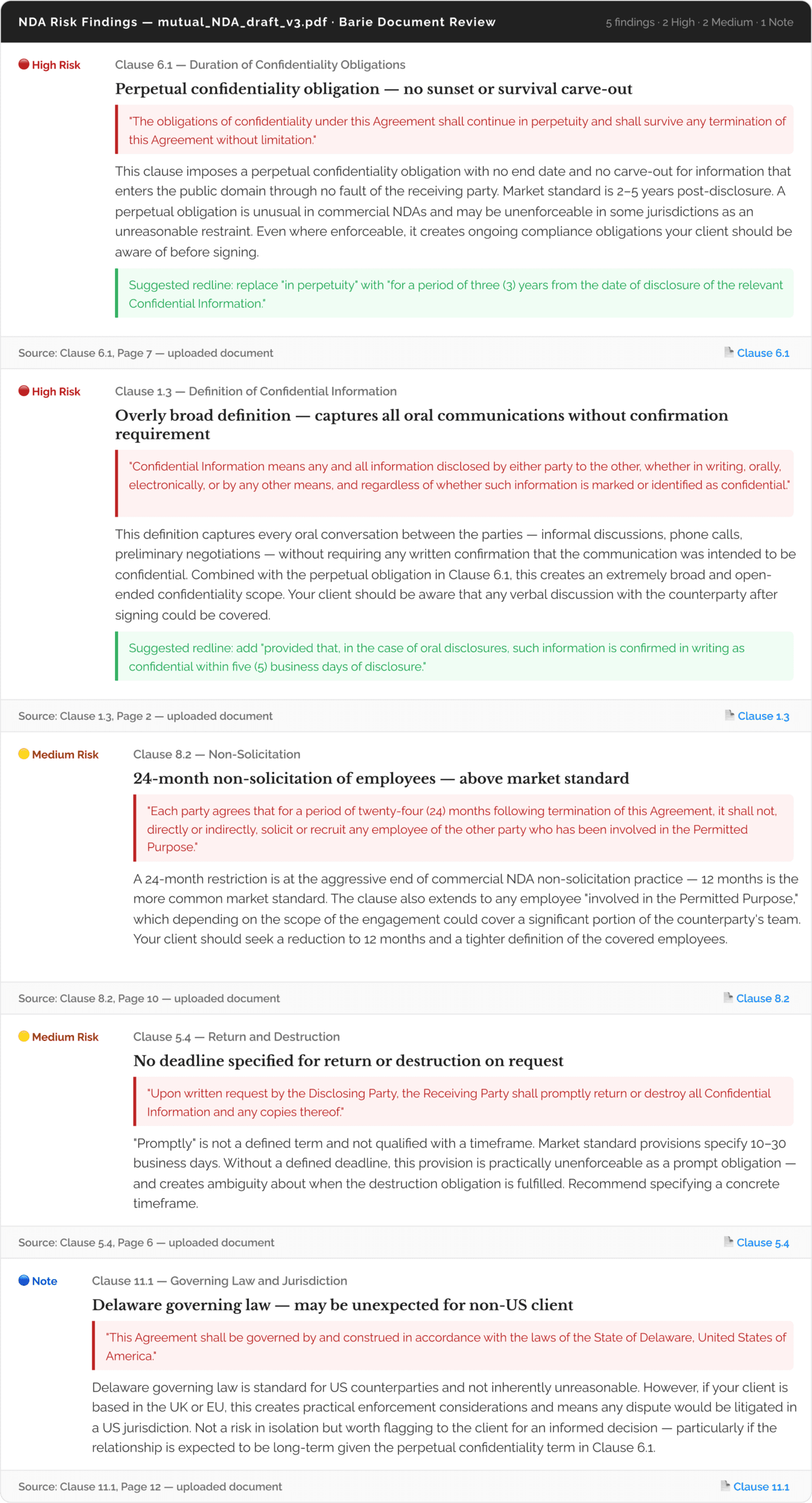
Every finding quotes the actual clause: The redlined text in each finding is pulled directly from the uploaded document. The clause number and page reference appear in the footer of every finding. If you want to verify a finding, you open the document to the page cited. There is no interpretation of a document Barie has not read, and no risk flag invented because it sounds like a reasonable concern for this type of agreement.
Export via Connectors
Step 4: Client-ready memo — exported via Connectors

The full review memo — findings, clause quotes, redline suggestions, and comparison table — exports to Google Docs in a formatted, client-ready document. A structured version lands in Notion for internal tracking. A summary of the two high-risk findings goes to Slack before the client call. Every finding in every output cites the clause number and page it came from.
What you get
A clause-by-clause NDA review grounded entirely in the uploaded document — five flagged findings with risk classifications, direct clause quotations, market standard comparisons, and redline suggestions. A comparison table of key provisions against market standard. A client-ready memo exported in one step.
What it would take a junior associate an hour to produce — reading the document, identifying deviations, drafting the risk memo — Barie delivers from a single upload. Every finding traceable to a specific page and clause. Nothing hallucinated. Nothing invented.
The Verdict
The failure mode of AI contract review is not that it misses the law. It is that it invents findings from pattern memory rather than reading the document in front of it. Barie ingests the uploaded NDA in full, grounds every finding in a specific quoted clause, flags where the provision deviates from market standard and in which direction, and suggests the redline. Every risk in the output is a risk in this agreement — not a risk that could theoretically appear in an NDA of this type. That is the only standard contract review can be held to.
Barie features used in this task