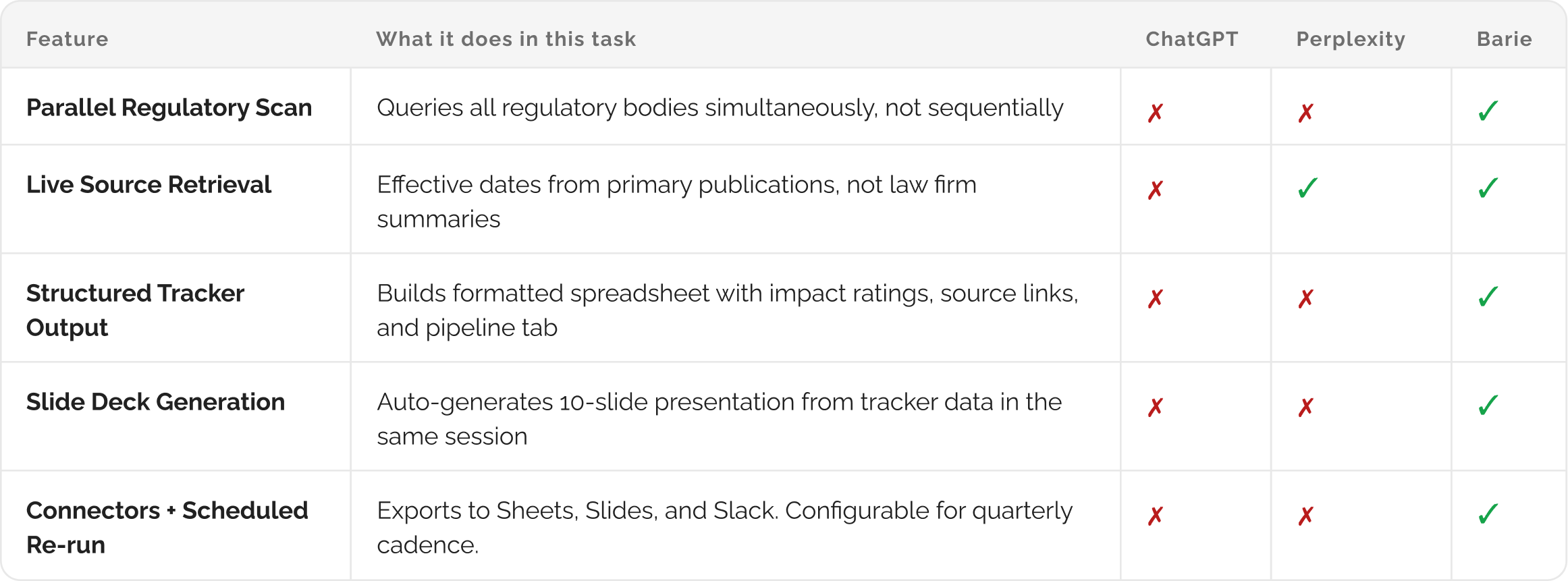
How Barie researches all financial services regulatory changes, builds the tracker spreadsheet, and generates the slide deck for your compliance team
Three deliverables from one prompt. Barie scans live regulatory publications across jurisdictions, compiles a structured change tracker spreadsheet covering regulation, jurisdiction, effective date, and impact assessment, then auto-generates a presentation-ready slide deck summarising the top changes for the compliance team. Research, spreadsheet, slides.
The problem with building a regulatory change tracker manually
A head of compliance asked their team to build a regulatory change tracker for the 2025 to 2026 period before the quarterly board presentation. Three people. Two weeks. They divided the jurisdictions between them and each compiled a list from memory, saved searches, and bookmarked publications.
When they merged the three lists, three regulations appeared in more than one version with different effective dates. Two significant changes, one from the European Banking Authority and one from the FCA, were missing entirely because neither team member had covered those publications. The effective date for one major change was wrong by three months.
Then someone had to turn the spreadsheet into slides.
That is not a research failure. That is what happens when a multi-jurisdiction regulatory scan is done manually by people who cannot simultaneously monitor every relevant publication. The information exists. The process of gathering it is the problem.
What Barie does differently: Barie scans the live publications from every relevant regulatory body simultaneously. It does not divide the work and merge later. It retrieves from all sources at the same time, deduplicates automatically, and produces a single structured output. Then it generates the slide deck from the same data in the same session. The team does not need to build the spreadsheet and then rebuild it as slides.
Your prompt
Task prompt
“Research all regulatory changes affecting financial services compliance in 2025 to 2026, compile them into a tracker spreadsheet, and generate a summary slide deck for the compliance team.”
One sentence. Three deliverables. Barie identifies the relevant regulatory bodies across the target jurisdictions, retrieves published changes and upcoming effective dates from live regulatory sources, builds the structured tracker, and then converts the findings into a formatted slide deck. Here is what happens at each step.
1 Task Decomposition
Step 1: Scope definition and source mapping
Before retrieving a single publication, Barie maps every regulatory body that could issue changes affecting financial services compliance in the target period. This is the step that prevents the gaps. A manual process relies on the researcher knowing which publications to monitor. Barie identifies them systematically.
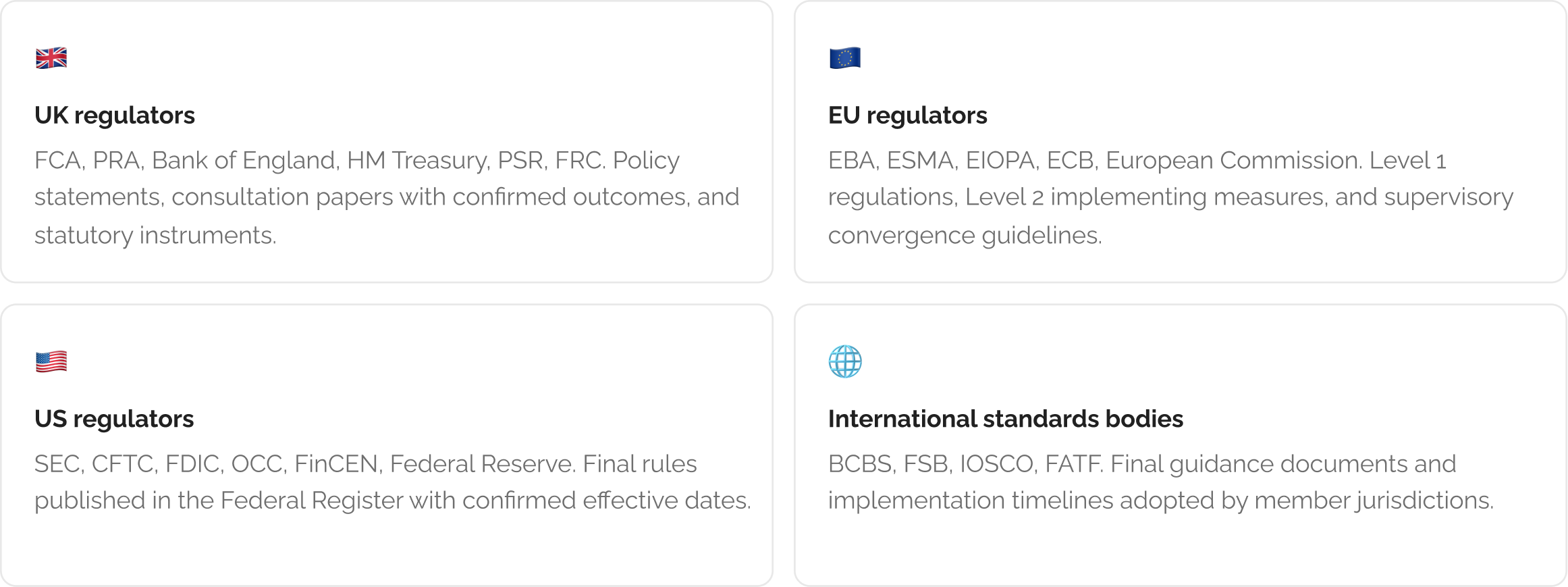
Only confirmed changes enter the tracker: Barie distinguishes between consultation papers that have not yet produced final rules and confirmed regulatory changes with operative effective dates. Proposals are tracked separately in a “pipeline” tab and do not appear as confirmed changes in the main tracker. Your compliance team is not acting on proposals that may change before implementation.
2. Parallel Live Research
Step 2: Parallel scan across all regulatory publications simultaneously
All source threads fire at the same time. Barie does not complete the FCA publication list before starting the EBA publications. Every regulatory body is queried in parallel. The combined results are deduplicated and cross-referenced so that a change that affects both UK and EU operations appears once in the tracker with both jurisdictions noted.

Effective dates retrieved from the primary source: Every effective date in the tracker comes from the official regulatory publication that announced the change. Not from a law firm summary that may contain a transcription error. Not from a third-party compliance newsletter that may reflect a proposed date that was subsequently revised. The date that appears in the spreadsheet is the date published by the regulator in the primary document.
3. Structured Tracker Output
Step 3: The regulatory change tracker spreadsheet

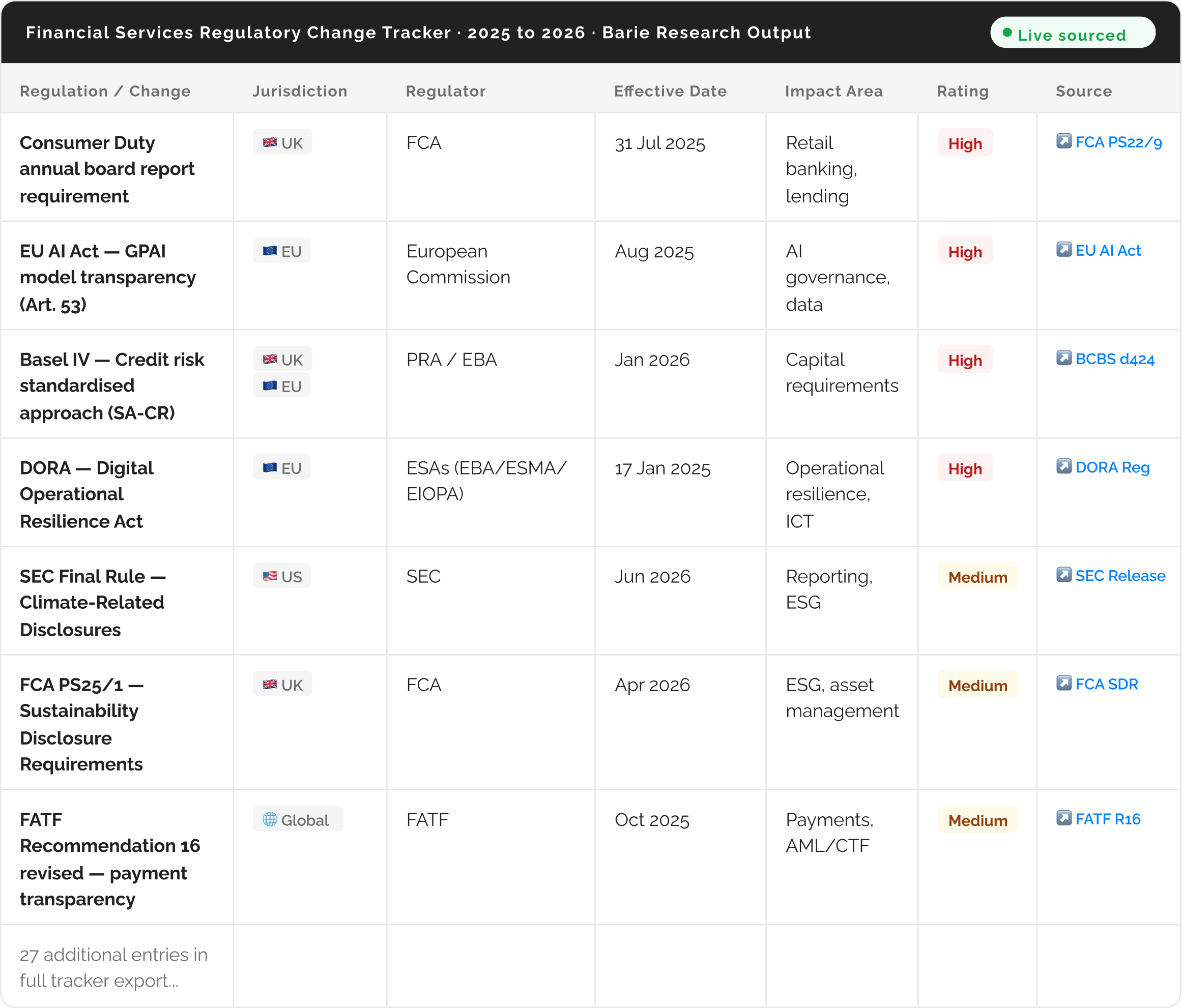
The tracker exports to Google Sheets with full functionality: Every source link in the tracker is live in the exported spreadsheet. The impact rating column is filterable. A second tab in the same sheet captures the regulatory pipeline, which is proposals not yet confirmed. The spreadsheet does not need reformatting after export. It lands in the format your compliance team will actually use.
4. Slide Deck Generation
Step 4: The compliance summary slide deck, auto-generated from the tracker data
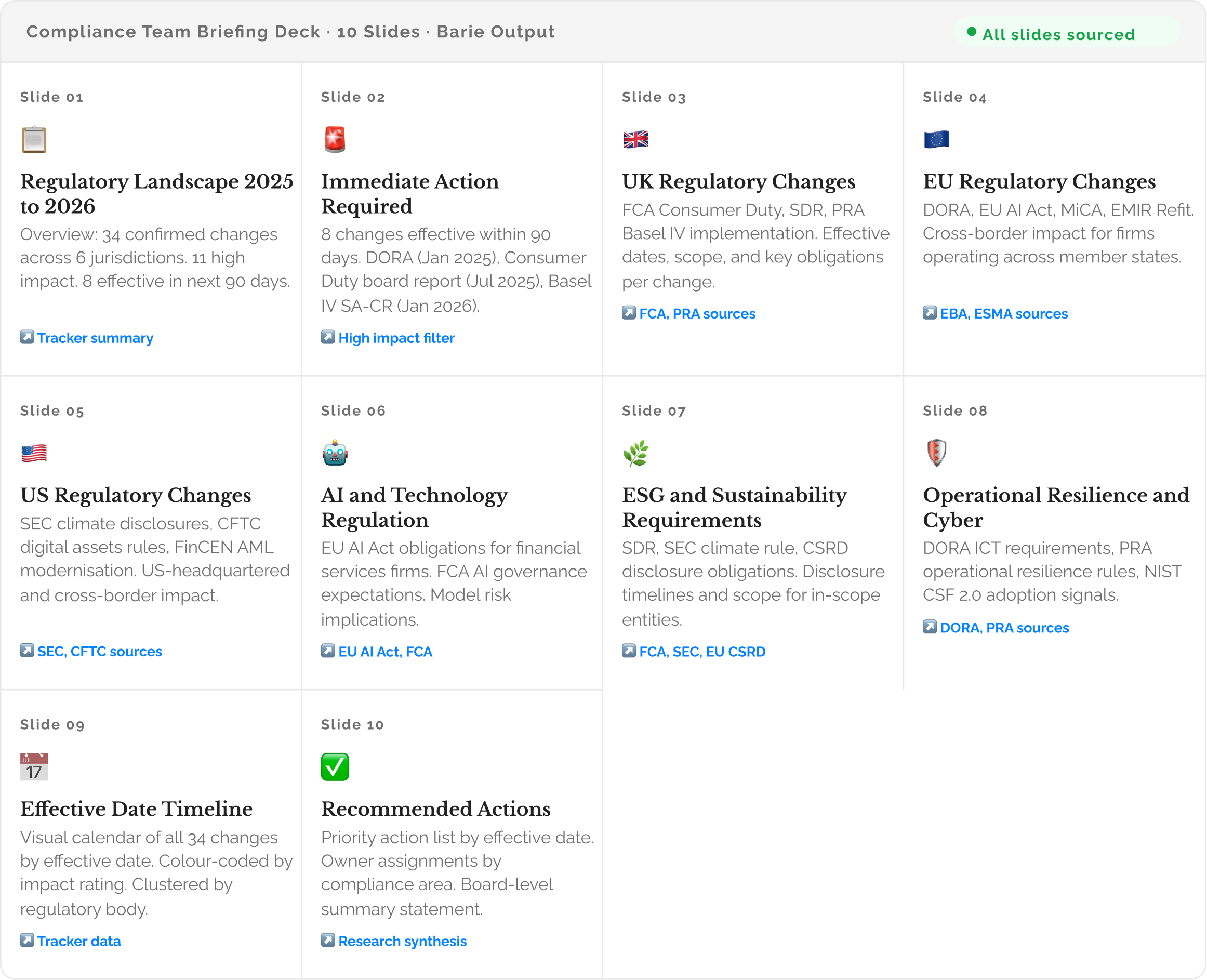
Once the tracker is complete, Barie converts the findings directly into a presentation. Not a reformatted version of the spreadsheet. A structured slide deck with one headline per slide, supporting evidence from the tracker data, and the source citations that give the compliance team confidence in presenting the material to a board that will ask questions.
5. Export via Connectors
Step 5: Three outputs, three destinations, one session

The full tracker lands in Google Sheets: 34 rows, seven columns, source links live, pipeline tab included. The compliance slide deck goes directly into Google Slides, formatted and ready for the board meeting. A digest of the eight highest-priority changes goes to the compliance team Slack channel before the next team call. No reformatting. No rebuilding the deck from the spreadsheet. No copy-pasting.
Configurable for quarterly re-runs: Set Barie to repeat this scan every quarter and push updates to the same Sheets document and Slides deck. New confirmed changes are added. Changes that reach their effective date are moved to a “completed” archive tab. The tracker stays current without a dedicated research session each time.
What you get
A complete financial services regulatory change tracker covering 34 confirmed changes across six jurisdictions, every entry sourced from the primary regulatory publication with a live source link and a verified effective date. A 10-slide compliance briefing deck generated from the same data, structured for a senior management or board audience. Both outputs delivered in a single session from one prompt.
What it would take a compliance team two weeks to compile manually, Barie delivers before the end of the working day. No missed publications. No incorrect effective dates. No need to rebuild the spreadsheet as slides.
The Verdict
Regulatory change tracking fails at the edges. The change your team missed was the one published by the regulator no one was monitoring that week. The incorrect effective date was from a consultation paper date that someone noted before the final rule revised it. Barie scans every relevant regulatory body simultaneously, distinguishes confirmed changes from proposals, retrieves effective dates from the primary publication, and builds a tracker and a slide deck in the same session. The work that used to take two weeks and three people now takes one prompt. That is not a modest improvement in process. That is a different way of doing the work.
Barie features used in this task