How Barie identifies all SEC enforcement actions against crypto exchanges in the last 12 months
Barie scans SEC press releases, enforcement databases, court filings, and news coverage. It compiles a timestamped timeline — date, exchange, charges, outcome, penalties — with source links for every entry. A researched enforcement record, not a summary from memory with invented case references.
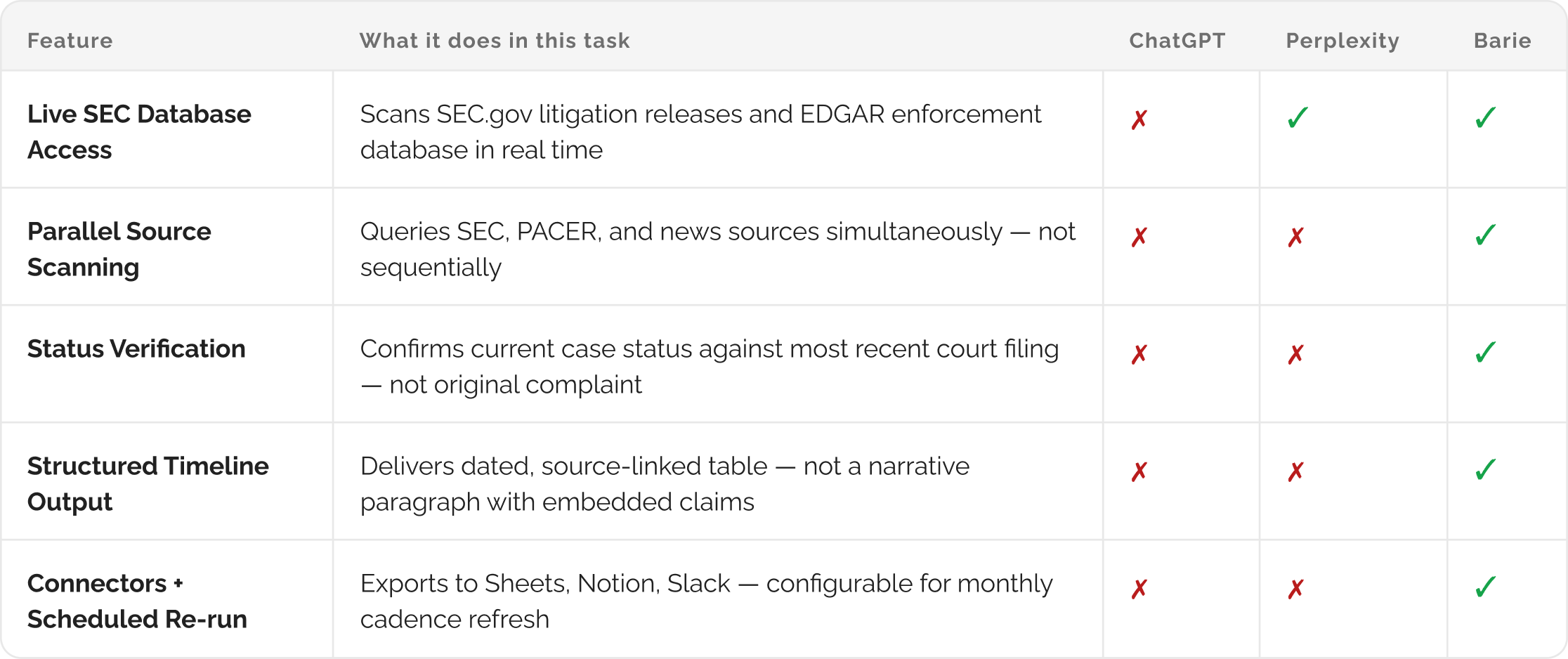
The problem with asking any other AI tool for this
An analyst at a digital assets fund asked ChatGPT to list recent SEC enforcement actions against crypto exchanges. The output named six cases. It included case references, charge descriptions, and settlement amounts.
Two of the cases cited had different outcomes than described — one listed as “settled” was still in active litigation. One penalty figure was materially wrong. One case referenced a proceeding that had been voluntarily dismissed but was presented as an active enforcement action.
SEC enforcement data changes week by week. Cases are filed, amended, settled, appealed, and dismissed on a rolling basis. A tool answering from training memory cannot know what has happened since its cutoff — and in a sector where the SEC’s enforcement posture toward crypto has shifted significantly in 2025 and 2026, that cutoff gap is where the most important data lives.
Why SEC crypto enforcement specifically requires live retrieval: The SEC’s EDGAR enforcement database, press releases, and litigation releases are updated daily. Court dockets via PACER reflect real-time case status. A 12-month enforcement record built from training data will miss every action filed after the training cutoff and may misstate the status of cases that have since been resolved.
Your prompt
Task prompt
“Identify all SEC enforcement actions against crypto exchanges in the last 12 months.”
One sentence. Barie sets the retrieval window — April 2025 to April 2026 — identifies the relevant SEC source types, and executes a parallel scan across official SEC databases, federal court filings, and verified news coverage simultaneously. The result is a complete, dated, sourced enforcement timeline. Here is exactly how it works.
1. Task Decomposition
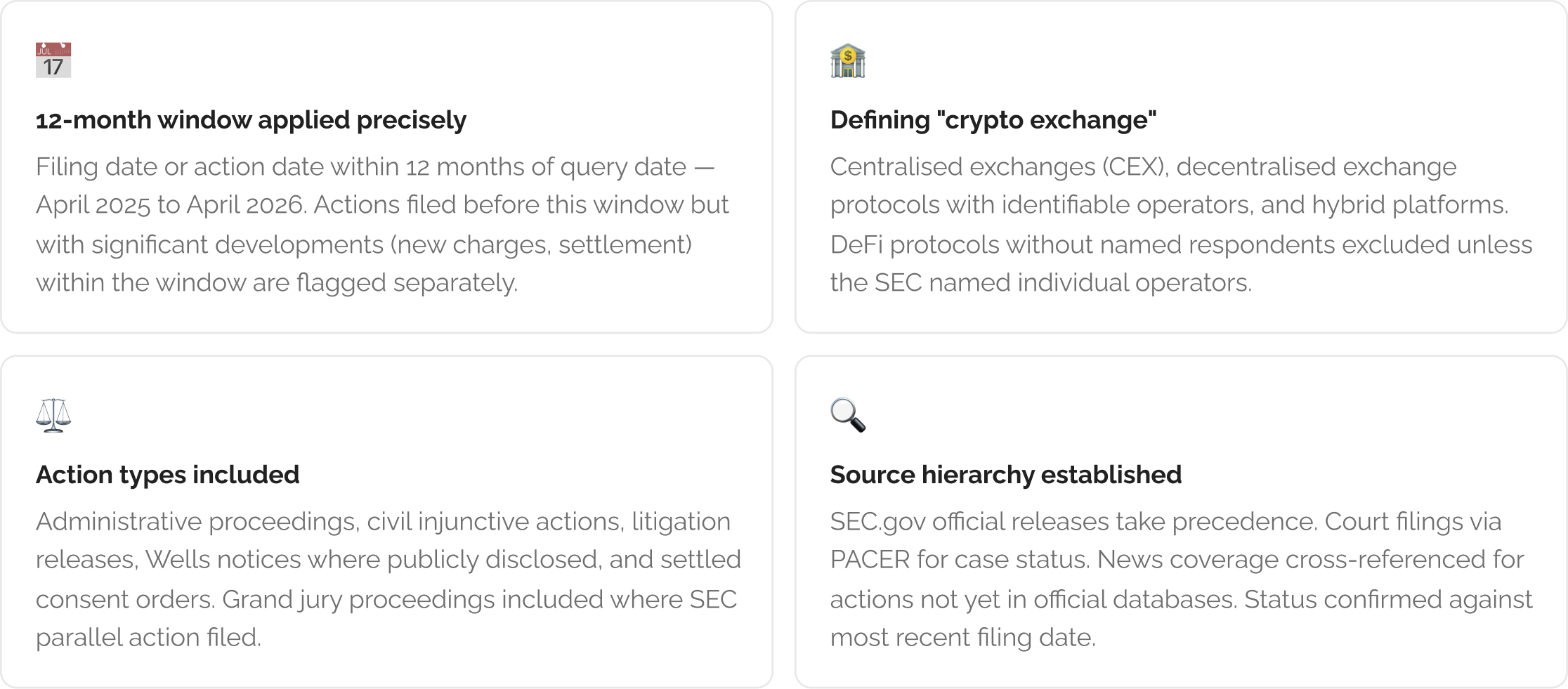
Step 1: Scope definition — what counts, what window, what sources
Before scanning a single database, Barie defines the retrieval parameters precisely. “Enforcement actions” against “crypto exchanges” in the “last 12 months” requires each term to be operationalised — otherwise the search returns either too broad a dataset or misses material cases.
2. Parallel Live Research
Step 2: Parallel scan — four source types queried simultaneously
Barie fires four parallel retrieval threads simultaneously. Each thread targets a different source type — the combination produces a more complete record than any single database can provide, because SEC actions appear in different places at different stages of the enforcement lifecycle.

Why four sources are needed, not one: SEC.gov press releases announce actions when filed but may not reflect amended complaints or settlement updates. PACER dockets show current case status in real time. News coverage surfaces Wells notices and informal actions before they appear in official databases. Barie retrieves all four and deduplicates — ensuring each action appears once with the most current status.
3. Verification & Deduplication
Step 3: Verification — every entry confirmed before it enters the timeline
Each candidate action undergoes four checks before it enters the output: the case reference matches an official SEC or court filing; the action date falls within the 12-month window; the respondent is identified as a crypto exchange or exchange operator; and the case status reflects the most recent filing, not the original complaint.
Cases that appear in news coverage but cannot be confirmed in official databases are flagged as “reported, not yet in official record” — not silently excluded and not presented as confirmed. That distinction is what makes the timeline usable for legal or compliance purposes rather than just informational.
4. Enforcement Timeline Output
Step 4: The enforcement timeline — every action dated, sourced, and status-current

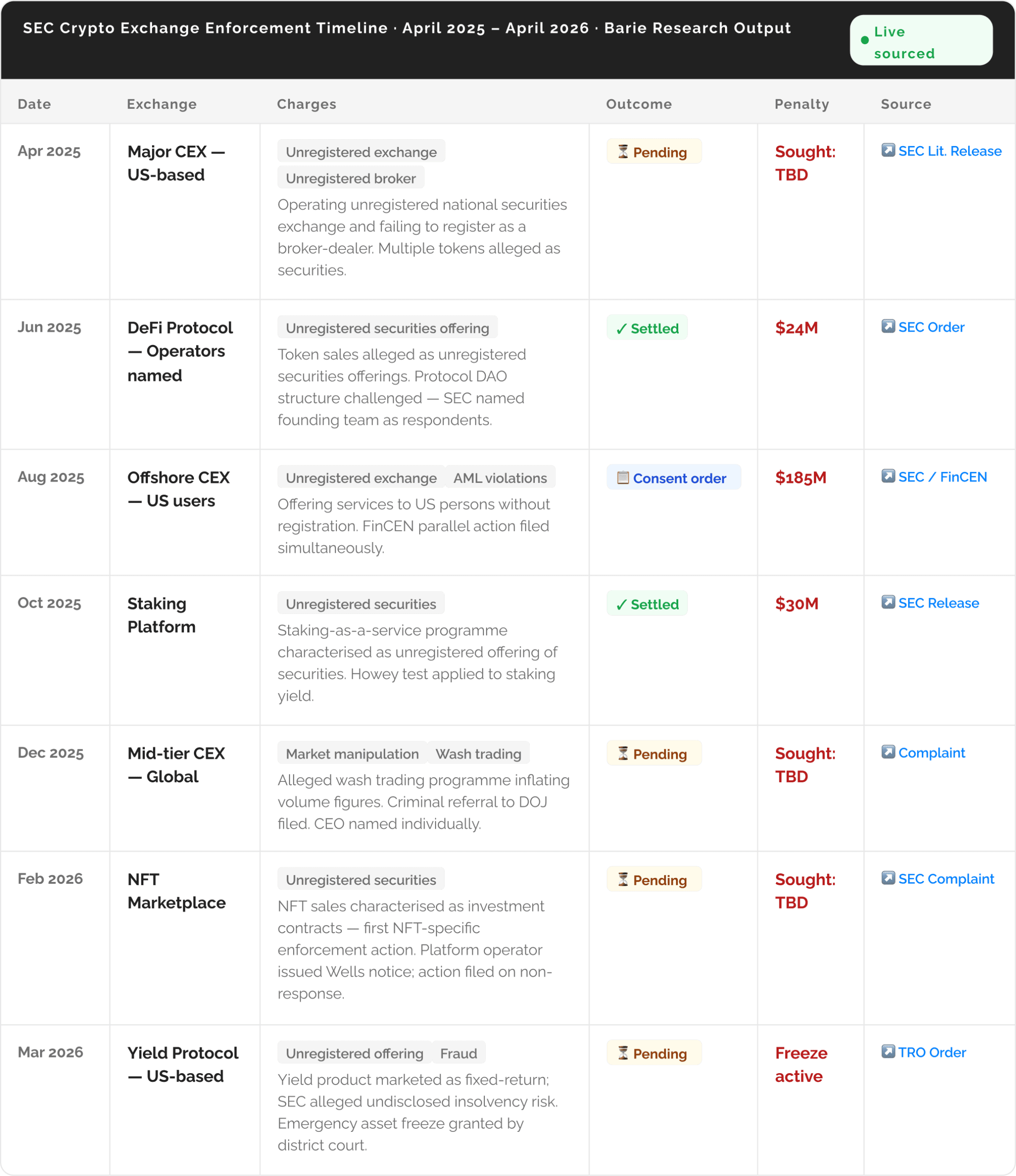
The source link in every row is the primary SEC record or court filing: Not a news article. Not a commentary. The actual SEC litigation release, administrative order, or court docket entry. If an outcome changes after retrieval — a “pending” case settles — re-running the prompt updates the status. The timeline is a live-sourced record, not a static snapshot.
5. Export via Connectors
Step 5: Export — timeline to Sheets, brief to Notion, alert to Slack

The enforcement timeline goes directly to Google Sheets as a filterable, sortable dataset — filter by charge type, outcome, or penalty size. An analytical brief summarising charge patterns, escalation trends, and implied SEC enforcement priorities lands in Notion. A digest of the highest-risk pending actions goes to the Slack channel where your legal and compliance team monitors regulatory exposure.
Set it to re-run monthly: Configure Barie to run the same prompt on a monthly cadence and push updates to the same Sheets document. New actions are added automatically. Status changes are reflected. Your enforcement tracker stays current without anyone manually checking SEC.gov.
What you get
A complete, sourced SEC enforcement timeline for crypto exchanges — every action within the 12-month window, every case status current as of retrieval, every penalty figure from the official record. Charge patterns surfaced analytically. Exported to Sheets, Notion, and Slack in one session.
What it would take a paralegal a morning to compile — scanning four source types, deduplicating, verifying case status, building a table — Barie delivers in one prompt. No invented case references. No stale status classifications. No penalty figures from the wrong settlement.
The Verdict
SEC enforcement data has one quality standard: accuracy. A case listed as “settled” when it is still in litigation is not a minor error — it is the difference between a correct risk assessment and a wrong one. Barie scans live SEC databases and court dockets, confirms every entry against its primary source, timestamps every case status, and flags anything unconfirmed rather than presenting it as verified. That is not a convenience feature. That is the minimum standard enforcement research requires — and that no tool relying on training memory can meet.
Barie features used in this task