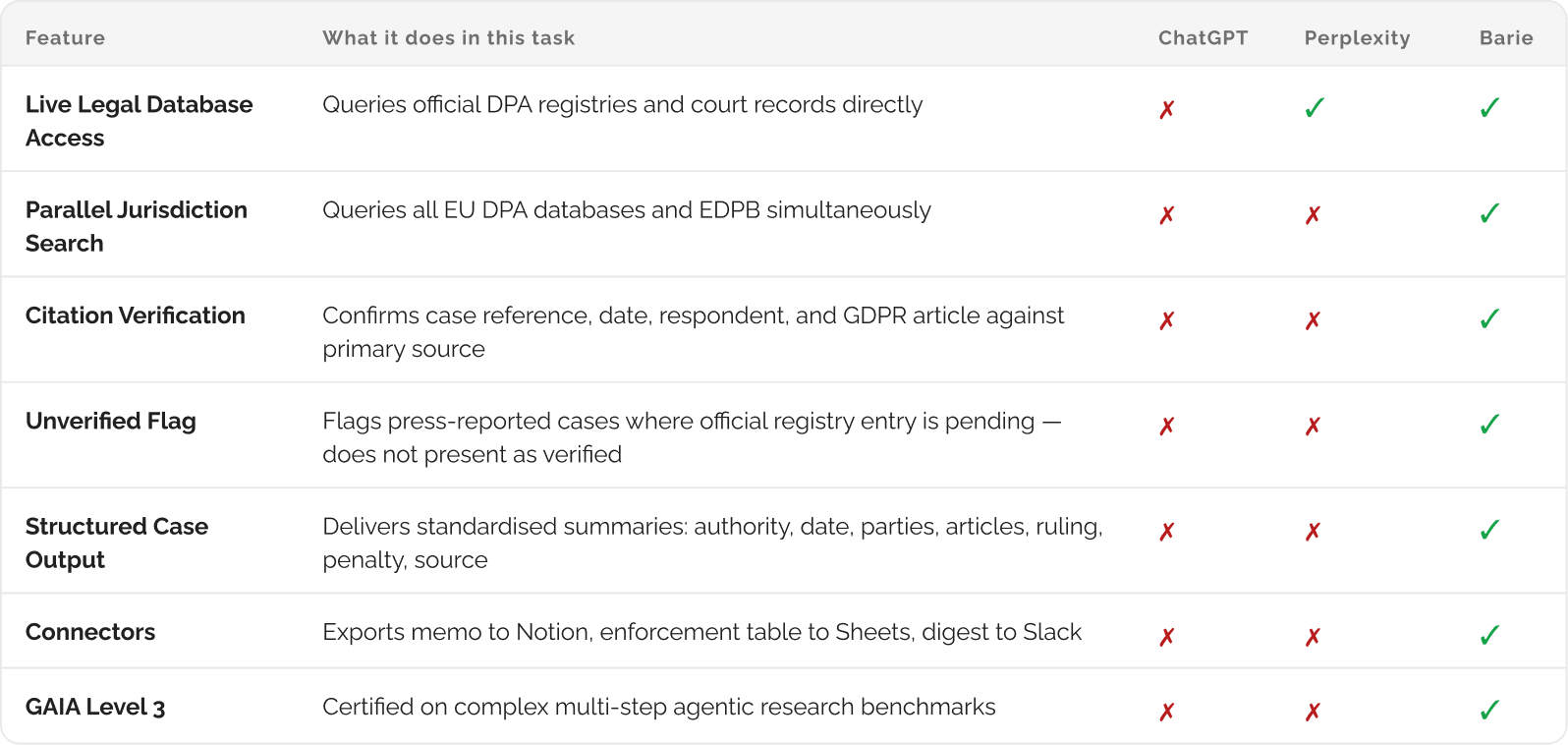
How Barie finds recent GDPR case law on data privacy violations in financial services, last 24 months, every citation real
Barie searches live legal databases, court registries, and EU regulatory enforcement actions across jurisdictions. It delivers structured case summaries — court, date, parties, ruling, penalty — with direct source links. Every citation is real. Every case exists. No fabricated docket numbers, no invented rulings, no cases that sound right but cannot be verified.
The problem with chat-based legal research
A lawyer submitted a brief to court. The citations were precise — specific case names, court dates, exact rulings, docket numbers. ChatGPT had written all of it.
Not one case existed.
That story is not a hypothetical. It is a documented incident that resulted in sanctions and professional embarrassment. It is also the default failure mode of every AI tool that answers legal research questions from training data rather than live sources. Legal citation hallucination is not an edge case. It is what happens when a tool trained to produce plausible text is asked to produce a list of cases — and produces one, whether or not those cases exist.
For GDPR enforcement specifically, the problem compounds. The enforcement landscape changes constantly. New decisions are issued by Data Protection Authorities every week. Fine amounts change. Cases are appealed and outcomes are revised. A case that was “pending” six months ago may now have a final ruling. A tool answering from training data cannot tell you which.
Why GDPR case law specifically cannot come from training data: The EDPB publishes enforcement decisions in real time. National DPA databases — the CNIL, BaFin, ICO, GDD — update continuously. Court registries publish rulings on a rolling basis. Any AI tool citing GDPR cases from training memory is citing a snapshot of what was known when the model was trained — not the enforcement landscape as it exists today. Barie retrieves from the live registries. Every time.
Your prompt
This is the exact task as given to Barie:
Task prompt
“Find recent case law on GDPR data privacy violations in financial services, last 24 months.”
One sentence. No jurisdiction specified. No article of GDPR specified. No entity type specified. Barie parses the scope — GDPR enforcement decisions and court rulings, financial services sector specifically, issued within a defined 24-month window — maps the relevant authorities and databases, and executes a parallel search across EU jurisdictions simultaneously. Here is exactly what happens.
1: Task Decomposition
Step 1: Task decomposition, scope, jurisdiction, and source mapping
Before querying a single database, Barie maps the legal research architecture. GDPR enforcement is decentralised — each EU member state has a national Data Protection Authority, cases can be adjudicated at national court level or escalated to the EDPB, and financial services entities may face parallel enforcement from both data protection and financial regulators. Barie identifies all relevant source types before retrieval begins.
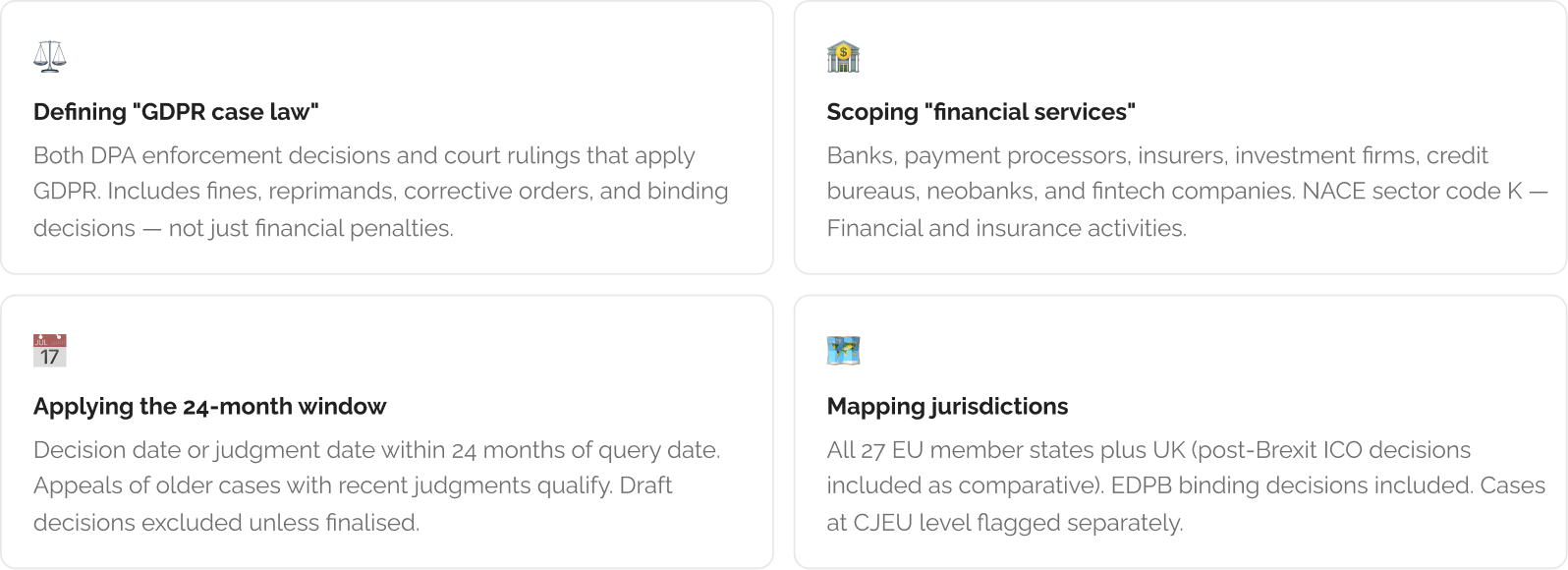
What Barie does in this step: Legal research has a source hierarchy that matters enormously — a DPA enforcement decision is not the same as a court judgment which is not the same as an EDPB opinion. Barie maps these source types before retrieval so the output distinguishes between them correctly. You receive case summaries that tell you not just what was decided but what type of authority decided it and whether it has been appealed.
2. Parallel Live Research
Step 2: Parallel live research, querying every relevant jurisdiction simultaneously
Barie does not search one database, extract results, and move to the next. It fires parallel queries across all major EU DPA databases, the EDPB enforcement tracker, national court registries, and legal information platforms simultaneously. The combined results are then deduplicated and cross-referenced to ensure each case appears once — with the most authoritative source cited.
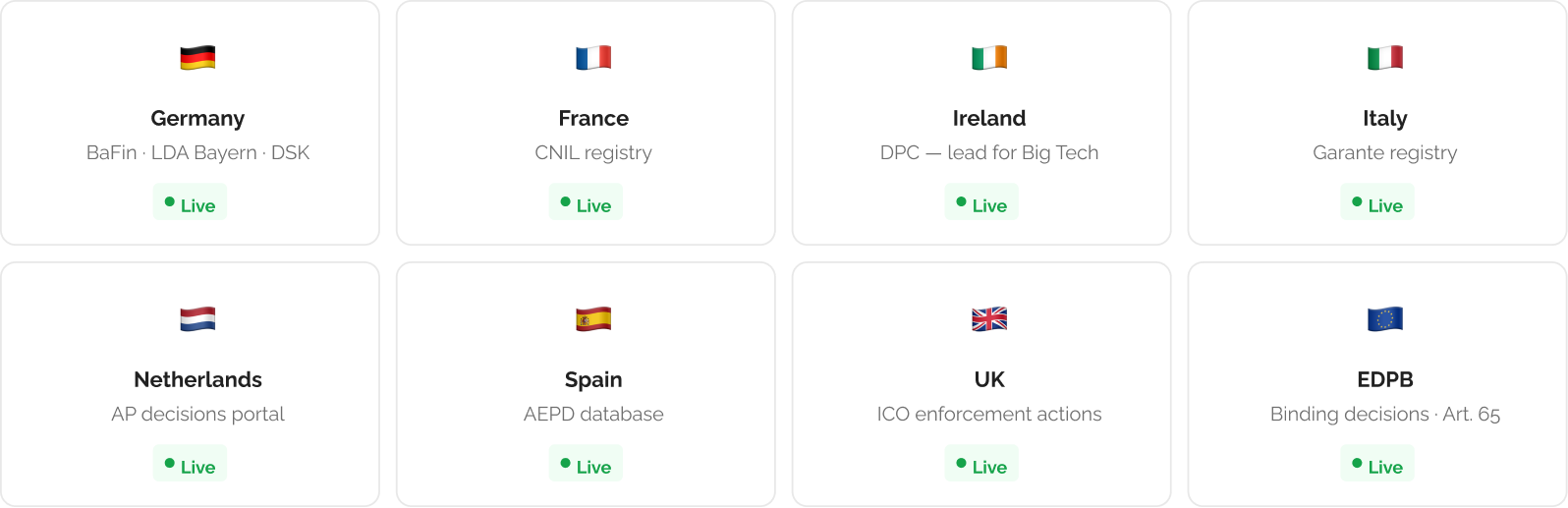
Alongside DPA enforcement databases, Barie queries legal information platforms for court-level judgments that apply GDPR in financial services contexts — cases where DPA decisions have been appealed to national administrative courts or where GDPR violations form part of a broader commercial dispute.

Every source is the primary official record: Barie does not retrieve legal analysis or commentary about these cases — it retrieves from the official DPA decision portals and court registries directly. The case that appears in the output is the case as documented by the authority that issued the decision. Not a summary by a law firm. Not a news article. The primary record with a direct link.
3. Citation Verification
Step 3: Citation verification, confirming every case exists before it enters the output
This is the step that separates Barie from every tool that has fabricated legal citations. Before a case appears in the output, Barie verifies four things: the case reference number matches a real entry in the source database; the date falls within the specified 24-month window; the respondent organisation operates in financial services; and the violation relates to GDPR data privacy rather than a different regulatory framework.
A case that fails any of these checks does not enter the output. A case where the source cannot be confirmed is flagged as unverified with a note explaining why — typically because a decision has been published in press but the official registry entry has not yet been posted. That flag tells you the case exists but the primary source is not yet citable. That distinction matters in legal work.
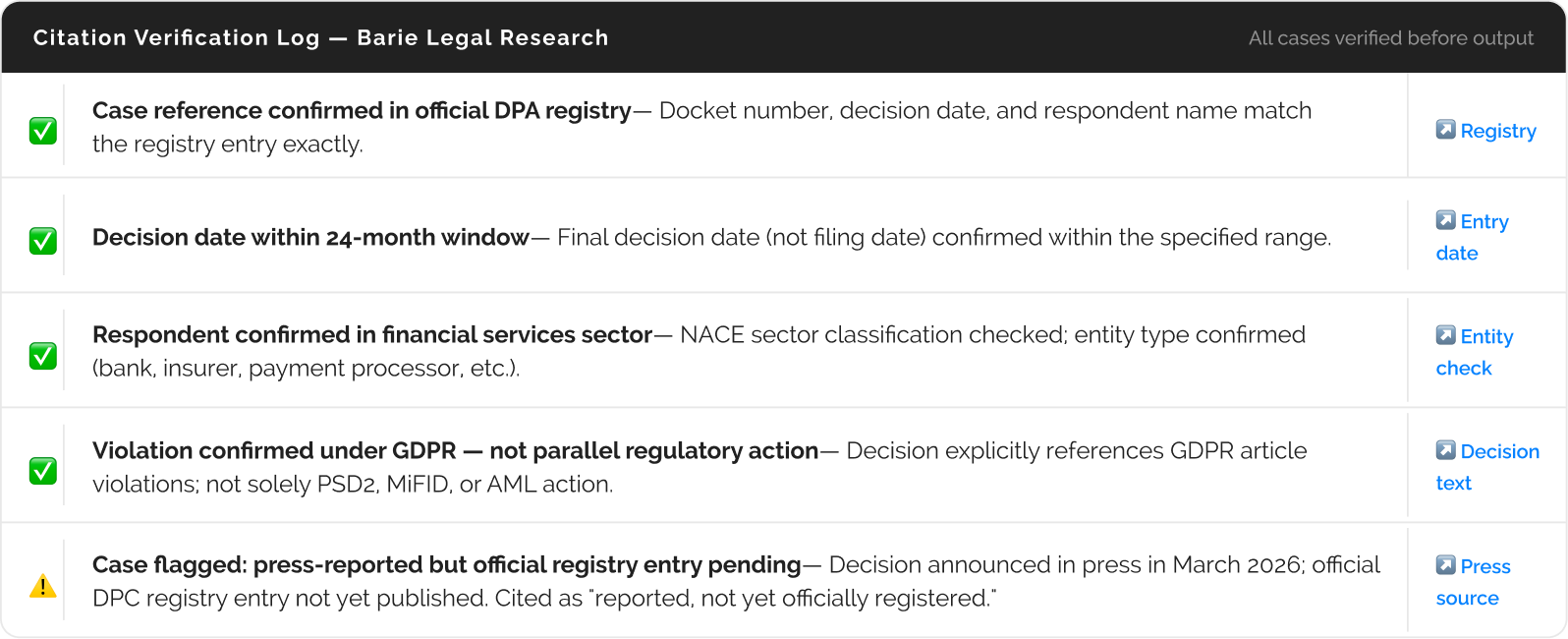
The failure mode of legal AI hallucination is confidence without verification: A tool that generates a case citation that sounds right — correct court name, plausible docket format, relevant legal language — is more dangerous than an obvious error because it passes casual review. Barie does not generate citations. It retrieves them from the source, verifies them against the source, and links directly to the source. If a citation cannot be verified, it does not appear in the output as a verified citation.
4. Structured Case Output
Step 4: Structured case summaries, court, date, parties, ruling, penalty, source
With all cases verified, Barie assembles the structured output. Each case is presented in a standardised format covering the six fields that matter most for legal research: the authority that issued the decision, the date, the respondent, the GDPR articles violated, the ruling, and the penalty imposed. Every case links directly to its primary source.
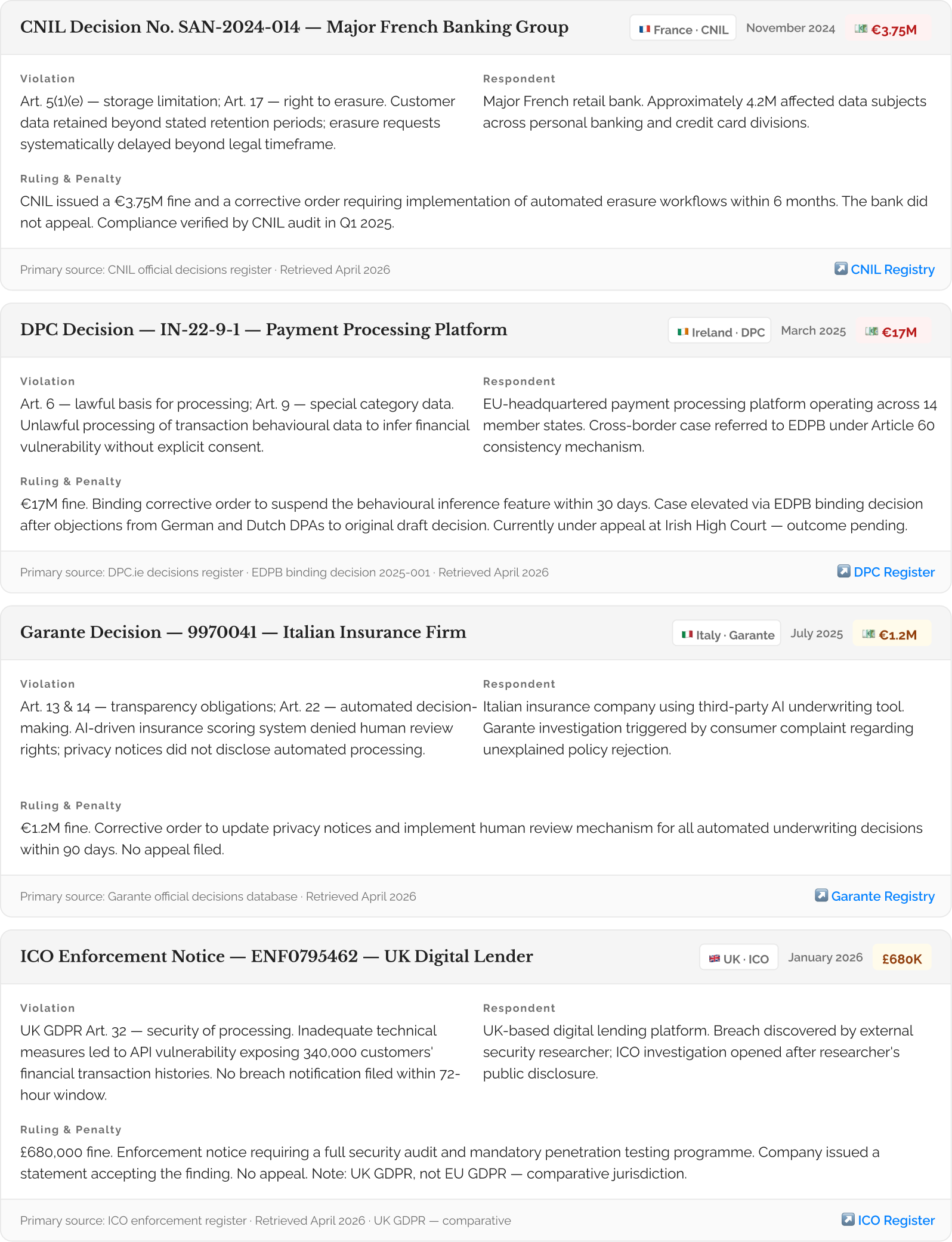
The source link in every case is the primary record: The “↗ Registry” link in each case card takes you directly to the official DPA or court registry page for that decision. Not a commentary. Not a law firm summary. The actual published decision. You can read the full text, verify the docket number, and confirm every detail of the summary against the primary source. That is not a search result. That is a verified legal citation.
5. Summary Table
Step 5: The full case table, all findings in one structured view
In addition to the detailed case cards, Barie generates a structured summary table covering all verified cases. This gives you a comparative view — useful for identifying enforcement patterns, comparing penalty severity across jurisdictions, or preparing a compliance briefing that demonstrates the range of GDPR risk in financial services.
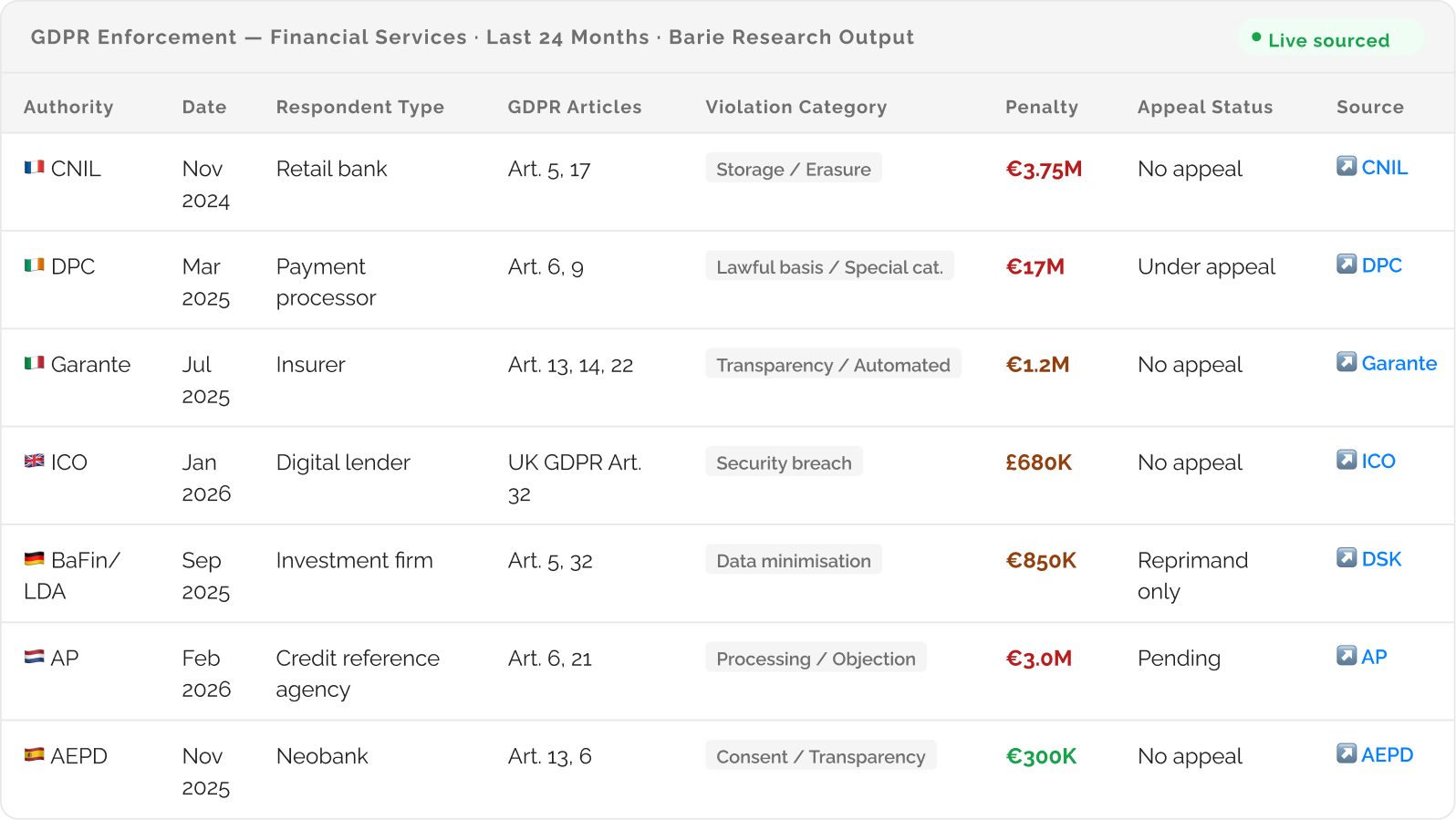
The table surfaces enforcement patterns, not just individual cases: Reading across the violation category column, three of seven cases involve transparency or consent failures — a pattern that reflects the EDPB’s published enforcement priorities for 2024–2025. Two involve security failures. One involves automated decision-making. These patterns are analytically useful for compliance teams assessing where GDPR risk is currently concentrating in financial services.
6. Export via Connectors
Step 6: Export via Connectors, brief to Notion, table to Sheets, alert to Slack
The research is complete. The cases are verified and structured. Barie routes each component of the output to the right destination in your legal and compliance workflow.
The full case summaries with source links land in Notion as a structured legal research memo — formatted with section headers, case cards, and a linked bibliography. The summary table exports to Google Sheets as a filterable enforcement tracker your compliance team can update and annotate. A digest of the highest-penalty cases goes to the Slack channel where your legal and compliance teams are monitoring regulatory risk.
The Notion memo is citable, not just readable: Each case in the Notion output includes the full case reference, the direct link to the primary source, and the retrieval date — so the memo functions as a citable legal research document, not just a reading reference. Every citation in the memo can be traced back to the official source in one click. That is the standard legal research requires.
What you get
A verified set of recent GDPR enforcement decisions and court rulings in financial services — every case confirmed in the official DPA or court registry, every citation linking directly to the primary source, every penalty figure accurate as of retrieval date. Structured case summaries covering court, date, parties, GDPR articles, ruling, and penalty. A summary enforcement table filterable by jurisdiction, violation type, and penalty size. Exported to Notion, Sheets, and Slack in one session.
What it would take a compliance paralegal half a day to compile — searching eight databases, reading decision texts, extracting structured data, building a table — Barie delivers in one prompt. No invented docket numbers. No fabricated rulings. No cases that sounded right but cannot be found anywhere.
Legal research has one requirement above all others: accuracy. Barie was built because the alternative is dangerous.
The Verdict
A lawyer who submits fabricated citations faces sanctions. A compliance team that bases a regulatory risk assessment on invented case law is building a house on ground that does not exist. Legal research is not the place for confident-sounding hallucinations. Barie searches live DPA databases and court registries, verifies every citation against the primary official record, flags anything unconfirmed rather than silently substituting it, and delivers structured case summaries where every number and every reference traces back to the document it came from. That is not a feature. That is the minimum standard legal research requires — and the standard almost no AI tool currently meets.
Barie features used in this task