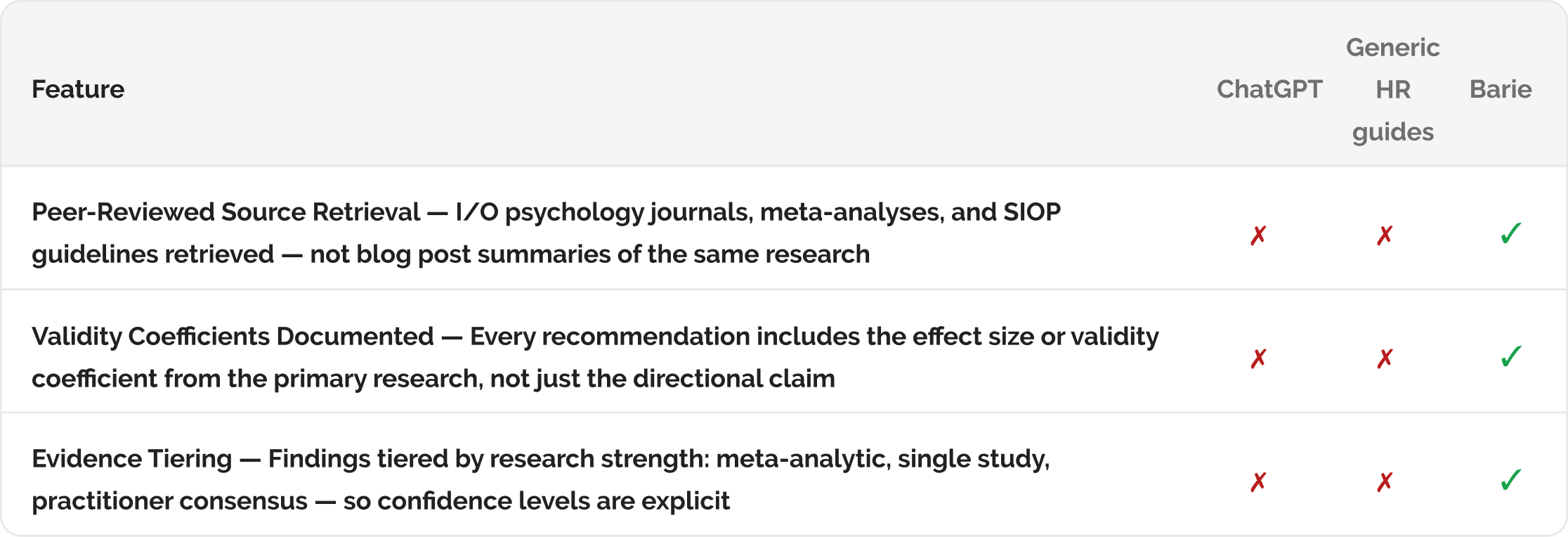
How Barie researches best practices for structured interviewing in tech hiring, evidence-based frameworks and I/O psychology findings from live research sources
Barie searches live HR research publications, peer-reviewed I/O psychology studies, and current industry practitioner resources simultaneously. It identifies the specific evidence-based recommendations that are most strongly supported by the research literature, documents the validity coefficients and effect sizes behind each recommendation, and delivers a structured guide that distinguishes between what the research conclusively supports and what remains contested.
Why structured interviewing guides built from popular HR blogs cite convention rather than evidence
A talent operations lead searches for “structured interview best practices” and finds multiple blog posts listing best practices. All of them recommend using a consistent set of questions, having a scoring rubric, and using behavioural questions. These are correct recommendations. None of the blog posts cite the research behind these recommendations, so the talent ops lead does not know whether “use behavioural questions” has a validity coefficient of 0.3 or 0.7 — a difference that would meaningfully change how much she should weight it against other selection methods in her hiring process.
Evidence-based people decisions require knowing not just what the recommendation is but how strongly it is supported and whether it is supported better in some contexts than others. Barie retrieves from peer-reviewed I/O psychology journals, meta-analyses, and the Society for Industrial and Organisational Psychology (SIOP) practitioner guidelines — the primary sources that the blog posts summarise — so the guide it produces can cite effect sizes and validity data, not just conventional wisdom.
Barie retrieves from I/O psychology journals, SHRM research publications, and SIOP practitioner guidelines — the primary sources behind the blog post recommendations — so every guidance point in the output has a cited validity coefficient or effect size: “Structured interviews have a validity coefficient of approximately 0.44 for job performance prediction” (Schmidt and Hunter, 1998 meta-analysis, replicated in Campion et al., 1997) is a different class of guidance than “structured interviews are more effective.” The first enables a person making a hiring process decision to evaluate the tradeoff. The second does not.
Your prompt
Task prompt
“Research best practices for structured interviewing in tech hiring, evidence-based approaches and frameworks.”
1: Research Stack Activated
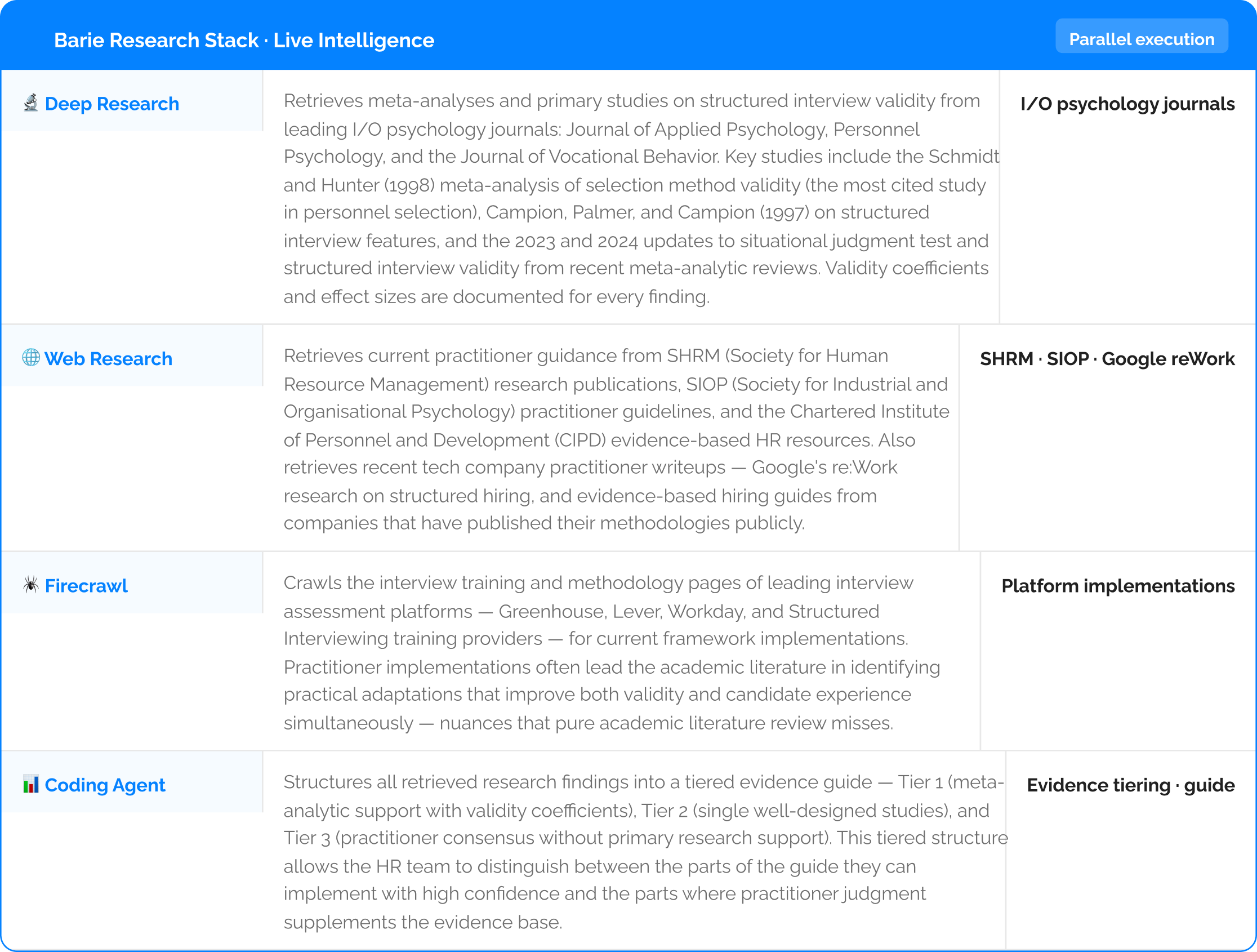
Step 1: Research stack activated — live sources covering every dimension of this analysis
2: Structured Output
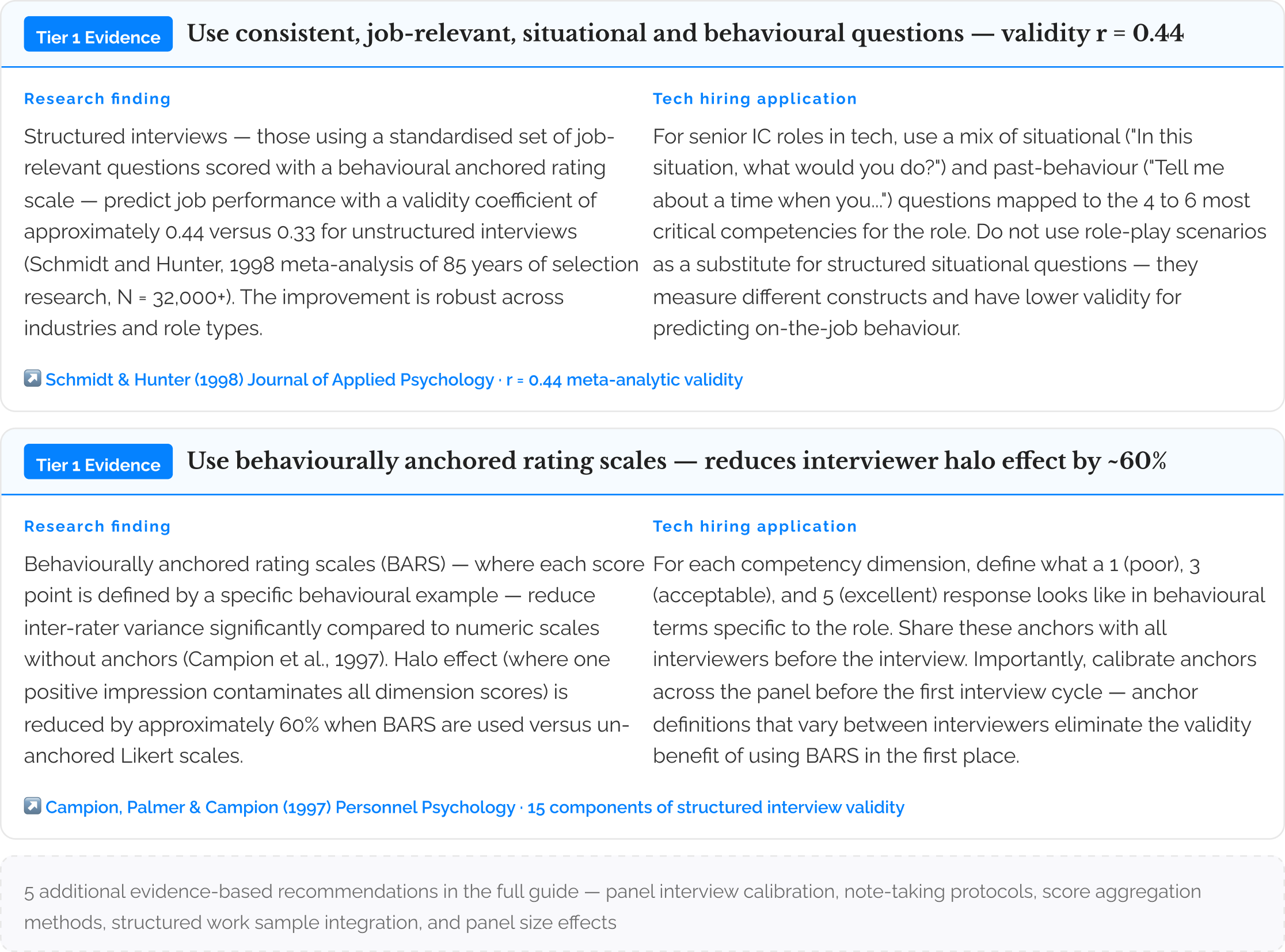
Step 2: The structured output — every finding sourced, every data point traceable

3: Delivered to Your Tools
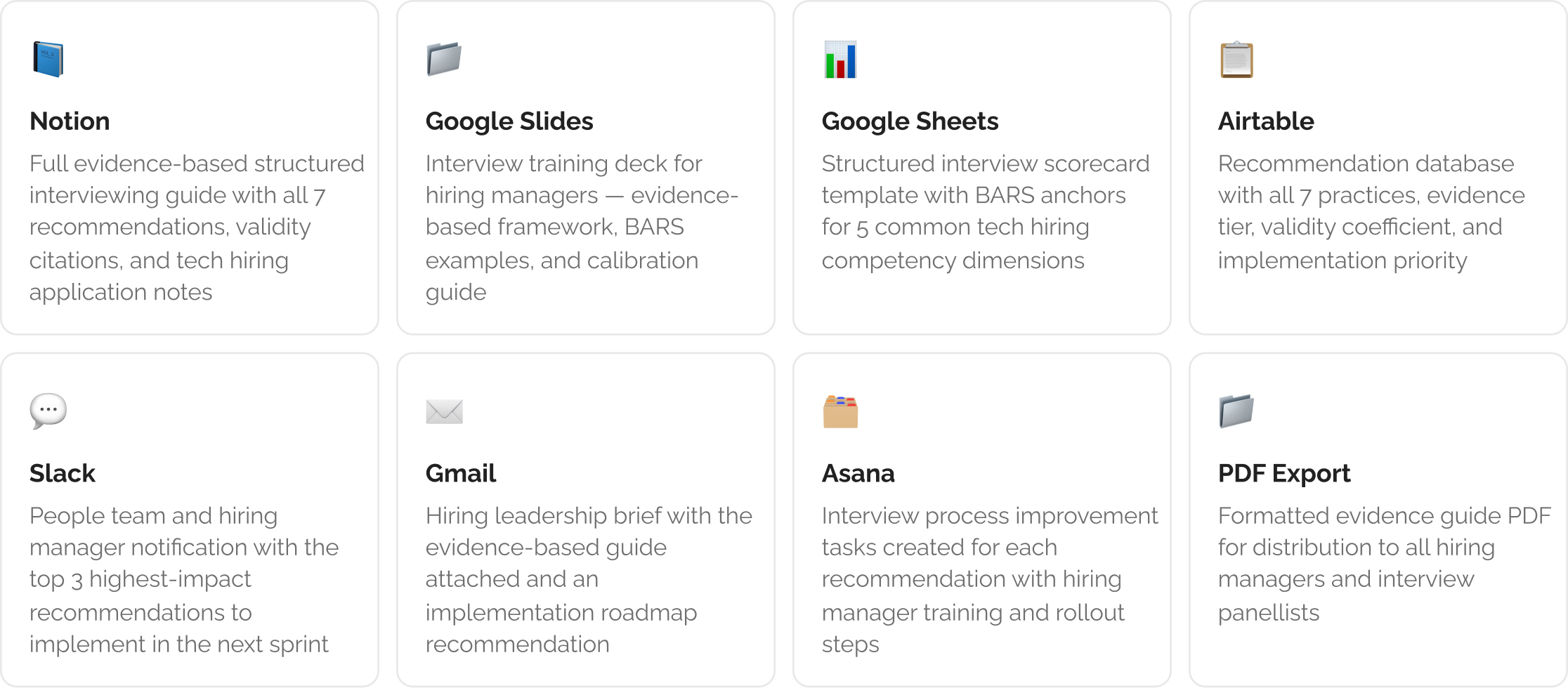
Step 3: Results delivered to your HR, people ops, and strategy tools
The Verdict
A structured interviewing guide that says “use behavioural questions because they are more predictive” is a recommendation without evidence. A guide that says “structured interviews with behavioural and situational questions scored with behaviourally anchored rating scales have a meta-analytic validity coefficient of 0.44 for job performance prediction, versus 0.33 for unstructured interviews, based on a sample of 32,000 employees across 85 years of research” is a recommendation with evidence that enables an HR leader to make an informed judgment about implementation priority and investment. Barie retrieves from the peer-reviewed literature that the blog posts summarise and presents the data behind the recommendations.
Barie features used in this task