How to analyse Apple’s last 3 quarterly earnings and flag every red flag using Barie
You asked for a financial analysis. Most AI tools would write one from memory — confident, professional, and largely made up. Barie retrieves the actual SEC filings, cross-references three quarters in parallel, and delivers a structured brief where every number traces back to the document it came from.
The problem with chat-based analysis
You give the earnings prompt to ChatGPT. It writes a well-structured response about Apple’s services strength and iPhone cycle. It cites specific revenue figures. It sounds exactly like a research brief.
None of the numbers are verifiable. Some may be from a year ago. Some may not exist at all.
That is not a minor flaw. In financial research — where a single incorrect data point can inform a real capital decision — confidence without accuracy is actively dangerous. ChatGPT has no mechanism to tell you which parts of its output are real and which parts it generated because they sounded right.
Barie’s entire architecture is built around one principle: every output must be traceable. If a number appears, it came from a document. If a claim appears, there is a source behind it. If there is no source, Barie says so.
Barie’s entire architecture is built around one principle: every output must be traceable. If a number appears, it came from a document. If a claim appears, there is a source behind it. If there is no source, Barie says so.
Your prompt
This is the exact task as given to Barie:
Task prompt
“Can you analyse Apple’s last 3 quarterly earnings and flag red flags in revenue growth, margins, or cash flow?”
One sentence. No further instruction. Barie parses the intent — live financial documents required, three specific periods, three specific metric categories — constructs a research plan, and executes it. Here is the exact sequence of what happens next.
Step 1: Task decomposition
Before touching the web, Barie breaks the prompt into a structured research plan. It identifies three distinct research threads — one per quarter — and three analytical dimensions to evaluate within each: revenue trajectory, margin structure, and cash flow quality.
Reading three requirements
Three quarters of 10-Q filings from SEC EDGAR. Q1, Q2, Q3 — each retrieved as a primary document, not a cached summary.
Registering metrics to score
Revenue growth rate QoQ and YoY. Gross margin by segment. Operating cash flow. Free cash flow yield. Management language flags.
Transcript pull items
Earnings call transcripts for the same three periods — CEO remarks, CFO guidance, analyst Q&A — to surface language divergence from filed numbers.
Red flag taxonomy
Anomaly classification prepared: margin compression, cash flow divergence, revenue deceleration, undisclosed concentration risk.
What Barie does in this step: Most tools skip decomposition entirely and go straight to generating output. Barie invests the first phase in building a research architecture — defining exactly what documents it needs and what it is measuring before it retrieves anything. This is why its outputs are structured and comparable rather than freeform and unverifiable.
Step 2: Parallel live research
Barie does not research sequentially. It fires all three document retrieval threads simultaneously — three 10-Qs and three earnings transcripts pulled from the live web at the same time. What a human analyst would spend a morning retrieving, Barie retrieves in one pass.
What Barie pulls in this step:

Simultaneously, Barie retrieves earnings call transcripts from the same three periods. These contain management guidance, analyst questions, and forward-looking statements the 10-Q alone cannot surface. The combination of filed numbers and spoken commentary is where the most revealing divergences appear.
Every source is timestamped and linked. Before Barie writes a single finding, you can see the URL of every document it retrieved. Not a summary. The actual filing. If a number appears in the brief, you can click through to the exact page of the 10-Q it came from.
Step 3: Source verification
Every document retrieved goes through Barie’s verification layer before any data is extracted. This step is invisible to most users — but it is the step that separates Barie from tools that simply paste retrieved text into a response.
The verification checklist: Barie confirms each source matches the expected filing period. It cross-checks Apple’s CIK number against the EDGAR submission. It verifies the filing date falls within the expected quarter window. It confirms the document type is 10-Q — not 10-K, not an amendment, not a proxy statement.
Anti-hallucination in practice: When Barie cannot verify a source — if a document is unavailable, a filing date is ambiguous, or a transcript cannot be confirmed as authentic — it flags this explicitly in the output rather than substituting a plausible-sounding alternative. That explicit acknowledgement of uncertainty is not a limitation. It is the product working correctly.
Step 4: Structured output
With all three quarters verified and parsed, Barie constructs the financial brief. The output is not a wall of text — it is a structured table with flagged anomalies, severity classifications, and source citations for every data point.
What the output looks like:
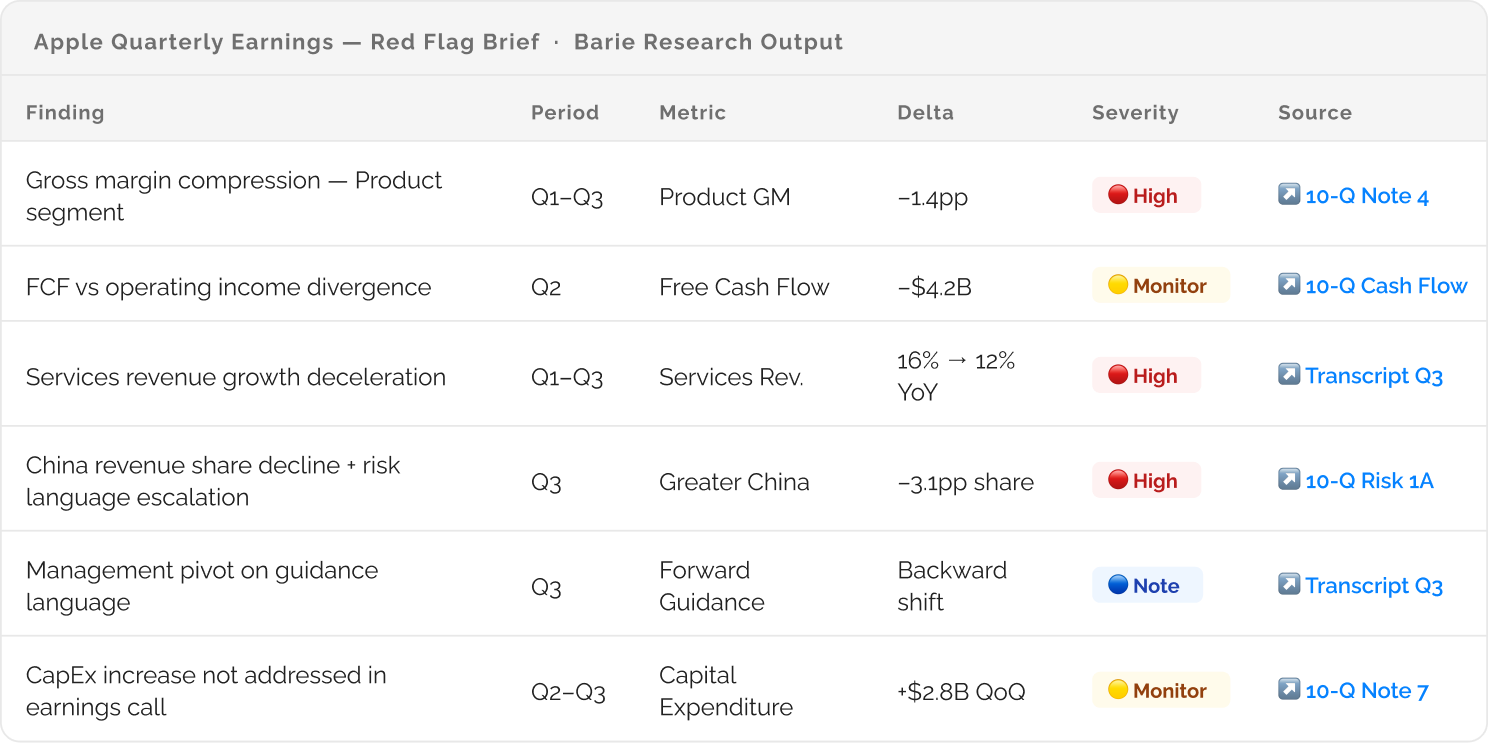
Every number links to its filing. The source column is not decorative. Each link takes you to the exact section of the actual SEC document where that figure appears. You do not need to verify Barie’s output. It verifies itself.
Executive summary included: Barie generates a structured executive summary at the top of the brief — a synthesis of the most material findings and an analytical verdict, not a recap of what the table says.
Step 5: Export via Connectors
The research is done. The brief is structured. Now Barie sends it wherever you need it to go.
Connector workflow:

One session. The brief lands in Notion as a structured page. The table goes to Google Sheets as live data. The executive summary gets sent to the relevant Slack channel. Three outputs. One prompt. No copy-pasting.
🔗 What makes Connectors different from export buttons: Barie understands the structure of what it produced and sends the right elements to the right destinations — the table to the spreadsheet, the narrative to the document, the alert to the channel. The workflow is the product.
What you get
A complete analysis of Apple’s last 3 quarters — live data, structured findings, and source citations — delivered in one session. Every number traceable. Every red flag explained. No hallucinated figures.
What it would take a full research morning to produce manually, Barie does in one prompt.
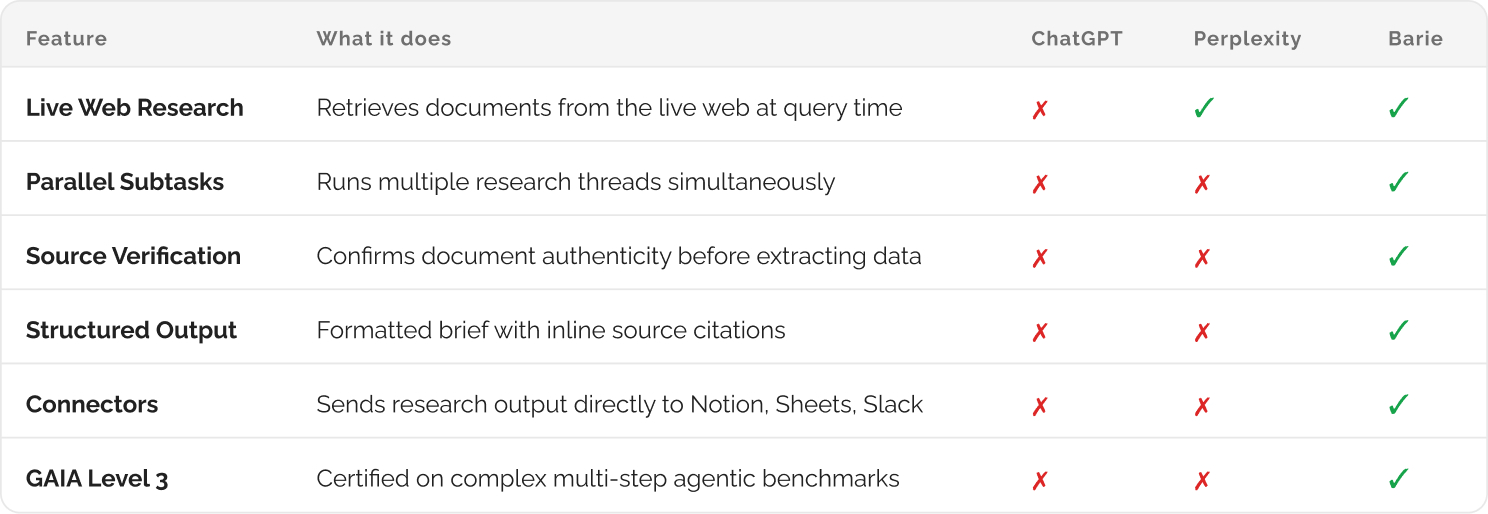
Barie features used in this task
Next steps
→ Deep Research overview — how Barie goes beyond search
→ Barie Connectors — send research directly to your tools
→ Prompt Library — finance and investment research templates
→ Wall of Love — what analysts are researching with Barie