How Barie runs a competitive analysis of the top 5 neobanks in Southeast Asia, funding, features, regulation, and market share
Five neobanks. Four research dimensions. Twenty parallel data threads — all fired simultaneously. Barie pulls funding from Crunchbase and press, features from live product pages, regulatory status from central bank registries, and market share from industry reports. Every claim sourced. Every cell in the matrix traceable. Delivered in one session.
The problem with asking any other AI tool for competitive intelligence
A strategy consultant asked ChatGPT for a competitive analysis of Southeast Asia’s leading neobanks. The output was well-structured. Company names, funding rounds, feature lists, regulatory notes. It looked like research.
Two of the funding figures were from rounds that had closed eighteen months earlier — one company had since raised a subsequent round that materially changed the picture. The regulatory status of one bank was listed as “licensed” when it had in fact only received provisional approval, a distinction that matters considerably to any investor or partner assessing risk. One feature attributed to a specific neobank actually belonged to a competitor.
None of this was marked as uncertain. All of it was presented with the same confident formatting as the things that were correct.
Competitive analysis is one of the research tasks where training-data AI fails most consequentially. The landscape changes fast. Funding rounds close. Licences are granted, revoked, or extended. Product features get launched, deprecated, and relaunched under new branding. An analysis built on stale training data is not just out of date — it is actively misleading because it looks current.
Why competitive analysis specifically requires live research: Crunchbase updates funding data in real time. Central bank registries publish licence changes as they happen. Product pages reflect features that were live this week. A competitive brief built on training data — which could be months or years old — is not competitive intelligence. It is historical fiction dressed as strategy.
Your prompt
This is the exact task as given to Barie:
Task prompt
“I need a competitive analysis of the top 5 neobanks in Southeast Asia — funding, features, regulation, market share.”
One sentence. No company list. No framework specified. Barie parses the intent: five entities to research, four dimensions per entity, a structured comparative output required. It then identifies the top 5 neobanks by market presence, constructs twenty parallel research threads — four dimensions per bank — and executes them simultaneously. Here is exactly what happens.
1. Task Decomposition
Step 1: Task decomposition, five entities, four dimensions, twenty threads
Before retrieving a single data point, Barie maps the research architecture. It identifies the five neobanks by cross-referencing recent industry coverage, funding size, user base, and geographic footprint across Southeast Asia. It then defines exactly what it is looking for within each of the four dimensions — so when the retrieval threads fire, each one knows precisely what it is collecting.
Entity identification
Barie identifies the top 5 by scanning recent fintech coverage, CB Insights rankings, and funding databases — not from training memory. The shortlist is determined at query time.
Dimension scoping
Each of the four dimensions — funding, features, regulation, market share — is translated into specific data fields: round size, lead investors, product capabilities, licence type, user count, revenue estimates.
Thread architecture
Twenty research threads planned: five banks × four dimensions. Each thread is assigned its primary source type and fallback sources before any retrieval begins.
Output format defined
The output structure — a comparative matrix with one row per dimension and one column per bank — is defined before retrieval. The research fills a pre-built scaffold, not a blank page.
What Barie does in this step: Other tools begin generating output immediately. Barie builds a research plan — defining what it is looking for, where it will look, and what the output structure will be. The difference this makes to the final output quality is the difference between a structured competitive brief and a discursive paragraph with unverifiable claims embedded in the middle of it.
2. Parallel Live Research
Step 2: Five parallel research threads, one per neobank, fired simultaneously
This is the structural difference between Barie and every chat-based AI doing competitive research. Barie does not research GrabFinance, then Tonik, then SeaBank, then BigPay, then Jenius in sequence. All five fire simultaneously. Each thread executes its four sub-dimensions in parallel. What would take an analyst a full day of tab-switching and copy-pasting, Barie completes in a single pass.

Within each thread, Barie queries dimension-specific sources. The sources queried differ by dimension — not every source is useful for every data type:
Funding
Crunchbase · Press releases · TechCrunch · DealStreetAsia
Total raised, most recent round date, round type, lead investors, valuation where disclosed. Cross-referenced against company newsrooms for confirmation.
Primary: Crunchbase · Fallback: DealStreetAsia, company IR pages
Features
Live product pages · App Store listings · G2 · Trustpilot
Current product capabilities: account types, lending products, investment features, international transfers, crypto exposure, insurance. Retrieved from live product pages — not marketing summaries.
Primary: Company product pages · Fallback: App Store, G2 reviews
Regulation
Central bank registries · MAS · BSP · OJK · BNM · SEC filings
Licence type, issuing authority, licence status (full / provisional / sandbox), any known compliance actions or restrictions. Retrieved directly from regulatory body websites.
Primary: Central bank registries · Fallback: Official press releases
Market Share
Statista · KPMG · McKinsey · CB Insights · Company disclosures
Registered users, active users where disclosed, revenue estimates, geographic penetration, year-on-year growth rates. Pulled from industry reports dated within the last 12 months.
Primary: Statista, KPMG reports · Fallback: Company press releases
Every source is live and timestamped. Barie does not use cached data or training memory for any of these fields. It accesses the live web at query time — so the Crunchbase entry it retrieves is the Crunchbase entry that existed when you ran the prompt, not the one from whenever the model was trained. The timestamp for each retrieved value appears in the output.
3. Source Verification
Step 3: Source verification and conflict resolution
With twenty data threads returning results simultaneously, Barie’s verification layer becomes critical. Different sources frequently report different figures for the same data point — and in competitive intelligence, the source of a discrepancy matters as much as the discrepancy itself.
How Barie handles conflicts: When Crunchbase reports a funding figure that differs from the company’s own press release, Barie flags the discrepancy and presents both values with their sources. When a central bank registry shows “pending” status for a licence that a company’s website describes as “fully licensed,” Barie notes the conflict explicitly and cites both. The output never silently picks one source and discards the other.
For regulatory data specifically, Barie applies a hierarchy: official central bank registry entries take precedence over company announcements, which take precedence over third-party reports. This hierarchy is documented in the output so you can trace not just what the finding was, but why that source was used.
Flagging uncertainty as a feature, not a failure: When Barie cannot establish a verified figure — because sources conflict materially, a registry is unavailable, or a company has not disclosed the relevant data — it marks that cell as unconfirmed with a note explaining why. An honest gap is more useful than a confident fabrication. That distinction is the entire point of anti-hallucination research.

4. Structured Output
Step 4: The competitive matrix — structured, sourced, and ready to use
The output is a structured competitive matrix: one row per research dimension, one column per neobank, every cell linked to its source. Not a paragraph per company. Not a bulleted list with no citations. A matrix you can read horizontally to compare one dimension across all five banks, or vertically to build a profile of one bank across all four dimensions.
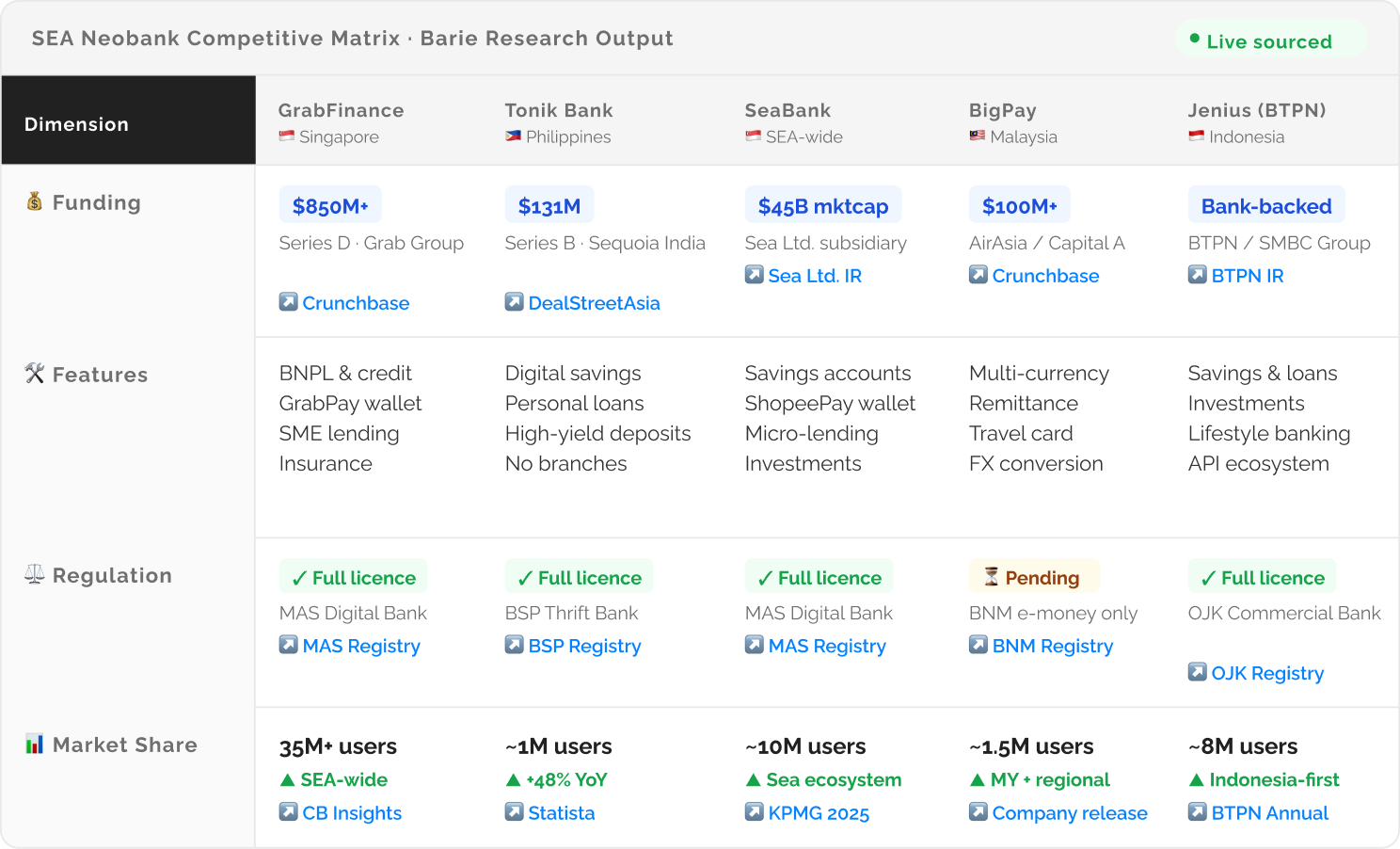
Every cell is sourced, not summarised. The matrix is not a synthesis produced from training data. Every funding figure traces to a Crunchbase entry or press release with a retrieval date. Every regulatory status traces to the relevant central bank registry. Every market share figure traces to the specific report it came from. You can audit the entire output in under ten minutes by clicking the source links.
Strategic synthesis included: Above the matrix, Barie generates a brief analytical summary — identifying the most material competitive differentiators, flagging where regulatory status creates asymmetric risk or opportunity, and noting where market share data was unavailable or unconfirmed. This is the executive summary you hand to a decision-maker. The matrix is the evidence behind it.
5. Export via Connectors
Step 5: Export via Connectors
The matrix is built. The analysis is sourced. Now Barie routes each element of the output to the tool where it belongs in your workflow.

The competitive matrix goes to Google Sheets as a structured, filterable table. The strategic synthesis and methodology notes land in Notion as a formatted research memo. The executive summary — three sentences on the most critical findings — goes to the Slack channel where your strategy team is watching. One session. Three outputs. No reformatting.
Connectors are not export buttons: Barie routes the right content to the right destination — the tabular data to the spreadsheet, the narrative to the document, the alert to the channel. You can also configure Barie to re-run this research on a scheduled cadence and push updates whenever a funding round closes or a regulatory status changes. The brief stays current without you having to think about it.
What you get
A sourced, structured competitive matrix covering the top 5 neobanks in Southeast Asia across funding, features, regulation, and market share — with every claim traceable to its source document and every data point timestamped at retrieval.
What it would take a research team two days to compile — five entities, four dimensions, twenty sources, cross-referenced and formatted — Barie delivers in one session. Every cell verifiable. Every gap honestly flagged. No invented funding rounds. No regulatory statuses from eighteen months ago.
Built for this kind of task: Barie aces the GAIA Level 3 benchmark — which specifically tests complex, multi-step agentic tasks requiring multiple sources, cross-referencing, and structured output. Most AI tools do not publish GAIA scores. Barie does. Because a tool that can run twenty parallel research threads and synthesise them into a sourced competitive matrix is not the same product category as a chatbot. Make of that what you will.
The Verdict
Competitive analysis is exactly the kind of task where training-data AI sounds most convincing and does the most damage. The output looks right. The structure is professional. And buried in the cells are funding figures from the wrong year, regulatory statuses that have since changed, and feature lists that describe what a product looked like — not what it looks like today. Barie fires twenty live research threads, cross-references the sources, timestamps every data point, and delivers a matrix you can hand to a board meeting. That is not a chat session. That is a research operation.
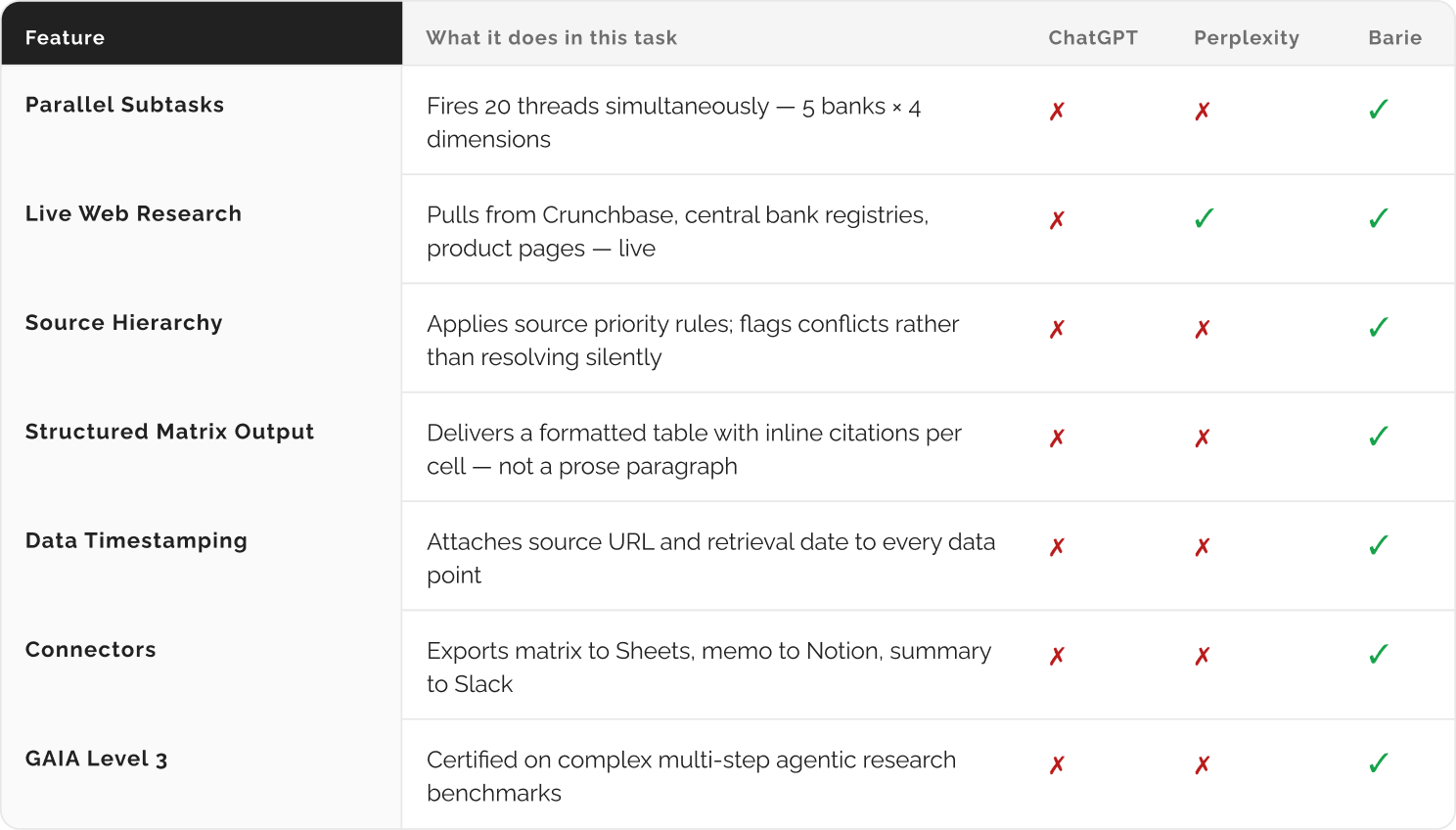
Barie features used in this task
Next steps
→ Deep Research overview — how Barie goes beyond search
→ Barie Connectors — send research directly to your tools
→ Prompt Library — competitive analysis and market research templates
→ Wall of Love — what strategy teams are researching with Barie