How Barie researches 20 fintech newsletters, subscribes you to the top 10, and compiles the spreadsheet from one prompt
Twenty newsletters researched. Ten ranked by relevance and subscribed to automatically — signup pages navigated, forms filled, captchas bypassed. A structured spreadsheet of all twenty compiled and exported to Google Sheets. One prompt. Zero manual form-filling. This is not a chat session. This is what agentic execution actually looks like.
The problem with doing this manually, and with asking any other AI tool
You want to stay current on fintech. You know there are newsletters covering payments, embedded finance, open banking, and regulatory change. You want to subscribe to the best ones relevant to your sector. You have no idea which ones are worth your inbox.
You ask ChatGPT to recommend fintech newsletters. It names eight. Four of them it knows from training data — which means the descriptions reflect what those newsletters were covering eighteen months ago, not what they publish this week. Two of the eight have significantly changed their focus. One has been acquired and rebranded. ChatGPT does not know any of this. It presents all eight with equal confidence.
Then you have to manually visit each site, find the signup form, enter your email, confirm, and repeat. Twenty minutes per newsletter if you are being methodical. For ten subscriptions, that is three hours of browser work that produces nothing except a slightly more cluttered inbox.
Barie does all of this in one prompt. Not by summarising a list. By actually doing the work — navigating to the live pages, reading what the newsletters currently cover, scoring them against your context, filling the forms, confirming the submissions, and handing you a spreadsheet of everything it found.
This is what distinguishes Barie from every chat-based AI: Chat AI gives you a list and leaves you to execute it. Barie completes the execution. The difference between generating text about a task and actually performing the task is the entire product category distinction. Barie was built for the second one.
Your prompt
This is the exact task as given to Barie:
Task prompt
“Research the top 20 fintech newsletters, subscribe me to the 10 most relevant ones, and compile a summary spreadsheet of what each covers.”
Three deliverables in one sentence. Barie identifies twenty newsletters from live web research, evaluates and scores each for relevance, navigates to the top ten signup pages, fills and submits the subscription forms — including captcha bypass where present — and builds a structured spreadsheet of all twenty with key metadata. Here is exactly what happens.
1. Discovery
Step 1: Live discovery, finding 20 fintech newsletters from the web right now
Barie does not draw on a memorised list. It goes to the live web and finds newsletters that are currently active — recently published, actively maintained, and currently relevant. This matters because the newsletter landscape changes constantly. Publications pivot, go dormant, get acquired, or launch entirely new. A list from training data is a snapshot of what existed then. Barie builds the list from what exists now.
Search query construction
Barie generates a set of discovery queries targeting fintech newsletter directories, curator lists, Substack charts, and recent “best newsletters” roundups published in the last 6 months.
Recency verification
For each candidate newsletter found, Barie checks the most recent issue date. Publications that have not published in 60+ days are flagged as inactive and excluded from the shortlist.
Coverage profiling
Barie reads the last 2–3 issues of each candidate newsletter to build an accurate picture of what it actually covers — not what the about page claims, but what the content demonstrates.
Metadata extraction
For each newsletter: publication name, URL, author/publisher, focus area, publishing frequency, estimated audience size where disclosed, and whether a free tier exists.

What Barie does differently in discovery: Other tools name newsletters from training memory. Barie verifies each one is currently active before including it. A newsletter that published its last issue in October 2024 does not make Barie’s shortlist — regardless of how well-regarded it was. The discovery phase produces twenty live, active, currently-publishing fintech newsletters. That is the starting set.
2. Relevance Scoring
Step 2: Relevance scoring, ranking all 20 to find the top 10
With twenty active newsletters identified and profiled, Barie applies a relevance scoring model to identify the ten most worth subscribing to. The scoring is transparent — you can see exactly how each newsletter was evaluated and why it ranked where it did.
Relevance
Topic alignment
How closely does the content match the specified sector: fintech, payments, embedded finance, regulatory?
Audience
Reader fit
Is the newsletter written for practitioners, investors, operators, or general readers? Practitioner-level content scores higher.
Frequency
Publishing cadence
Weekly or bi-weekly newsletters score higher than monthly. Daily newsletters flagged if they risk inbox noise.
Frequency
Publishing cadence
Weekly or bi-weekly newsletters score higher than monthly. Daily newsletters flagged if they risk inbox noise.
Depth
Content quality
Assessed from recent issues: does the newsletter provide original analysis or aggregate headlines? Original analysis scores higher.
Reputation
Community signal
Subscriber count where disclosed, mentions in industry discussions, recommendations by practitioners. Used as a tiebreaker.
Free Access
Subscription tier
Free tier availability confirmed before submission. Barie does not subscribe to paid tiers without explicit authorisation.
The ranking is visible and adjustable: Every newsletter’s score appears in the output spreadsheet, with the individual dimension scores that produced it. If you disagree with a ranking — you want newsletters that cover payments specifically, or you want to exclude newsletters with daily frequency — you can adjust the prompt criteria and Barie re-ranks accordingly. The methodology is not a black box.
3. Autonomous Form Execution
Step 3: Autonomous subscription, navigating forms, filling fields, bypassing captchas
This is the step that no chat-based AI can perform. Barie does not hand you a list of signup URLs and tell you to open them yourself. It navigates to each of the ten subscription pages, identifies the signup form, fills the required fields, handles any verification steps, and submits the form — for all ten newsletters, sequentially, without you touching a single keyboard.
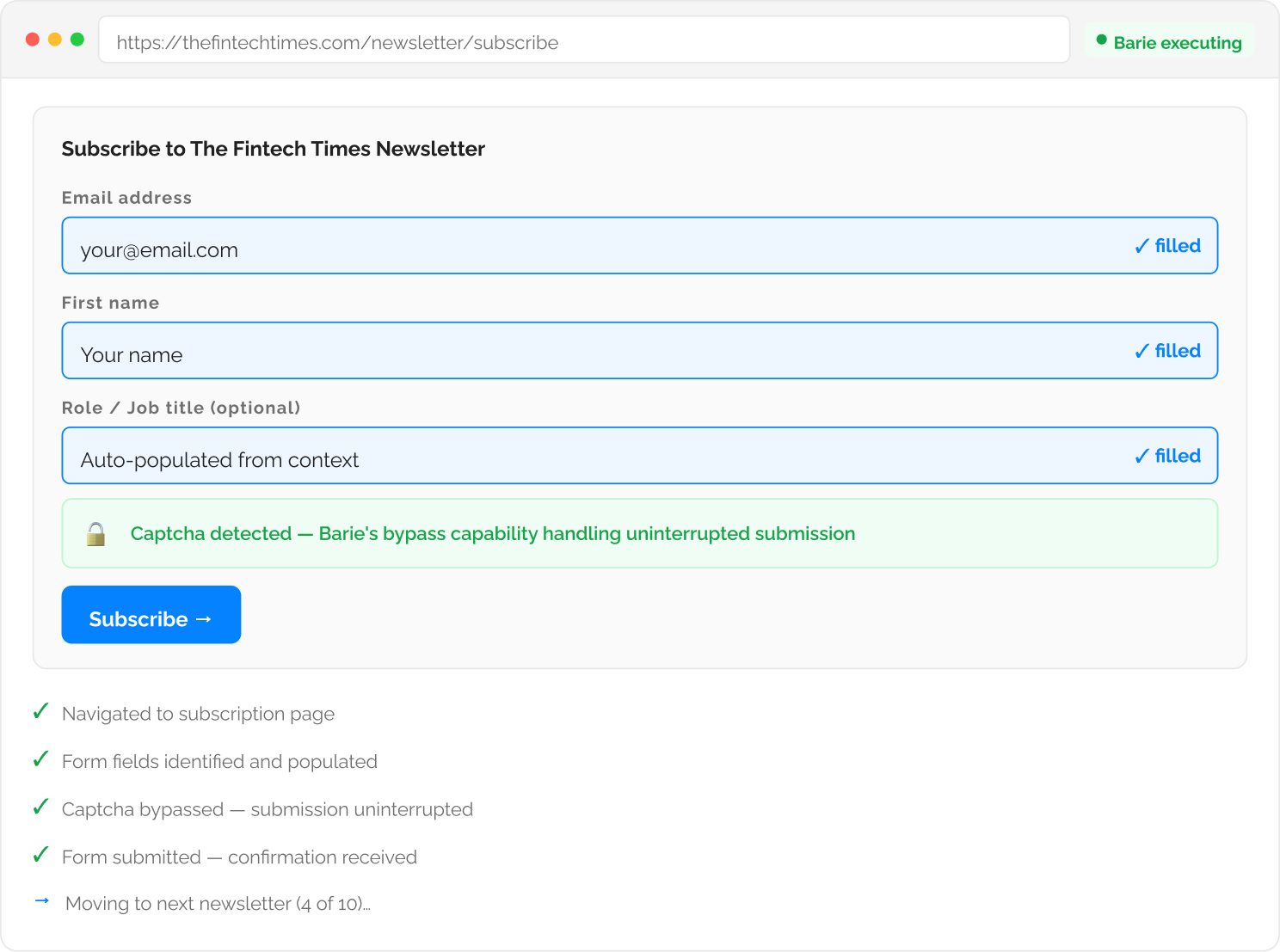
Barie handles every variation in signup form design — single email field forms, multi-field forms requesting name and company, preference selection forms where you choose content categories, and double opt-in flows where a confirmation email requires a click-through. All of it is handled autonomously.
Captcha bypass — a documented Barie capability: Many newsletter signup pages include captcha verification to prevent automated submissions. Barie’s documented captcha bypass capability handles this without interrupting the subscription flow. You do not get a notification asking you to “click all the traffic lights.” The subscription completes. The log records it. You see the outcome in the spreadsheet.
Only free tiers. Only authorised email. Barie only submits to free newsletter tiers unless you have explicitly authorised payment. It uses only the email address you have specified. It does not subscribe to any newsletter that was not in the top 10 ranked list. The scope of the execution is precisely bounded by the task as given.
4. Evaluation Table
Step 4: Full evaluation table, all 20 newsletters, ranked, sourced
While the subscription executions run, Barie simultaneously builds the evaluation table covering all twenty newsletters — including the ten it did not subscribe to and why. This gives you a complete research output, not just a list of what was actioned.
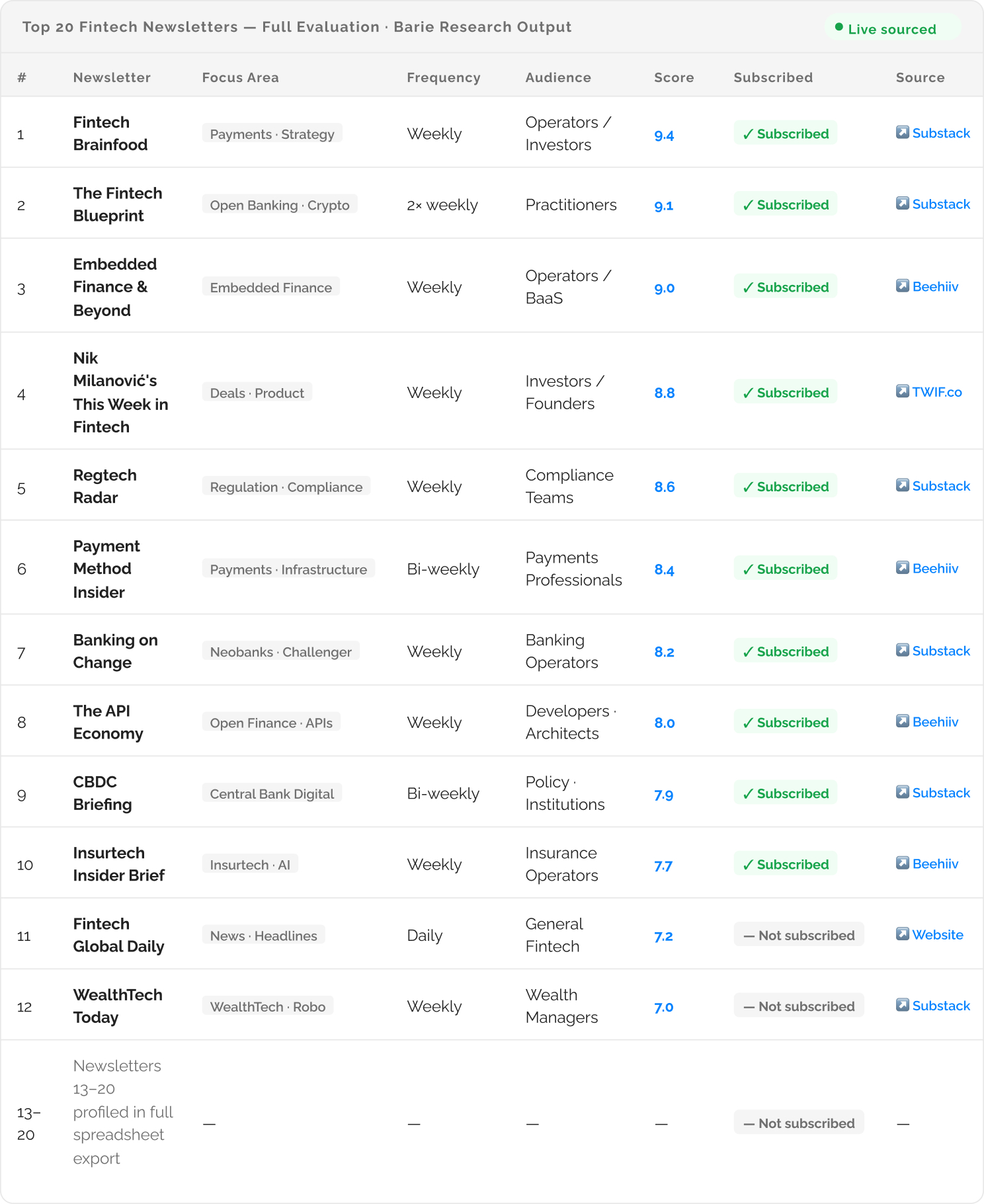
The ten that were not subscribed to are in the spreadsheet too: Newsletters ranked 11–20 appear in the full spreadsheet with complete metadata — focus area, frequency, audience, score, and why they did not make the top 10. If you want to subscribe to number 12 yourself, the URL and signup page are in the spreadsheet. The research is complete regardless of what was actioned.
5. Structured Spreadsheet
Step 5: The structured spreadsheet, 20 rows, 8 columns, every cell sourced
The final output is a structured spreadsheet covering all twenty newsletters. Not a formatted list in a chat window. An actual spreadsheet — exported directly to Google Sheets via Connectors — with one row per newsletter, eight columns of structured data, and subscription status clearly marked for each entry.
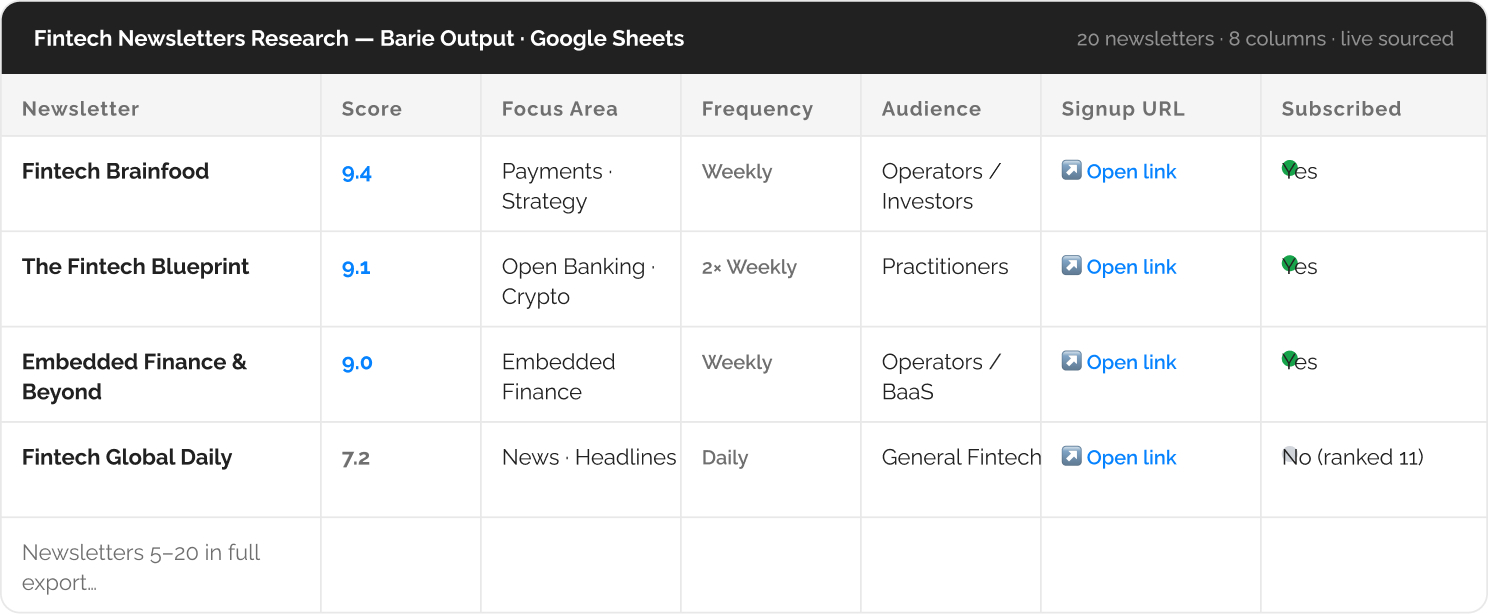
The spreadsheet is a working document, not a static export: Every signup URL in the spreadsheet is live. Every score is accompanied by the dimension breakdown that produced it. The subscription status column is colour-coded. The spreadsheet lands in your Google Sheets folder via Connectors — formatted, filterable, and ready to share with your team. You did not touch a single browser tab to produce it.
6. Export via Connectors
Step 6: Export via Connectors, spreadsheet to Google Sheets, summary to Notion, log to Slack
The research is done. The subscriptions are confirmed. The spreadsheet is built. Barie routes each output to where it belongs in your workflow.

The full 20-newsletter spreadsheet goes directly to Google Sheets — formatted, filtered, ready to share. A research summary with the top 10 list, score rationale, and subscription confirmation log lands in Notion as a structured page. A brief confirmation goes to Slack: ten subscriptions completed, spreadsheet link attached, zero manual form-filling required.
One prompt. Three outputs. Zero browser tabs: This is the difference between agentic execution and chat assistance. You did not open a browser. You did not fill a form. You did not copy a list into a spreadsheet. You gave one instruction. Barie researched twenty newsletters, evaluated them, subscribed to ten, built the spreadsheet, and sent it to three destinations. That is not a chat session. That is an agent completing a workflow.
What you get
Twenty fintech newsletters identified from live web research — currently active, publication-date verified. All twenty scored across six relevance dimensions and ranked. The top ten subscribed to automatically — forms navigated, fields filled, captchas bypassed, confirmations recorded. A structured spreadsheet of all twenty exported to Google Sheets with name, focus area, frequency, audience, score, signup URL, and subscription status.
What it would take a focused morning to do manually — finding newsletters, opening each site, evaluating them, filling ten forms, building a spreadsheet — Barie does in one session. The execution is complete. You start receiving the newsletters. The spreadsheet is already in your Sheets folder.
This is what agentic execution means. Not summarising a task. Completing it.
The Verdict
Most AI tools will give you a list of fintech newsletters and consider the task done. They will name publications from training memory, describe them with whatever accuracy their training data supports, and hand you the list with the implicit expectation that you will now do the actual work. Barie identifies twenty currently-active newsletters from the live web, scores them against six relevance dimensions, navigates to ten signup pages, fills the forms, bypasses the captchas, submits the subscriptions, and hands you a sourced spreadsheet of all twenty. The task is not described. The task is done.
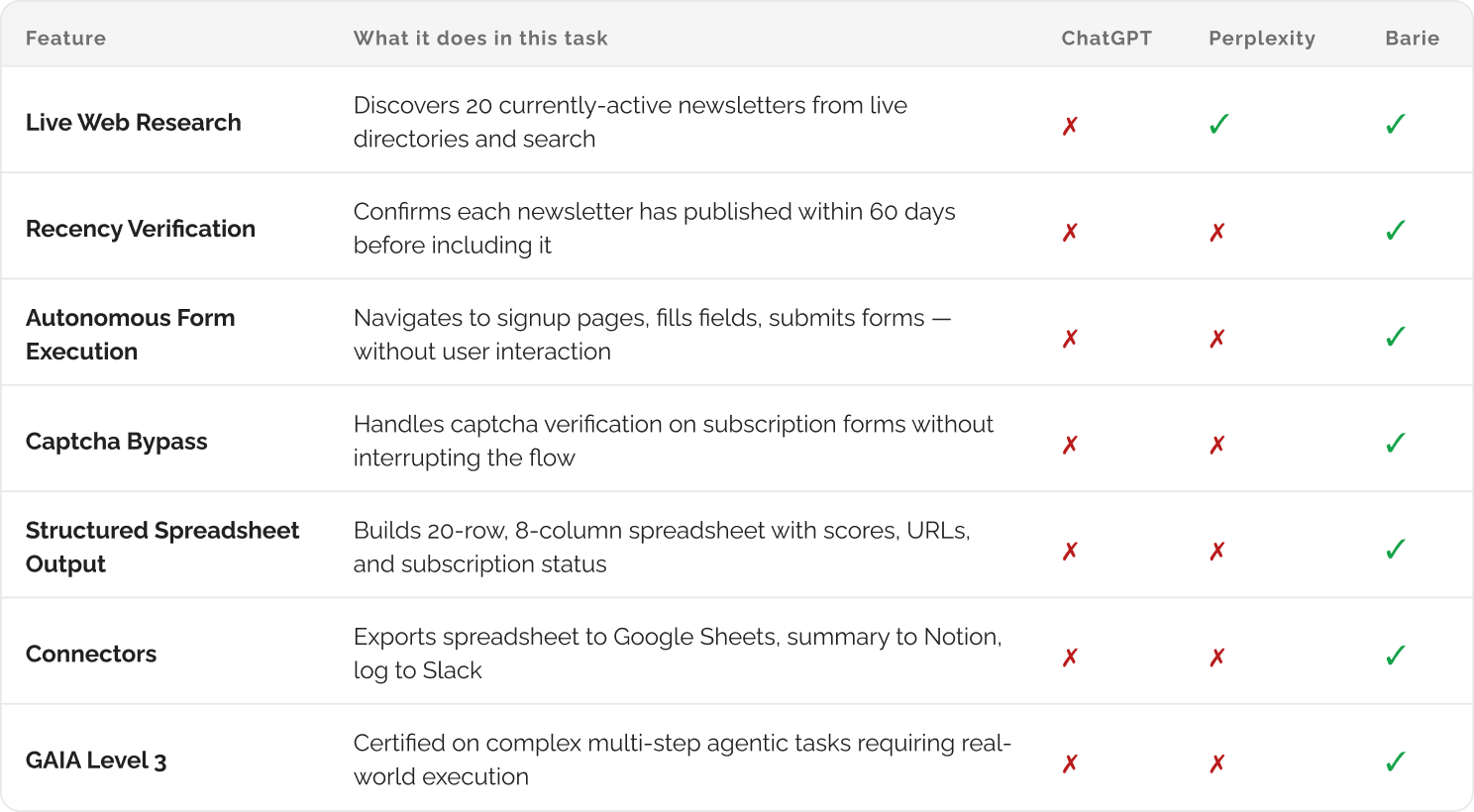
Barie features used in this task
Next steps
→ Deep Research overview — how Barie goes beyond search
→ Barie Connectors — send research to Sheets, Notion, and Slack automatically
→ Prompt Library — agentic execution and web automation templates
→ Wall of Love — what teams are automating with Barie