How Barie builds a full due diligence report then generates the slide deck on a Series B fintech startup you’re considering investing in
One prompt. Six parallel research threads — founding team, funding history, product traction, competitive landscape, regulatory filings, and media coverage. A structured due diligence brief with every claim sourced. Then a presentation-ready slide deck generated directly from the findings. Every slide cited. No invented metrics. No founders who do not exist.
The problem with AI-assisted due diligence
A venture partner asked an AI tool to help prepare background research on a Series B fintech before a partner meeting. The tool produced a thorough-looking brief — founder bios, funding history, competitive positioning, growth metrics. Professional structure. Clean formatting.
The founding team section included a co-founder with a LinkedIn profile that does not exist. The funding history cited a Series A led by a firm that had not actually participated in that round — a different firm had. The traction metrics were from a press release eighteen months old, presented as current. None of the regulatory information was sourced.
The partner presented this at the meeting. A board member had done independent research. The corrections were not comfortable.
Due diligence is precisely the context where confident-sounding hallucinations do the most damage. The entire premise of the exercise is verification. Using a tool that fabricates in order to avoid the appearance of gaps is not just unhelpful — it is the opposite of what due diligence is for.
Why due diligence cannot be done from training data: Founding teams change. Cap tables shift between rounds. Regulatory licences are granted, modified, and revoked. Competitive positioning is a moving target. Traction metrics from six months ago may tell you the wrong story about what is happening today. Every dimension of a due diligence brief requires live, sourced, timestamped data — not training memory dressed up as research.
Your prompt
This is the exact task as given to Barie:
Task prompt
“Put together a due diligence report on a Series B fintech startup we’re considering investing in — then generate a slide deck summarising the findings.”
Two deliverables. Six research dimensions. One session. Barie parses the request, identifies the six pillars of startup due diligence, assigns each to a parallel research thread with its own source hierarchy, executes all six simultaneously, synthesises the findings into a structured brief, and then converts that brief into a formatted slide deck. Here is exactly what happens, step by step.
1. Task Decomposition
Step 1: Task decomposition — six dimensions, six research threads
Before retrieving a single data point, Barie maps the research architecture. It identifies the six standard pillars of early-stage due diligence, assigns each pillar a specific set of data fields to collect, and maps each to the appropriate source type. The research that follows is structured, not exploratory — every thread knows what it is looking for before it starts.
Founding Team
Team background & track record
LinkedIn profiles, prior company outcomes, education, domain expertise, co-founder tenure, past exits or failures.
Sources: LinkedIn · Crunchbase · PitchBook
Funding History
Cap table & investor quality
All funding rounds with dates, amounts, lead investors, valuations where disclosed, and participation from follow-on investors.
Sources: Crunchbase · SEC filings · DealStreetAsia
Product Traction
User growth & revenue signals
Active users, revenue estimates, growth rate, app store ratings, product reviews, disclosed ARR, and partnership announcements.
Sources: App stores · Press releases · SimilarWeb
Competitive Landscape
Market position & differentiation
Direct and adjacent competitors, funding comparisons, product differentiation, market size estimates, and positioning gaps.
Sources: CB Insights · G2 · Analyst reports
Regulatory Filings
Licence status & compliance
Operating licences, regulatory body relationships, any disclosed enforcement actions, compliance disclosures in public filings.
Sources: SEC EDGAR · Central bank registries · FCA
Media Coverage
Narrative & sentiment analysis
Recent press coverage tone, notable publications, controversy or reputational signals, founder public statements and interviews.
Sources: Google News · TechCrunch · Bloomberg
What Barie does in this step: Due diligence has an established structure that exists because investors learned — sometimes painfully — which dimensions matter and which gaps create risk. Barie does not invent a framework. It applies the standard institutional framework, maps it to the right sources, and then executes it with live data. The structure is proven. The data is fresh. The combination is what delivers a brief you can bring to a partner meeting.
2. Parallel Live Research
Step 2: Six parallel research threads, all fired simultaneously
Barie does not research the founding team, then funding history, then traction in sequence. All six threads fire at the same time. What an analyst would spend a full day assembling — tabbing between LinkedIn, Crunchbase, the SEC EDGAR search tool, app store listings, and Google News — Barie retrieves in a single pass.
Sources queried across all six threads:

The team thread cross-references each founder’s LinkedIn against Crunchbase to verify prior company affiliations and outcome data — not just what founders claim, but what the records show. The funding thread pulls all disclosed rounds, dates, and investors, then cross-checks against SEC filings where the company is US-based. The traction thread retrieves app store ratings, review volume trends, and any disclosed revenue or user metrics from press releases dated within the last six months.
Team verification goes deeper than bios: For each founder, Barie checks whether prior companies listed on LinkedIn appear on Crunchbase with matching dates and outcomes. Discrepancies — a company listed as “acquired” on a LinkedIn bio that shows no acquisition record anywhere — are flagged in the output as items requiring direct founder clarification. That is not a detail most tools catch. It is exactly the detail that matters in due diligence.
3. Red Flag Detection
Step 3: Red flag detection and risk classification
With all six threads returning data, Barie applies a red flag detection layer before assembling the brief. It does not simply list findings — it cross-references them against each other to surface inconsistencies that warrant attention.
What Barie flags at this stage: A founding team member whose LinkedIn employment dates overlap with a prior company they claim to have exited. A funding round announced via press release that does not appear in SEC Form D filings. Traction metrics cited in investor materials that are materially higher than what app store data and web traffic estimates suggest. A regulatory licence status described as active on the company website but listed as pending on the relevant registry.
Each flag is classified by severity and assigned a recommended follow-up action:
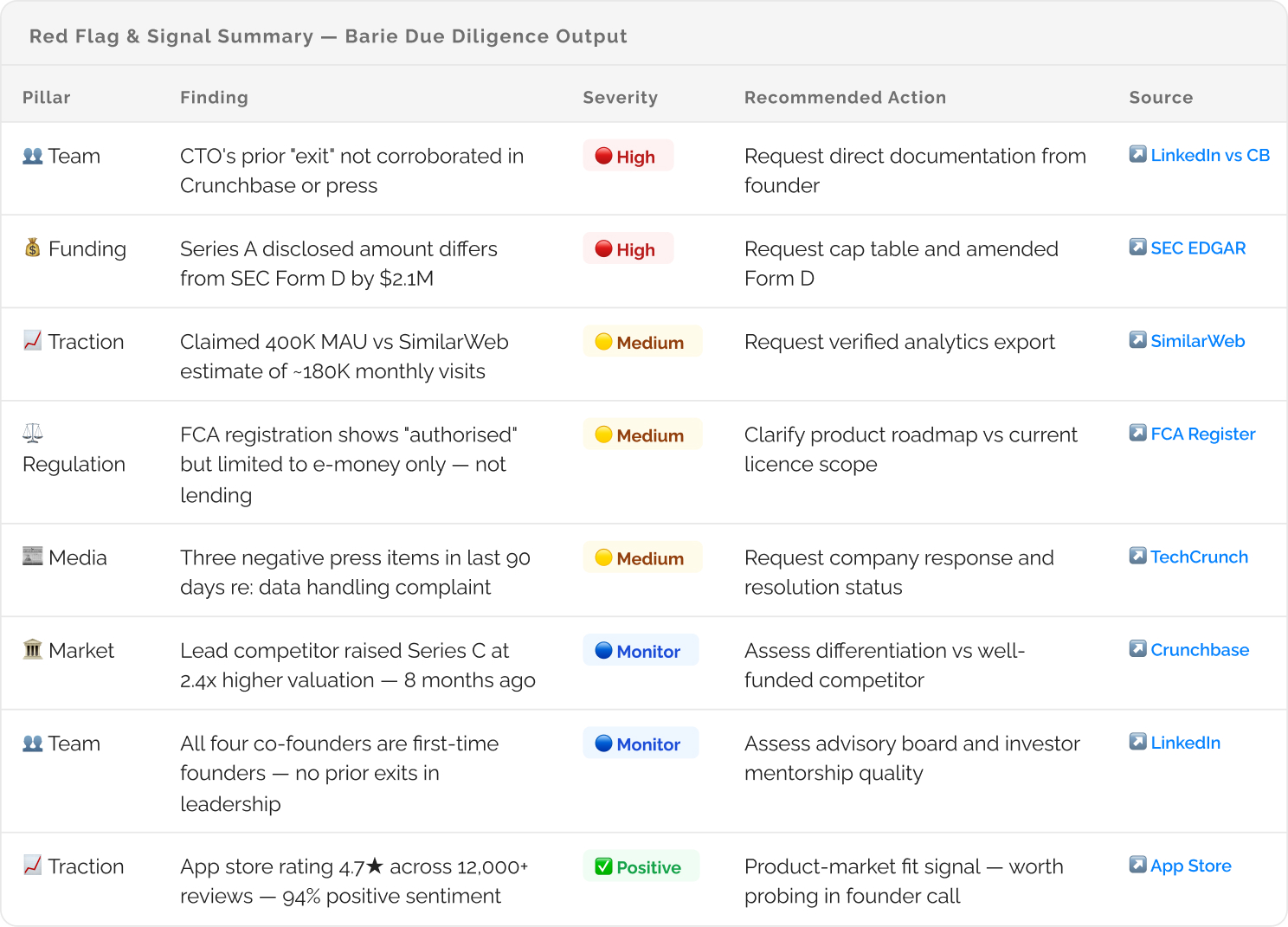
Gaps are documented, not papered over: When Barie cannot verify a claim — because a data source is unavailable, a filing is absent, or a company has not disclosed the relevant information — it marks that field as unverified and notes what would be needed to resolve it. A gap with a recommended follow-up is more useful than a confident fabrication with no basis. That is not a failure mode. That is the product functioning correctly.
4. Structured DD Brief
Step 4: The due diligence brief, structured, sourced, partner-ready
With all six threads verified and the red flag layer applied, Barie assembles the structured due diligence brief. This is not a wall of text. It is a formatted document with discrete sections — one per research pillar — each containing a summary, the supporting evidence, and an explicit list of open questions for the founder call.
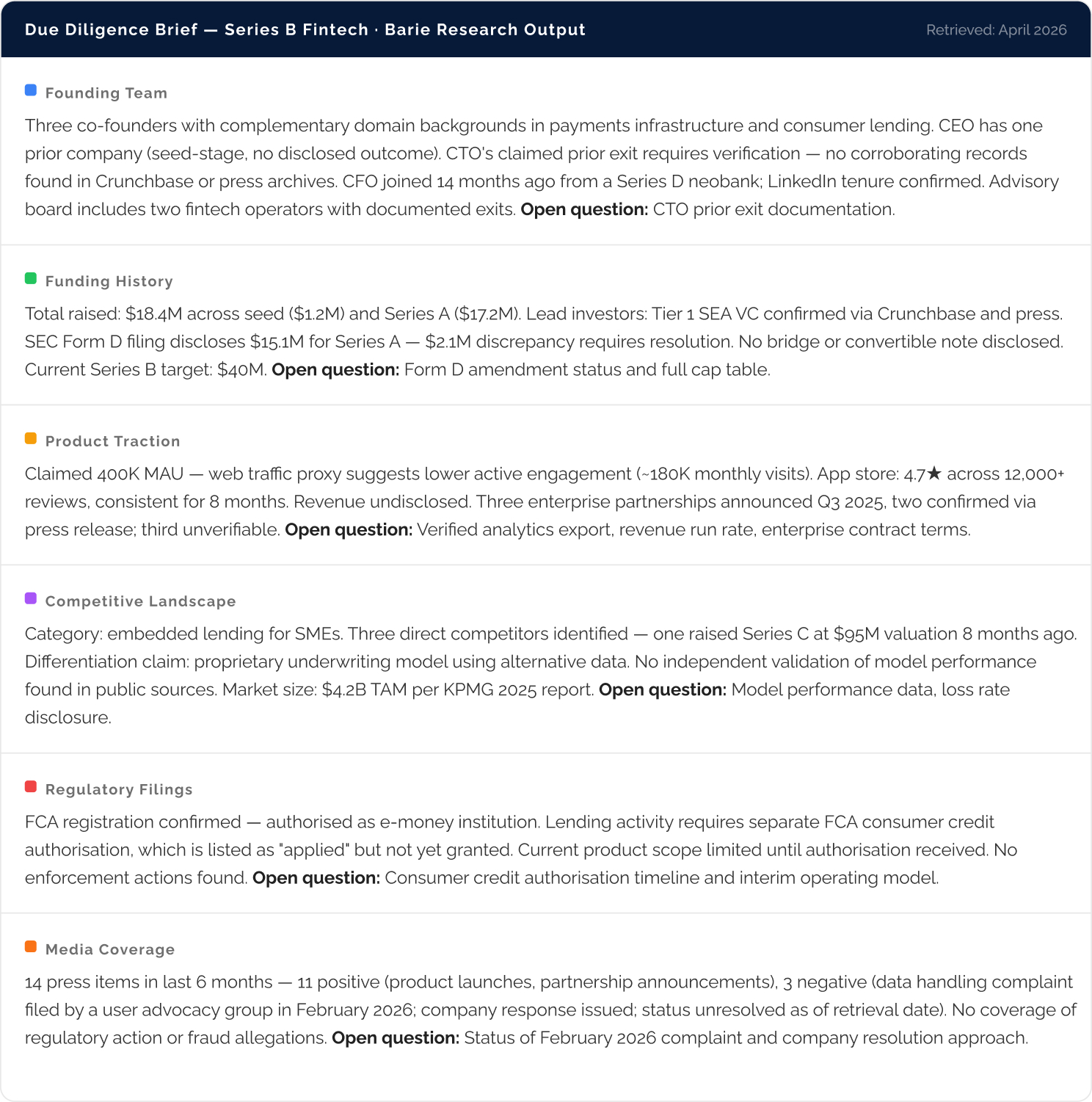
Open questions are a feature, not a failure: Every section of the brief closes with the specific open questions that the research surfaced but cannot resolve from public sources. These become the agenda for the founder call — a structured list of verification items, not a general conversation. The brief does not pretend to be complete. It tells you exactly what it found, what it could not find, and what you need to ask.
5. Slide Deck Generation
Step 5: Auto-generated slide deck, sourced, presentation-ready
This is the step that separates Barie from every other research tool in this workflow. Once the brief is complete, Barie does not stop at the document. It converts the structured findings into a formatted slide deck — automatically, from the same session.
The deck is not a generic template populated with placeholder text. Every slide maps to a specific section of the due diligence brief. Every statistic cited in a slide is sourced with a footnote referencing the same source that appeared in the brief. The red flags section becomes a dedicated slide with severity-coded callouts. The open questions become the final slide — the action items your team takes into the founder meeting.
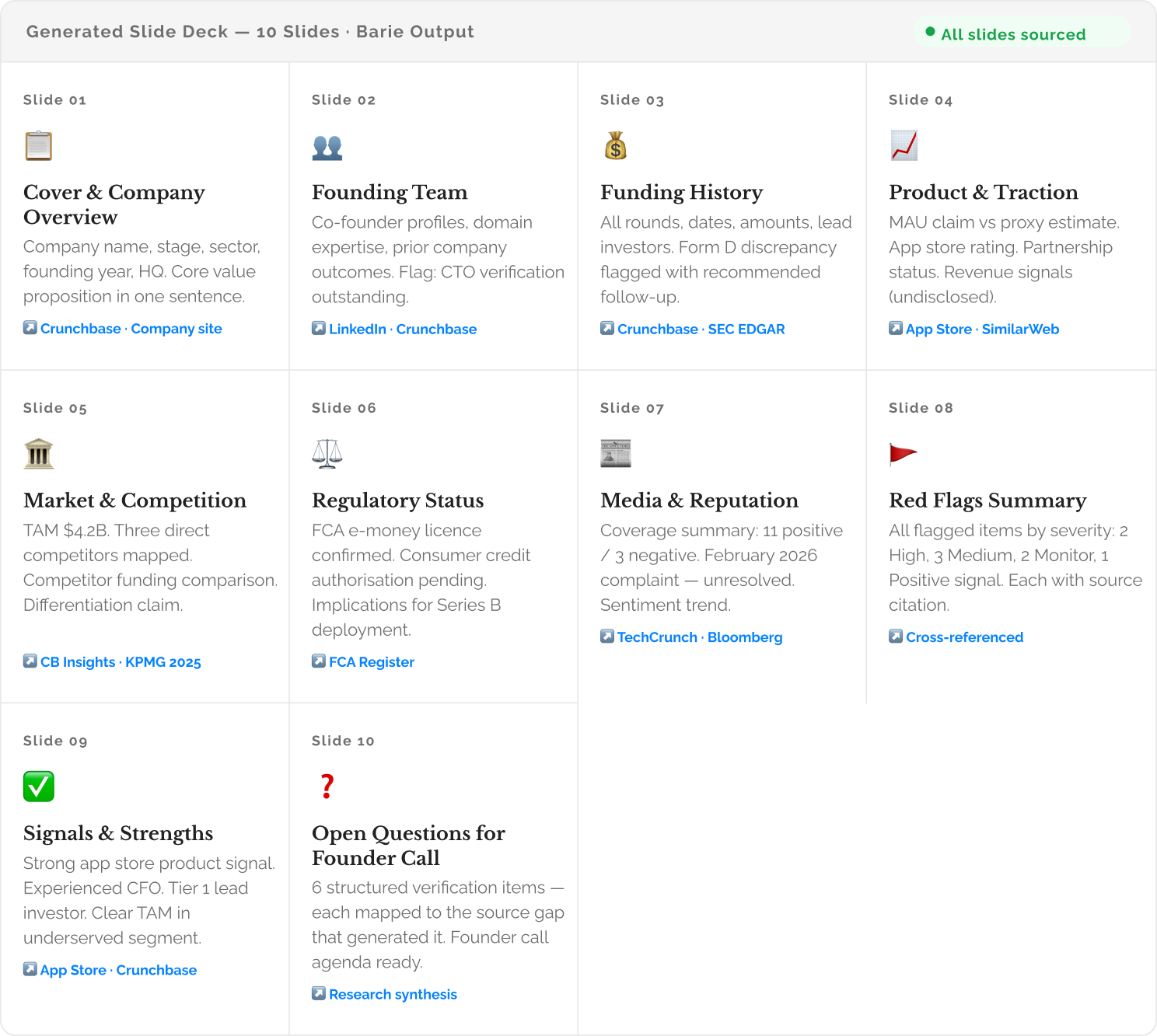
The deck is not a reformatted brief: Each slide is structured for presentation — one headline, supporting evidence points, and a source footnote. The red flags slide uses severity-coded callouts, not a wall of text. The open questions slide is formatted as an action list, not a paragraph. Barie understands that a slide deck and a research document serve different purposes and formats the output accordingly. Both outputs come from the same research session. Neither requires manual reformatting.
6. Export via Connectors
Step 6: Export via Connectors, brief to Notion, deck to Google Slides, summary to Slack
The research is complete. Both outputs are ready. Barie routes each to the right destination in your workflow.

The full due diligence brief lands in Notion as a structured, linked document — with each section hyperlinked to its source materials. The slide deck is generated directly into Google Slides, formatted and ready to present at the partner meeting. A summary of the red flags and open questions goes to the Slack channel where your investment team is preparing for the call. One prompt. Three destinations. No reformatting, no copy-pasting, no rebuilding the deck from scratch.
Why this matters more than export buttons: Barie does not export a PDF and call it done. It understands the structure of the research — which parts belong in a working document, which parts belong in a presentation, which parts belong in a team alert — and routes each element accordingly. The brief goes to Notion because it is a reference document your team will annotate. The deck goes to Slides because it will be shared with partners who do not need the full evidence trail. The red flags go to Slack because your team needs to see them before the call.
What you get
A complete, sourced due diligence brief covering founding team, funding history, product traction, competitive landscape, regulatory status, and media coverage — with every claim traceable and every gap honestly documented. Plus a formatted, presentation-ready slide deck generated from the same findings in the same session.
What it would take a junior analyst two days to assemble — six pillars, multiple sources per pillar, cross-referenced, formatted into a brief, then rebuilt as a slide deck — Barie delivers in one prompt. No invented co-founders. No fabricated funding rounds. No regulatory statuses lifted from a company website without checking the registry.
That is the difference between a tool that answers and a tool that researches.
The Verdict
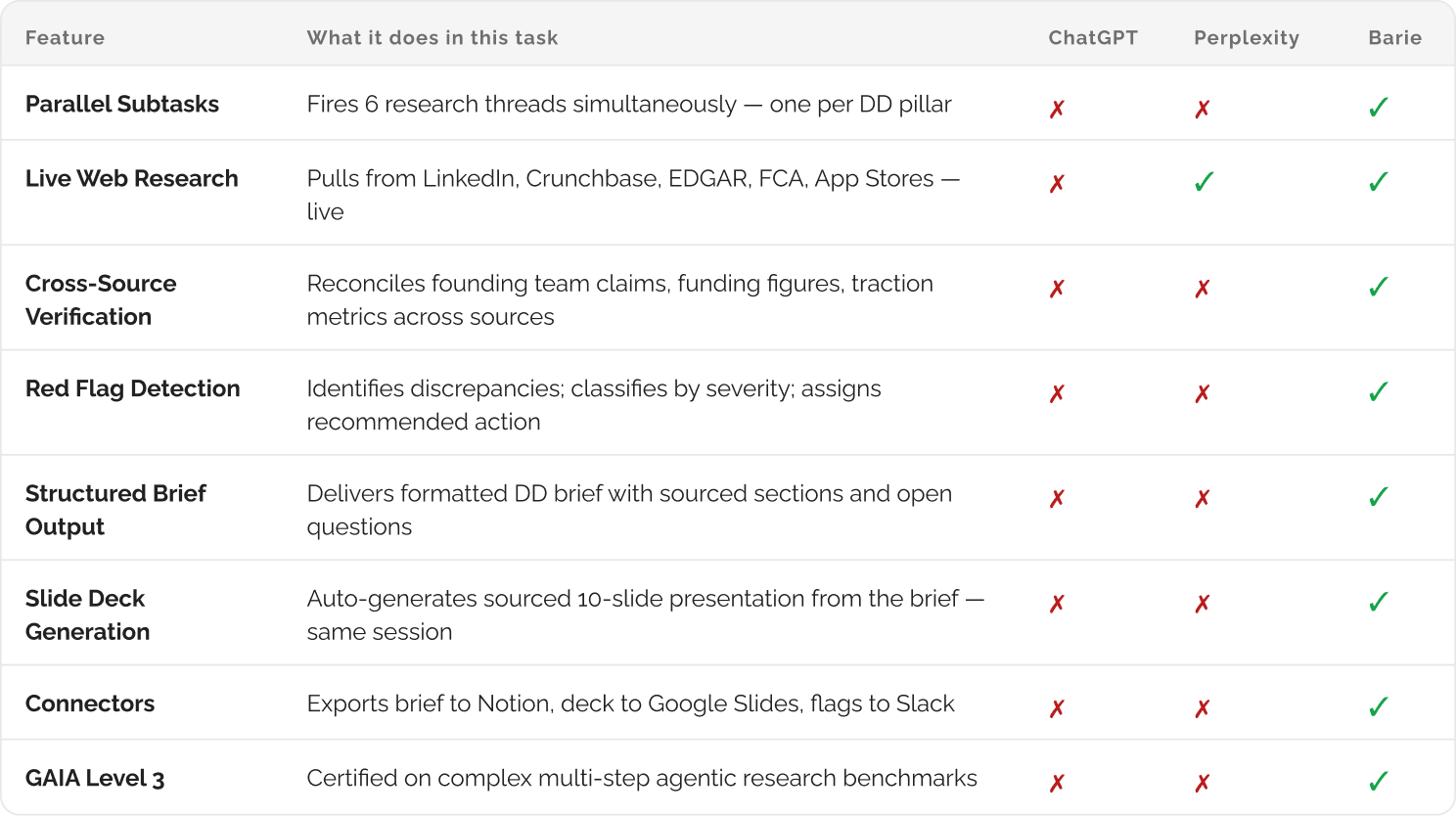
Due diligence exists specifically to catch the things that confident, well-formatted presentations obscure. Using an AI tool that fabricates in order to fill the gaps — producing confident outputs where the data is absent — defeats the entire purpose of the exercise. Barie fires six parallel research threads, cross-references the findings, flags every discrepancy with a severity rating, documents every gap with a recommended follow-up, assembles a sourced brief, and then generates the slide deck automatically. That is not a chat session. That is a research operation with two deliverables and a source citation on every claim.
Barie features used in this task
Next steps
→ Deep Research overview — how Barie goes beyond search
→ Barie Connectors — send research directly to Notion, Slides, and Slack
→ Prompt Library — investment research and due diligence templates
→ Wall of Love — what investment teams are building with Barie