How Barie tracks customer sentiment across Amazon, Trustpilot, and Reddit — last 90 days, scheduled weekly
Barie scans live reviews and mentions across Amazon, Trustpilot, and Reddit within a 90-day window. It categorises every mention by sentiment, surfaces recurring praise themes and complaint patterns, flags new issues as they emerge, and delivers a structured report. Configure it once as a scheduled task and it runs every week without another prompt.
The problem with manual sentiment monitoring
A product manager at a consumer goods brand checked their Amazon reviews once a month. She would scroll through the most recent twenty, note the themes she recognised, and write a summary paragraph for the weekly team update. The process took about forty minutes and produced a paragraph that said roughly the same thing each month: customers liked the packaging, some found the instructions confusing, and a handful complained about delivery.
What the monthly manual scan never surfaced: a cluster of 34 one-star Amazon reviews posted over a single two-week period all describing the same product defect. A Reddit thread with 800 upvotes comparing her product unfavourably to a new competitor that had launched six weeks earlier. A sharp decline in the ratio of five-star to three-star Trustpilot reviews that had been building for eight weeks and had just crossed a threshold that suggested a product quality issue, not just individual outliers.
Manual sentiment monitoring produces a confirmation of what you already believe. Systematic sentiment monitoring tells you what is actually happening.
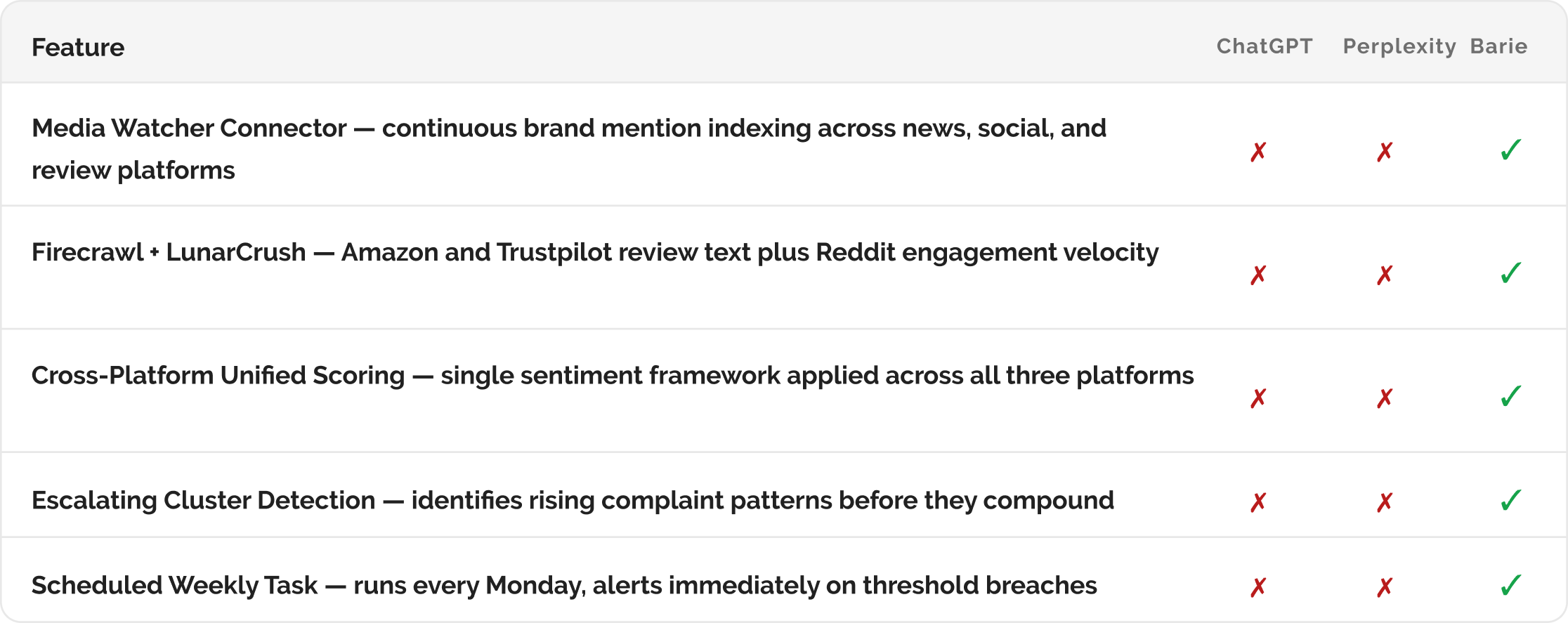
Three connectors together make this analysis possible: Media Watcher indexes brand mentions continuously across news, social, and review platforms. Firecrawl retrieves the current review text directly from Amazon and Trustpilot product pages. LunarCrush tracks Reddit mention volume and engagement velocity. Each connector covers what the others do not. Running all three together produces a sentiment picture that no single tool can generate alone.
Your prompt
Task prompt
“Track customer sentiment for our product across Amazon, Trustpilot, and Reddit, last 90 days.”
One sentence. The first thing Barie does is activate the connector stack that makes cross-platform sentiment retrieval possible. Here is the full workflow, starting with those connectors.
1: Connector Stack Activated
Step 1: Three connectors activated — each handles one layer of the platform coverage
Amazon reviews, Trustpilot scores, and Reddit mentions each live on different platform architectures. No single connector retrieves all three. Barie activates Media Watcher, Firecrawl, and LunarCrush simultaneously, and each connector is assigned the platform coverage it handles best. The 90-day date window is applied at the connector level so every piece of data returned falls within the specified period before the sentiment analysis begins.
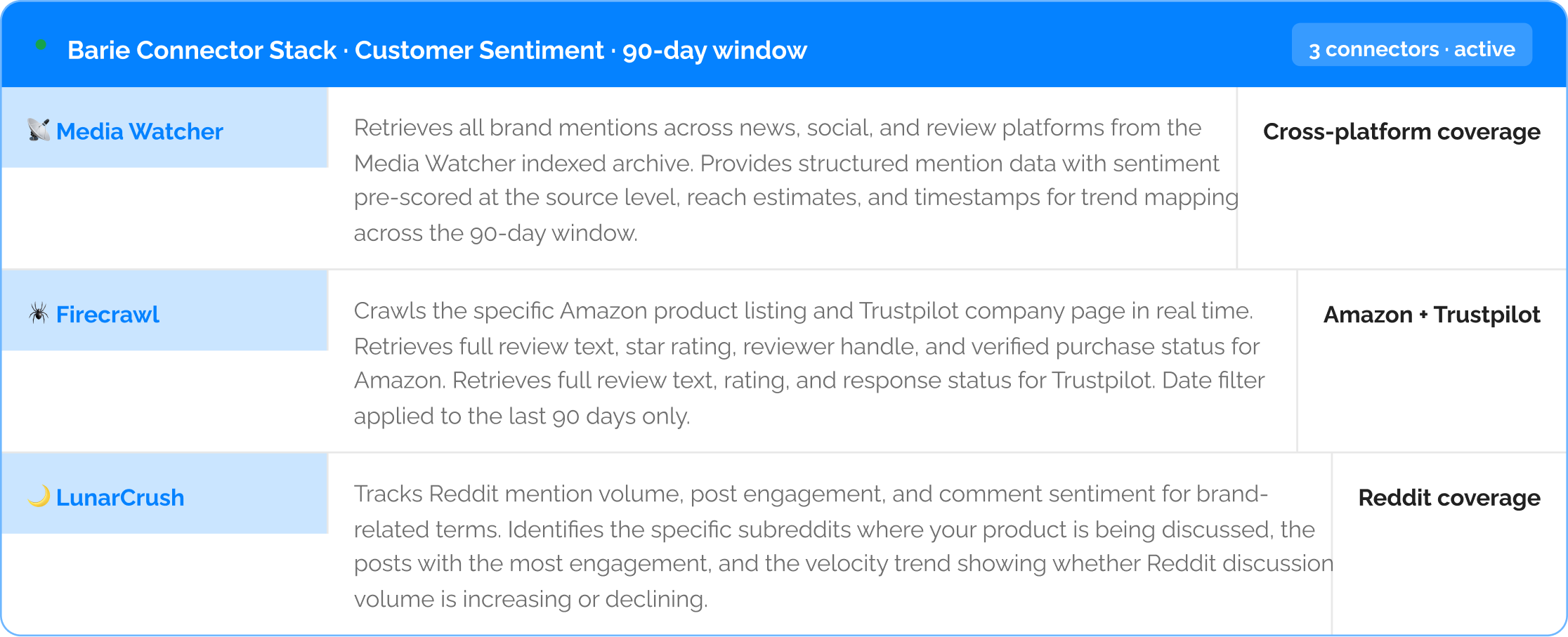
Media Watcher covers the gaps the other two leave: Firecrawl retrieves review text directly from platform pages but does not monitor forums, news coverage, or social posts that reference your product without linking to a review page. LunarCrush tracks Reddit engagement but does not cover Twitter, LinkedIn, or news coverage. Media Watcher indexes all of these continuously and fills the coverage gaps across the broader mention landscape. The three connectors together have no meaningful blind spots in the consumer-facing sentiment environment.
Live Sentiment Retrieval and Scoring
Step 2: All mentions retrieved, scored, and grouped by recurring theme
With all three connectors active, Barie retrieves every qualifying mention from the 90-day window across all three platforms. The full dataset is assembled before any scoring begins. Barie applies a single consistent sentiment framework across Amazon review text, Trustpilot review text, and Reddit posts and comments so a positive mention on Reddit and a five-star Amazon review are scored on the same scale. This removes the methodological inconsistency that makes manual cross-platform sentiment analysis unreliable.
After sentiment scoring, Barie applies theme clustering to the mention text. Recurring themes are identified inductively from the data, not from a pre-set category list. A theme that appears in 40 reviews on Amazon and 12 Reddit posts and 6 Trustpilot reviews is surfaced as a pattern with a combined mention count across all three platforms. A one-off complaint that appears in a single review is classified as an outlier and excluded from the primary findings. The analysis distinguishes between what individual customers have said and what the customer base as a whole is consistently expressing.

3: Structured Sentiment Report
Step 3: The structured report — sentiment breakdown, themes, and escalating risk flags
The report opens with the 90-day sentiment breakdown across all three platforms, then presents the nine recurring themes ranked by mention volume, then shows the two escalating complaint clusters with their trajectory and source evidence. Every theme and every risk flag links back to the specific mentions that generated it.
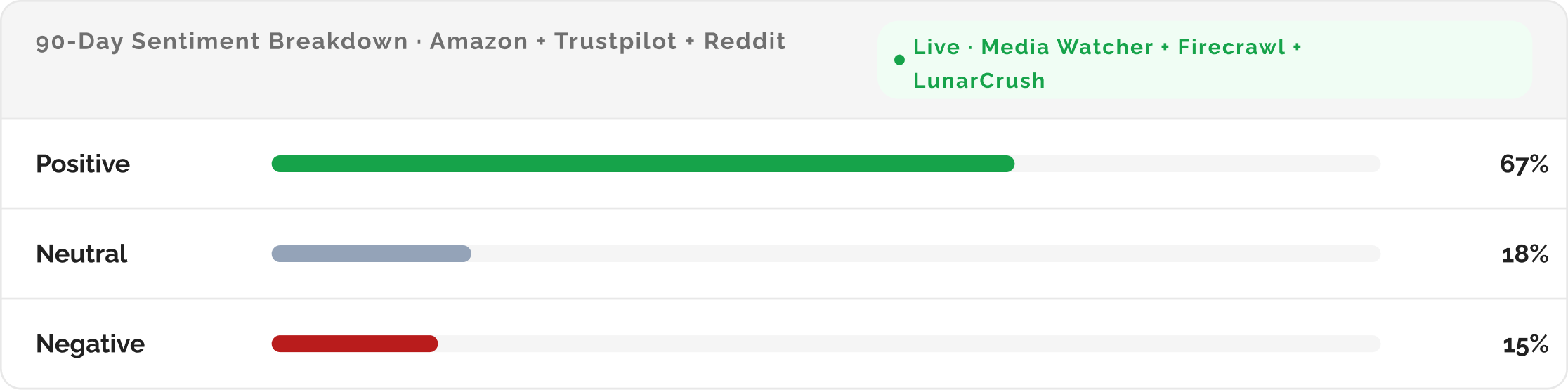
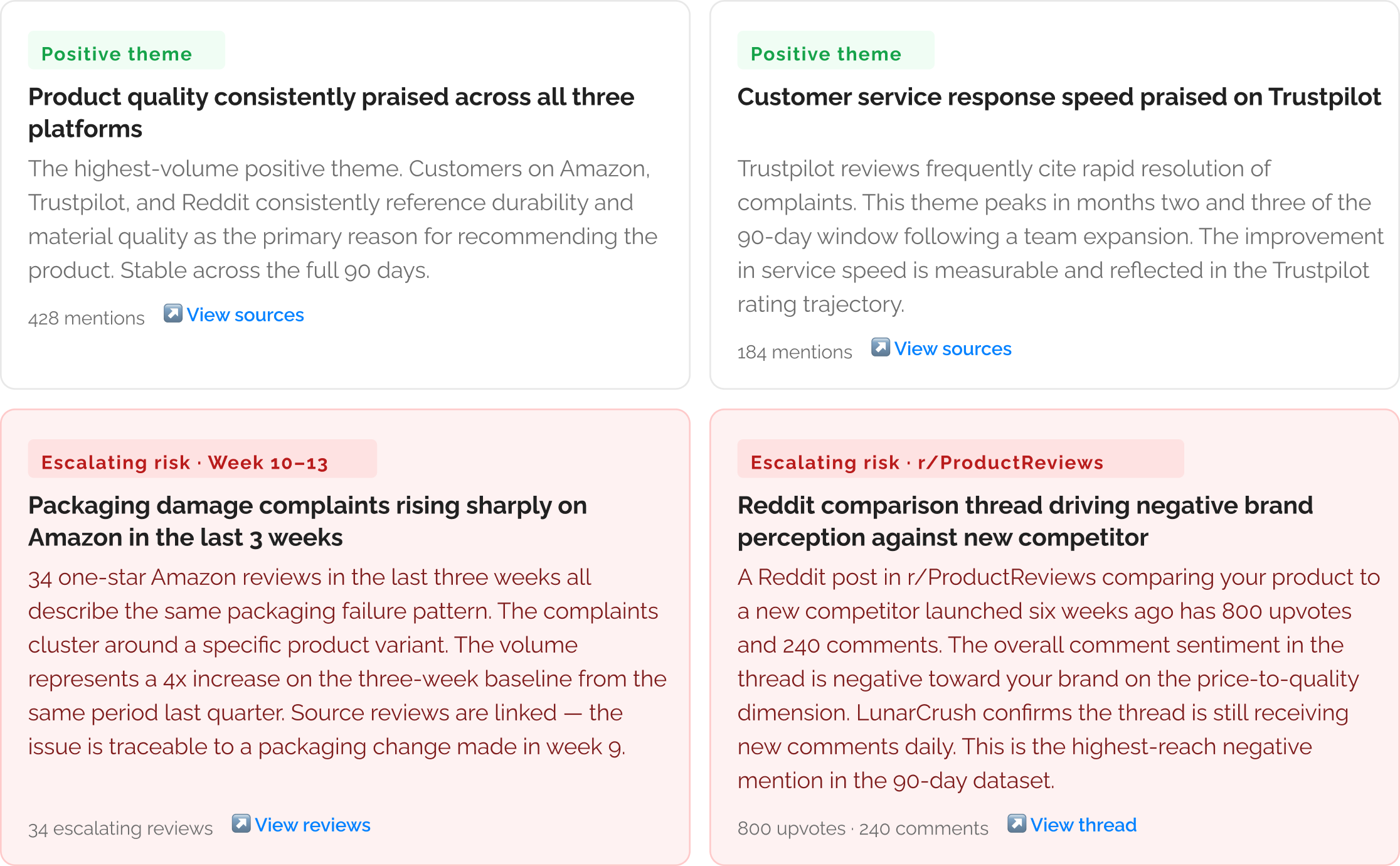
The two escalating risk flags would not surface in a monthly manual scan: The Amazon packaging cluster built over three weeks and only crossed the threshold that makes it visible as a pattern in week 13 of the 90-day window. The Reddit thread was posted in week 8 and has been compounding since. A monthly manual review conducted on week 4 and week 8 would have missed both. Barie’s continuous data retrieval identifies patterns as they build rather than after they have already affected your overall rating.
Scheduled Weekly Monitoring
Step 4: Configure once as a scheduled task — runs every week without another prompt
The 90-day sentiment analysis is designed to be the baseline. The ongoing value comes from running the same analysis on a weekly cadence so your team sees sentiment trends in motion rather than as a point-in-time snapshot. Barie runs the full connector stack refresh every Monday morning, compares the new results against the previous week’s output, and pushes the delta to your team before the start of the working week.
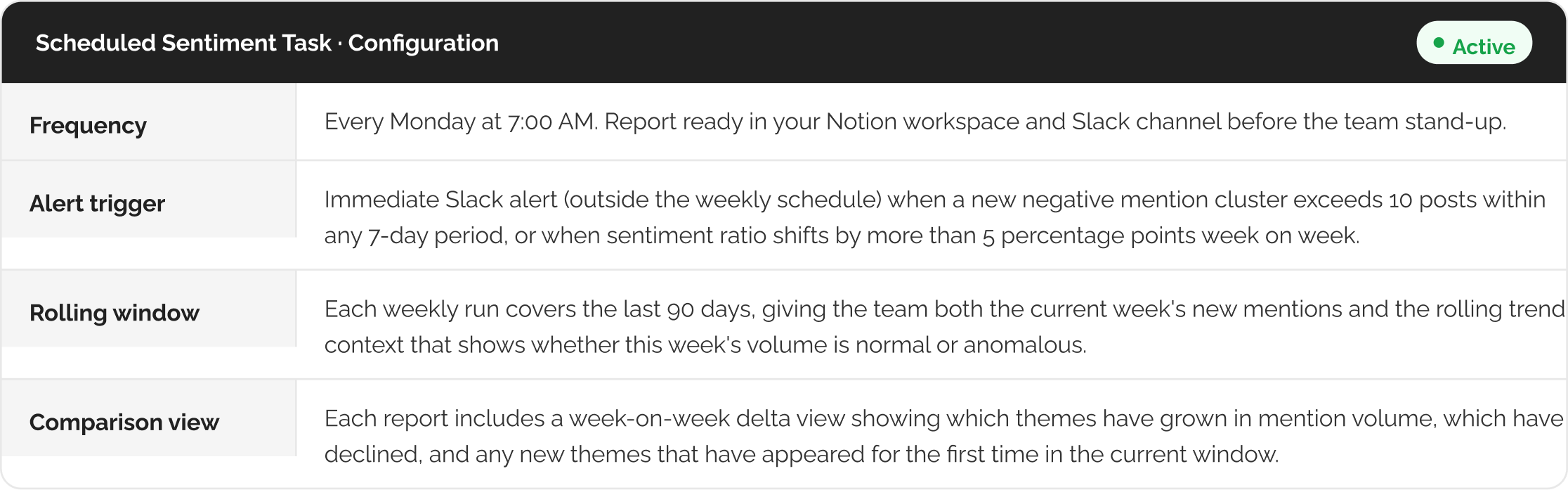
The report and alert outputs are distributed through your product and marketing tools. Notion receives the full weekly report as a database entry, keeping all 13 weeks of rolling data accessible in a single linked view. HubSpot receives the escalating complaint flags as service tickets so the product and CX teams can track resolution. A Monday morning Slack digest goes to the product, marketing, and CX channels. Amplitude receives the sentiment trend data as structured events so the product team can correlate sentiment movements with feature releases.

The packaging complaint cluster in this example would have triggered an alert in week 11: A weekly Barie run would have detected the rising complaint volume at 12 reviews in week 11, before it reached 34. The Slack alert would have fired before the cluster compounded and before it started affecting the overall rating trajectory. Early detection is the entire value proposition of scheduled monitoring over periodic manual review.
What you get
A structured 90-day sentiment report covering 3,240 mentions across Amazon, Trustpilot, and Reddit, scored consistently using a single sentiment framework. Nine recurring themes identified and ranked by mention volume. Two escalating risk flags with trajectory data and direct source links to the mentions that triggered the flag. The packaging cluster and the Reddit comparison thread surfaced before they compound further. Weekly scheduled monitoring configured with immediate Slack alerts on new clusters. Full weekly output distributed to Notion, HubSpot, Slack, and Amplitude every Monday before the stand-up.
The Verdict
A forty-minute monthly manual review tells you what customers are saying in the most recent twenty reviews. Barie’s connector stack tells you what 3,000 customers have been saying across three platforms for 90 days, how that is trending week by week, and which clusters are building toward a reputation problem before they have finished building. The packaging cluster and the Reddit comparison thread in this example were both visible to any analyst who had the time to look. The question is whether anyone had the time to look before they became the problem. Scheduled weekly monitoring removes that dependency. It looks every week whether anyone has time or not.
Barie features used in this task