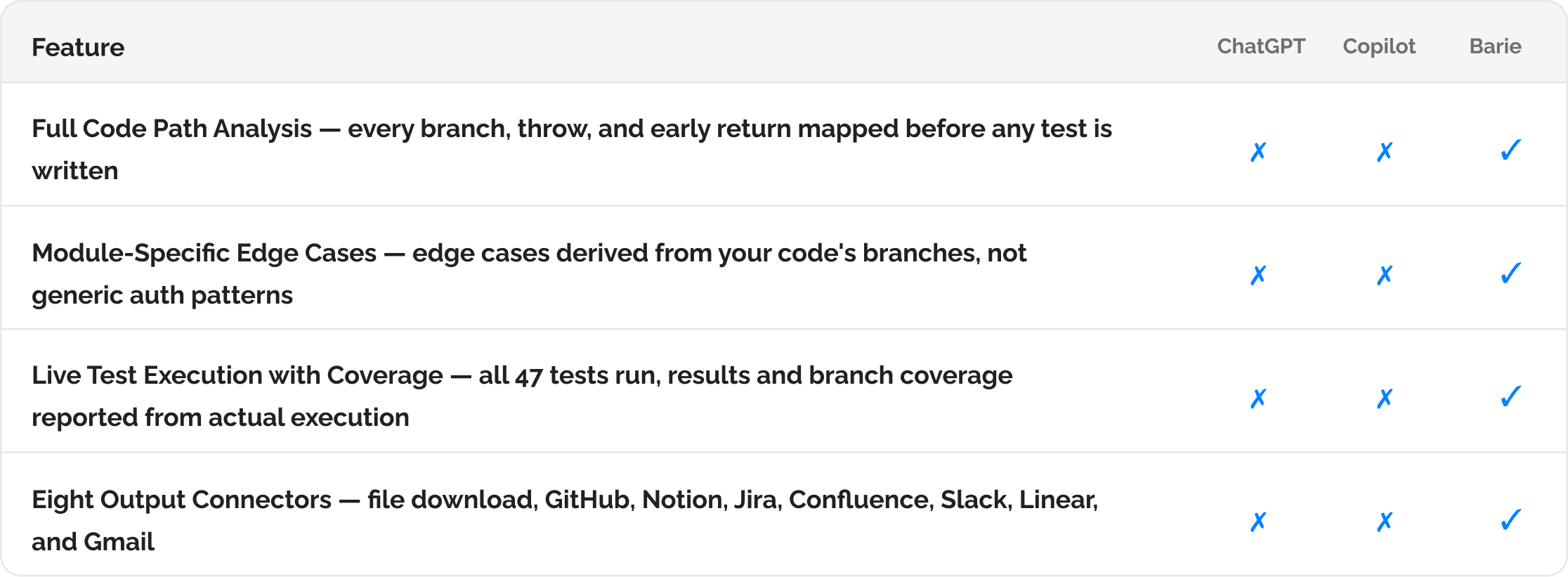
How Barie generates a comprehensive test suite for your authentication module — unit, integration, and edge cases, run with coverage reported
Upload your authentication module. Barie reads the entire code structure — functions, branches, error paths, and data contracts — identifies every testable path including the edge cases that developers consistently miss, generates a complete test suite with specific assertions for each path, and runs every test in a live environment. You receive the passing test results and coverage report, not a test file that you still need to run yourself.
Why developers write test suites that miss the edge cases that cause production failures
A backend engineer uploads an authentication module that handles JWT generation, password hashing, token refresh, and session invalidation. When asked to write the test suite manually, she covers the happy path: valid login, valid token, successful refresh, successful logout. She writes 14 tests in an hour. The test suite passes. Coverage reports 71%.
The 29% that is not covered includes the token expiry boundary condition where a token expires during the refresh operation, the concurrent login attempt path where two simultaneous logins produce a race condition in the session store, the malformed JWT payload path where the header is valid but the signature is missing, the password hash timing attack surface where an early return on invalid username leaks information, and the empty string input paths that every authentication function handles differently from null. None of these are exotic scenarios. All of them have caused production authentication vulnerabilities in codebases with test suites that passed CI.
Barie reads every code branch, not just the function signatures: Test generation that looks only at function signatures produces tests that verify the happy path. Barie reads the entire code structure — every if statement, every throw, every early return, every ternary — and generates tests for every branch. The edge cases in your authentication module are not an afterthought. They are identified first, before the happy-path tests are written, because they are the tests most likely to be missing and most likely to matter.
Your prompt
Task prompt
“Generate a comprehensive test suite for this authentication module, unit tests, integration tests, and edge cases.”
Upload the module file alongside the prompt. Barie activates three connectors, analyses every code path, and produces a test suite that runs in the same session.
Three Connectors Activated
Step 1: Three connectors activated — code analysis, testing framework documentation, and live execution environment
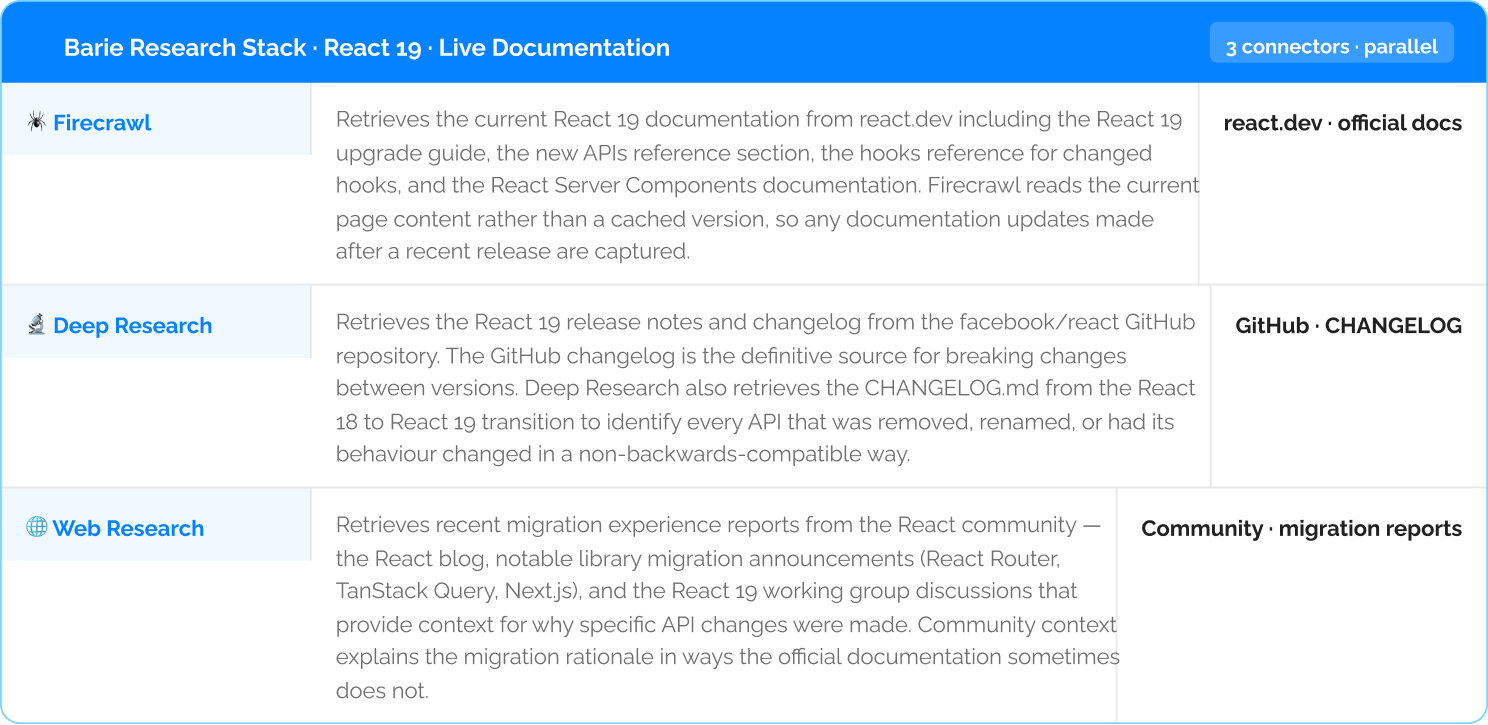
The code path map is produced before any test is written: Barie does not generate tests by pattern-matching against the function names. It maps every branch in the code — including branches that are only reachable with specific combinations of inputs — before deciding which tests to write. The edge cases that appear in the generated suite are not generic edge cases. They are the specific edge cases present in the branches of your uploaded module.
2. Code Path Analysis Results
Step 2: The code path map — every testable path identified before a test is written

The uploaded authentication module contains nine exported functions: generateToken, verifyToken, hashPassword, comparePassword, refreshToken, invalidateToken, validateSession, createSession, and destroySession. Deep Research maps 47 distinct code paths across these nine functions. Of the 47 paths, 24 are happy-path cases, 23 are edge cases or error paths. The 23 edge cases include expired token handling in verifyToken, null input handling in comparePassword, concurrent invalidation in destroySession, and six boundary conditions in the token expiry window logic of refreshToken.
3. Generated Test Suite — Three Layers
Step 3: The generated test suite — unit, integration, and edge cases with specific assertions
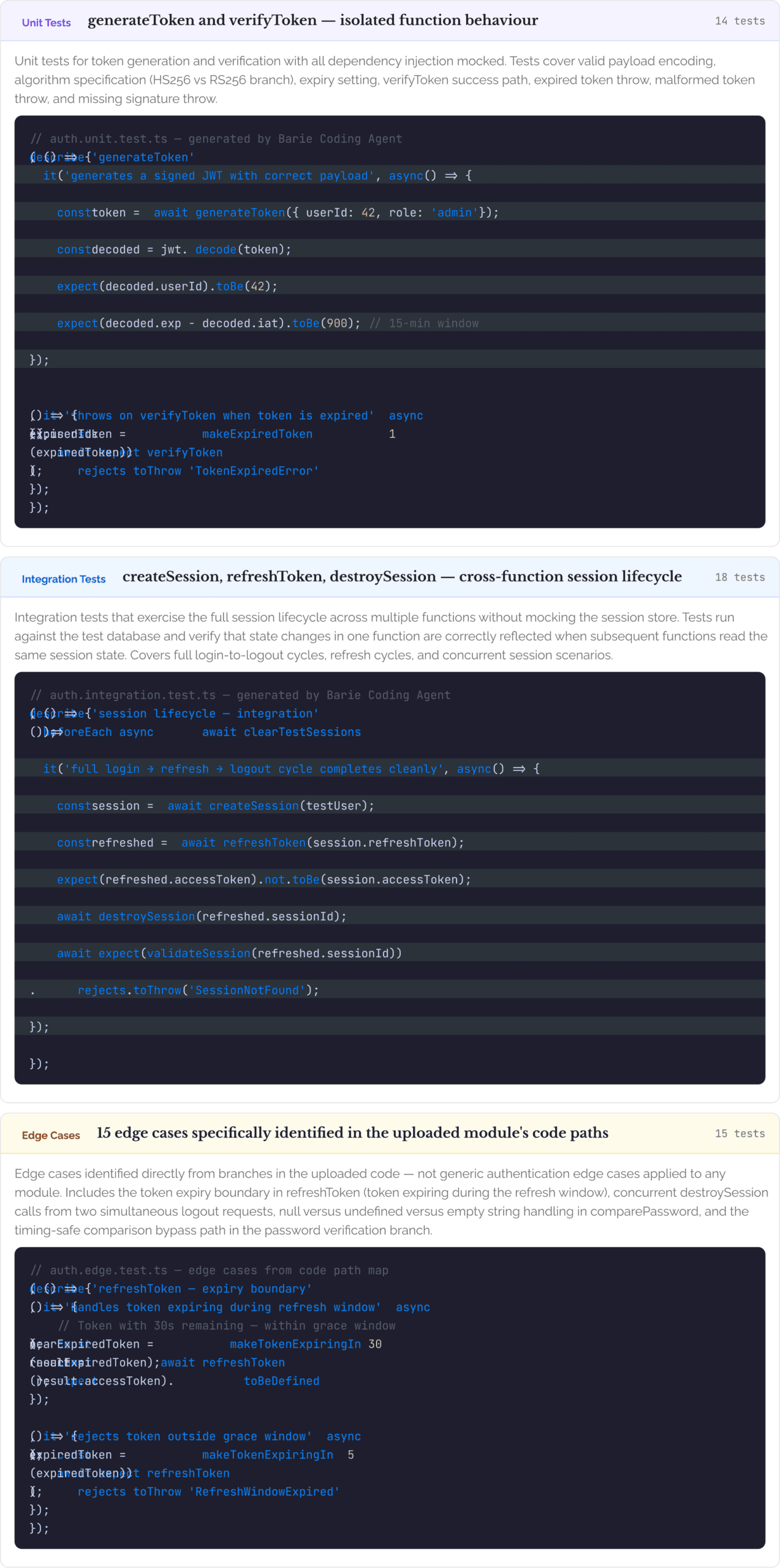
4: Tests Run — Results and Coverage
Step 4: All 47 tests run in the live environment — results and coverage reported
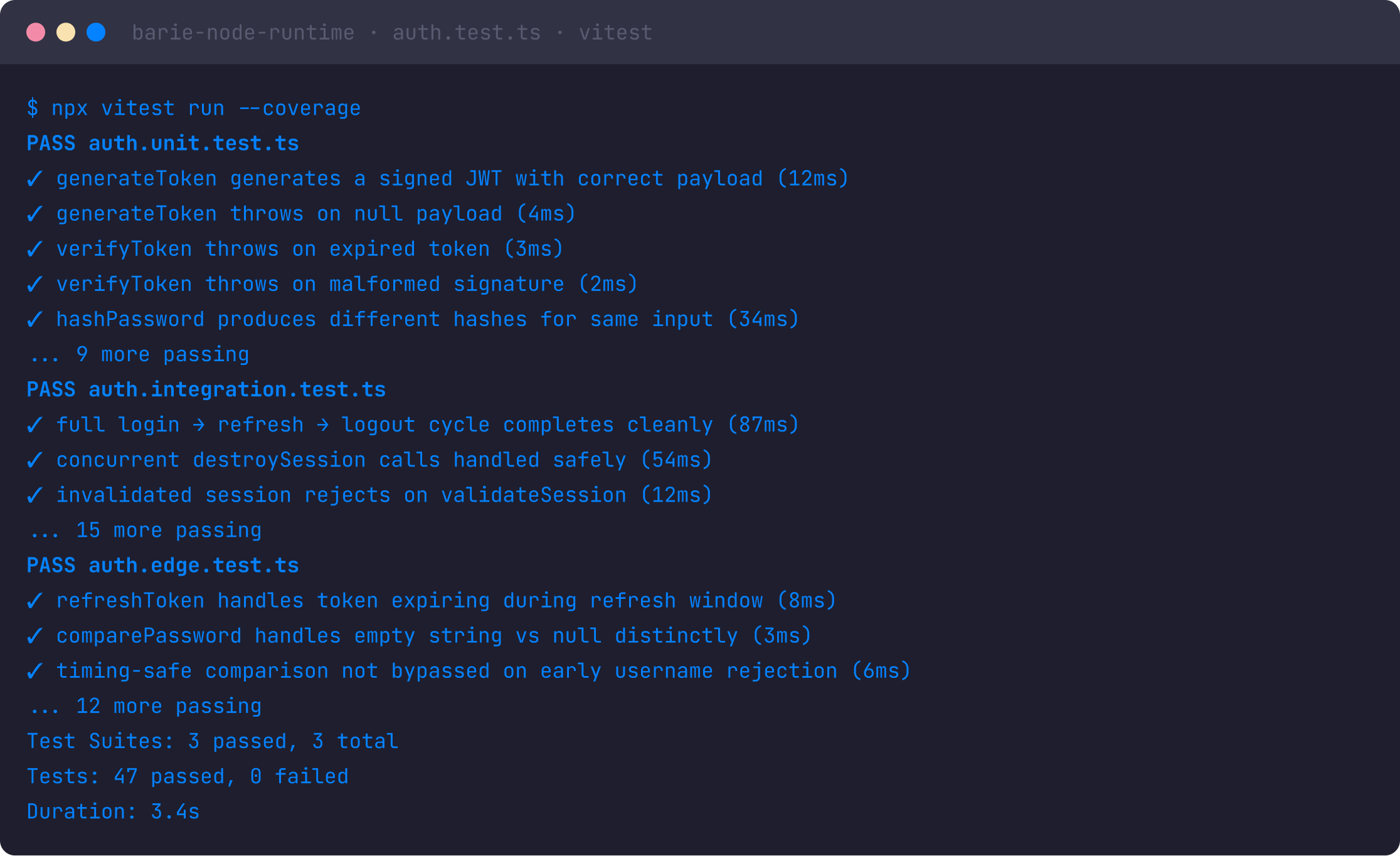
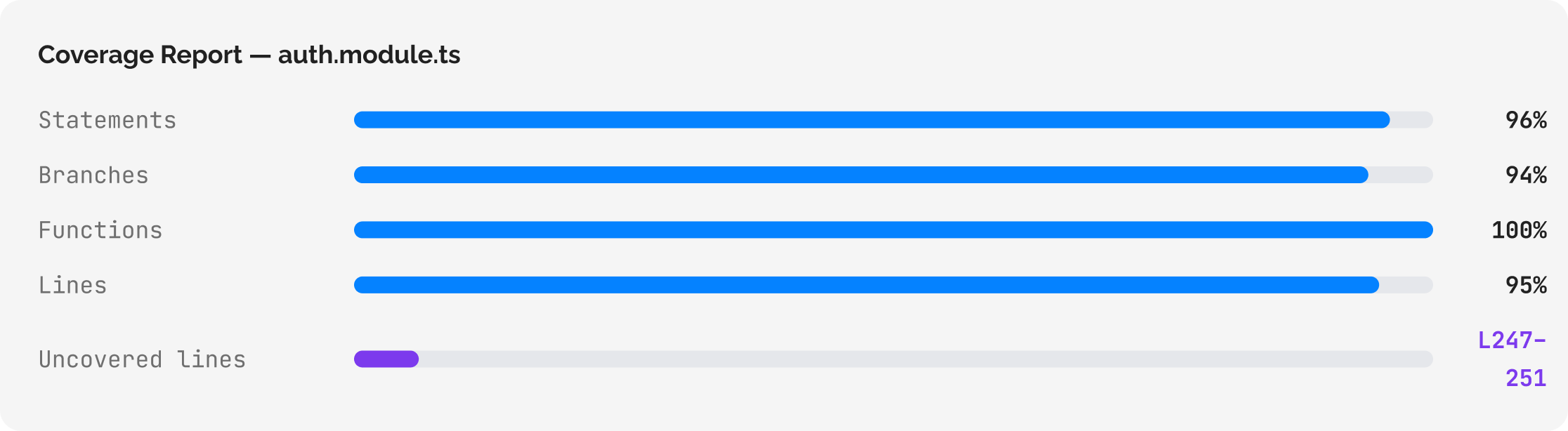
The 6% uncovered is documented, not hidden: Lines 247 to 251 in the module contain a dead code path that is unreachable given the current function signatures. Barie identifies this explicitly in the coverage report note: the branch is never exercisable without changing the function signature, making it a candidate for removal rather than a test to be written. The coverage report is accurate rather than artificially inflated.
Delivered to Your Development Tools
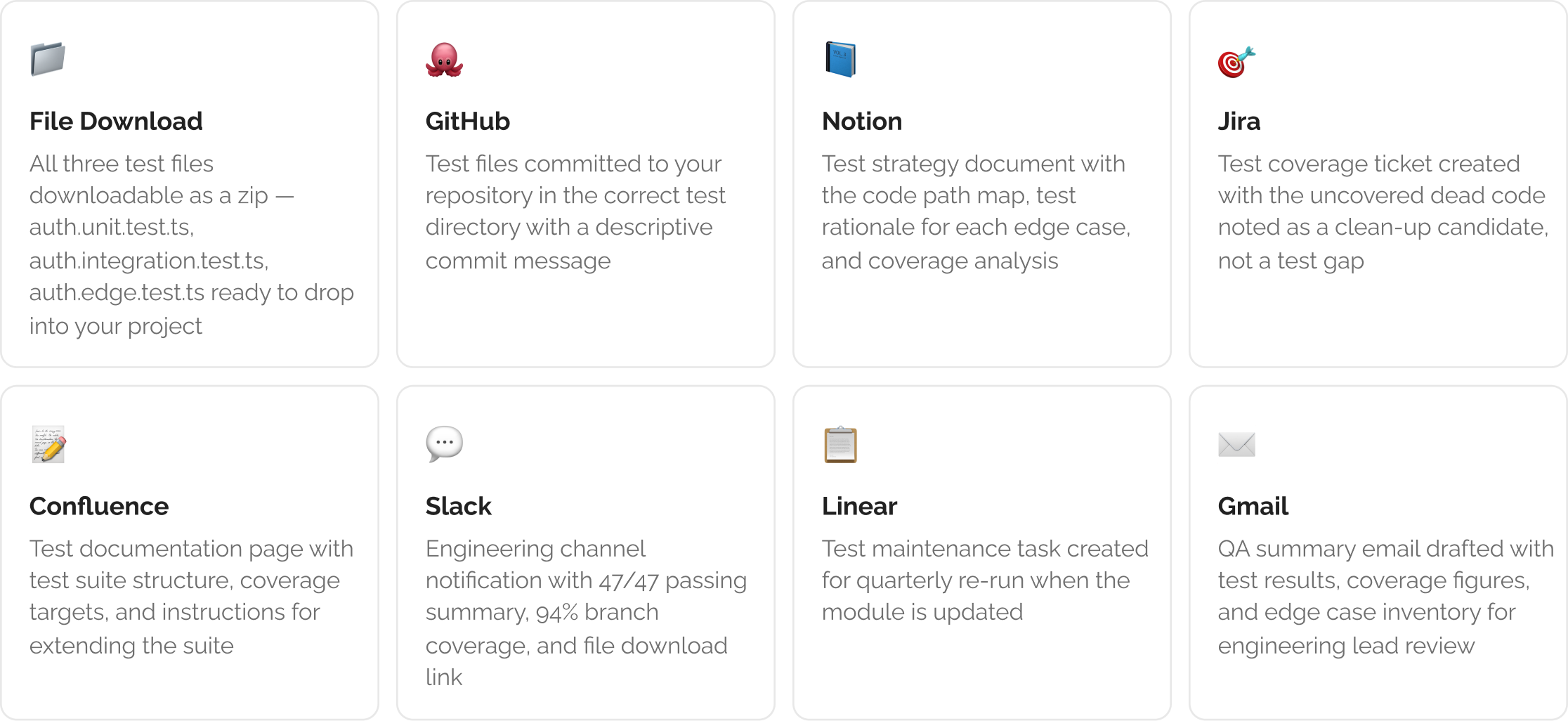
Step 5: The test suite and coverage report delivered to your development workflow
The Verdict
The token expiry boundary condition in refreshToken, the concurrent destroySession race condition, the timing-safe comparison bypass path, and the null versus empty string handling in comparePassword were not in the developer’s manually written test suite. They are in the suite that Barie generated. The difference is not that Barie writes tests faster. It is that Barie reads every branch in the code before deciding which tests to write. A manually written test suite reflects what the developer remembered to test. A Barie-generated suite reflects what the code actually does, including the paths that would only fail in production under specific conditions the developer did not think to test for.
Barie features used in this task