How Barie sets up weekly monitoring of 3 competitors — product updates, hiring, press, and funding — and sends a structured brief to Slack every Monday
Set the schedule once. Every Monday morning, Barie scans live news, each competitor’s product and blog pages, job posting databases, and funding trackers simultaneously. It assembles a structured three-competitor brief and delivers it to your Slack channel via Connector — before the first team standup of the week, without anyone having to press a button.
Why competitive intelligence gathered manually becomes the task that happens when there’s time — which means never
A product manager decides to track three competitors weekly. She sets up Google Alerts for each competitor name, subscribes to their blogs, and bookmarks their jobs pages. Week one, she reviews everything and spends 90 minutes synthesising it into a Slack post. Week two, she skims it in 30 minutes. By week four, the Google Alerts emails are unread and the Slack post hasn’t happened in two weeks. The signal is there. The capacity to synthesise it consistently is not.
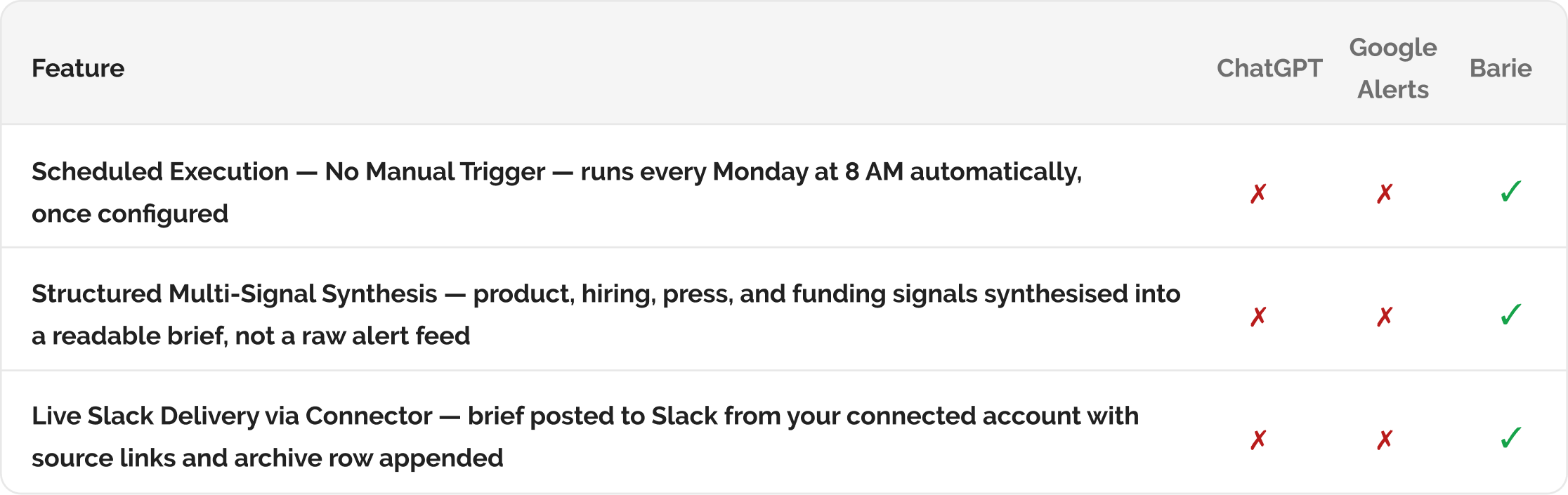
Manual competitive intelligence fails not because the information is hard to find but because synthesis is time-consuming enough that it only happens under dedicated pressure, which is rarely weekly. Barie’s Scheduled Task feature executes the research and synthesis automatically on the schedule you set. The brief arrives in Slack every Monday at 8 AM regardless of whether anyone had time to prepare it.
This task is configured as a Barie Scheduled Task — not a one-time prompt: You set it up once. After configuration, Barie executes the competitive scan automatically every Monday at 8 AM, synthesises the findings into a structured three-competitor brief, and posts it to your Slack channel. No prompt, no login, no manual trigger required each week.
Your prompt
Task prompt — configured as a weekly scheduled task
“Set up weekly monitoring of our 3 main competitors, product updates, hiring, press, funding, and send me a summary every Monday via Slack.”
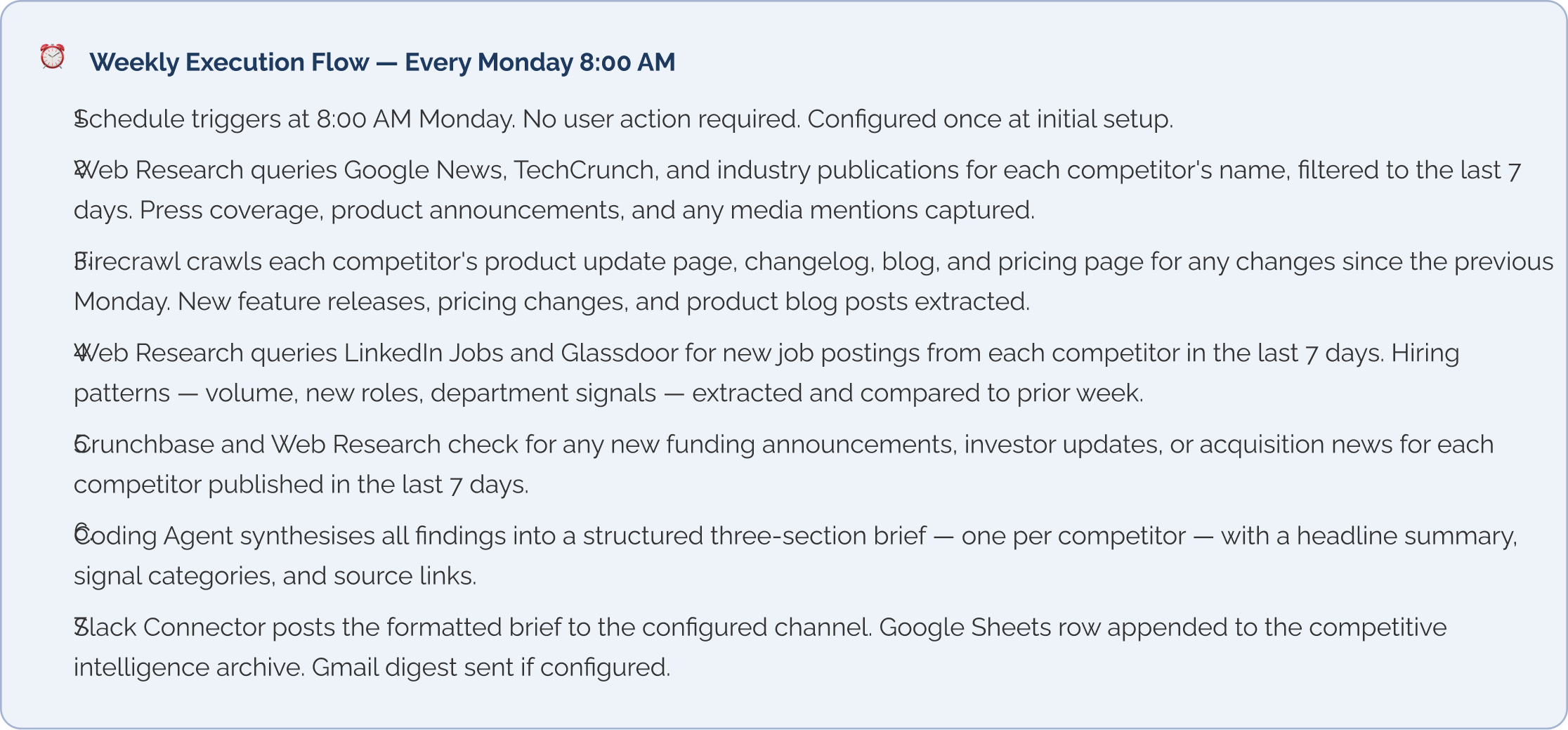
1: Scheduled Task Configuration
Step 1: The scheduled automation — four signal types monitored per competitor, every Monday 8 AM
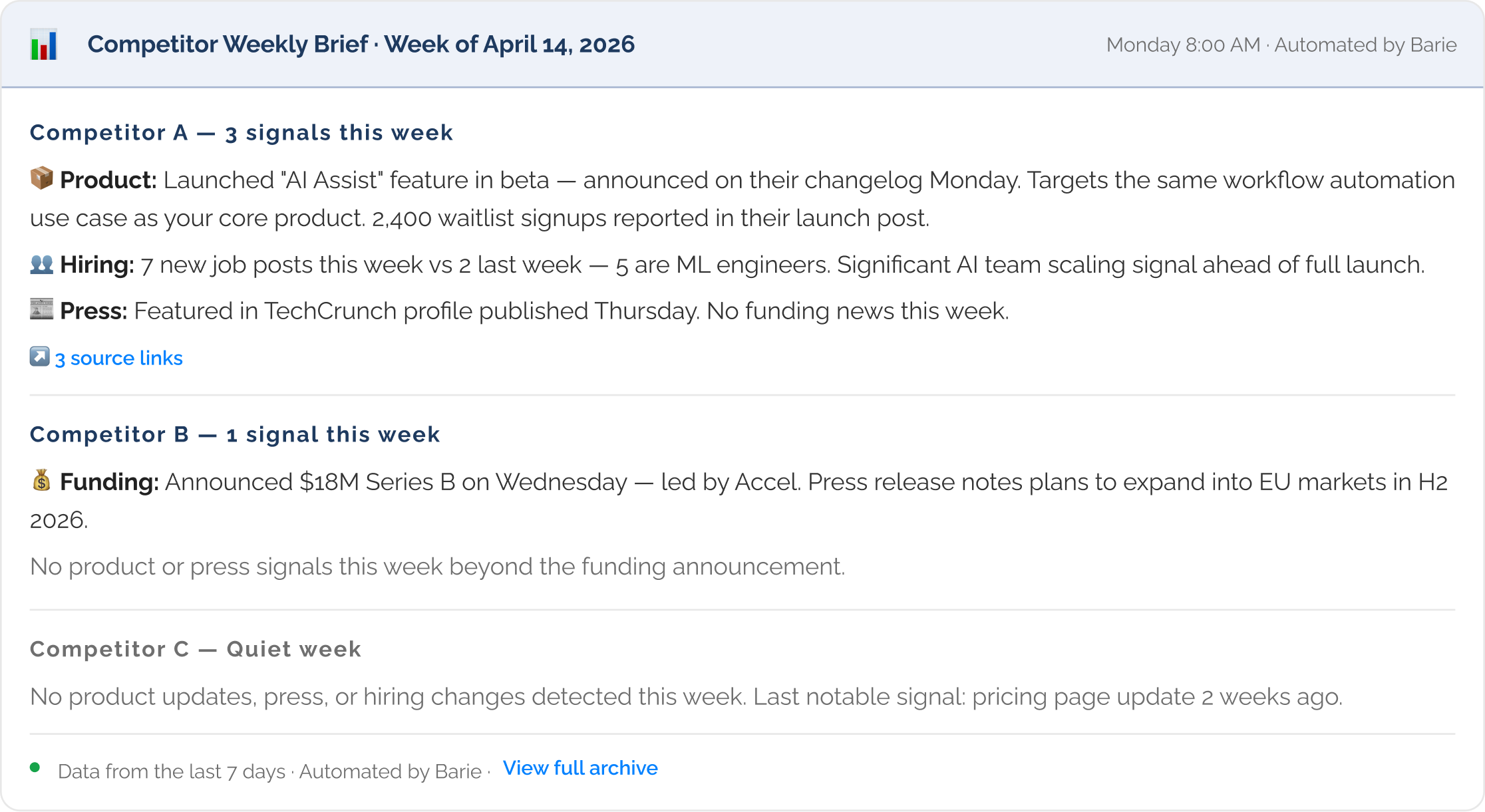
2: The Weekly Brief — Delivered Every Monday
Step 2: The weekly competitive brief — what arrives in Slack every Monday before the standup

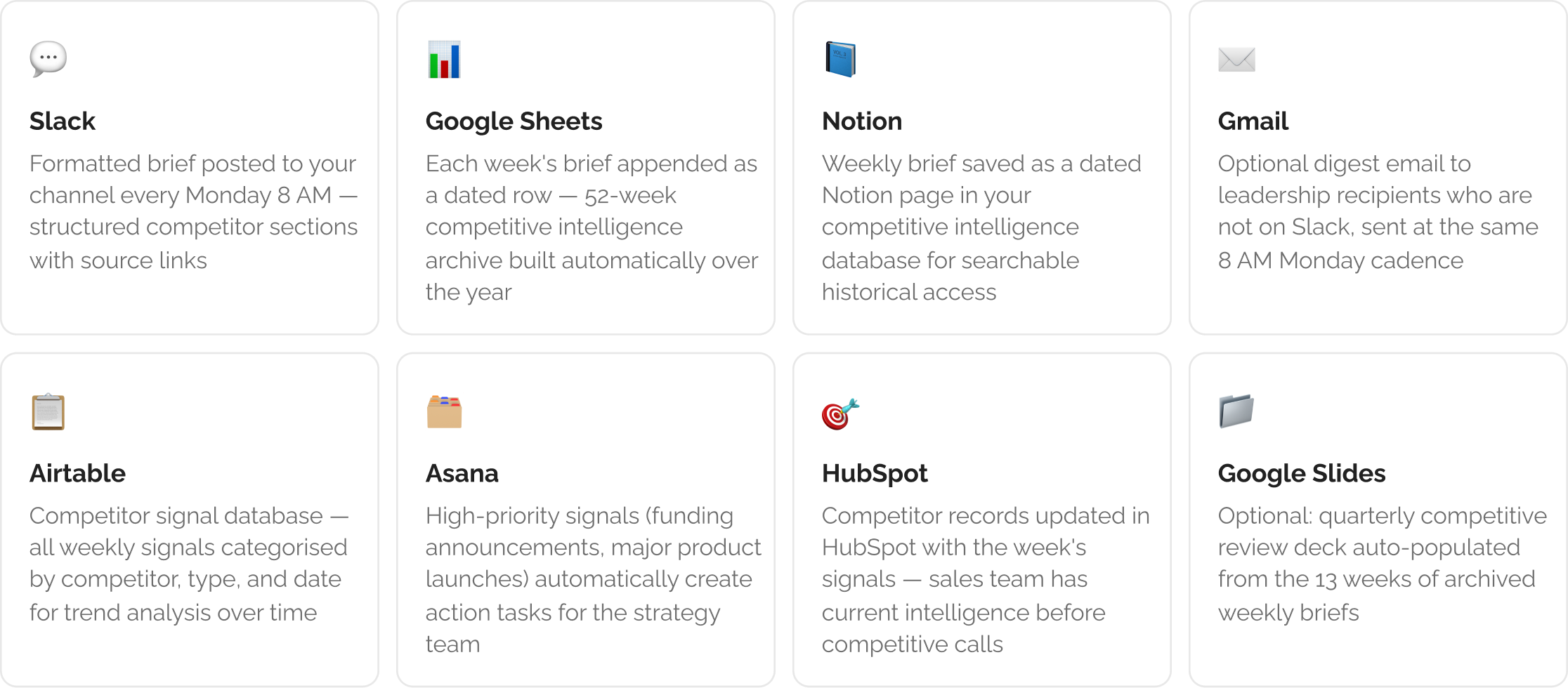
3: Archived and Delivered
Step 3: Every brief archived and searchable — across Slack, Sheets, and Notion
The Verdict
Competitive intelligence that relies on someone having time to compile it every week reliably fails by week three. The signal exists. The synthesis capacity does not. Barie runs the competitive scan on a schedule that does not depend on anyone having time — four signal types, three competitors, every Monday, automatically. Competitor A’s AI team hiring surge was in the brief before the Monday standup started. By the time the product team discussed it, the sales team had already received the HubSpot update with the context for competitive calls that week. That is what a scheduled task that actually runs produces. Not a promise to check competitors more often.
Barie features used in this task