The article
You asked Perplexity a research question. It returned cited sources, clean formatting, and a confident answer. Then you clicked through to one of those citations and found it said something entirely different from what was claimed. That is not a fringe experience: it is a documented structural failure. Perplexity cites real URLs with content that may be fabricated. The URL is genuine; the claim attributed to it may not be. In 2026, that gap matters more than ever.
Perplexity built something genuinely useful. Compared to ten blue Google links, it is a clear upgrade. But “better than Google” is a low bar when your research feeds a business decision, a client deliverable, or a published piece. If you are one of the many professionals who have quietly started questioning its accuracy ceiling, or hit the Pro plan paywall and wondered whether the cost is worth it, you are not imagining things.
The best Perplexity AI alternatives in 2026 are not just different interfaces for the same task. Several of them do things Perplexity was never designed to do: execute multi-step workflows, connect to your existing tools, run parallel research threads, and deliver outputs you can act on immediately. This list covers eight of them: what they actually do, and who each one is built for.
1. Barie AI: Best Perplexity AI Alternative for Deep Research and Autonomous Execution
Perplexity searches the web and synthesizes an answer. Barie AI researches the live web, runs parallel subtasks, cites every source with full traceability, and then executes on the output through app integrations. That is a different product category entirely.
Barie AI was built specifically because AI hallucinations wreck real work. It achieves GAIA Level 3: the hardest benchmark for complex agentic tasks, with 92% accuracy, matching the human benchmark. It has processed over 1M hallucination-free chats across 25+ industries. When accuracy is the job requirement, the difference between a search tool and a research agent becomes very clear.
One prompt can trigger a competitive analysis across five sources, a structured brief with live citations, and an automated push to your connected apps. Barie AI Connectors handle the execution layer. No tab-switching, no copy-pasting, no re-prompting from scratch.
If your research outputs feed real decisions, Barie AI is where the alternatives conversation starts, not ends.
2. ChatGPT with Deep Research: Best for Complex Reasoning Tasks
ChatGPT Pro’s Deep Research mode runs extended, multi-step research sessions with cited outputs. It handles complex reasoning better than Perplexity’s base models on analytical tasks. The trade-off is cost: it sits behind the $20/month Pro tier, and deep research queries are throttled at roughly 100 per month.
It is worth using when the task demands heavy reasoning, not just retrieval. For straightforward sourced answers, Perplexity is faster and cheaper. For anything that requires synthesis across many sources, ChatGPT pulls ahead.
3. Google Gemini Advanced: Best Perplexity Alternative for Multimodal Research
Gemini’s AI Mode with Gemini 2.5 Pro is a credible replacement for Perplexity Pro on research-heavy workflows. It handles text, images, and documents in a single session, which Perplexity cannot do natively. Google’s search infrastructure gives it a structural advantage on current-events retrieval.
The weakness is the same one that plagues most large-model tools: confidence without consistent traceability. Citations exist, but the sourcing is less granular than Perplexity’s. At $19.99/month, it competes directly on price. Teams already inside Google Workspace get the most from it.
4. You.com: Best Alternatives to Perplexity Pro Features for Model Flexibility
You.com lets you choose which model answers your research question: GPT-4o, Claude, Gemini, or Llama, and switch between them within a single session. It runs three modes: Smart for quick answers, Genius for deep research, and Create for content generation.
For power users who want to cross-reference how different models handle the same research question, this is one of the more practical alternatives to Perplexity pro features on the market. Privacy controls are stronger than Perplexity’s. The free tier is usable; Plus starts at $15/month.
5. Microsoft Copilot: Best for Teams Inside Microsoft 365
Copilot is the strongest Perplexity alternative for organizations embedded in Microsoft 365. Research flows directly into Word, Excel, and PowerPoint without exporting. The integration is tight enough that a research session in Copilot Chat can populate a slide deck or a document in minutes.
Outside the Microsoft ecosystem, it loses much of its advantage. For standalone research, other tools on this list perform better. For enterprise teams where the output format matters as much as the answer, Copilot eliminates a significant step.
6. Elicit: Best for Academic and Scientific Research
Elicit searches Semantic Scholar’s database of 200M+ peer-reviewed papers, extracts key findings, and organizes them into structured tables. It is purpose-built for literature reviews, academic research, and scientific synthesis: a task Perplexity handles poorly because it draws from the general web rather than curated academic sources.
If your research involves peer-reviewed evidence rather than recent news or business data, Elicit is not a competitor to Perplexity: it is a different tool for a different job. Free tier is available; Plus starts at $10/month.
7. Exa AI: Best for Developer-Facing Search and Recent Source Discovery
Exa is a neural search engine built for developers who need structured data extraction, predictable API costs, and recent source discovery for RAG pipelines and AI agents. Where Perplexity optimizes for human-readable answers, Exa optimizes for machine-readable data at scale.
For building research infrastructure: not just using it: Exa is one of the cleaner alternatives to Perplexity AI in the developer tooling space. It is not a consumer product. It is infrastructure for teams building AI-powered research applications.
8. Kagi: Best Private Alternative to Perplexity AI
Kagi is an ad-free, privacy-first search and research tool with no tracking, no data resale, and no advertising layer shaping results. The research quality is high because the incentive structure is different: Kagi charges users directly, so it has no reason to optimize for advertiser intent. Pricing starts at $5/month for 300 searches.
For professionals who find Perplexity’s data practices uncomfortable, the company has faced scrutiny over how it handles user queries: Kagi offers a clean, independent alternative.
Which Perplexity AI Alternative Is Right for You in 2026?
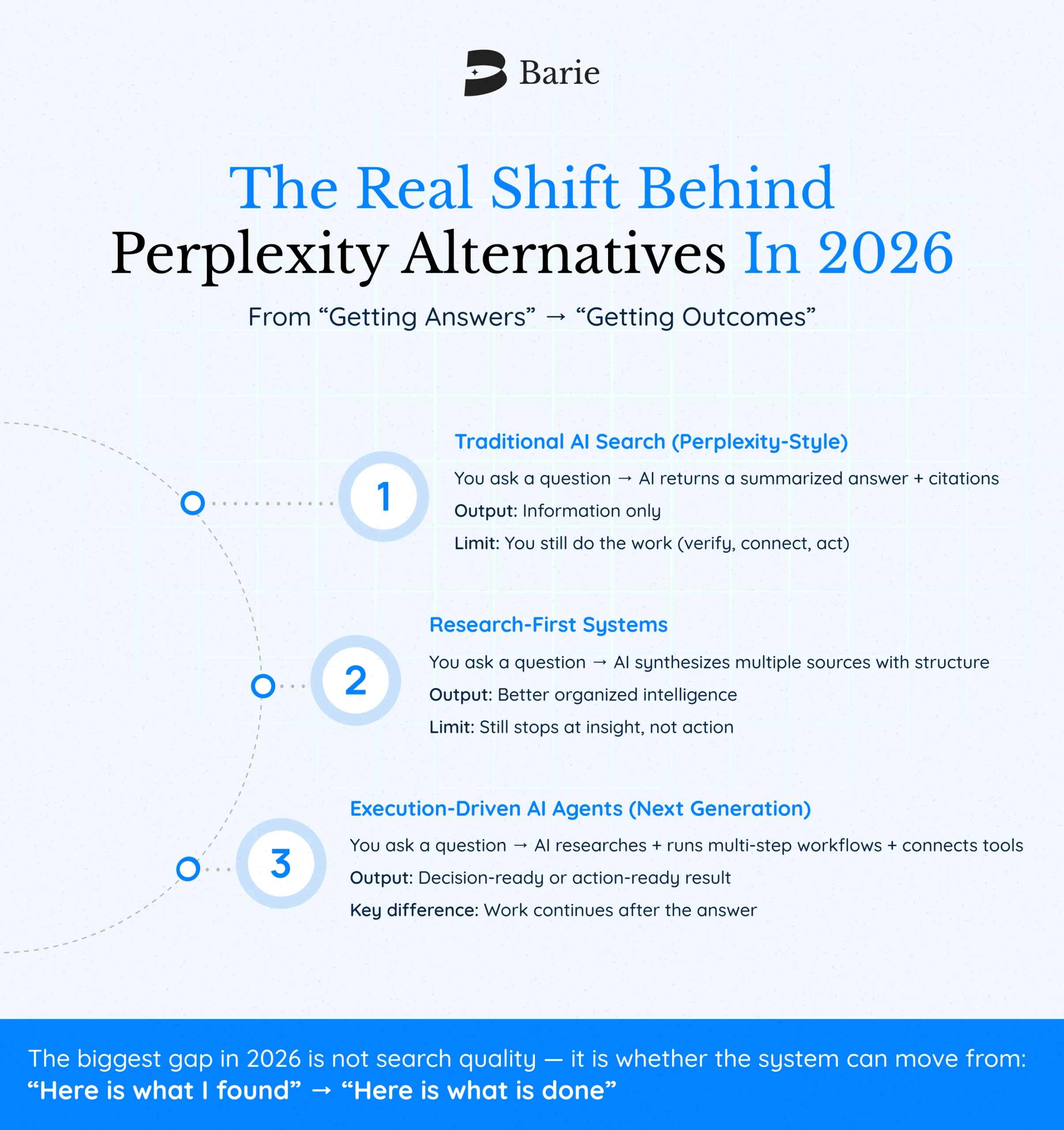
The honest answer is that these tools are not all competing for the same job. Perplexity is fast and useful for sourced answers to well-documented questions. It is a poor choice for tasks that require agentic execution, multi-step workflows, or an accuracy guarantee you can stake something important on.
Most of the alternatives to Perplexity AI on this list are better in one specific context and weaker in others. The exception is Barie AI, which is structurally different: built from the ground up as an anti-hallucination research agent that keeps moving after the answer is ready.
If the question you are asking Perplexity feeds a real output: a client brief, a competitive analysis, a business decision, the right tool is not a faster search. It is verified research with execution built in.
Start your first deep research session free with Barie AI