
The article
You asked your AI email tool to help reply to a potential client. It produced something confident and polished. But it had no idea who that client was. It was generating from a void and dressing it up beautifully.
That is what most AI email assistant comparisons skip entirely. They rank tools on drafting speed and inbox sorting. But they never ask the more important question: Does this AI know anything useful before it writes?
What Most People Mean When They Search for the Best AI Email Assistant
The best email AI assistant category is genuinely crowded in 2026. Superhuman, Shortwave, Fyxer, Lindy, and Copilot are all capable. They share the same core purpose: to help you spend less time in your inbox.
In 2026, the divide that actually matters is not between paid and free tools. The real split is between assistants who draft from live context and those who draft from nothing.
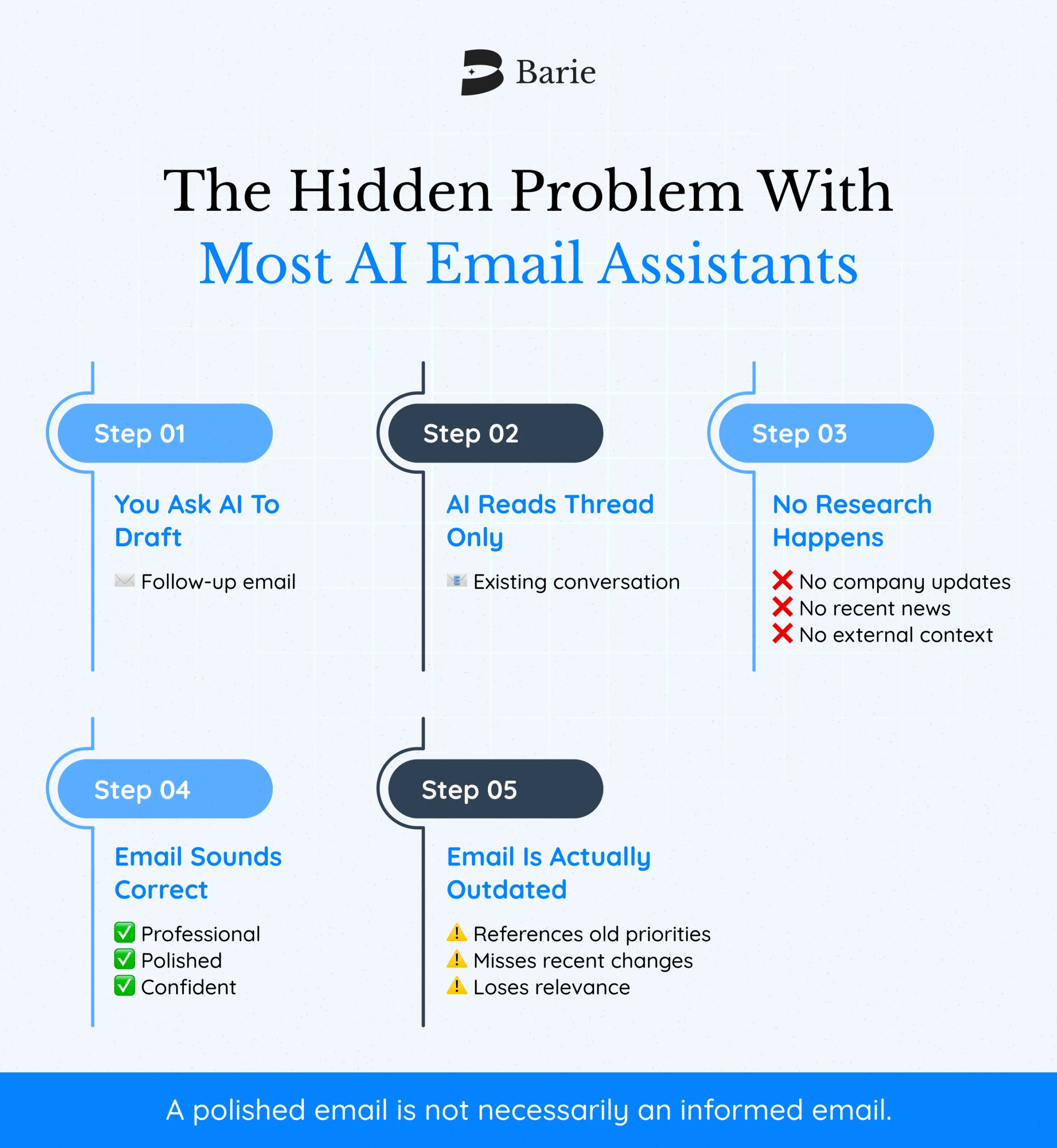
Most email AI tools start from nothing at all. They scan the thread, identify the tone, and produce something that sounds reasonable. For routine acknowledgments, this approach is often sufficient.
For anything requiring knowledge of the client’s current situation, the approach fails quietly. You usually don’t notice until the email lands wrong. The gap costs more than most teams realize.
The best AI email assistant for sales teams cannot afford that gap at all. Sales conversations carry context spread across CRM records, inbox history, LinkedIn activity, and the open web. An assistant reading only the visible thread is working with most of the picture missing.
What is the best AI email assistant for teams managing complex, multi-touch deals? The answer is not whichever tool has the slickest inbox UI.
It is the one that arrives at the drafting stage with information the others never bothered to gather. Speed matters less than accuracy when the wrong email can close a door that took months to open.
The Specific Failure That Costs the Most
Here is what happens when AI drafts without researching. A sales rep follows up with a VP whose company just announced a restructure. The assistant pulls context from a call summary three months old.
The tool has no way to know that things have changed. The email references a priority the buyer abandoned weeks ago. It lands tone-deaf, and the deal goes cold.
This is not rare or unusual at all. It happens across seniority levels because most email AI tools are text predictors rather than information gatherers. They write with fluency but without knowledge of what is currently true.
The best AI writing assistant for email closings runs into this exact wall. A well-crafted closing email must match the current moment in a deal, not a training dataset. Generic follow-up language carries little weight when you don’t know what has shifted for the recipient since your last exchange.
What an AI Email Assistant Looks Like When It Actually Researches
Barie AI approaches the email drafting problem from a different starting point. Before generating a single sentence, it researches. That is not a premium feature or a settings toggle. It reflects a different view of what AI assistance is actually for.
When a user asks Barie AI to draft a follow-up email, it does not reach for a template. It searches the live web for recent news about the recipient’s company. It pulls relevant announcements and cross-references the user’s thread context.
Those tasks run in parallel rather than one at a time. The process takes a fraction of the time a researcher would need. The output is grounded in what is currently true.
Every claim Barie AI makes in the draft traces back to a verifiable source. That is not how most email AI operates today. That is how a well-prepared human writer works before drafting something important.
For sales teams, this changes what AI assistance actually delivers. A rep can ask Barie to surface the prospect’s recent priorities from public sources. Barie then drafts a message connecting the product directly to those stated concerns.
The practical result is a message that references things the recipient actually cares about right now. Not a template with the company name swapped in. Not a prediction of what a follow-up typically sounds like. A response built on current, traceable information, the kind that earns a reply instead of getting quietly archived.
Why “Best Email AI Assistant” Rankings Miss the Core Question
Most roundups score AI email tools on secondary important criteria. They cover thread summarization speed, Outlook compatibility, and pricing tiers. Those benchmarks matter, but they miss the question that determines whether a tool is actually safe to trust.
The category split between Gmail and Outlook tools, or between inbox clients and overlay assistants, also misses this point. Whether a tool works inside Gmail or sits above it has nothing to do with whether it knows current facts about the person you’re emailing. Platform fit is a preference. Accuracy is a risk issue.
The core question is simple: where is the AI getting its information? If the answer is the email thread and nothing else, you have a sophisticated autocomplete. If the answer includes live web data and verified citations, you have something worth trusting.
Barie aces GAIA Level 3, which tests whether AI handles complex, multi-step tasks reliably. Most AI tools do not publish benchmark results at all. Barie’s stated accuracy rate is 90%, across 1M+ hallucination-free chats in 25+ industries.
That is not a product spec. That is the standard the best AI email assistant should actually be held to.
What the Best AI Email Assistant Does That the Others Don’t
The difference becomes visible in a real workflow. A user asks Barie to help draft a procurement committee response. Barie pulls stated priorities, surfaces the competitor’s recent announcements, and drafts a reply with sourced context. The user edits two lines and sends.
That sequence mirrors how skilled writers approach high-stakes communication. Most AI email assistants start at the drafting step and skip the research entirely. Barie AI Connectors extend this by pulling from CRM records, project updates, and external sources in a single session.
The Real Standard for the Best AI Email Assistant in 2026
The best email AI assistant in 2026 is the one that researches before it writes. Not the fastest drafter, not the cheapest tool, not the one with the most integrations. It is the one that treats research as a prerequisite.
For anyone whose emails carry real stakes, this distinction matters more than any feature list. Sales professionals cannot afford confident drafts built on outdated context. An assistant writing without knowing what is true moves risk from your inbox to your reputation.
Barie AI was built specifically because AI that sounds right while being wrong is a genuine, recurring problem. Email is one of the highest-stakes places that problem shows up, and one of the most underexamined.
The best AI email assistant, free trial or paid tier, should prove it can answer a basic question: where did this information come from?
Try It Before Your Next Important Email
Your next important email is not the place to find out your AI was guessing. The research happens before the draft, the citations are there when you need them, and the output is grounded in what is actually true today. Try Barie free today!