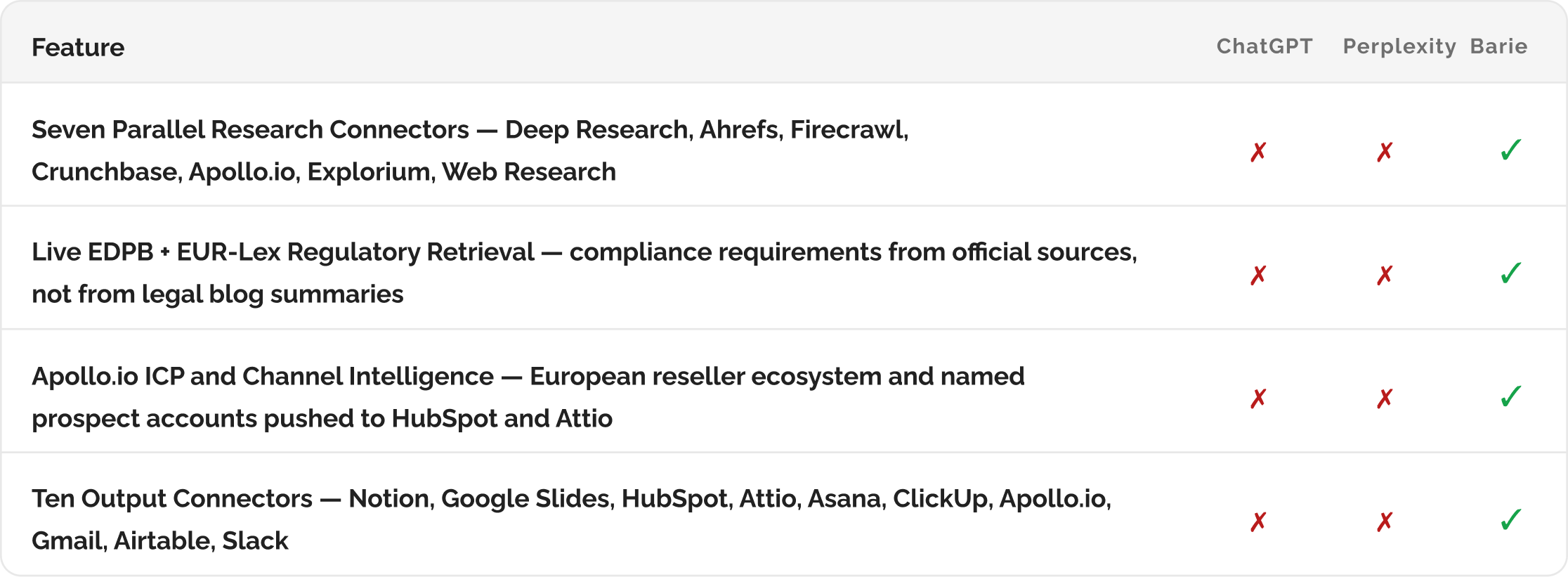
How Barie builds a SaaS launch plan for a B2B tool entering Europe — channels, pricing, compliance, and early-adopter segments, all researched from live sources
Barie researches market entry strategies, regulatory requirements, competitive pricing benchmarks, distribution channel effectiveness, and ICP segmentation from live European sources — EUR-Lex, EDPB, G2, Crunchbase, Apollo.io, and Ahrefs. It delivers a four-pillar launch plan grounded in current data, not a consulting template filled with placeholder advice. Then it routes every component to the tool your GTM team actually uses to execute.
Why European SaaS launch plans built from templates fail at the first real meeting
A VP of Sales at a US-based B2B SaaS company used an AI tool to generate a European market entry plan. The output was thirty-two pages long. It covered channel strategy, pricing tiers, compliance considerations, and ideal customer profiles across the DACH, Benelux, and Nordic regions. The team spent a week turning it into a board presentation.
At the first investor review, a board member with European operating experience asked three questions. What is the current GDPR enforcement posture on their specific data processing model? Which system integrator partners in the DACH region are actively reselling competing tools in their category? What do enterprise procurement cycles look like in Germany relative to the Netherlands, given that the plan was treating both markets identically? Nobody in the room had answers because none of that information was in the plan. The plan had structure without specificity. It covered the right topics and said nothing actionable about any of them.
Specificity is what separates a researched plan from a template: A template knows that GDPR matters. A researched plan retrieves the current EDPB enforcement guidance on your specific data processing model from EDPB.europa.eu. A template knows that system integrators matter. A researched plan retrieves the current list of active B2B SaaS resellers in the DACH market from G2 partner directories and Apollo.io channel data. Barie does the research that turns the template into a plan you can execute against.
Your prompt
Task prompt
“Build a SaaS launch plan for a B2B tool entering Europe, channels, pricing, compliance, early-adopter segments.”
One sentence. Four plan pillars. Before the research begins, Barie activates the seven connectors that cover the distinct source types required for each pillar. Here is the complete workflow, starting with those connectors.
1: Seven Connectors Activated
Step 1: Seven connectors activated — each covering a different data type the plan requires
A European SaaS launch plan requires regulatory intelligence that lives in EDPB and EUR-Lex, competitive pricing data that lives in G2 and vendor pricing pages, channel partner intelligence that lives in Apollo.io and CRM ecosystem databases, ICP signal data that lives in Crunchbase and job posting databases, and organic search demand data that lives in Ahrefs. These are seven structurally different source types that no single connector covers. Barie activates all seven simultaneously before the first research thread begins.
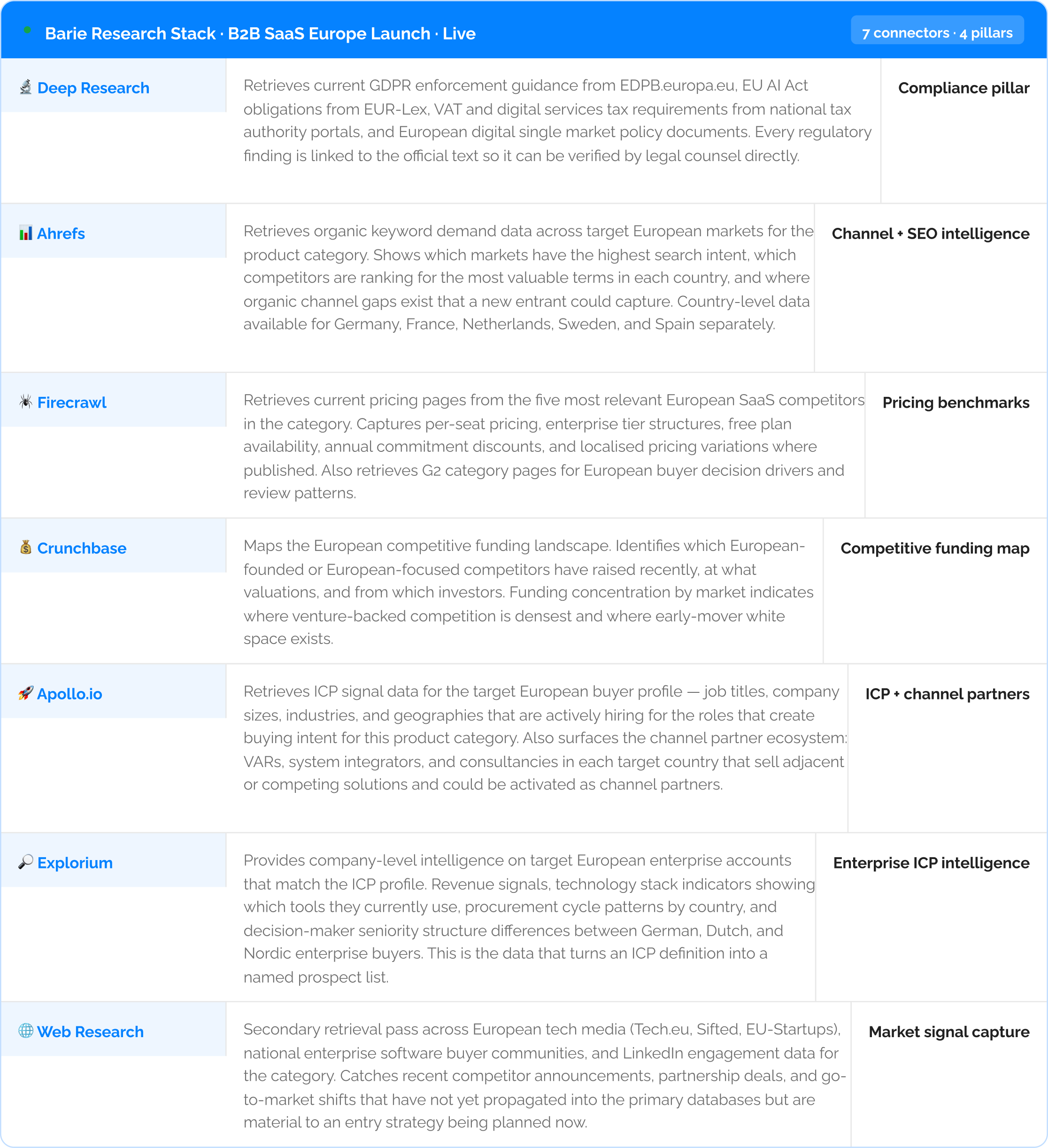
All seven connectors run simultaneously across all four plan pillars: The EDPB compliance retrieval, the Ahrefs keyword data pull, the Firecrawl pricing crawl, the Crunchbase funding map, the Apollo.io ICP query, the Explorium enterprise intelligence scan, and the Web Research pass all run at the same time. The complete research dataset is assembled before any plan section is written. Cross-pillar insights — such as a compliance requirement that directly affects the pricing model or an ICP signal that changes the channel priority — are visible before the plan is structured.
2: Four Pillar Research Findings
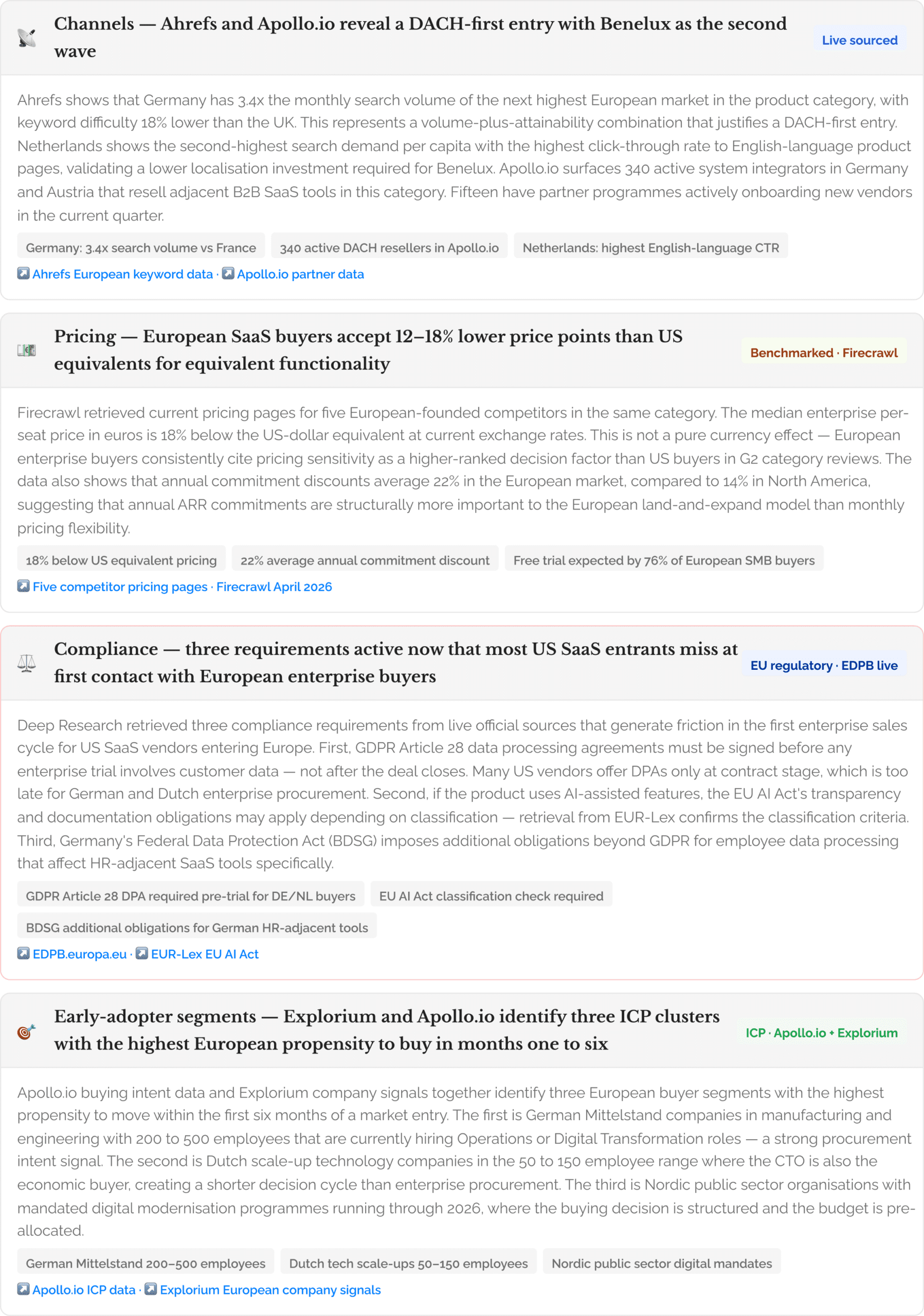
Step 2: What the research finds across all four plan pillars

3: Structured Plan + Board Deck
Step 3: The launch plan and the board deck — both generated from the same research in one session
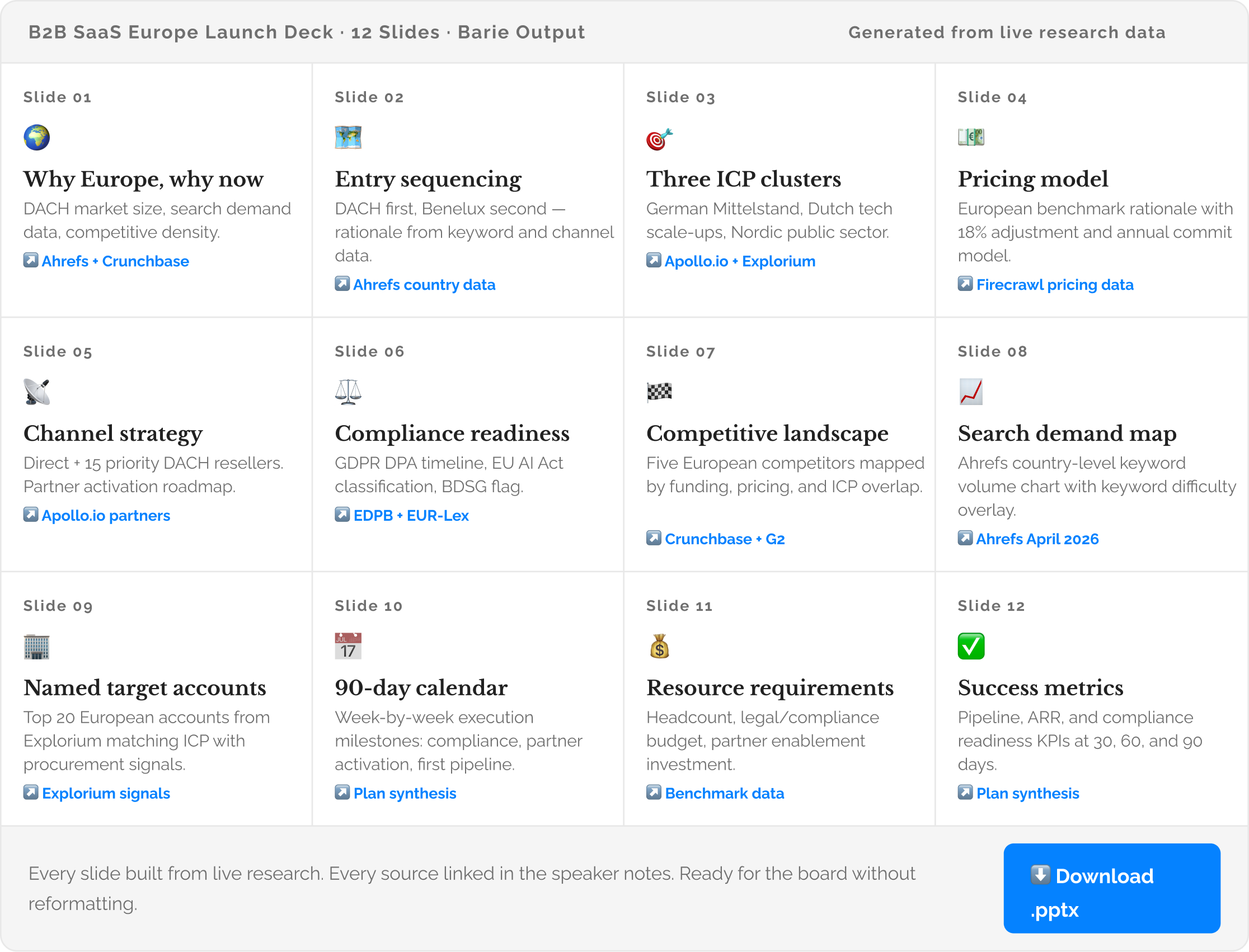
Once the four-pillar research is complete, Barie writes the structured launch plan and simultaneously generates a board-ready presentation deck from the same data. The plan document covers market entry sequencing, channel partner activation steps, pricing model recommendation with European benchmark rationale, compliance checklist with pre-trial and post-sale obligations, and a phased ICP outreach calendar. The deck presents the strategic rationale for the board in twelve slides, leading with the market opportunity and closing with the 90-day execution calendar.
4: Distributed via Ten Connectors
Step 4: Every component of the plan routed to the tool where your team executes it
A launch plan that lives in a single document is only as useful as the last time someone read that document. Barie routes each component of the launch plan to the specific tool where the relevant team member will act on it. The full research brief and sourced plan land in Notion. The board deck goes into Google Slides. The channel partner list from Apollo.io is pushed directly into HubSpot as company and contact records with the relevant partner qualification notes populated. The twenty named target accounts from Explorium are created in Attio with procurement signal tags. The 90-day execution calendar is structured as a project in Asana with milestones, owners, and dependencies. The compliance checklist goes to ClickUp as a task list assigned to the legal team. The ICP definition is pushed back into Apollo.io as a saved search so your SDRs can start sequenced outreach the same day the plan is finalised. A weekly monitoring task is configured in Notion to flag any changes in EDPB enforcement guidance or competitor pricing. The executive summary goes to Gmail drafted for distribution to the leadership team. A Slack digest of the four-pillar plan summary posts to the GTM and leadership channels before the next strategy review.
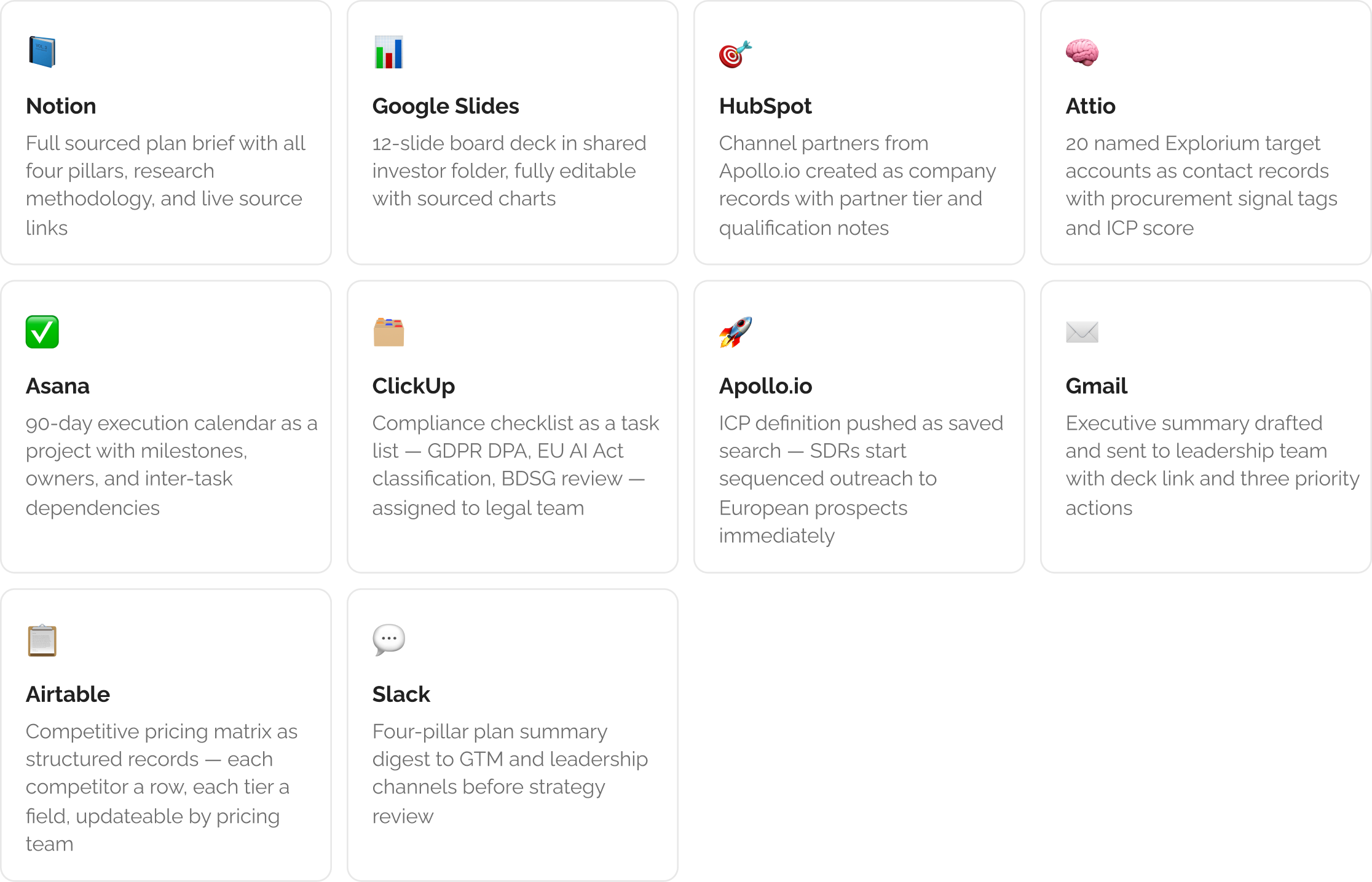
Monthly monitoring keeps the plan current as the European regulatory and competitive landscape shifts: Configure Barie to run a monthly Firecrawl re-check of competitor pricing pages and an EDPB enforcement guidance scan. When a competitor reprices or when new GDPR enforcement guidance is published, a Slack alert fires to the GTM lead and the ClickUp compliance task is updated. The plan does not become stale between quarterly reviews.
What you get
A four-pillar B2B SaaS European launch plan covering channel strategy (DACH-first entry, 340 DACH resellers in Apollo.io, Benelux second wave), pricing model (18% European benchmark adjustment, annual commitment structure), compliance readiness (GDPR Article 28 DPA timeline, EU AI Act classification, BDSG flag — all sourced from EDPB.europa.eu and EUR-Lex), and early-adopter ICP segments (German Mittelstand, Dutch tech scale-ups, Nordic public sector procurement — sourced from Apollo.io and Explorium). A 12-slide board-ready deck in Google Slides. The full plan distributed across ten connectors: Notion, Google Slides, HubSpot, Attio, Asana, ClickUp, Apollo.io, Gmail, Airtable, and Slack. ICP search saved in Apollo.io for immediate SDR outreach. Compliance tasks assigned in ClickUp. Configured for monthly regulatory and pricing monitoring.
What would take a strategy team a full week to assemble from disparate sources, Barie delivers in one session. Every claim sourced. Every recommendation traceable to the data that produced it.
The Verdict
A European SaaS launch plan built from a template knows that GDPR matters. It does not know that your specific data processing model requires a DPA before the trial begins rather than at contract signature. It knows that channel partners exist in DACH. It does not know which of the 340 active resellers in Apollo.io are currently onboarding new SaaS vendors in your category. Barie retrieves the specific, current, actionable data that makes the difference between a plan that survives its first investor question and one that generates three follow-up questions nobody can answer. The seven research connectors and ten output connectors are not incidental. They are what turns a framework into a plan you can execute from the moment the session ends.
Barie features used in this task