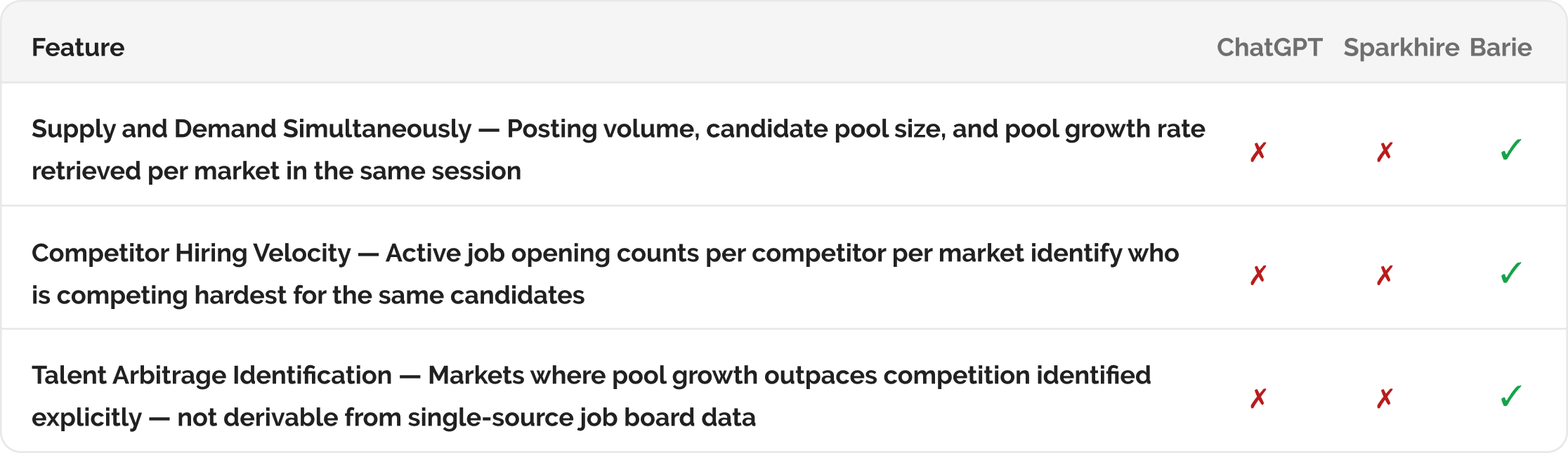
How Barie maps the AI/ML talent landscape in Europe — supply, demand, compensation trends, and the top hiring competitors for AI engineers
Barie researches active job posting volumes, LinkedIn candidate pool indicators, compensation benchmarks, and competitor hiring velocity across the major European AI/ML talent markets simultaneously. It delivers a structured market map showing where supply is concentrating, where demand is outstripping availability, and which companies are competing hardest for the same profiles you are trying to hire.
Why talent market research built from outdated job board exports misrepresents where the competition is actually happening
A talent acquisition lead building a hiring plan for an AI engineering team across Europe searches for “AI/ML jobs” on LinkedIn and looks at the counts. She sees high volumes in London and Berlin and concludes those are the hottest markets. But job posting volume is a demand signal, not a supply signal. London and Berlin show high posting volumes partly because candidate availability is also highest there — meaning competition is fierce but the pool is real. Warsaw and Amsterdam, which she ignores because posting volumes are lower, have rapidly growing candidate pools and significantly lower competition for available candidates because fewer companies are targeting them.
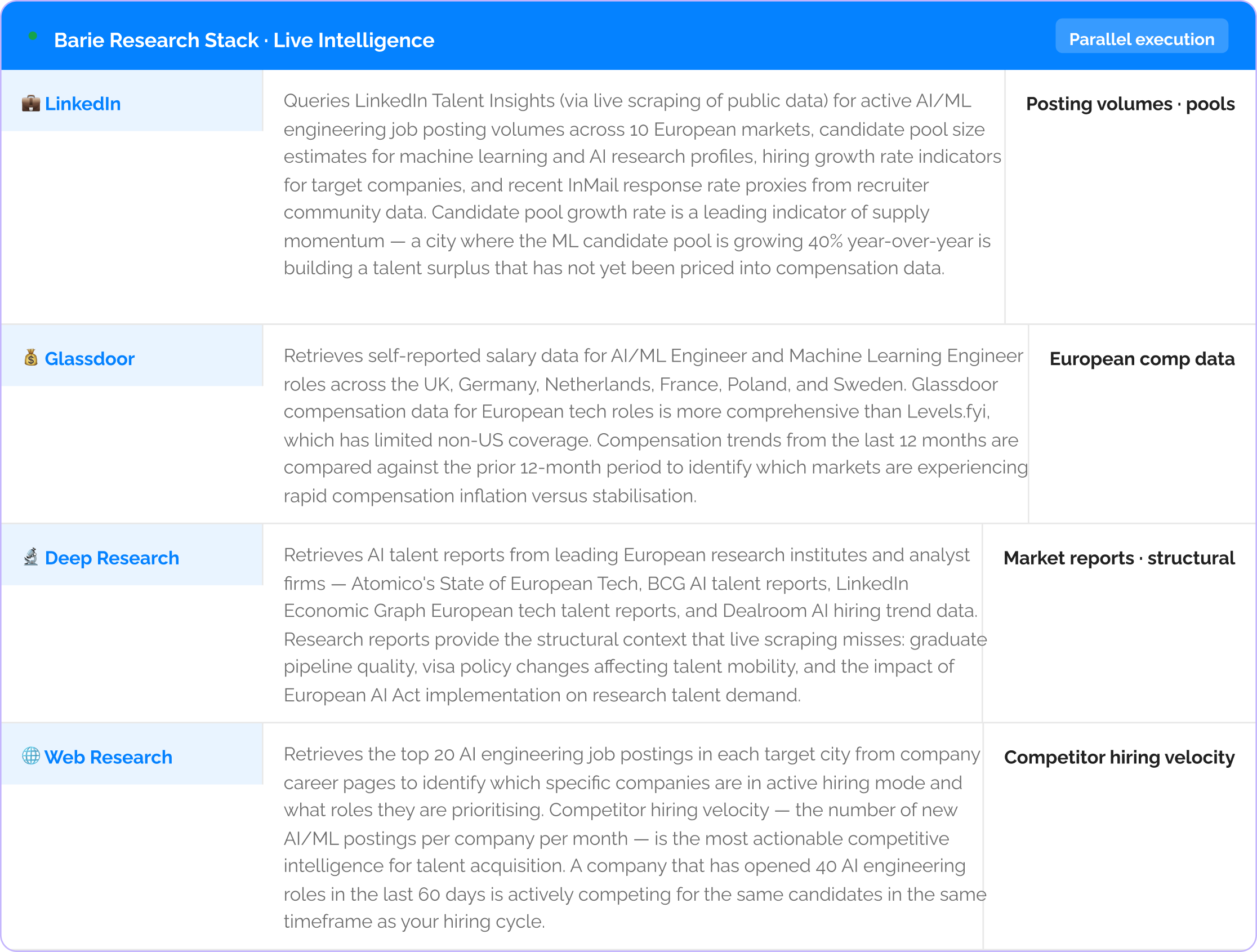
Talent market intelligence requires reading supply and demand signals simultaneously, not just demand (posting volume) or just supply (LinkedIn profiles). Barie queries posting volume, candidate pool growth, compensation trends, and competitor hiring velocity in parallel across all major European AI/ML markets, and synthesises them into a market map that tells you where the opportunity actually is — not just where the most job posts happen to be.
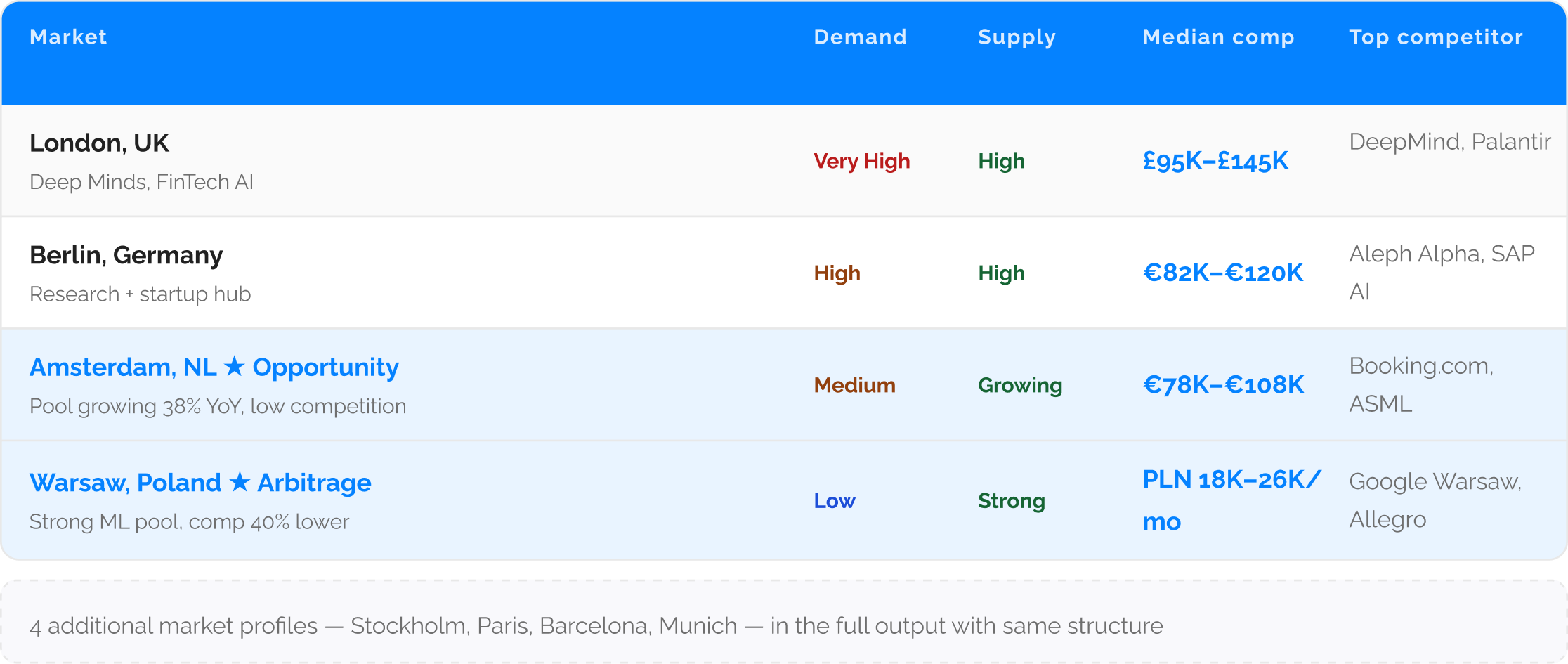
Barie reads supply and demand simultaneously — job posting volumes, candidate pool size, compensation ranges, and which specific companies are posting the most aggressively: The market map identifies the markets where high candidate availability and low competition intersect — the talent arbitrage opportunities that a posting-volume-only analysis would miss entirely.
Your prompt
Task prompt
“Map the talent landscape for AI/ML engineers in Europe, supply, demand, compensation trends, and top hiring competitors.”
Research Stack Activated
Step 1: Research stack activated — live data sources across every dimension this analysis requires
2: Structured Output
Step 2: The structured output — every finding sourced, every insight traceable

3: Delivered to Your Tools
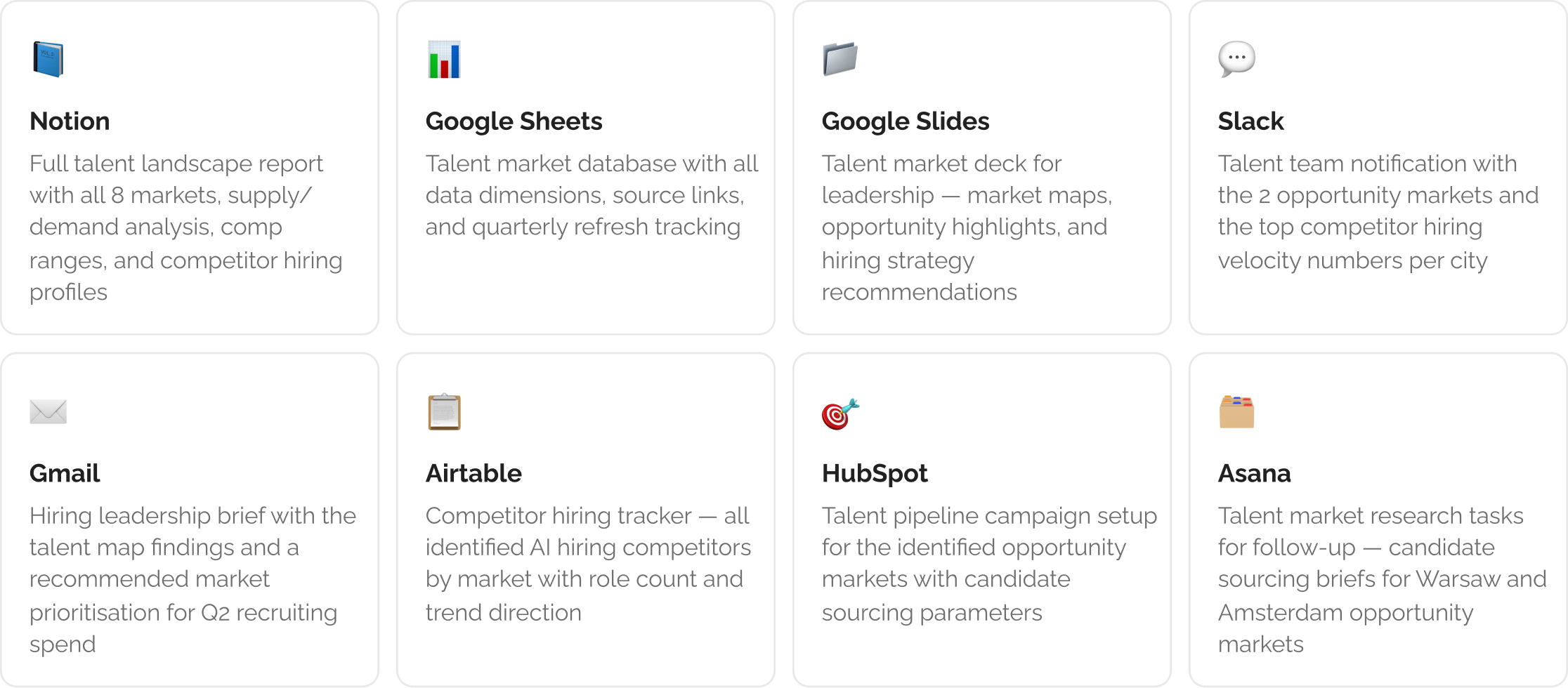
Step 3: Results delivered to your people ops, HR, and strategy tools
The Verdict
A talent market map built only from job posting volumes tells you where companies are trying to hire, not where the best hiring opportunity is. The best opportunity is where candidate pools are growing fastest relative to competition — the markets where demand has not yet caught up with available supply. Barie reads supply and demand simultaneously, per market, from live sources. Amsterdam’s 38% year-over-year candidate pool growth combined with medium-level competition is an arbitrage opportunity that pure job-volume analysis would classify as a secondary market. That is the analysis Barie produces and a keyword search cannot.
Barie features used in this task