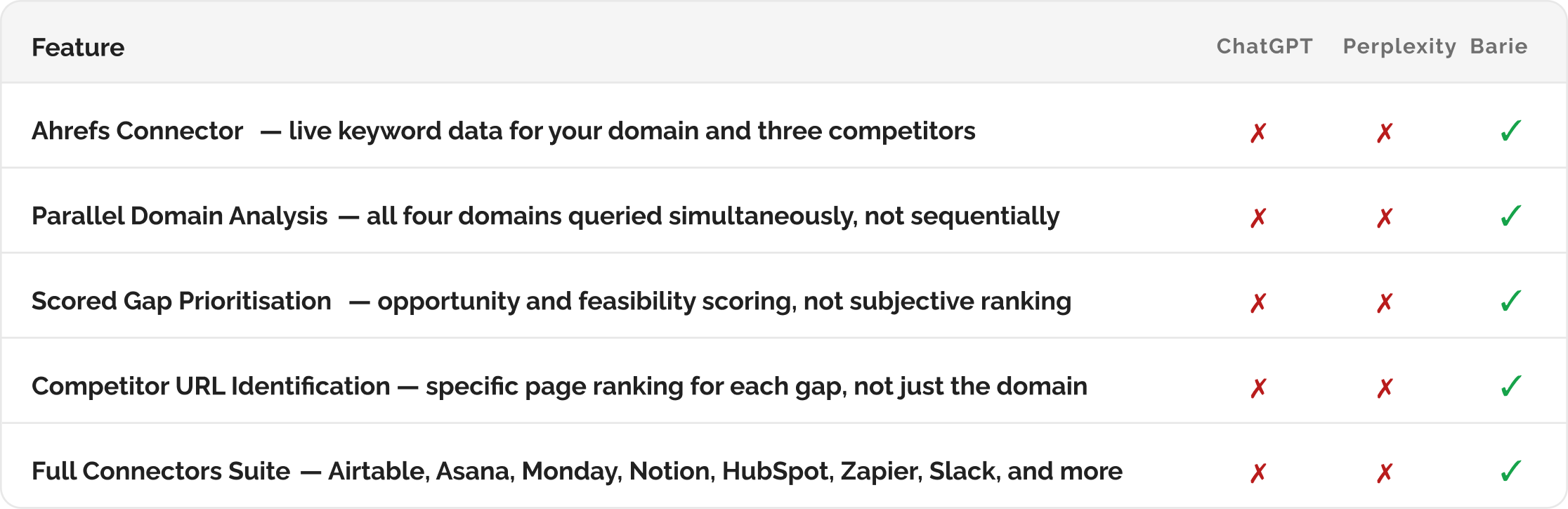
How Barie finds the top 10 content gaps between your blog and your 3 main competitors
Barie connects to Ahrefs to pull live keyword data for your domain and your three named competitors. It identifies topics they rank for that you have no content covering, scores each gap by search volume and keyword difficulty, and delivers a prioritised content roadmap with the specific URLs your competitors use to rank. Not a guess. Not a template. Your actual gaps.
The problem with manual content gap analysis
A content manager spent a Friday afternoon doing manual competitor research. She opened four Ahrefs tabs, one for each competitor, and started scrolling through organic keyword lists looking for topics her blog did not cover. She found 40 potential gaps. Some were relevant. Some were not. She had no reliable way to estimate which ones were worth writing about first. The exercise took three hours and produced a list she was not confident in.
The following Monday, a different team member ran the same analysis using a different methodology and produced a different list. The two lists overlapped on six items. Fourteen topics appeared on only one of them. Nobody knew which list was right.
Content gap analysis fails when it relies on manual comparison of keyword lists across multiple tools. The methodology is inconsistent, the prioritisation is subjective, and the analysis is already out of date before anyone acts on it because competitor rankings change weekly.
Why the Ahrefs Connector changes this completely: Barie connects to Ahrefs at query time and pulls live keyword data for your domain and all three competitors in parallel. It does not compare what competitors wrote about in the past. It compares what they are ranking for right now, against what your site is ranking for right now. The gap list is built from current data, not from a manually assembled spreadsheet that may already be stale.
Your prompt
Task prompt
“Find the top 10 content gaps between our blog and our 3 main competitors.”
One sentence. Barie identifies your domain, names the three competitors, connects to Ahrefs, pulls the organic keyword data for all four domains simultaneously, runs the gap analysis, scores and ranks each gap, and delivers a prioritised content roadmap. Here is exactly how it works.
1: Ahrefs Connector Activated
Step 1: Barie connects to Ahrefs and pulls live keyword data for all four domains
Before producing a single gap finding, Barie connects to Ahrefs and retrieves the live organic keyword rankings for your domain and all three competitors simultaneously. Every topic in the final output is derived from what these four domains are actually ranking for today, at the moment the prompt was run.
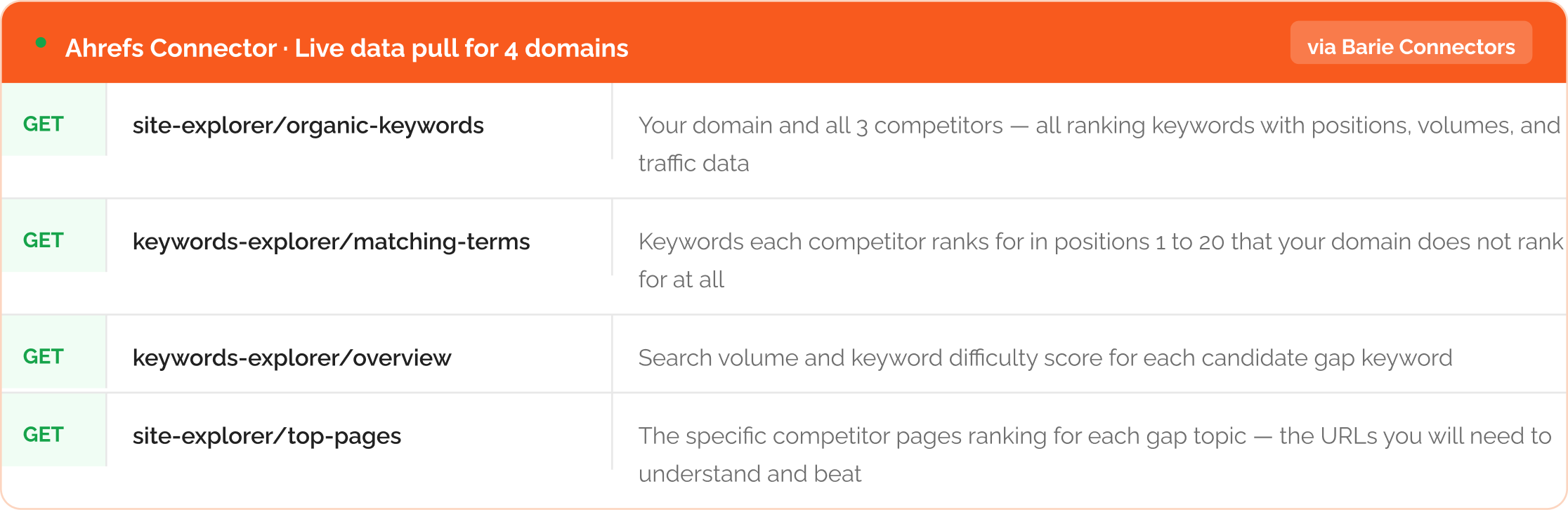
All four domains are queried simultaneously: Barie does not pull your keyword data, then wait, then pull Competitor 1, then Competitor 2, then Competitor 3. All four requests fire in parallel. The complete dataset for all four domains is available before gap analysis begins.
2: Competitor Mapping
Step 2: What Barie finds about your three competitors before comparing
Before running the gap analysis, Barie builds a snapshot of each competitor’s content position. This context is what makes the gap prioritisation meaningful. A topic covered by all three competitors and driving significant traffic to each of them is a different kind of gap from a topic only one competitor covers and drives minimal traffic. Barie surfaces this context alongside each gap finding.
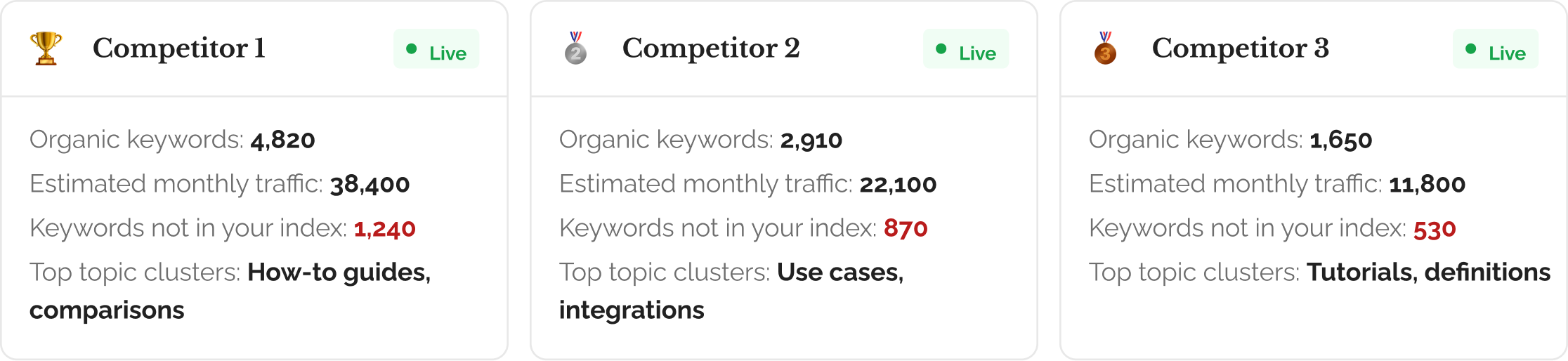
Barie also checks for keyword cannibalisation before declaring a gap. If your site has a page that ranks on page three for a keyword, that is not a gap. It is an optimisation opportunity, and it is flagged differently so you do not spend resources creating content you already have.
3. Content Gap Findings
Step 3: The top 10 content gaps, prioritised by opportunity

Each gap is scored by two factors. The first is opportunity size, which is search volume multiplied by a click-through rate estimate based on the current SERP layout. The second is feasibility, which combines keyword difficulty with an assessment of how strong the existing competitor content is. High opportunity plus low competition equals priority one. The ten gaps below represent the best available ratio of traffic potential to achievability for your specific domain.
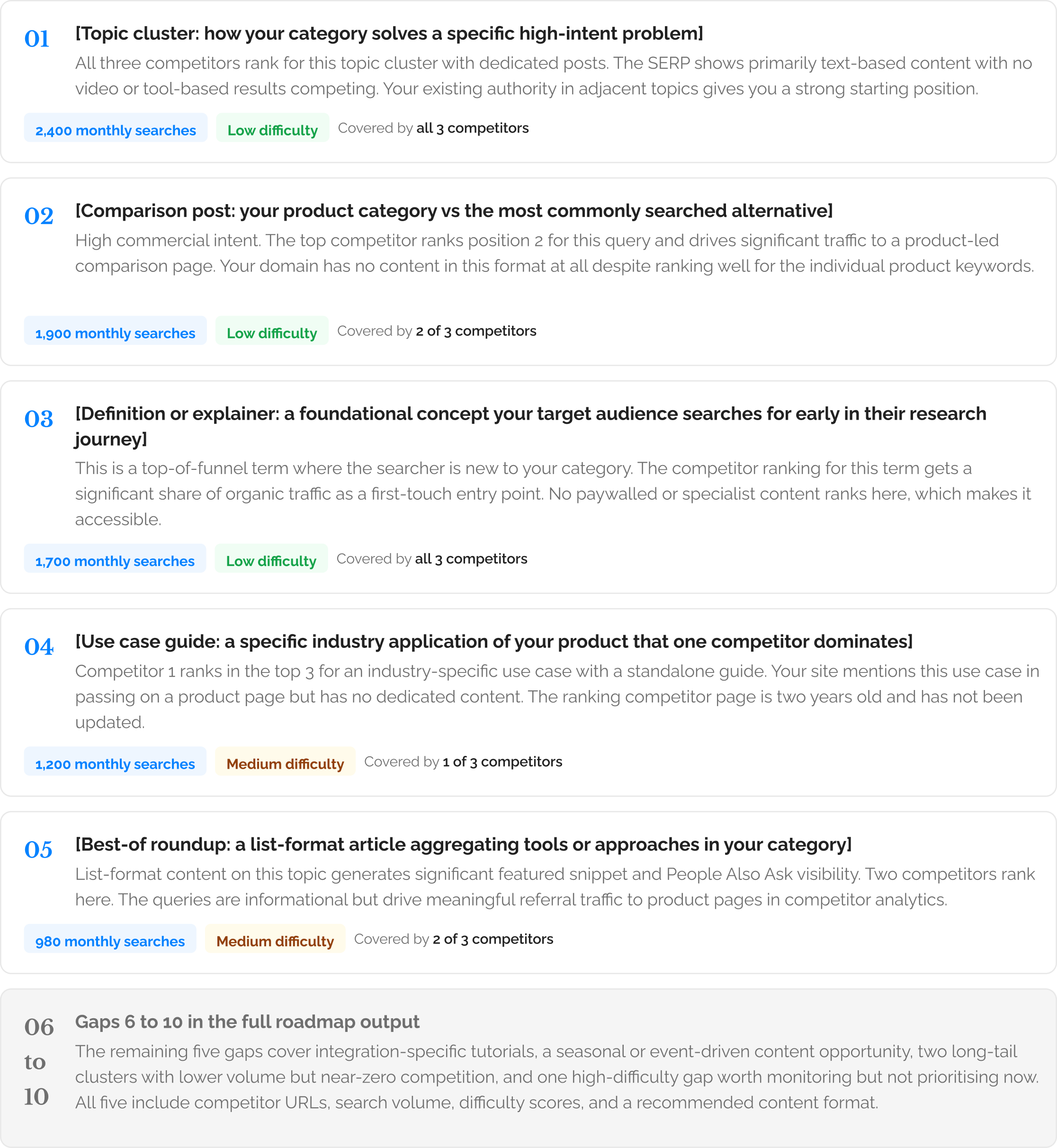
Every gap includes the competitor URL that ranks for it: For each of the 10 gaps, Barie identifies the specific page the competitor uses to rank. You can see the format they chose, how they structured the content, and what the page’s estimated traffic and authority looks like. You are not starting from a blank brief. You have a model to understand and a clear target to beat.
4. Output Across Your Full Workflow
Step 4: The content roadmap delivered across your tools via Connectors
Barie does not produce a document and stop. It routes each component of the output to the tool where your team will actually use it. The right output in the right tool is the difference between a research session that drives action and one that gets filed away.
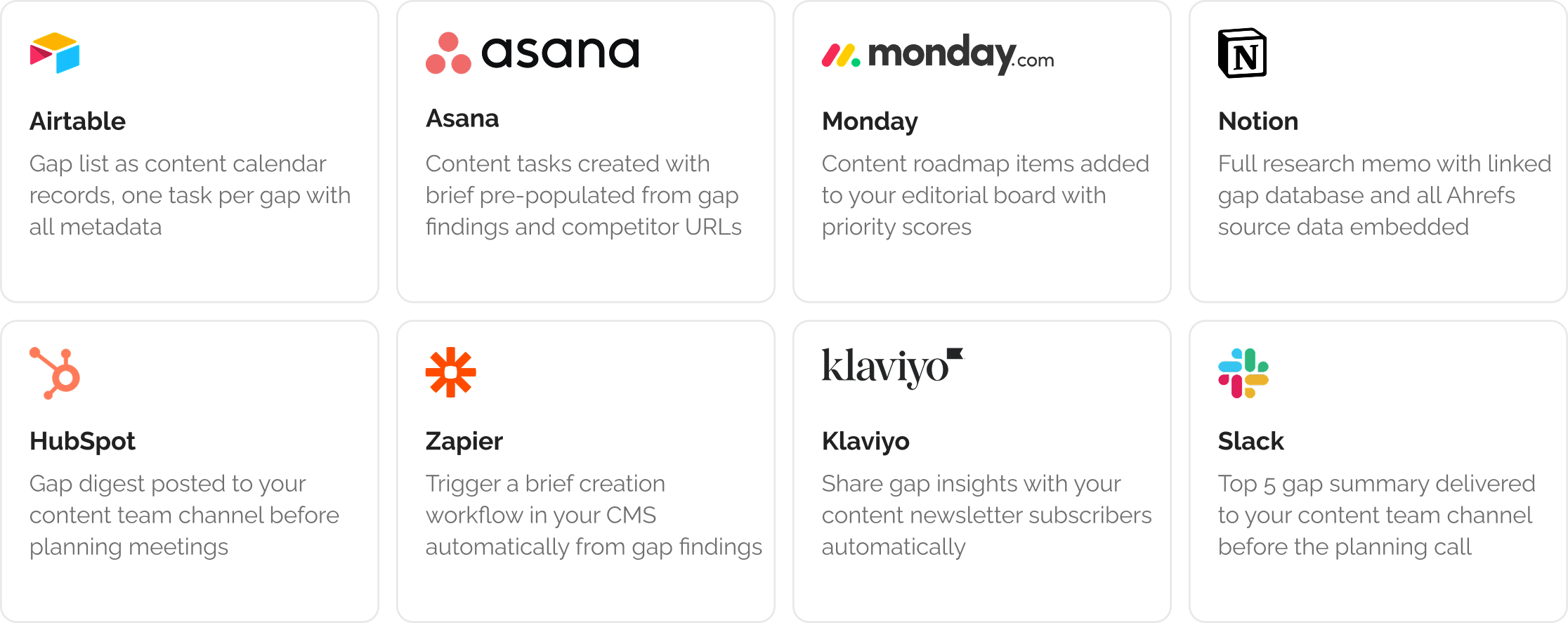
The prioritised gap list with search volumes, difficulty scores, and competitor URLs goes directly into an Airtable content calendar base as draft records, one per gap. From there your team can assign writers, set target dates, and track status without rebuilding the list manually. If your content workflow runs through Asana or Monday, Barie creates tasks directly in your project boards with the brief pre-populated from the gap findings. If you use Notion, the full research memo lands as a linked database page with all source data embedded.
For distribution and team alignment, Barie sends a digest of the top five gaps to your Slack or HubSpot channels before the next content planning meeting. For teams with active campaign workflows, the gap findings can trigger a Zapier sequence that creates draft briefs in your content management system automatically.
Re-run quarterly to stay ahead: Configure Barie to repeat the gap analysis every quarter using the same Ahrefs Connector and push new findings into the same Airtable base or Asana board. As you publish content and close gaps, new ones surface. As competitors update their strategy, the priority order shifts. The roadmap stays current without a new research session each time.
What you get
A live content gap analysis grounded in current Ahrefs keyword data for your domain and three named competitors. Ten prioritised gaps with search volume, keyword difficulty, a plain-language description of the opportunity, coverage status across your competitors, and the specific competitor URL ranking for each topic. A content roadmap delivered to Airtable, Asana, Monday, Notion, or whichever tools your team actually uses.
What it would take a content team three hours to produce manually, Barie delivers in one prompt. The prioritisation is objective and based on data, not editorial intuition. Every gap reflects what your competitors are ranking for today, not what they were ranking for when an article about your industry was last published.
The Verdict
Content gap analysis has one job: tell you what to write next, in priority order, with evidence. Manual comparison of keyword lists across multiple Ahrefs tabs fails at the prioritisation step every time because the methodology is inconsistent and the data is already stale by the time it is assembled. Barie connects to Ahrefs, pulls live data for all four domains simultaneously, scores each gap by traffic potential and competitive difficulty, and delivers the top ten in a format that goes directly into the tools your team uses to act on it. That is not a research output. That is a content strategy.
Barie features used in this task