How Barie researches the legal implications of AI-generated content for copyright law across the US, EU, and UK
Three parallel research threads — one per jurisdiction. Court decisions, legislative proposals, regulatory guidance, and academic analysis. Delivered as a structured jurisdictional comparison with live source links for every legal claim. Not a training-data summary of a legal landscape that changed last month.
The problem with asking any other AI tool about AI copyright law
A counsel at a creative agency asked ChatGPT to summarise AI copyright law across the US, EU, and UK. The output was three well-structured paragraphs — one per jurisdiction, coherently written, professionally formatted.
It was also materially out of date. The US Copyright Office had issued new guidance on AI-generated content registration since the model’s training cutoff. A significant federal case had reached a ruling that shifted the analytical landscape. The EU AI Act had progressed to a stage with direct implications for copyright obligations on AI training data. None of this appeared.
AI copyright law is one of the fastest-moving areas in intellectual property. Courts are issuing decisions monthly. Legislative proposals are advancing on different timelines across jurisdictions. Regulatory bodies are publishing guidance in real time. Any tool answering from training data is describing the legal landscape as it existed at an unknown point in the past — while presenting that description with the same confidence as settled law.
Why this question specifically requires live research: The US Copyright Office issued updated AI registration guidance in 2024. The EU AI Act’s training data transparency provisions became operative in 2025. UK IPO consultations on AI and copyright are ongoing. Three jurisdictions. Three different rates of change. One training-data summary cannot be accurate across all three simultaneously.
Your prompt
Task prompt
“Research the legal implications of AI-generated content for copyright law across the US, EU, and UK.”
One sentence. Three jurisdictions. Barie fires three parallel research threads simultaneously — one per jurisdiction — each retrieving court decisions, legislative texts, regulatory guidance, and academic analysis from live sources. The outputs are then synthesised into a structured jurisdictional comparison. Here is exactly how it works.
1. Task Decomposition
Step 1: Task decomposition — three threads, four source types per thread
Before touching any database, Barie defines the research architecture. Three jurisdictions require different source hierarchies — US federal court decisions and Copyright Office guidance, EU legislation and CJEU rulings, UK IPO guidance and domestic court decisions. Each thread is structured before retrieval begins.
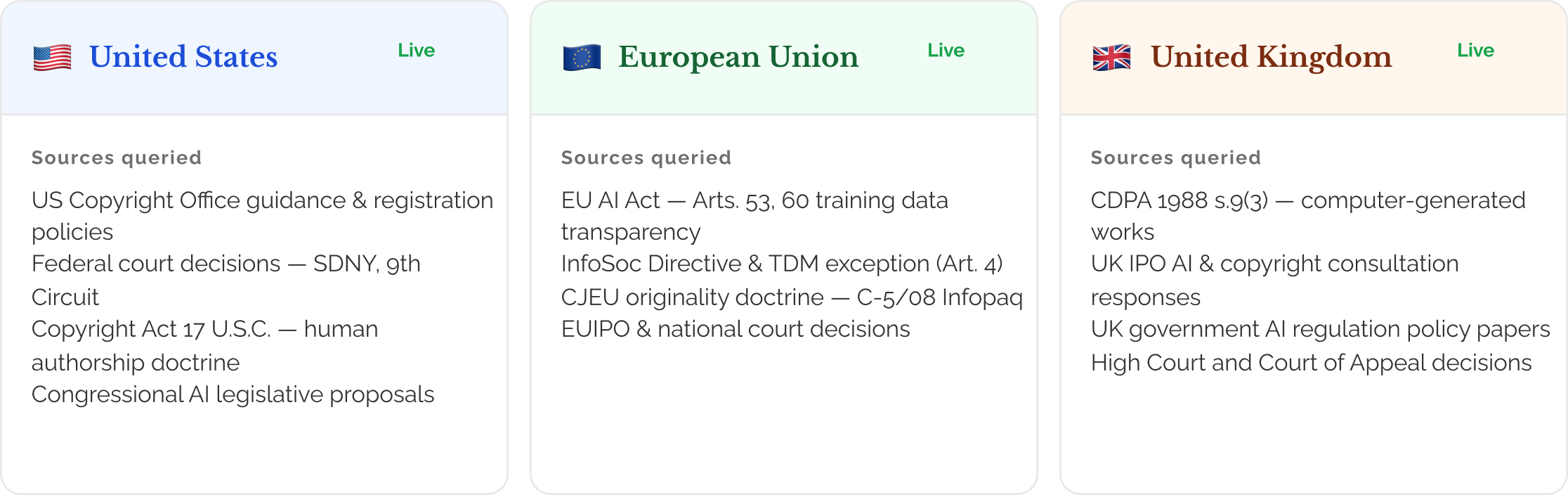
The UK is structurally different from both US and EU: The CDPA 1988 s.9(3) already provides for copyright in computer-generated works without a human author — a provision that predates AI entirely and that no other major jurisdiction has an equivalent for. A comparison that treats UK law as simply “similar to EU” is missing the most significant jurisdictional difference in the analysis.
2. Parallel Live Research
Step 2: Three threads fired simultaneously — courts, legislation, and guidance in parallel
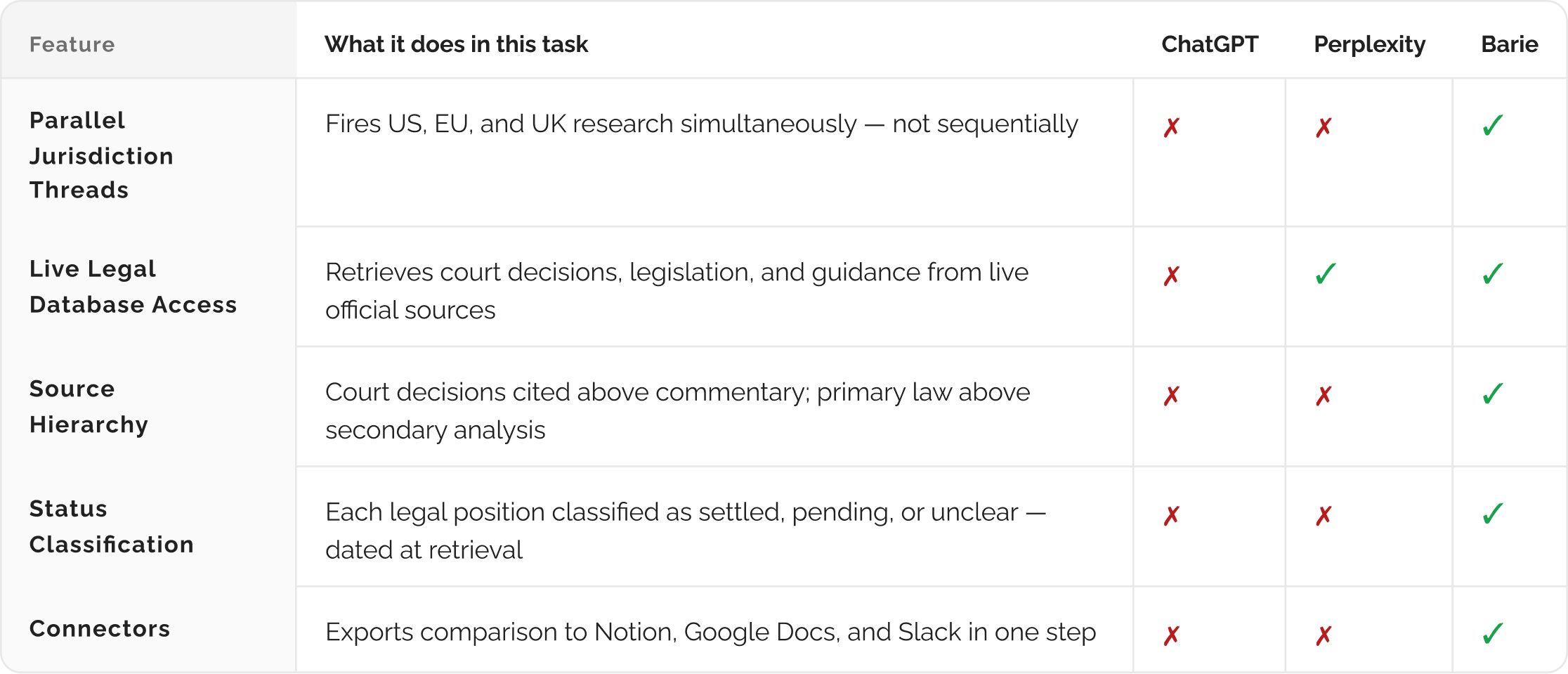
All three jurisdiction threads execute at the same time. Within each thread, Barie retrieves court decisions first — these are the most authoritative statements of current law — then legislative texts, then regulatory guidance, then academic analysis where it surfaces interpretive consensus on unsettled questions. Every source is timestamped at retrieval.
Court decisions take precedence over commentary: When a law firm article and a federal court decision describe the same legal principle differently, Barie cites the court decision and notes the commentary as secondary analysis. Legal research requires a source hierarchy — primary law first, authoritative guidance second, academic analysis third. Barie applies that hierarchy automatically across all three threads.
3. Jurisdictional Comparison Matrix
Step 3: The jurisdictional comparison — five dimensions, three jurisdictions, every claim sourced
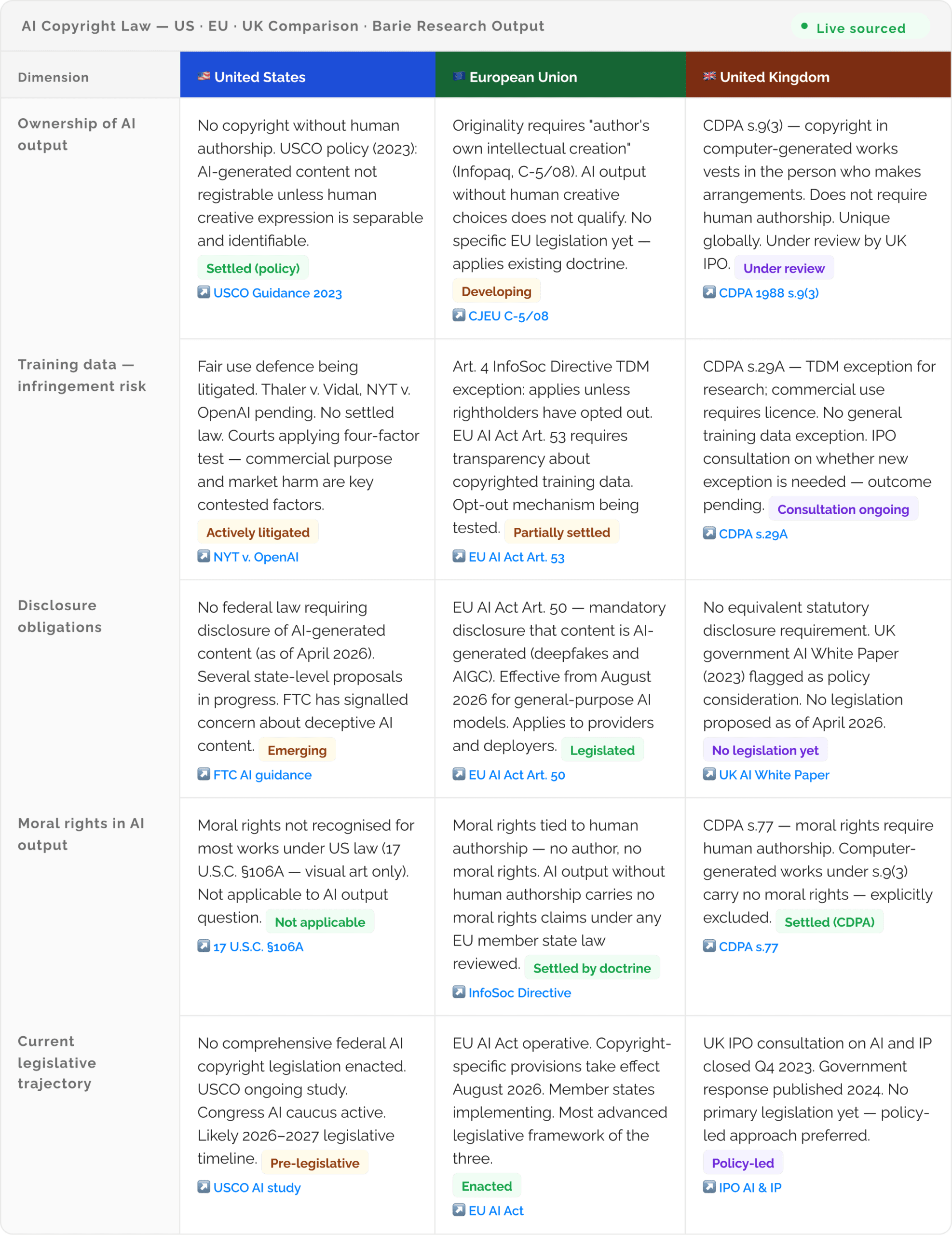
Status pills reflect the current state of law — not a permanent classification: “Actively litigated” means cases are pending that could change the analysis within months. “Under review” means the law is known but policy is being reconsidered. Every status is dated at retrieval. Run the same prompt in six months and the status pills will reflect whatever has changed.
4. Key Cases & Legislative Anchors
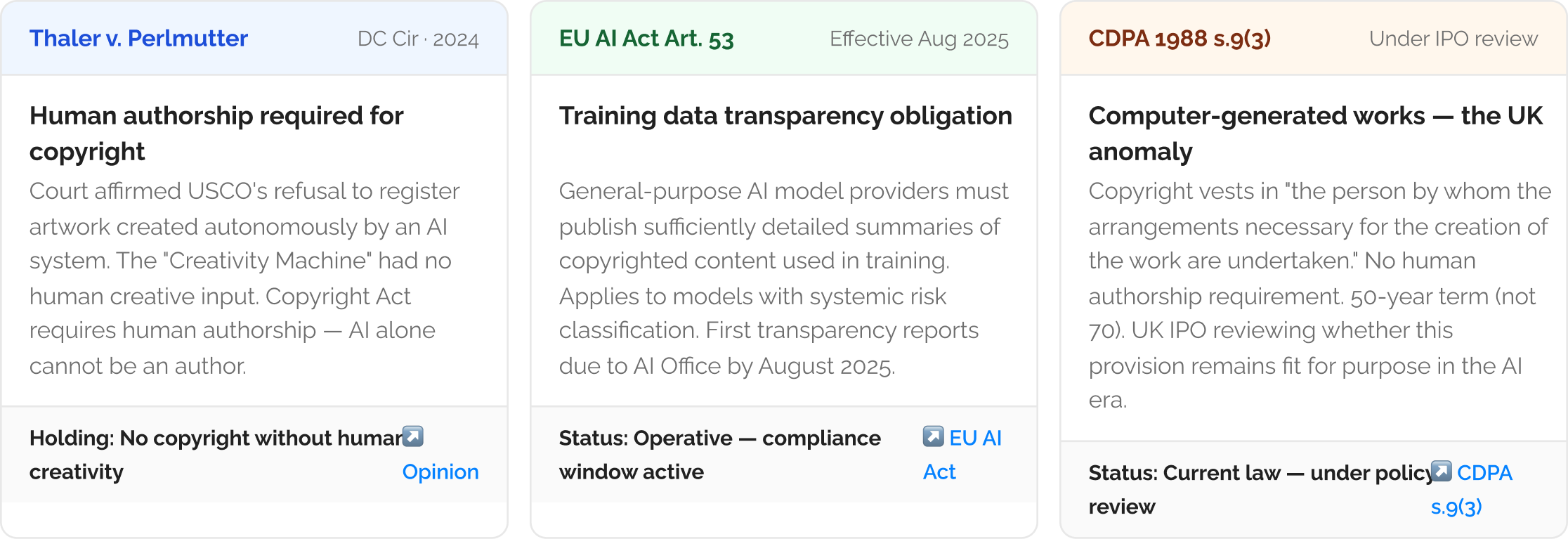
Step 4: The anchoring cases and provisions — where the law is actually being made
Export via Connectors
Step 5: Client-ready output via Connectors

The full jurisdictional comparison lands in Notion as a structured legal memo — with linked bibliography, status classifications, and each source URL live. A formatted version exports to Google Docs for client or counsel review. A summary of the three most material differences goes to Slack before the briefing call. Every source link in every output points to the primary legal text it describes.
What you get
A structured comparison of AI copyright law across the US, EU, and UK — five analytical dimensions, every claim sourced to a primary legal text or court decision, every status classification reflecting the current state of the law as of retrieval date. Anchoring cases and key provisions surfaced with direct document links. Exported to Notion, Google Docs, and Slack in one session.
What it would take a lawyer half a day to compile — three jurisdictions, four source types each, synthesised into a structured comparison — Barie delivers in one prompt. Every claim traceable. Nothing fabricated. Nothing stale.
The Verdict
AI copyright law is one of the fastest-moving areas in intellectual property. Courts are issuing decisions monthly. The EU AI Act’s copyright provisions became operative in 2025. UK IPO consultations are ongoing. A summary drawn from training data is a snapshot of a landscape that has moved on. Barie fires three parallel research threads, retrieves from live primary sources, applies a source hierarchy that puts court decisions above commentary, and delivers a comparison where every claim is dated and every source is linked. That is not a legal opinion. It is what accurate legal research looks like.
Barie features used in this task