How Barie builds a CCPA vs GDPR comparison for a client briefing, from live regulatory texts, not training memory
Barie pulls the actual regulatory texts and authoritative legal analyses from live sources. It builds a structured comparison across scope, consumer rights, penalties, enforcement, and exemptions — with source links to the relevant provisions. Not a training-data summary that may reflect outdated law.
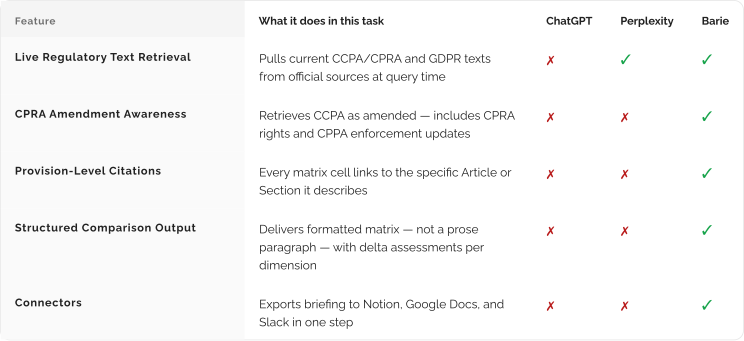
The problem with asking any other AI tool for this
A compliance consultant asked ChatGPT to compare CCPA and GDPR for a client briefing. The output was fluent, structured, and professionally formatted. It included penalty ranges, key rights, and exemption notes.
Two problems. First, CCPA has been significantly amended by the CPRA — the California Privacy Rights Act, which took effect in 2023. Several of the rights and penalty structures described in the output reflected the pre-CPRA CCPA. A client acting on this briefing would have been working from outdated law. Second, none of the penalty figures linked to the actual statute. There was no way to verify them without independently checking the source.
Privacy law is not static. Both frameworks evolve continuously through amendments, regulatory guidance, and enforcement decisions. A summary drawn from training data is a photograph of what the law looked like when the model was trained — not what it requires today.
Why this comparison requires live sources: The CPRA amended CCPA in 2023. The EDPB has issued updated guidance on specific GDPR provisions. FTC interpretations of CCPA enforcement thresholds have shifted. Any comparison relying on training data may be describing provisions that have been modified, clarified, or superseded. Barie retrieves from the current official texts. Every comparison cell is sourced to the provision it describes.
Your prompt
This is the exact task as given to Barie:
Task prompt
“Summarise the key differences between California’s CCPA and the EU’s GDPR for a client briefing.”
One sentence. Barie identifies five comparison dimensions — scope, consumer rights, penalties, enforcement, and exemptions — retrieves the relevant provisions from live official sources for each, and assembles a structured briefing document with source citations throughout. Here is what happens at each step.
1. Task Decomposition
Step 1: Task decomposition — five dimensions, two frameworks, live sources
Before retrieving a single provision, Barie defines the comparison architecture. A client briefing on CCPA vs GDPR must be comparable — the same dimensions evaluated against both frameworks using the same framing, so differences are structural rather than artefacts of inconsistent analysis.
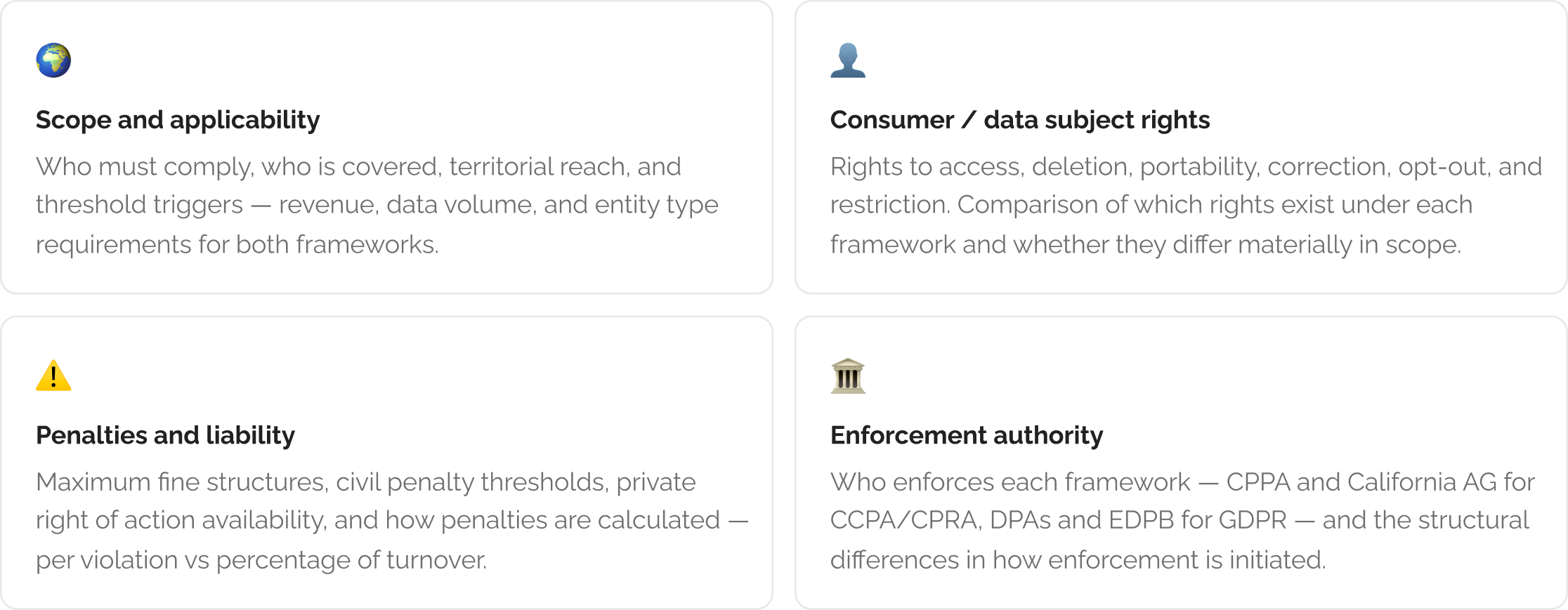
CPRA amendments are included by default: Barie retrieves CCPA as amended by the CPRA — the current operative text as of 2026. It does not cite the pre-2023 CCPA unless specifically asked. The CPRA created new rights (correction, limiting use of sensitive data), established the California Privacy Protection Agency, and modified penalty structures. These changes are material to any current comparison.
2. Parallel Live Research
Step 2: Parallel retrieval — official texts and authoritative analyses simultaneously
Barie retrieves both frameworks from official sources and cross-references each dimension against authoritative regulatory guidance. Both primary legal texts and published regulatory interpretations are retrieved at the same time.

For each dimension in the comparison, Barie retrieves the specific article or section from both frameworks — not a paraphrase of what a law firm said about it, but the actual provision text — and then surfaces any regulatory guidance that clarifies interpretation. The result is a comparison grounded in primary law, not secondary commentary.
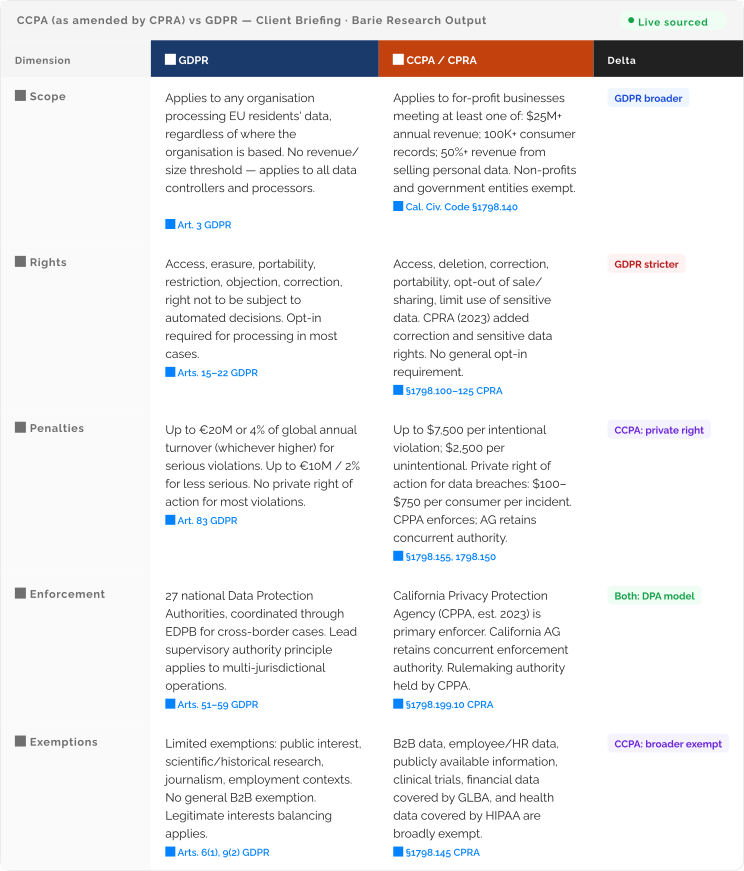
Every comparison cell links to the provision it describes: When the briefing states that GDPR requires a legal basis for all processing while CCPA operates on an opt-out model, that claim links directly to GDPR Article 6 on EUR-Lex and to California Civil Code Section 1798.100 on the CPPA site. The comparison is not asserted — it is sourced.
3. Structured Comparison Matrix
Step 3: The structured comparison matrix — every cell sourced
The core output is a structured comparison matrix — five dimensions, two frameworks, one delta assessment per row. Every cell links to the primary source provision it describes.
4. Provision Deep-Dives
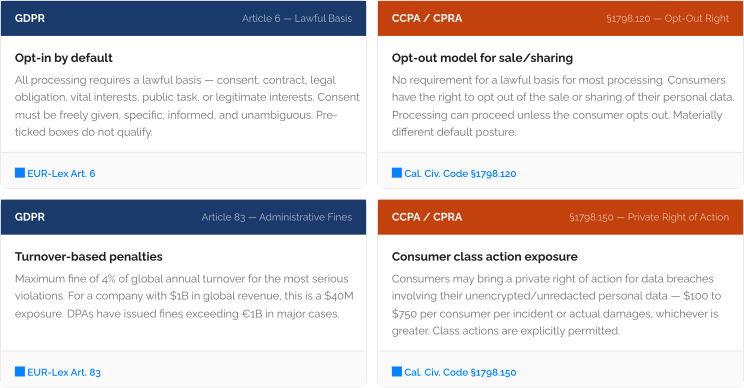
Step 4: Key provision deep-dives — where the differences matter most in practice
Beyond the matrix, Barie surfaces the specific provisions where the two frameworks diverge most materially for practical compliance — the areas where a company operating under both regimes faces genuinely different obligations, not just differently worded ones.
5. Export via Connectors
Step 5: Client-ready output — exported via Connectors
The briefing is complete. Every comparison sourced. Every provision linked. Barie routes the output to the right formats for client delivery.

The full briefing lands in Notion as a structured document with a linked bibliography — every source cited in the matrix links to the live official text. A clean, formatted version exports to Google Docs for client delivery. A summary of the five most material differences goes to Slack for the team before the client call.
The Notion version is a living document: Because every provision in the briefing links to the official source URL, the Notion memo can be verified and updated as both frameworks evolve. When the CPPA issues new regulations or the EDPB publishes new guidance, the relevant provision link takes you directly to the current text. The briefing does not become outdated — it becomes a reference point you update at source.
What you get
A structured CCPA vs GDPR comparison — five dimensions, both frameworks as currently in force including CPRA amendments, every comparison point sourced to the relevant provision. A client briefing that reflects the law as it stands today, not the law as a model last encountered it. Exported to Notion, Google Docs, and Slack in one session.
What it would take a paralegal an afternoon to compile — retrieving both full texts, identifying the relevant provisions, building the comparison, and formatting for client delivery — Barie does in one prompt. Every source link included. Every provision current.
The Verdict
A client briefing on data privacy law has one job: be accurate about what the law currently requires. A comparison drawn from training data cannot guarantee that. CCPA was materially amended by the CPRA in 2023. GDPR guidance is updated continuously. Barie retrieves both frameworks from their current official texts, sources every comparison to the specific provision it describes, and builds a briefing where every claim can be verified in one click. That is not a feature. That is what legal accuracy requires.
Barie features used in this task